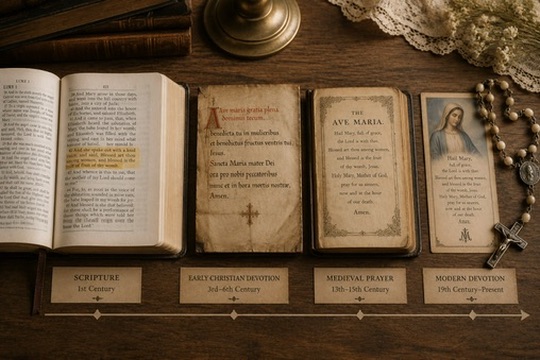
Few prayers seem as ancient as the Hail Mary. Many Catholics even believe that the Church has always prayed it this way. In reality, the Hail Mary evolved over centuries. While the Lord’ s Prayer comes from Christ directly, several elements came together over time to form the Hail Mary. Scripture, theology, liturgy, and popular piety all played a role. Each era of Church history contributed something to the prayer we say today. How did this happen? Below is a basic timeline of the prayer’ s development.
First Century: The Scriptural Foundation
Luke 1:28 Gabriel greets Mary: “Hail, full of grace, the Lord is with thee.” – The Annunciation
At this stage: Scripture exists. No prayer exists. No devotional formula exists.
These words form the earliest component of the future Hail Mary. The prayer begins with the words of an angel.
Luke 1: 42 Elizabeth greets Mary: “Blessed art thou among women, and blessed is the fruit of thy womb.” – The Visitation
These words become the second major component of the prayer. At this point, the future Hail Mary consists entirely of biblical material. But is there any evidence that Christians had combined these verses into a prayer?
Second Through Fifth Centuries: Marian Reflection Expands
The Church increasingly reflects upon Mary’ s role in salvation history. Writers such as Justin Martyr, Irenaeus, Ephrem the Syrian, and Ambrose compare Mary to Eve and ponder her place in the mystery of Christ. While Marian devotion grows, the Hail Mary itself has not yet appeared.
AD 431: Council of Ephesus
One of the most important milestones occurs at the Council of Ephesus . The council affirms Mary’ s title: Theotokos (“God- bearer” or “Mother of God”)
At this council: The council’ s purpose is primarily Christological, not Marian. The bishops defend the truth that Jesus Christ is both God and Man.
Nevertheless, this decision eventually contributes one of the most important phrases of the Hail Mary: Holy Mary, Mother of God
The title is now doctrinally established, though it is not yet part of the prayer.
Sixth Through Tenth Centuries: Growing Liturgical Use
The biblical greetings become increasingly common in both Christian worship and private devotion. Monastic communities frequently meditate upon the Annunciation and Visitation. Various liturgical texts also draw from Gabriel’ s and Elizabeth’ s greetings.
Eleventh Century: The First Combined Formulas
Historical evidence begins showing the two scriptural greetings combined into a single formula. A representative version might look like this:
While the overall structure is there, much remains missing.
Hail Mary, full of grace, the Lord is with thee.
Blessed art thou among women, and blessed is the fruit of thy womb.
This represents a major milestone. For the first time, Christians are praying an identifiable ancestor of the Hail Mary. Notice what remains absent:
Jesus
Holy Mary
Mother of God
Pray for us sinners
Now and at the hour of our death
The prayer is still entirely biblical.
Twelfth Century: Increasing Popularity
Marian devotion expands dramatically throughout Western Europe. The prayer begins appearing in monastic prayer, private devotion, and early Marian Psalters. As a result, the Hail Mary becomes increasingly familiar to ordinary Christians. Its association with repetitive Marian prayer begins to grow.
Thirteenth Century: The Addition of the Holy Name
A significant development occurs. The prayer increasingly concludes:
Blessed is the fruit of thy womb, Jesus.
This addition serves several purposes:
Christological Clarity. The identity of the child is made explicit.
Devotional Focus. The prayer’ s climax becomes the name of Jesus.
Liturgical Consistency. The growing emphasis on Holy Name devotion contributes to the change.
The prayer now roughly resembles:
Hail Mary, full of grace, the Lord is with thee.
Blessed art thou among women, and blessed is the fruit of thy womb, Jesus.
This version would become widespread throughout Europe.
Fourteenth Century: Intercessory Additions Appear
The next major development begins. Christians start adding brief petitions after the biblical greeting. There is significant variation. Some manuscripts conclude with:
Holy Mary, pray for us.
Others include much longer invocations. There is no universal wording.
Fifteenth Century: Toward a Standard Form
More stable versions begin to appear. Examples include:
Holy Mary, Mother of God, pray for us sinners.
The theological influence of Ephesus is now clearly visible. But something else is happening. Christians are increasingly asking Mary to pray specifically for sinners. The latter half of the Hail Mary is now starting to take shape.
Late Fifteenth Century: The Rosary’ s Influence
As the Rosary gains popularity, the Hail Mary becomes its defining prayer. Repeated usage encourages greater standardization. Rosary confraternities spread common versions all across Europe.
Sixteenth Century: Standardization Under Pope Pius V
The most significant milestone in the prayer’ s history occurs. 15 68 Pope Pius V releases the new Roman Breviary. The Hail Mary appears in something approaching its modern form:
While various minor versions persist, every member of the Latin Church now has an official text to which they can conform.
Today
Few Catholics have even realized that their version differs from the official text in any way. The prayer has remained substantially unchanged since that time.
Layer- by- Layer Construction
Perhaps the most fascinating thing about the Hail Mary is that it different portions come from different eras. One easily visualizes each element being added over time.
Hail, full of grace
Gabriel ( Luke 1:28) / 1 st Century
The Lord is with thee
Gabriel ( Luke 1:28) / 1 st Century
Blessed art thou among women
Elizabeth ( Luke 1:42) / 1 st Century
Blessed is the fruit of thy womb
Elizabeth ( Luke 1:42) / 1 st Century
Jesus
Medieval addition / 13 th Century
Holy Mary
Devotional development / 14 th–15th Century
Mother of God
Ephesus theology entering prayer / 15th Century
Pray for us sinners
Medieval intercessory formula / 15 th Century
Now and at the hour of our death
Late medieval devotion / 15th Century
Amen
Traditional liturgical conclusion / Ancient Christian usage
What Changed— and What Did Not
Over time, Christians added:
Jesus
Mother of God
Intercessory petitions
References to death
What never changed was the biblical foundation of the prayer. Both the greetings of Gabriel and Elizabeth remained at the center. This helps explain why the Hail Mary feels:
Scriptural
Ancient
Medieval
Universally Catholic
All at the same time. The prayer contains elements from across Church history.
Summary Timeline
1st Century → Gabriel greets Mary. → Elizabeth blesses Mary.
431 → Council of Ephesus affirms Mother of God.
11th Century → Biblical greetings combined.
12th Century → Prayer becomes widespread.
13th Century → “Jesus” added.
14th Century → Early intercessory petitions appear.
15th Century → “Holy Mary, Mother of God, pray for us sinners” becomes common.
1568 → Pope Pius V standardizes the prayer in Roman Breviary.
Present Day → Prayer remains substantially unchanged.
Conclusion
The Hail Mary did not come from a single author or century. Layer by layer, the Church built what would become one of Christendom’ s most recognizable prayers. Its opening lines come from Scripture; its doctrinal language from the councils. Its petitions come from centuries of Catholic devotion. It’ s final form comes from the life of the Church. Few prayers demonstrate the convergence of Scripture, doctrine, and devotion quite like the Hail Mary. For that reason, it functions as more than a prayer about history. Rather, the Hail Mary contains history within its words.

 The Living Rosary Archives