The Invitations of Mary Series
©MS 2026
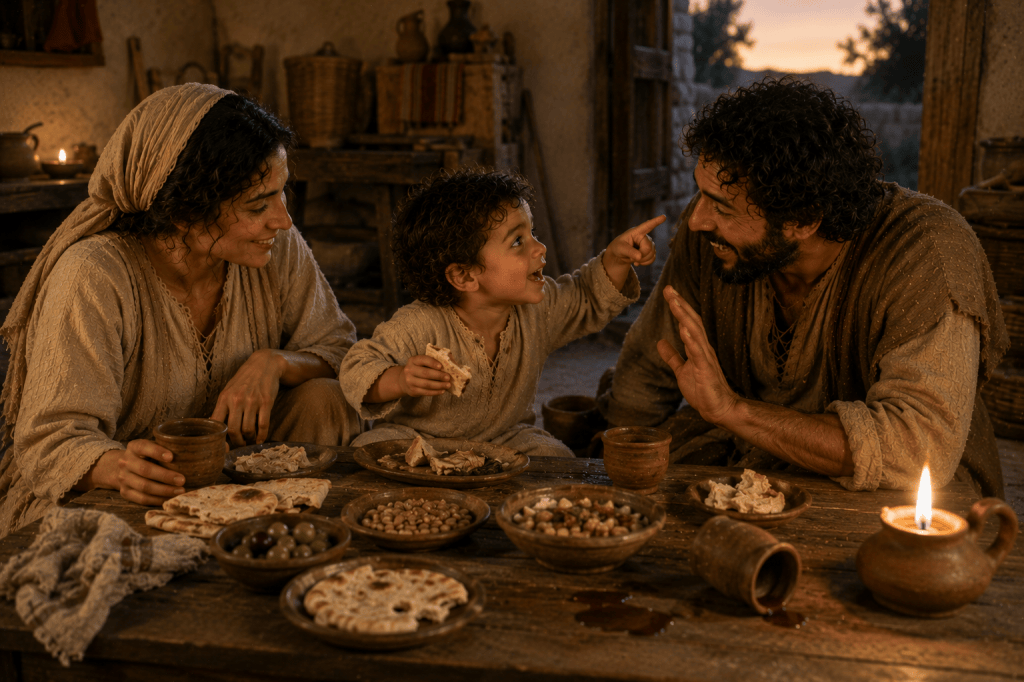
Before the Last Supper, before the multiplication of loaves, before anyone listened when Jesus spoke over bread—there was a little table in Nazareth where someone probably had to remind him to finish chewing before he talked.
I wonder what dinner sounded like.
Not what they ate.
We can make reasonable guesses about that.
Bread. Olives. Lentils. Beans. Fruits and vegetables in season. Perhaps fish when available. Cheese or other simple foods. Meat less frequently. The ordinary foods of a Jewish family living in first-century Galilee.
But what did it sound like?
Because when we imagine the Holy Family eating together, somehow everyone becomes silent.
Mary sits serenely.
Joseph sits solemnly.
Jesus is suspiciously well behaved.
Nobody interrupts.
Nobody spills anything.
Nobody talks with food in their mouth.
Nobody reaches across anybody else.
Nobody tells a story badly.
Nobody laughs halfway through drinking and nearly chokes.
They apparently spend thirty years having dinner like figures already arranged for an icon.
Surely not.
Surely sometimes the home of Mary, Joseph, and Jesus sounded like—
“Wait, wait, wait. Start again.”
“I already started.”
“I wasn’t listening.”
“I know. That’s why I’m telling you to start again.”
“Why weren’t you listening?”
“Because Jesus was asking me something.”
“I asked one thing.”
“You asked six things.”
“They were about one thing.”
Joseph looks at Mary.
Mary looks at Joseph.
Jesus looks between them.
And dinner continues.
Maybe Jesus was four or five now.
Old enough to participate fully in conversation.
Which also meant old enough to participate constantly in conversation.
Perhaps Joseph came home with a story.
Something happened while he was working.
A customer said something strange.
An animal got loose.
Someone tried to carry something much too large by himself.
Maybe Joseph was halfway through explaining when Jesus interrupted.
“Why?”
Joseph stopped.
“Why what?”
“Why did he do that?”
“I don’t know.”
“But why?”
“I wasn’t there when he decided.”
Jesus considered.
“Did you ask him?”
“No.”
“Why not?”
Joseph looked at Mary.
Mary was eating very quietly.
She was enjoying this far too much.
“Because,” Joseph said carefully, “I was busy helping him.”
“Why?”
Joseph stared.
Mary took a drink.
Her shoulders moved slightly.
She was laughing.
“Are you enjoying yourself?”
Mary swallowed.
“Very much.”
Maybe Jesus was in a why phase.
God help them.
Imagine being responsible for answering the questions of the child who would one day ask questions capable of silencing Pharisees.
Except currently:
“Why are olives green?”
“Some are.”
“Why?”
“I don’t know.”
“Why does bread get hard?”
“Because it dries.”
“Why?”
“Because the water leaves it.”
“Where does it go?”
Mary pauses.
Joseph suddenly becomes fascinated by his dinner.
Mary looks at him.
“Oh, no.”
Joseph looks up innocently.
“You started this.”
“I explained the bread.”
“You mentioned water.”
“You know more about bread than I do.”
“How?”
“You make it.”
“That doesn’t mean I understand water.”
Jesus watches this exchange.
“So where does it go?”
Silence.
Mary sighs.
Dinner has become natural philosophy.
Again.
Maybe sometimes Jesus asked questions they could answer.
“Why do we pray before we eat?”
That one would change the room slightly.
Perhaps Joseph answered.
“Because everything we have comes from God.”
Jesus looked at the bread.
“Did God make this?”
Mary smiled.
“I made that.”
Jesus looked confused.
Joseph wisely said nothing.
Mary continued:
“But God gave us what we needed to make it.”
Jesus considered.
“The grain?”
“Yes.”
“And the water?”
“Yes.”
“And Mama?”
Joseph smiled.
“Yes. God gave us Mama too.”
Mary looked at him.
Something quiet passed between them.
Jesus accepted this.
Then:
“And you?”
Mary tore off a piece of bread.
“God gave us your father too.”
Jesus nodded.
Good.
Inventory complete.
Maybe they prayed the traditional Jewish blessings appropriate to meals.
Jesus learned the words first by listening.
Then by repeating.
Perhaps he stumbled over them when he was little.
Mary corrected him gently.
Again.
Eventually the words became his own.
That thought stops me.
Before Jesus blessed bread before crowds—
someone taught him how to bless bread.
Before his disciples heard him give thanks—
Jesus had heard Joseph and Mary give thanks.
Before the Last Supper—
there were thousands of ordinary suppers.
Bread placed on a table.
Hands reaching.
Words of blessing.
Eat.
Talk.
Clean up.
Tomorrow again.
I wonder if Jesus ever raced through the prayer because he was hungry.
Joseph:
“Slowly.”
Jesus slows down for approximately four words.
Then accelerates.
Mary opens one eye.
“Jesus.”
He stops.
“I am praying.”
“I know.”
“I’m hungry.”
“So is everyone.”
Jesus looks at Joseph.
Joseph is also hungry.
Unfortunately, he knows better than to admit it.
Mary continues.
Jesus finishes at a respectable pace.
Then reaches immediately for bread.
Mary catches his wrist.
“Wait.”
“What?”
“Your father hasn’t finished.”
Jesus looks at Joseph.
Joseph is now under enormous pressure.
He finishes.
Jesus attacks the bread.
Maybe dinner was where Mary learned everything Jesus had done that day.
This seems universal.
Children will tell you absolutely nothing when asked directly.
“How was your day?”
“Good.”
“What did you do?”
“Nothing.”
Then, halfway through dinner:
“Eli fell into a ditch.”
Mary stops chewing.
Joseph looks up.
“What?”
Jesus continues eating.
“Eli fell into a ditch.”
“When?”
“Today.”
“Was he hurt?”
“No.”
“Why was he in a ditch?”
Jesus shrugs.
Joseph asks the important question.
“Did you fall into the ditch?”
“No.”
Mary looks at him.
Jesus avoids eye contact.
“Jesus.”
“I didn’t fall.”
Joseph catches the distinction.
“Were you in the ditch?”
Silence.
Mary closes her eyes.
There it is.
“How did you get into the ditch?”
“I climbed.”
“Why?”
“To help Eli.”
Mary looks at Joseph.
Joseph is trying very hard to determine whether this is admirable or infuriating.
“Did an adult know where you were?”
Jesus becomes extremely interested in his lentils.
“Jesus.”
“No.”
Mary exhales.
Now dinner has become a parenting conference.
Maybe Jesus was a storyteller.
I hope so.
Perhaps he noticed everything.
A bird doing something strange.
Two people arguing in the marketplace.
A woman carrying an enormous basket.
A shepherd trying to convince an obstinate sheep to move.
Maybe he recreated voices.
Expressions.
Gestures.
Joseph laughed.
Mary laughed.
Jesus realized he had an audience.
And the story became increasingly dramatic.
“The sheep was THIS big.”
Mary looked at him.
“That sheep was not that big.”
Jesus spread his arms wider.
“It was.”
Joseph nodded solemnly.
“I’ve seen large sheep.”
Mary turned.
“Do not encourage him.”
Jesus made the sheep noise.
Joseph nearly spit out his drink.
Mary covered her face.
Dinner was gone.
Maybe Mary told stories too.
Not every evening revolved around Jesus.
That’s important.
Perhaps Mary had news.
Elizabeth had sent word.
Someone in the family was getting married.
A neighbor had a baby.
Someone needed help.
Maybe she told Joseph about something absurd that happened while buying grain.
Joseph laughed before she reached the end because Mary herself couldn’t finish the story.
Jesus looked between them.
“What?”
Mary tried.
Couldn’t.
Joseph started laughing harder.
“What happened?”
Mary waved one hand.
“Give me a minute.”
Jesus hated not understanding.
“What happened?”
That made Mary laugh more.
Eventually Jesus began laughing too.
He still had no idea why.
Maybe some dinners were quiet.
Not sacred quiet.
Tired quiet.
Joseph had worked all day.
Mary had worked all day.
Jesus had apparently spent all day being five.
Everyone was done.
Bread tore.
Cups moved.
Spoons scraped against bowls.
Someone sighed.
Jesus leaned against Mary.
Mary ate with one hand.
Joseph looked across the table.
“Long day?”
Mary nodded.
“You?”
Joseph nodded.
Jesus, eyes half closed:
“No.”
Both parents looked at him.
Of course not.
Maybe Jesus fell asleep during dinner once.
Actually, surely some child somewhere in Nazareth did, and I desperately want it to have been Jesus.
He is eating.
Slowly.
Slower.
Mary notices.
“Jesus.”
His eyes open.
“I’m awake.”
“Eat.”
He eats.
Two minutes later his head begins drifting.
Joseph watches.
Jesus corrects.
Still awake.
Then the piece of bread stops halfway to his mouth.
Mary presses her lips together.
Joseph whispers:
“Don’t.”
“I didn’t say anything.”
Jesus’ eyes close.
His head dips.
Jerks up.
“I am awake.”
Joseph nods.
“Obviously.”
Another minute.
Jesus is asleep.
Still holding bread.
Mary looks at Joseph.
Joseph looks at Mary.
“What do we do?”
Mary whispers:
“Take the bread.”
Joseph carefully reaches.
Jesus’ fingers tighten.
Both parents freeze.
Jesus remains asleep.
Joseph slowly extracts it.
Victory.
Perhaps Joseph carried him to bed.
Mary cleared the table.
Or Mary carried him and Joseph cleared it.
Maybe they didn’t assign those things.
Whoever had the sleeping child was temporarily exempt from household responsibilities.
A sacred domestic law.
Other dinners were probably loud.
Jesus had friends nearby.
Family visiting.
Cousins.
Neighbors.
Perhaps Elizabeth and Zechariah, depending on the period and travel.
John.
Oh, imagine Jesus and John eating together as little boys.
There is an entire article hiding there.
Mary:
“Sit down.”
Elizabeth:
“John.”
Mary:
“Jesus.”
Silence for approximately twelve seconds.
Then:
“Stop touching him.”
“I didn’t!”
“He did!”
Elizabeth drinks something.
Mary looks at her.
Elizabeth looks back.
They had once stood together while both children were still inside them.
Now they were considering sending both children outside.
Life moves quickly.
Maybe Joseph had table rules.
Simple ones.
Sit properly.
Don’t waste food.
Let someone finish speaking.
Help clean afterward.
Jesus probably learned them the way children learn everything:
inconsistently.
“Jesus.”
“What?”
“Your elbow.”
Jesus looks at his elbow.
“What about it?”
“Move it.”
“Why?”
Joseph realizes he has walked directly into another question.
Mary smiles.
Maybe Mary had one rule she repeated constantly:
“Finish chewing.”
Jesus tries to answer.
“Finish chewing.”
He chews faster.
Joseph begins speaking.
Jesus remembers what he wanted to say.
“Mmph—”
Mary points.
Jesus closes his mouth.
Chews.
Swallows.
Then:
“Papa is wrong.”
Joseph stops.
Mary immediately regrets teaching him to finish chewing.
“About what?”
Jesus launches into his argument.
Joseph listens.
Maybe that’s how it began.
Not theological debate.
Family debate.
Why does this work?
Why do we do that?
What if?
But you said—
Children discover reasoning by using it against their parents.
Perhaps Jesus was exceptionally good at this.
Poor Joseph.
“Yesterday you said—”
Joseph closes his eyes.
Mary looks delighted.
“You did say that.”
Joseph turns to her.
“Whose side are you on?”
“The truth.”
Jesus nods.
Excellent.
Mama understands justice.
Joseph looks between them.
He is outnumbered.
But I don’t want Jesus to become a miniature philosopher in these imaginings.
Sometimes he probably talked absolute nonsense.
Children do.
Long explanations involving three unrelated events, someone’s goat, a rock he found, something that happened six days ago, and a question that bears no relationship to any previous sentence.
Mary follows as best she can.
Joseph has been lost for several minutes.
“And then the bird went over there but not the same bird because that bird was smaller and Eli said it was his but you can’t own a bird because it flies and then—”
Joseph looks at Mary.
Mary mouths:
I don’t know.
Jesus continues.
“—so tomorrow can I have one?”
Joseph blinks.
“One what?”
Jesus stares at him.
Were you not listening?
Maybe dinner was also where Jesus learned about Joseph’s work.
“What did you make?”
“A door.”
“For who?”
“Micah.”
“Why?”
“Because he needed a door.”
“What happened to his old door?”
“It broke.”
“How?”
Joseph looks at Mary.
Mary smiles.
Here we go.
“I don’t know.”
“Did you see it?”
“Yes.”
“How did it break?”
“I didn’t ask.”
“Why?”
Joseph sighs.
Mary reaches for more bread.
This could take awhile.
Perhaps one day Jesus began joining Joseph.
Then dinner changed.
Now they had stories.
Mary became the outsider.
Joseph:
“Tell Mama what happened.”
Jesus is already laughing.
Mary looks suspiciously between them.
“What happened?”
Jesus can’t speak.
Joseph starts laughing too.
Mary waits.
This is irritating.
“What?”
Jesus finally manages:
“The stool.”
Joseph loses it.
Mary stares.
“What stool?”
Neither can answer.
Wonderful.
She lives with idiots.
Eventually Joseph explains.
Something about a stool collapsing.
Nobody was hurt.
Apparently it was hilarious.
Mary shakes her head.
Jesus imitates Joseph’s expression when it happened.
Joseph objects.
“I did not look like that.”
“You did!”
“I absolutely did not.”
Mary looks at Jesus’ imitation.
Then Joseph.
“Oh, you probably did.”
Betrayal.
Jesus and Mary laugh.
Joseph eats his bread in wounded dignity.
Maybe those were the best dinners.
Not because anything happened.
Because everybody was there.
Mary.
Joseph.
Jesus.
A table.
Food.
Conversation.
The ordinary certainty that tomorrow evening they would probably do it again.
Nobody knew how precious repetition was while living inside it.
We rarely do.
That’s the part that gets me.
We know something Mary didn’t know in those early years:
there would be a last family dinner with Joseph.
We don’t know when Joseph died.
Scripture doesn’t tell us.
But Christian tradition has long understood that he likely died before Jesus’ public ministry, since Joseph disappears from the Gospel narrative while Mary remains.
Which means at some point—
there was a last evening when all three sat together.
Nobody necessarily knew it was the last.
Maybe Joseph told a story.
Maybe Jesus disagreed with him about something.
Maybe Mary reminded someone to finish chewing.
Perhaps they laughed.
Then they cleaned up.
Went to sleep.
And one ordinary family dinner entered memory forever.
That’s how most lasts happen.
They don’t announce themselves.
Perhaps years later Mary sometimes looked at the place Joseph used to sit.
Jesus would have noticed.
Maybe dinner became quieter for awhile.
Two voices instead of three.
Perhaps Jesus told one of Joseph’s old stories.
Mary corrected him.
“That is not how your father told it.”
Jesus smiled.
“He always exaggerated that part.”
“He did not.”
“Mama.”
“He did not.”
Jesus raised an eyebrow.
Mary lasted perhaps three seconds.
Then smiled.
“All right. A little.”
Joseph remained at the table in the way people we love sometimes do.
Through stories.
Then eventually Jesus left home.
Another chair empty.
Mary ate without him.
Did she hate that at first?
Maybe the silence was enormous.
For years dinner had contained:
Mama.
Where’s Papa?
Why?
What is that?
Can I have more?
I don’t like this.
I’m hungry.
I’m not tired.
Tell Mama what happened.
Papa is wrong.
Finish chewing.
Sit down.
Stop.
Again.
And then—
quiet.
Perhaps Mary discovered that peace and loneliness can sound remarkably similar.
Meanwhile Jesus was eating at other tables.
So many tables.
The Gospels are full of them.
Jesus ate with tax collectors.
With Pharisees.
With friends.
With disciples.
At Bethany.
At weddings.
In homes.
Near crowds.
People criticized him for whom he ate with.
Meals became part of his ministry.
And I wonder whether anything from Nazareth traveled with him.
The way he broke bread.
The words he used when giving thanks.
The instinct to make sure everyone had enough.
The habit of listening to someone’s story all the way through.
Perhaps even some tiny gesture nobody else would recognize.
Mary would.
Joseph did that.
Or:
I taught you that.
Then came the night Christians remember at every Mass.
A table.
Friends.
Bread.
Wine.
Jesus took bread.
Blessed it.
Broke it.
Gave it.
“This is my body.”
The Last Supper is so enormous in Christian imagination that it can feel detached from every meal that came before.
But Jesus did not first encounter bread that night.
He had been receiving it from human hands since infancy.
Mary baked bread.
Joseph broke bread.
Jesus ate bread.
Jesus asked for bread.
Jesus dropped bread.
Jesus apparently may have once worn bread beneath his nose if we are indulging our imagination.
Bread belonged to home before it belonged to altar.
Maybe that’s part of why the Eucharist is so astonishing.
Jesus chose something utterly ordinary.
Something that had sat on the table in Nazareth thousands of times.
Bread.
Perhaps somewhere in Jerusalem that final week, Jesus broke bread in a way that would have looked immediately familiar to Mary.
She wasn’t at the Last Supper in the Gospel accounts.
But imagine someone later telling her:
“He took the bread…”
And Mary already knows how his hands moved.
Of course she does.
She watched those hands reach across her table for thirty years.
But we’re going too far again.
Back to Nazareth.
Jesus is perhaps five.
Joseph has just returned from work.
Mary puts dinner down.
They pray.
Jesus rushes the ending because he’s starving.
Mary makes him slow down.
Joseph breaks the bread.
Jesus immediately begins telling them something that happened today.
Mary says:
“Chew first.”
He chews.
Swallows.
Begins again.
Joseph interrupts.
Jesus protests:
“I was talking.”
“You interrupted me six times yesterday.”
“That was yesterday.”
Mary laughs.
Joseph points at her.
“You are not helping.”
“I didn’t say anything.”
Jesus continues his story.
It involves a goat.
Of course it does.
Nobody knows whose goat.
This is apparently irrelevant.
Halfway through, Joseph starts laughing.
Mary asks why.
Jesus explains badly.
Joseph tries to explain.
Now Jesus is correcting Joseph’s version of Jesus’ own story.
Mary has completely lost track.
Eventually she starts laughing because both of them are arguing over the precise behavior of a goat she has never seen.
Jesus laughs.
Joseph laughs.
Someone spills water.
Mary grabs a cloth.
Jesus reaches for bread.
Joseph moves the cup.
Three voices overlap.
The house is warm.
Dinner is getting cold.
Nobody cares.
And perhaps that is what family dinner sounded like in the home Christians would someday call the Holy Family.
Not Gregorian chant.
Not reverent silence.
Not three saints gazing serenely at one another across an immaculate table.
Conversation.
Questions.
Stories.
Correction.
Prayer.
Chewing.
Laughter.
Someone saying please pass that.
Someone saying I already told you.
Someone saying what happened next?
Someone saying finish what’s in your mouth.
And every so often—
silence.
The comfortable kind.
Three people eating together who did not need to fill every moment with words.
Maybe holiness sounded like that too.
Because long before Jesus fed five thousand people—
before he ate with sinners—
before he broke bread and told his friends to remember him—
someone passed him bread across a little table in Nazareth.
And for years, before the world came asking Jesus to feed it,
he simply sat between Mary and Joseph,
ate his dinner,
told them about his day,
and belonged at home.

 The Living Rosary Archives