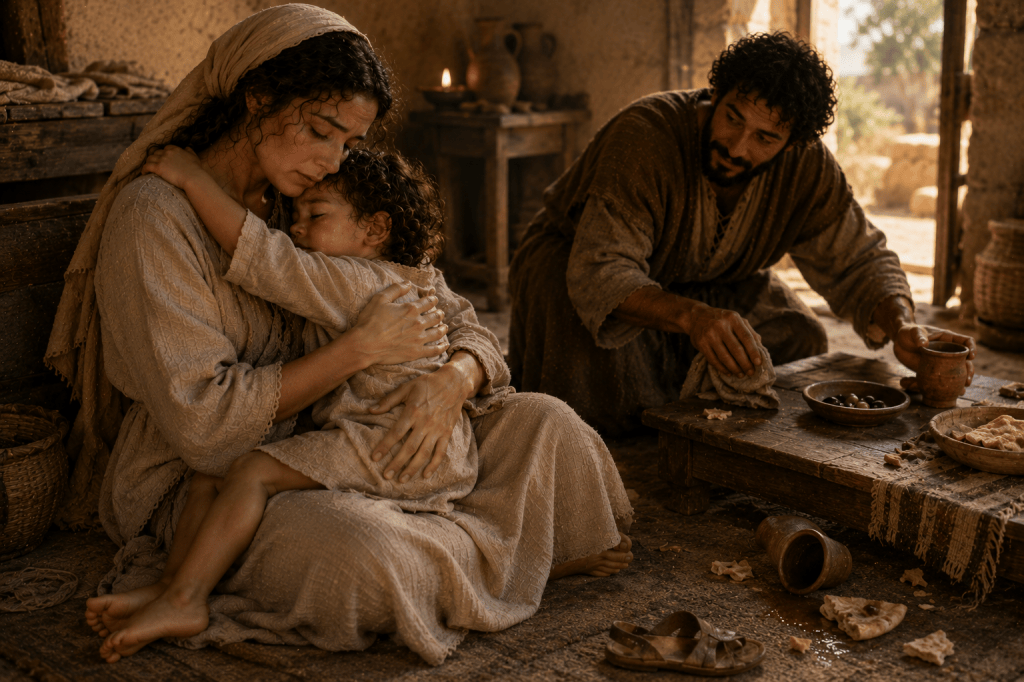
The Invitations of Mary Series
©MS 2026
Jesus was without sin. That does not mean Jesus was never three years old.
There is a particular kind of toddler catastrophe that begins with something completely insignificant.
The wrong cup.
A piece of bread breaking.
A sandal that suddenly feels offensive.
Someone saying no.
Someone saying yes in the wrong tone.
Being hungry while simultaneously refusing every available food.
Being desperately tired while regarding sleep as a personal betrayal.
And sometimes—
nothing.
Nothing happened.
The world simply became too much.
I wonder whether Mary ever watched this happen to Jesus.
Not Jesus being naughty.
Not Jesus sinning.
Just little Jesus reaching the absolute end of what his developing human nervous system could manage.
And Mary realizing:
Oh.
We’re done.
Maybe he was three.
Old enough to have opinions.
Young enough for those opinions to occasionally become matters of international importance.
Perhaps they’d been away from home most of the day.
Visiting family.
Running errands.
Traveling somewhere nearby.
Whatever ordinary obligations filled the lives of families in Nazareth.
Jesus had missed whatever usually counted as rest.
He hadn’t eaten enough.
There had been too many people.
Too much noise.
Too much walking.
Too much being told:
“Come here.”
“Wait.”
“Not that.”
“Stay with Mama.”
“Give that back.”
“Jesus.”
“Jesus.”
“Jesus.”
And for most of the day, he’d managed beautifully.
Then they got home.
Mary put food in front of him.
Jesus looked at it.
“No.”
Mary paused.
“You’re hungry.”
“No.”
“You told me you were hungry.”
“No.”
Ah.
Excellent.
Joseph was nearby.
He looked over.
Mary looked at him.
Neither said anything.
Experienced parents probably recognize this moment.
The storm had appeared on the horizon.
There was still time.
Maybe.
Mary crouched beside Jesus.
“Would you like some bread?”
“No.”
“Dates?”
“No.”
“Something else?”
“No.”
“What would you like?”
Jesus’ little face crumpled.
“I don’t know!”
There it was.
Not defiance.
Overload.
Maybe Mary understood immediately.
Maybe she didn’t.
Because even the most loving parent can spend several minutes attempting logic against a nervous system that has already left the building.
“You need to eat something.”
“No!”
“Jesus.”
“I don’t want it!”
“You were asking for food on the way home.”
“I’M NOT HUNGRY!”
Joseph quietly stopped whatever he was doing.
Mary inhaled.
Jesus shoved the dish slightly away.
Not violently.
Just emphatically.
The bread fell onto the floor.
Silence.
Jesus looked at the bread.
Mary looked at the bread.
Joseph looked at Mary.
Nobody moved.
And perhaps Mary thought:
Lord, give me patience.
Then remembered who was standing in front of her.
Not helpful.
“Jesus.”
His lip trembled.
Mary heard the sharpness in her own voice.
She softened it.
“Come here.”
“No.”
“Come here.”
“No!”
He backed away.
Mary closed her eyes for one second.
Just one.
Because she loved this child more than she knew how to contain.
And right now—
he was driving her absolutely crazy.
Those things can coexist.
I think sometimes we’re afraid to imagine Mary exasperated with Jesus because we’re afraid it implies that Jesus sinned.
It doesn’t.
Christian tradition teaches that Jesus was without sin.
But sinlessness is not the same thing as possessing adult emotional regulation from infancy.
If Jesus’ humanity was genuine, then his human brain developed.
His language developed.
His coordination developed.
His understanding developed.
Luke says explicitly that Jesus “grew and became strong” and later that he “increased in wisdom and in years.”
Growth means there was something appropriate to each stage of human development.
A three-year-old Jesus was not a thirty-year-old Jesus trapped inside a smaller body.
He was three.
And three-year-olds become overwhelmed.
Hunger is not sinful.
Fatigue is not sinful.
Crying is not sinful.
Needing physical comfort is not sinful.
Being unable to articulate everything is too much and I don’t know what I need is certainly not sinful.
Neither is a mother’s frustration.
Mary’s holiness did not require her nervous system to remain permanently untouched by the demands of raising a child.
She could love Jesus perfectly—
and still occasionally think:
Please. Just eat the bread.
Maybe she tried again.
She picked up the fallen piece.
Jesus was crying now.
Not screaming.
That miserable, exhausted toddler cry where everything has collapsed.
Mary reached for him.
He pulled away.
“No!”
Fine.
She sat down.
Jesus cried.
Mary waited.
Joseph remained wisely quiet.
Eventually Mary said:
“I’m right here.”
Jesus cried harder.
“I know.”
He probably didn’t know either.
That was the problem.
Maybe Joseph tried.
He crouched.
“Would you like to come with me?”
“No!”
Joseph nodded.
Fair enough.
“Would you like Mama?”
“No!”
Mary raised an eyebrow.
Joseph almost smiled.
Do not.
“Would you like—”
“NO!”
Joseph sat back.
Apparently the official position of Jesus of Nazareth was currently:
No.
To everything.
Maybe Mary became genuinely irritated.
Not cruel.
Not rejecting.
Just tired herself.
Because here’s the part we often forget:
Mary had also had the day Jesus had.
If there had been too much walking for him, Mary had walked too.
If there had been too many people, Mary had dealt with them too.
If Jesus had been asking questions for four hours, Mary had been answering them.
If he’d needed carrying, she’d carried him.
If he hadn’t rested—
perhaps neither had she.
Parents don’t observe childhood exhaustion from some limitless reservoir of adult energy.
Sometimes everyone reaches the end together.
Maybe Mary stood.
“Fine.”
Joseph looked at her.
She picked up the food.
“He doesn’t want it.”
Jesus immediately cried:
“I want it!”
Mary stopped.
Of course.
She slowly put the dish back down.
Jesus looked at it.
“I don’t want that.”
Mary stared.
Joseph looked very intently at the wall.
“Joseph.”
“Yes?”
“Do not.”
“I didn’t do anything.”
“You’re thinking something.”
“I am thinking many things.”
“Think them quietly.”
Jesus cried.
Mary pressed her fingers briefly against her forehead.
Maybe this was one of those moments when the Blessed Virgin Mary had to resist the deeply human desire to walk outside and scream into the hills.
Instead she crouched again.
“Jesus.”
He wouldn’t look at her.
“Look at me.”
No.
She waited.
Eventually those dark little eyes found hers.
And maybe suddenly she saw it.
Not rebellion.
Not stubbornness.
Just a tiny person who had completely run out of capacity.
His cheeks were flushed.
His curls were damp.
His eyes were swollen with tears.
His breathing had that little hitch that comes after crying too hard.
Mary’s irritation didn’t disappear magically.
But it changed shape.
“Oh, sweetheart.”
Jesus’ face collapsed again.
And this time when Mary opened her arms—
he came.
Maybe he came violently.
Toddlers don’t always approach tenderness gracefully.
One second:
NO MAMA.
The next:
entire body launched directly into Mama.
Mary nearly fell backward.
“Whoa.”
Jesus buried his face against her neck.
Still crying.
Mary wrapped both arms around him.
There.
There you are.
He was getting heavy now.
Not newborn heavy.
Toddler heavy.
All knees and elbows and absolute trust.
Mary sat with him on the floor.
Joseph quietly moved the food aside.
He didn’t need to be told.
Maybe he brought Mary water.
She took it over Jesus’ shoulder.
Their eyes met.
Joseph’s expression asked:
Need anything?
Mary shook her head.
Not yet.
He stayed nearby.
Jesus cried until the crying wasn’t really about anything anymore.
Mary rubbed his back.
Slowly.
Up.
Down.
Up.
Down.
“You had a hard day.”
Jesus sniffed.
“No.”
Mary almost laughed.
Apparently even the day itself was incorrect.
“All right.”
A few breaths.
“You’re tired.”
“No.”
His eyes were literally closing.
Mary looked at Joseph.
Joseph looked away before she could see him smile.
“You’re not tired.”
“No.”
“Of course not.”
Jesus relaxed slightly.
Mary kissed his curls.
“You’re the least tired person I’ve ever met.”
A sleepy little:
“Yeah.”
Mary’s mouth twitched.
Maybe that’s when she realized arguing about the truth of his exhaustion was pointless.
He didn’t need to admit he was tired.
He needed her to help his body through it.
So she stopped asking questions.
Stopped offering choices.
Stopped trying to get him to eat.
She simply held him.
The room became quiet.
Jesus’ breathing slowed.
His fingers loosened around her clothing.
His head grew heavier against her shoulder.
Mary shifted.
His eyes opened.
“No sleep.”
“I didn’t say anything about sleep.”
Jesus stared suspiciously.
Mary rocked slightly.
“We’re just sitting.”
Joseph raised an eyebrow.
Mary gave him a warning glance.
We’re just sitting.
Joseph nodded solemnly.
Of course.
Five minutes later Jesus was asleep.
Completely.
Mary looked down.
Then at Joseph.
Joseph whispered:
“Not tired.”
Mary bit the inside of her cheek.
“Apparently not.”
They both looked at the unconscious child.
Then Jesus’ stomach growled.
Mary closed her eyes.
Joseph covered his mouth.
“Don’t.”
He was shaking.
“Joseph.”
“I am not laughing.”
“You absolutely are.”
Jesus slept through his own betrayal.
Mary looked down at him.
“You were hungry.”
No response.
Of course.
Maybe she stayed there for a while.
Because transferring a sleeping toddler requires its own tactical considerations.
Eventually Joseph crouched.
“I’ll take him.”
Mary hesitated.
“He’ll wake.”
“I’ll be careful.”
“You always say that.”
“I am careful.”
“You walk differently.”
Joseph stared.
“I walk differently?”
“When you’re carrying him.”
“How?”
“Bouncier.”
“I do not walk bouncier.”
Jesus stirred.
Both froze.
Silence.
Mary whispered:
“See?”
Joseph stared at her.
He had not moved.
Marriage.
Perhaps Mary eventually let Joseph take him.
Jesus shifted against his father’s chest.
Made a tiny unhappy sound.
Joseph immediately began that instinctive sway parents seem to acquire without instruction.
Mary noticed.
“Bouncy.”
Joseph ignored her.
Jesus settled.
Mary smiled.
Then maybe she looked at the abandoned dinner.
Bread on the floor.
Cup slightly overturned.
Whatever meal she’d prepared going cold.
And for one brief second, perhaps Mary felt defeated.
She had wanted him to eat.
He hadn’t.
She had wanted him to rest.
He had fought it.
She had wanted to get through one simple evening without catastrophe.
Instead there had been tears.
Frustration.
Food on the floor.
And now her son was asleep hungry.
Maybe she wondered:
Did I handle that badly?
Parents have probably asked themselves some version of that forever.
Joseph might have seen her face.
“He’s fine.”
Mary picked up the bread.
“He didn’t eat.”
“He’ll eat when he wakes.”
“I got frustrated.”
Joseph adjusted Jesus against his shoulder.
“So did he.”
“He’s three.”
Joseph waited.
Mary looked at him.
“Yes. I know.”
Maybe that was exactly what she needed to hear.
Not:
You were perfectly patient.
Not:
You are the ideal mother.
Just:
He is three.
And perhaps silently:
You are human too.
I wonder whether Mary ever apologized to Jesus.
Not because she sinned against him necessarily.
But because parents sometimes repair moments even when nobody has done anything terribly wrong.
Maybe later, when Jesus woke, he was hungry.
Of course.
Mary gave him bread.
He ate as though the previous evening’s ideological opposition to bread had never existed.
Mary watched.
“You know, I offered you that earlier.”
Jesus ate.
Joseph looked at her.
Mary sighed.
Right.
Let it go.
Perhaps after he had eaten, Mary pulled him into her lap.
“Jesus?”
He looked up.
“I was frustrated earlier.”
He stared.
“I was tired too.”
Maybe he understood some of that.
Maybe not.
Mary kissed his forehead.
“I love you when I’m frustrated.”
That’s a lesson worth teaching.
“I love you when you’re crying.”
Jesus leaned against her.
“I love you when you don’t know what you need.”
A pause.
“And I love you when you throw perfectly good bread on the floor.”
Joseph, nearby:
“That one requires greater holiness.”
Mary laughed.
Jesus looked at Joseph.
Then Mary.
Maybe he laughed too.
Crisis over.
Perhaps this happened more than once.
Of course it did.
Maybe Jesus had sensory dislikes.
A scratchy piece of clothing.
Too much noise.
Heat.
Crowds.
The wrong texture of food.
We cannot know.
But every human nervous system has thresholds.
And children are still learning theirs.
Maybe Mary gradually learned Jesus’ warning signs.
The way he became quieter before becoming overwhelmed.
Or louder.
The particular rub of his eyes.
The clinginess.
The increasingly unreasonable objections.
Perhaps she learned:
He needs food now.
We need to leave now.
He’s done with people.
If we stay another half hour, we are going to regret every decision that brought us here.
That knowledge wouldn’t make every meltdown disappear.
But motherhood is partly learning the weather patterns of another person.
Mary learned Jesus.
And Joseph learned him too.
Maybe there were days when Mary wanted to stay somewhere longer.
Joseph quietly said:
“Look at him.”
Mary looked.
Jesus was sitting unusually still.
Uh-oh.
“You think?”
Joseph nodded.
Mary sighed.
They began saying goodbye.
Someone protested:
“But you just arrived!”
Mary smiled politely.
“We need to go.”
Jesus was asleep against Joseph before they reached home.
Joseph looked at her.
Mary whispered:
“Good call.”
Tiny marital victory.
Other times they probably got it completely wrong.
“He isn’t tired.”
Ten minutes later:
disaster.
“He ate plenty.”
Twenty minutes later:
apparently not.
“He can handle one more stop.”
He could not.
That’s parenting.
Even Mary and Joseph would have had to learn by living.
And I think allowing that makes the Holy Family more beautiful, not less.
Because sometimes we turn them into an impossible household.
Mary never frustrated.
Joseph never impatient.
Jesus never overwhelmed.
Everyone communicates perfectly.
Nobody misunderstands anyone.
Dinner is peaceful.
The house is serene.
Apparently holiness eliminates nervous systems.
But that isn’t what Christianity teaches.
Grace perfects nature.
It doesn’t erase it.
A holy family can still be tired.
A holy mother can need five minutes.
A holy father can misread the situation.
A sinless child can cry until he cannot remember why he started.
What makes a family holy may not be the absence of difficult moments.
Maybe it’s what happens after them.
Nobody humiliates Jesus for crying.
Nobody withdraws affection.
Nobody demands that he stop feeling whatever he’s feeling before he can be comforted.
Mary gets frustrated.
Joseph gets tired.
Jesus falls apart.
And then—
they come back together.
Food gets picked up.
Someone says sorry.
Someone gets held.
Someone sleeps.
Tomorrow begins.
That’s ordinary reconciliation before children even have words for it.
And maybe Jesus learned something there too.
Long before he taught about mercy—
he experienced repair.
Long before he told the story of a father running toward a returning son—
he knew what it felt like to collapse into his mother’s arms after insisting moments earlier that he didn’t want her.
Long before he said:
“Come to me, all you that are weary…”
he had been weary.
Little.
Overwhelmed.
Unable to explain himself.
And someone had opened her arms.
There is something beautiful in imagining that the human Jesus learned what safety felt like before he had theological language for it.
Mama is frustrated.
Mama still loves me.
Papa is tired.
Papa still stays.
I can fall apart here.
Nobody leaves.
The world becomes too much—
and eventually someone’s arms gather me back into it.
That isn’t spoiling a child.
That’s attachment.
That’s home.
Maybe Mary thought about those days when Jesus was grown.
Crowds pressing around him.
People constantly asking.
Heal me.
Teach me.
Answer me.
Come here.
Go there.
Tell us.
Show us.
Prove it.
Everyone wanting something.
Perhaps Mary recognized the look before anyone else did.
He’s tired.
The disciples might not notice.
Mary would.
She had seen that face at three.
Maybe she quietly put food in front of him.
Jesus looked at her.
“Mama.”
“Eat.”
“I’m fine.”
Mary raised an eyebrow.
Thirty years disappeared.
Jesus looked at the bread.
Then at Mary.
Perhaps he smiled.
And ate.
There would eventually come another moment when Jesus was overwhelmed.
Not toddler overwhelm.
Gethsemane.
Sorrowful unto death.
His body under such distress that Luke describes his sweat like drops of blood.
He asked his friends to stay awake.
They couldn’t.
Mary wasn’t there in the Gospel account.
But I wonder if, afterward, she heard about it.
Her grown son frightened.
Exhausted.
In anguish.
Wanting someone nearby.
And maybe part of her remembered a little boy who had once reached the end of himself and collapsed against her chest.
The difference would have been unbearable.
At three, she could hold him until the world became manageable again.
In Jerusalem, there were places she could not follow.
Not yet.
But today isn’t Gethsemane.
Today is Nazareth.
Jesus is three.
And the crisis is bread.
Beautifully, ridiculously, mercifully—
just bread.
Maybe Mary is sitting on the floor.
Jesus asleep against her.
Joseph beside them.
The abandoned dinner nearby.
The house finally quiet.
Mary looks at her son’s face.
Tear tracks drying on his cheeks.
Dark curls stuck to his forehead.
His mouth slightly open.
Completely peaceful now.
Impossible child.
Beloved child.
She brushes the curls away.
“Next time,” she whispers, “we eat before you become impossible.”
Joseph hears.
“Next time?”
Mary looks at him.
He has a point.
There will absolutely be a next time.
She sighs.
Jesus sleeps.
Then his stomach growls again.
Mary closes her eyes.
Joseph’s shoulders begin shaking.
This time Mary laughs too.
Quietly.
Carefully.
Because Jesus is asleep.
And perhaps that’s what holiness looked like that evening.
Not perfect patience.
Not perfect behavior.
Not a mother untouched by frustration.
Just a tired family discovering that love can survive everyone reaching their limit at once.
Mary was exasperated.
Jesus was overwhelmed.
Joseph probably wanted dinner.
The bread ended up on the floor.
Nobody handled every second perfectly.
And still—
when Jesus finally couldn’t carry himself anymore,
Mary opened her arms.
He came.
And she held him.
Because perhaps one of the first things the human Jesus learned about love was also one of the most important:
You do not have to be easy to be held.

 The Living Rosary Archives