The Invitations of Mary Series
©MS 2026
Knowing who he was would not necessarily stop a mother from worrying about a fever.
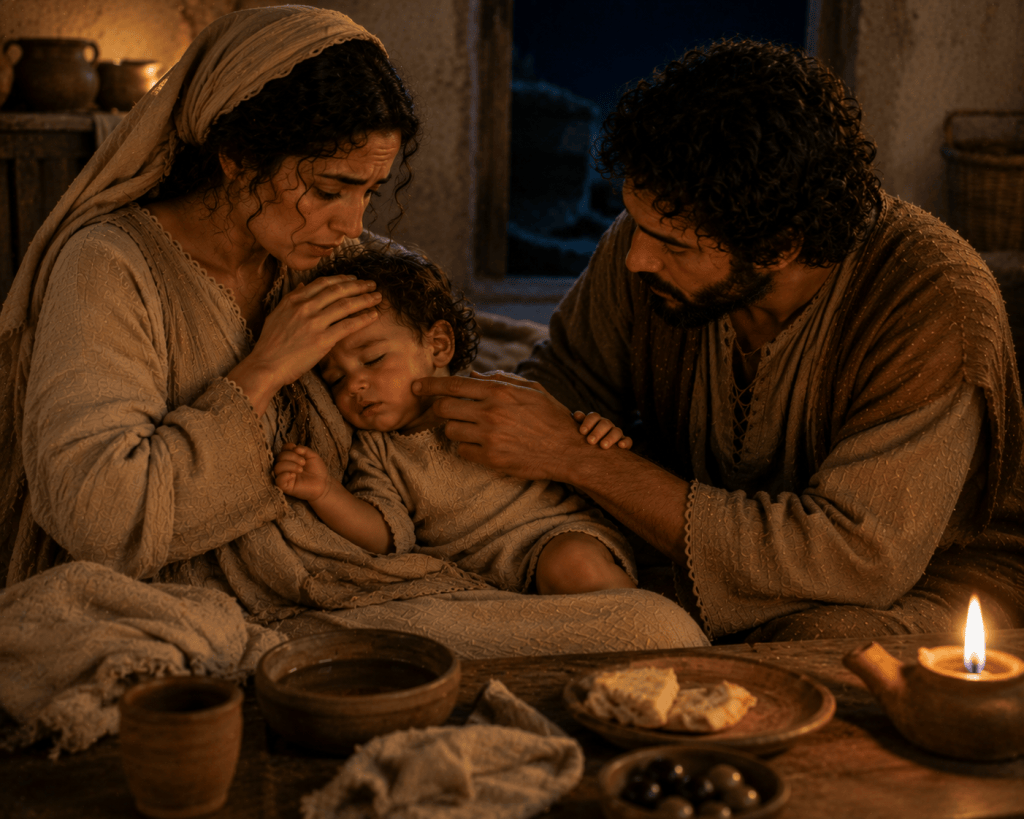
The first time Jesus developed a fever, I imagine Mary touched his forehead and immediately thought:
No.
Not a theological no.
Not Gabriel said his kingdom would have no end, therefore this cannot possibly be happening.
Just the instinctive, bodily refusal of a mother whose hand has discovered that her child is warmer than he should be.
No.
Something is wrong.
Perhaps Jesus was still very small.
Maybe not a newborn anymore. Perhaps a toddler—the age when he had begun running around the house, laughing at Joseph’s nonsense, getting into things, becoming increasingly unmistakably himself.
And then one morning—
he wasn’t.
That may have frightened Mary before she ever felt the fever.
Because mothers learn the normal sounds of their children.
Jesus usually woke talking.
Or moving.
Or calling for her.
Maybe he usually appeared beside wherever Mary was working, curls disheveled from sleep, already interested in breakfast and whatever Joseph was doing.
But that morning?
Nothing.
Mary noticed the quiet.
She went looking.
Jesus was still lying down.
“Jesus?”
His eyes opened.
But he didn’t get up.
Mary crouched beside him.
“Good morning.”
No smile.
No reaching for her.
Just tired eyes.
And perhaps that was when her stomach tightened.
She placed the back of her hand against his cheek.
Warm.
Then his forehead.
Hot.
And suddenly Mary wasn’t the Mother of God.
She was simply a mother thinking:
My baby is sick.
We have no Gospel account of Jesus being ill as a child.
We should be very clear about that.
Scripture gives us almost nothing about Jesus’ childhood between the infancy narratives and the episode in Jerusalem when he was twelve.
But Catholic Christianity has always insisted that the Incarnation was real.
Jesus possessed a genuinely human body.
He experienced hunger.
Thirst.
Fatigue.
Pain.
He could bleed.
He could die.
The Gospels later show him physically exhausted enough to sleep through a storm.
So it is entirely reasonable, as imaginative reflection rather than historical claim, to wonder whether the child Jesus experienced the ordinary illnesses of childhood.
A fever.
A cough.
A stomach illness.
A miserable little cold.
And if he did—
Mary had to care for him.
Maybe she checked his forehead again.
Because apparently the temperature might have changed during the last four seconds.
Still hot.
“Joseph.”
Something in her voice probably brought him immediately.
“What?”
“Feel him.”
Joseph crouched.
Mary watched his face as his hand touched Jesus’ forehead.
“He’s warm.”
“I know he’s warm.”
Joseph looked at her.
Mary was already gathering Jesus into her arms.
“How warm?”
“I don’t know.”
There were no digital thermometers.
No number to reassure or alarm them.
No pediatrician to call.
No search bar.
No medicine cabinet containing carefully measured children’s fever reducer.
There was observation.
Touch.
Experience.
The knowledge of family and neighbors.
And the terrifying uncertainty that has accompanied sick children for most of human history.
Mary held Jesus against her.
His cheek fell against her shoulder.
That frightened her too.
Normally he would have squirmed.
Instead he just—
rested.
Perhaps Mary became very quiet.
That’s how I imagine her fear.
Not hysterical.
Not dramatic.
Focused.
She offered him water.
A little.
Good.
She touched his forehead again.
Still hot.
She loosened some clothing.
Kept him comfortable.
Held him.
Watched.
Waited.
Then checked again.
Still hot.
Maybe Joseph said:
“Mary.”
“What?”
“You just checked.”
“I know.”
She checked anyway.
Who did they ask for help?
Probably someone.
That’s important.
Mary didn’t live in our modern fantasy of isolated parenthood where two adults are expected to possess every piece of knowledge necessary to raise a child alone.
Ancient communities depended heavily upon family, neighbors, experienced women, healers, and accumulated household knowledge.
Perhaps an older woman came.
Maybe someone who had seen dozens of childhood fevers.
She touched Jesus’ forehead.
Watched his breathing.
Asked whether he had eaten.
Whether he had drunk.
Whether he’d been sick to his stomach.
Mary answered every question immediately.
“How long has he been like this?”
“Since this morning.”
“Has he taken water?”
“Yes.”
“How much?”
Mary knew exactly.
“Has he urinated?”
Mary paused.
Joseph answered.
“Yes.”
Both women looked at him.
Joseph shrugged.
He had noticed too.
Of course he had.
Maybe the older woman wasn’t terribly concerned.
Children get fevers.
“He needs rest.”
Mary nodded.
“Keep offering him something to drink.”
“Yes.”
“Watch him.”
“I am.”
The woman perhaps smiled.
Clearly.
Maybe she gave them whatever ordinary advice was appropriate to their place and time.
Then she left.
And Mary felt absolutely no better.
Because children get fevers is reassuring when discussing children generally.
It is less reassuring when the child is currently burning against your chest.
And then there was the question Mary couldn’t ask anyone else.
Can he die?
Surely it crossed her mind.
How could it not?
Child mortality in the ancient world was brutally familiar.
Mary would have known children who died.
Everyone did.
Illness was not an inconvenience that automatically ended with recovery.
A fever could mean nothing.
A fever could mean everything.
And Mary knew something no other mother knew.
Gabriel had told her things about this child’s future.
“He will be great and will be called the Son of the Most High.”
God would give him David’s throne.
He would reign.
His kingdom would have no end.
Mary knew Jesus had not done any of that yet.
So perhaps some part of her reasoned:
He cannot die from this.
But I don’t think that necessarily stopped her fear.
Because faith does not always quiet the body.
Sometimes your mind knows one thing while your nervous system screams another.
Gabriel said—
But he’s so hot.
God promised—
But look at him.
He has a future—
Then why won’t he eat?
Maybe Mary discovered that promises and fear can inhabit the same room.
Perhaps she prayed.
Of course she prayed.
But imagine how strange that prayer might have felt.
Her child was sick.
Her child was also the one Christians would eventually confess as God the Son.
What exactly does the Mother of God pray when God is feverish in her lap?
Maybe theology disappeared very quickly.
“Please.”
That might have been enough.
“Please let him be all right.”
She touched Jesus’ hair.
“Please.”
No elaborate language.
No Magnificat.
No poetry.
Just the oldest prayer mothers have ever prayed.
Please don’t take my child.
And perhaps immediately after praying it, Mary felt foolish.
Because Gabriel had promised.
Because she knew who Jesus was.
Because surely she should trust God more than this.
Maybe she tried to correct herself.
“I know.”
Silence.
“I know what you told me.”
Jesus breathed against her chest.
“But he’s sick.”
There it was.
Faith and motherhood.
Not enemies.
Just different kinds of knowing.
Joseph might have been frightened too.
I don’t want him calm merely so Mary can be anxious.
Perhaps he was simply frightened differently.
He needed something to do.
Water.
More cloth.
Find someone experienced.
Adjust the room.
Check whatever needed checking.
Bring Mary food.
She wasn’t hungry.
Bring it anyway.
“You need to eat.”
“I’m fine.”
“You haven’t eaten.”
“I’m not hungry.”
“Mary.”
She looked at him.
He held out the food.
She sighed.
Took it.
One bite.
Then another.
Joseph said nothing.
Maybe Jesus slept most of the day.
Mary did not.
Every strange breath:
her eyes went to him.
Every movement:
hand to forehead.
Every little whimper:
“What?”
Jesus couldn’t explain.
She held him closer.
Perhaps he wanted her constantly.
That wouldn’t have been unusual.
A sick toddler who normally wanted to explore might suddenly become almost newborn again.
No Joseph.
No floor.
No bed.
Mama.
Only Mama.
Maybe Mary secretly loved that for approximately twenty minutes.
Then her arm went numb.
Her back hurt.
She desperately needed to relieve herself.
Jesus had somehow fused permanently to her chest.
She tried handing him to Joseph.
Immediate protest.
“Jesus.”
He reached back toward her.
Joseph looked sympathetic.
Mary closed her eyes.
Of course.
She took him again.
Jesus settled.
“Traitor.”
Joseph smiled.
“Apparently illness has strengthened his preferences.”
“Don’t encourage him.”
Jesus tucked his face against her neck.
Mary kissed his curls.
Fine.
She wasn’t really complaining.
Maybe he refused food.
That probably worried her terribly.
“Just a little.”
Jesus turned his face away.
“Jesus.”
No.
Mary tried again.
“Please.”
No.
She offered something else.
No.
Joseph tried.
Jesus looked personally offended that Joseph had joined this campaign.
Mary nearly laughed.
Nearly.
Because the little expression was so unmistakably him.
There you are.
Even sick.
Still Jesus.
Maybe he drank.
That mattered.
Mary offered water.
Jesus took some.
She watched every swallow like a miracle.
“Good.”
Another.
“Yes.”
Jesus stopped.
Mary wanted more.
“Another?”
No.
“Please?”
No.
Mary looked at Joseph.
“He drank.”
Joseph nodded.
“He drank.”
They were celebrating approximately four mouthfuls of water.
Parenthood had changed their standards for victory.
Then maybe the fever climbed.
This is where Mary’s composure might have cracked.
Jesus woke crying.
Not his normal cry.
Something miserable.
Confused.
Mary gathered him.
“I know.”
She didn’t know.
But mothers say it anyway.
“I know, baby.”
Maybe that word.
Baby.
Jesus was getting bigger.
Walking.
Talking.
Laughing.
But suddenly he was her baby again.
She pressed her cheek against his forehead.
Too hot.
“Joseph.”
He was already there.
“I know.”
“No, he’s hotter.”
Joseph touched him.
His face changed.
That was worse than anything.
Mary had been hoping Joseph would say:
No, he feels the same.
He didn’t.
Maybe they sought more help.
Of course they would.
And perhaps this is where our romantic imagination needs some historical humility.
Illness in the ancient world was frightening.
There were no antibiotics.
No modern diagnostics.
No emergency department.
No pulse oximeter.
No laboratory.
No way to know whether a fever was a passing viral illness or the beginning of something dangerous.
Parents watched.
Waited.
Prayed.
Did what knowledge and resources allowed.
Sometimes children recovered.
Sometimes they didn’t.
Mary lived in that world.
Knowing Gabriel’s promise did not remove her from it.
That night might have been terrible.
Jesus couldn’t settle.
Mary held him.
Joseph stayed awake beside them.
Maybe the whittling knife from our earlier image remained untouched.
Nobody needed distraction tonight.
Joseph sat close.
His hand occasionally rested against Jesus’ back.
Mary leaned against him.
Three bodies together.
Jesus burning between them.
No one spoke much.
Perhaps Joseph finally whispered:
“He’ll be all right.”
Mary didn’t answer.
Because she didn’t want reassurance.
She wanted certainty.
Those aren’t the same thing.
Joseph couldn’t give her certainty.
So instead he put his arm around her.
Maybe that was better.
At some point Mary may have fallen asleep sitting up.
Not intentionally.
Jesus against her.
Her head against Joseph’s shoulder.
Joseph remained awake.
Or perhaps Joseph slept first and Mary watched both of them.
They traded fear in shifts.
One rested.
One watched.
Then the other.
That’s family too.
And perhaps sometime before dawn, something changed.
Mary woke.
Or maybe she had never slept.
She touched Jesus’ forehead.
Stopped.
Touched again.
Cooler.
Her heart jumped.
“Joseph.”
He woke instantly.
“What?”
“Feel him.”
Joseph touched Jesus.
Waited.
Looked at Mary.
“He’s cooler.”
Mary’s eyes filled.
“Is he?”
“Yes.”
“Are you sure?”
Joseph touched him again.
“Yes.”
Mary checked herself.
Of course.
Cooler.
Not cold.
Not completely normal perhaps.
But cooler.
Mary closed her eyes.
Maybe her entire body sagged.
She hadn’t realized how tightly she’d been holding herself together until she didn’t have to anymore.
Perhaps she cried then.
Quietly.
Joseph pulled her against him.
Jesus slept between them.
Mary kissed his forehead.
Still warm.
But not frighteningly so.
“Thank you.”
Maybe she whispered it toward heaven.
Then kissed Jesus again.
“Thank you.”
Perhaps both.
Morning came.
Jesus woke.
Mary was immediately alert.
His eyes opened.
“Hi.”
He looked at her.
Still tired.
But different.
More present.
Mary smiled.
Jesus stared.
Then perhaps—
the tiniest smile back.
There he was.
Mary laughed through tears.
Joseph looked over.
“What?”
“He smiled.”
Joseph smiled too.
“Good.”
Mary touched Jesus’ forehead.
Joseph watched.
“You’re going to do that all day, aren’t you?”
“Yes.”
No hesitation whatsoever.
Joseph nodded.
Reasonable.
Maybe by afternoon Jesus wanted down.
That was the real sign.
He squirmed.
Mary tightened her hold.
“No.”
Jesus pushed against her.
“You’re sick.”
Down.
“You need rest.”
Down.
Mary looked at Joseph.
Joseph raised his hands.
Not getting involved.
Jesus wriggled.
Mary finally lowered him carefully.
His feet touched the floor.
He stood.
A little unsteady.
Mary’s hands remained approximately half an inch from his body.
Jesus took a step.
Then another.
Mary followed.
“Careful.”
Jesus turned.
Perhaps irritated.
There he was.
Joseph smiled.
“I think he’s feeling better.”
Mary watched Jesus reach for something he absolutely shouldn’t touch.
She moved immediately.
“Yes.”
Definitely better.
Maybe two days later Jesus was completely himself.
Running.
Laughing.
Refusing sleep.
Creating whatever degree of chaos a tiny child in first-century Nazareth could manage.
Mary stood watching him.
She should have been relieved.
She was.
Mostly.
Then Jesus coughed.
Once.
Mary froze.
Joseph looked at her.
“No.”
Mary looked at him.
“He coughed.”
“He swallowed wrong.”
“How do you know?”
“Because he was eating.”
Mary watched Jesus.
Fine.
Completely fine.
She waited.
Nothing.
Joseph gently touched her shoulder.
“Mary.”
“I know.”
She exhaled.
Parenthood apparently involved learning when not to panic too.
That lesson might take awhile.
I wonder if that first illness changed something in her.
Until then, perhaps Jesus had seemed strangely invulnerable.
Not because she believed he couldn’t be hurt.
But because he had simply been healthy.
Growing.
Laughing.
Sleeping badly.
Demanding food.
Getting into things.
Then suddenly his body betrayed him in the ordinary way human bodies do.
He became weak.
Hot.
Miserable.
Dependent.
Mary had seen vulnerability before.
She had held him as a newborn.
But sickness is different.
A newborn is helpless because that’s what newborns are.
A sick child is someone you know in motion suddenly made still.
That’s terrifying.
Perhaps Mary realized:
I cannot protect him from everything.
That might have been one of motherhood’s first heartbreaks.
She could feed him.
Hold him.
Keep him warm.
Watch him.
Teach him.
Move dangers out of reach.
Tell Joseph to stop throwing him quite so high into the air.
But she could not create a world in which nothing ever hurt Jesus.
No mother can.
And for Mary, that truth would eventually become unbearable.
But not yet.
Years later, she would see him tired after traveling.
Perhaps coughing from dust.
Hungry because crowds had kept him from eating.
Maybe injured in ordinary ways Scripture never records.
And perhaps some instinct never disappeared.
“You look tired.”
“Mama.”
“When did you last eat?”
“I ate.”
“When?”
Jesus pauses.
Mary raises an eyebrow.
Some things do not change because your son turns thirty.
And then there would come a day when Mary touched Jesus again and knew something was terribly wrong.
Not fever.
Blood.
Wounds.
A body she could not make well with water and rest.
The child she had once held through a fever would eventually be placed into her arms after the Cross.
Christian art has preserved that image:
the Pietà.
Mother holding Son.
Again.
But this time no fever would break before dawn.
No sleepy smile would tell her he was improving.
No little feet would demand to be put down.
That day, she would have to trust God’s promise when absolutely everything visible seemed to contradict it.
Perhaps the little fevers of childhood had taught her something about that.
Maybe not.
Some grief is too large to rehearse.
But that is decades away.
For now—
Jesus is perhaps two years old.
His fever has broken.
Morning sunlight reaches into the house.
Mary is sitting with him in her lap.
His curls are damp.
His cheeks are less flushed.
His little body is heavy with the wonderful exhaustion of recovery.
Mary touches his forehead.
Again.
Jesus looks up at her.
Maybe he catches her hand.
“Mama.”
“Yes?”
“No.”
Mary almost laughs.
“No what?”
He pushes her hand away from his forehead.
Apparently he has had enough.
Mary kisses him.
He objects to that too.
Good.
Very good.
She hugs him tighter.
“Mama.”
“I know.”
Joseph looks over from his work.
“He seems better.”
Mary smiles into Jesus’ hair.
“Yes.”
Jesus squirms indignantly.
Definitely better.
And perhaps Mary closes her eyes for just a moment and breathes him in.
Because Gabriel’s promise had not prevented her from being afraid.
Knowing Jesus was the Son of God had not made his forehead feel any less hot beneath her hand.
Faith had not transformed her into a mother incapable of fear.
Maybe faith simply meant that when fear arrived—
she held him.
She cared for him.
She asked for help.
She stayed awake.
She prayed.
And when morning finally came, she whispered thank you.
The Queen of Heaven would someday be invoked by frightened parents beside hospital beds.
But once, perhaps, she was simply a frightened mother herself—
sitting through the darkness,
one hand resting on her little boy’s back,
waiting for his fever to break.

 The Living Rosary Archives