The Invitations of Mary Series
©MS 2026
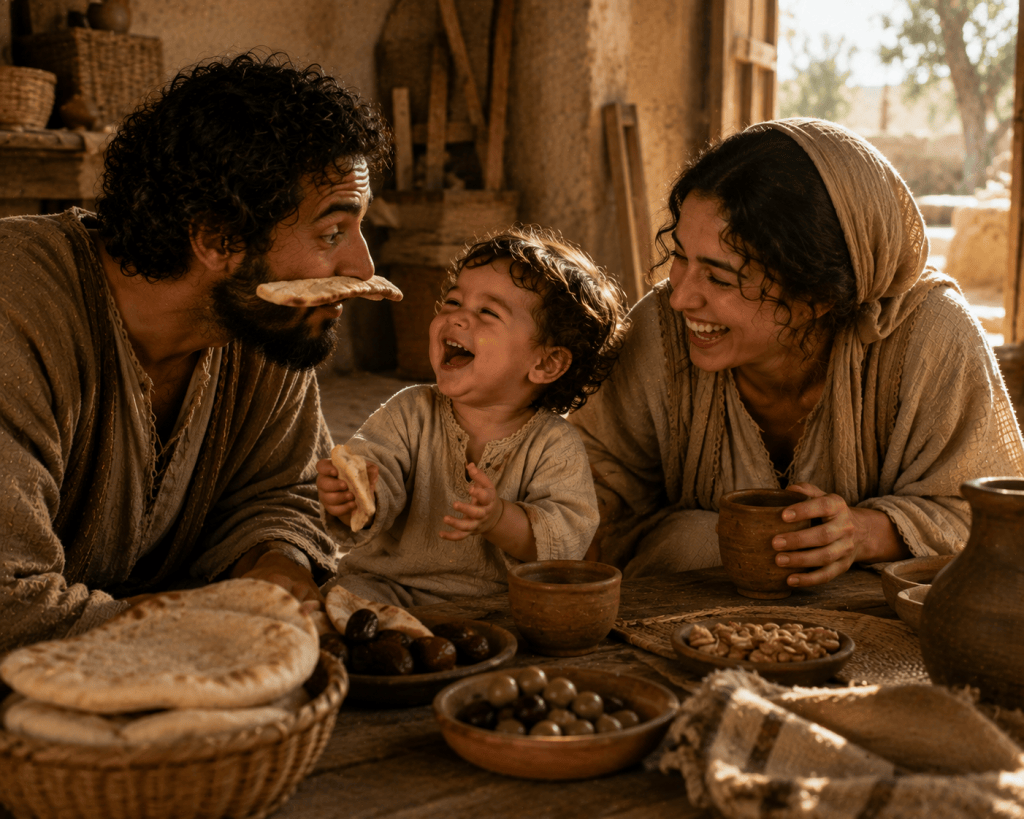
Before people gathered to hear him teach, there was probably a time when Joseph could make him collapse into helpless laughter by doing something profoundly stupid with a piece of bread.
There must have been something.
Something ridiculous.
Not profound.
Not symbolic.
Not the first-century equivalent of an educational toy carefully selected to encourage cognitive development.
Something stupid.
Because toddlers have impeccable taste in comedy.
Give them something genuinely clever?
Nothing.
Perform the exact same ridiculous noise seventeen consecutive times?
Funniest thing that has ever happened in the history of humanity.
And if Jesus was truly human—and Christianity insists that he was—then somewhere between the newborn who smiled at Mary and the boy we eventually meet in the Temple was a toddler.
A toddler who learned to walk.
A toddler who learned words.
A toddler who probably fell down occasionally.
A toddler who discovered things.
A toddler who laughed.
And I desperately want to know:
What made Jesus lose it?
Maybe it was Joseph.
Actually, I strongly suspect it was Joseph.
Mary probably made Jesus laugh too.
But Joseph feels like the parent who accidentally discovered something funny and then was condemned to repeat it for the next six months.
Perhaps it happened during dinner.
Nothing special.
Bread.
Something simple to eat.
Mary was sitting nearby.
Jesus was perhaps eighteen months old, or two, at that wonderful age when language was emerging but dignity had not yet arrived.
Joseph tore off a piece of bread.
Jesus watched.
Joseph ate it.
Normal.
Another piece.
Normal.
Then perhaps Joseph tore off a particularly long strip.
He looked at it.
For some inexplicable reason, he placed it between his upper lip and his nose.
A bread mustache.
Mary looked up.
“Joseph.”
He crossed his eyes trying to see it.
Jesus stared.
Joseph looked at him.
Jesus’ mouth opened.
And then—
laughter.
Not a polite little giggle.
Toddler laughter.
Whole body.
Head thrown back.
Eyes squeezed shut.
Hands flapping.
The kind where breathing temporarily becomes optional.
Joseph froze.
Mary stared.
Jesus looked at the bread hanging from Joseph’s face.
Another explosion.
Joseph’s eyes widened.
“Oh.”
Mary already knew.
“Don’t.”
Joseph slowly removed the bread.
Jesus stopped laughing.
Joseph put it back.
Jesus collapsed.
Mary closed her eyes.
Wonderful.
This was their life now.
Joseph removed it.
Put it back.
Laughter.
Removed.
Silence.
Back.
Laughter.
Again.
Again.
Again.
By approximately the fifteenth repetition, Mary had stopped finding it funny.
Jesus had not.
In fact, somehow it had become funnier.
Toddlers understand comedic escalation differently from adults.
Adults think:
I’ve seen this already.
Toddlers think:
IT HAPPENED AGAIN.
Maybe Jesus began pointing.
“Abba!”
Joseph nodded solemnly.
“Yes?”
Jesus pointed at the bread.
Joseph pretended not to understand.
“This?”
He held up the bread.
Jesus bounced.
“Again!”
Mary looked at Joseph.
“No.”
Joseph looked at Jesus.
Then Mary.
Then Jesus.
He knew where his loyalties lay.
Bread mustache.
Jesus screamed with laughter.
“Joseph.”
“I can’t disappoint him.”
“You absolutely can.”
Jesus pointed at Mary.
Maybe that was when everything went wrong.
Joseph looked at the bread.
Then at Mary.
Mary saw the thought form.
“No.”
Joseph smiled.
“Absolutely not.”
Jesus watched.
Joseph held out the bread.
Mary stared.
Her son began chanting whatever toddler approximation of:
“Mama! Mama! Mama!”
he possessed.
Traitor.
Maybe Mary resisted.
She was a grown woman.
She was the mother.
She had dignity.
She had once conversed with an archangel.
She had carried the Messiah.
She was not putting bread beneath her nose.
Jesus looked at her expectantly.
Joseph waited.
Mary looked between them.
“No.”
Jesus’ face fell.
Oh.
That was unfair.
Mary sighed.
Joseph handed her the bread.
She put it beneath her nose.
Jesus absolutely lost his mind.
Joseph did too.
Mary tried to maintain a stern expression.
Which made it worse.
Jesus was practically falling sideways.
Joseph leaned against the table laughing.
Mary finally started laughing too.
There.
The Holy Family.
Future subject of countless icons.
Currently wearing bread on their faces.
Maybe that wasn’t the thing.
Perhaps Jesus’ great comedic obsession was a goat.
Toddlers and animals are a dangerous combination.
Maybe a neighbor owned one.
Jesus loved it.
Every time they passed:
“Goat.”
“Yes,” Mary said.
“Goat.”
“Yes.”
“Goat.”
“I see it.”
Then one afternoon the goat sneezed.
Jesus stopped.
The goat stared.
Jesus stared back.
The goat sneezed again.
Jesus folded.
Utterly gone.
Mary looked at the goat.
Then Jesus.
Apparently this was comedy.
The goat sneezed again.
Jesus laughed so hard he had to sit down.
Mary laughed because Jesus was laughing.
That might have been enough.
Maybe for the next several weeks Jesus tried to make the goat sneeze.
“Again.”
Mary crouched beside him.
“I don’t think the goat understands.”
Jesus pointed.
“Again.”
“The goat cannot sneeze on command.”
Jesus looked personally betrayed by the goat’s lack of professionalism.
Joseph arrived.
“What are you doing?”
“He wants the goat to sneeze.”
Joseph considered this.
Then looked at the goat.
Jesus looked hopefully at Joseph.
Mary immediately said:
“Do not attempt to make the goat sneeze.”
Joseph looked at her.
“I wasn’t.”
“You were thinking.”
“I have thoughts.”
“Yes. Unfortunately.”
Maybe it was something even smaller.
Mary hiccupping.
Imagine that.
Mary gets the hiccups.
Jesus notices.
Hic.
He looks at her.
Mary continues what she’s doing.
Hic.
Jesus smiles.
Mary looks suspicious.
Hic.
Giggle.
“No.”
Hic.
More laughter.
Mary presses her lips together.
Joseph looks over.
“What?”
Mary raises a hand.
“Don’t.”
Hic.
Jesus laughs.
Joseph understands.
Unfortunately, Joseph now begins laughing too.
Mary glares at both of them.
“This is not funny.”
Hic.
Jesus squeals.
Joseph turns away, shoulders shaking.
Mary stares toward heaven.
“Wonderful.”
Then Jesus tries to imitate it.
“Hup!”
Mary looks down.
Jesus grins.
“Hup!”
Joseph laughs.
Mary points at him.
“You are encouraging this.”
“I haven’t said anything.”
“Hup!”
Jesus laughs at himself.
Perhaps Mary eventually joins in.
Because honestly—
how could she not?
I think we sometimes forget that Jesus must have learned humor.
That’s fascinating to me.
Adults sometimes talk about humor as though it’s a decorative personality trait.
But laughter begins astonishingly early.
Babies smile.
Then laugh.
Then discover anticipation.
Repetition.
Surprise.
Absurdity.
They begin deliberately trying to make other people laugh.
That means Jesus’ human development likely included discovering:
I can make Mama laugh.
Imagine the power of that realization.
Dangerous.
Perhaps toddler Jesus made a face once.
Mary laughed.
Jesus stopped.
Something had happened.
He made the face again.
Mary laughed again.
Oh.
Jesus had discovered cause and effect.
He spent the rest of the afternoon abusing this knowledge.
Face.
Mary laughs.
Face.
Mary laughs.
Face.
“Jesus.”
Face.
Mary tries not to laugh.
Jesus watches her.
Makes the face more dramatically.
Mary breaks.
Joseph walks in.
“What is happening?”
Mary, wiping her eyes:
“Nothing.”
Jesus turns.
Face.
Joseph laughs immediately.
Excellent.
New audience.
Maybe Jesus’ first joke wasn’t verbal at all.
Perhaps he hid something.
Joseph’s tool.
A spoon.
Mary’s cloth.
Then waited.
Mary searches.
Jesus watches.
“Where did it go?”
Toddler Jesus is visibly vibrating with the effort not to reveal himself.
Mary notices.
“Jesus.”
His eyes widen.
“Do you know where it is?”
“No.”
The first theological crisis of toddlerhood.
Mary raises an eyebrow.
Jesus looks away.
Joseph watches from across the room.
Mary holds out her hand.
Jesus considers.
Then reaches behind himself and produces the missing object.
Mary takes it.
“Thank you.”
Jesus grins.
Mary tries to remain serious.
Fails.
Jesus laughs.
No, maybe Jesus wouldn’t deliberately lie.
Fair enough.
Perhaps his hiding skills were simply terrible.
He covers the object with one hand.
Mary:
“Where is it?”
Jesus stares at his hand.
Mary:
“I wonder.”
Jesus giggles.
Mary looks around theatrically.
“Could it be over here?”
“No!”
“Here?”
“No!”
“Perhaps Joseph has it.”
Joseph checks his clothing.
“I do not.”
Jesus is now barely containing himself.
Mary finally lifts his hand.
“There!”
Jesus shrieks.
Again.
Again.
Again.
And thus Mary spends twenty minutes repeatedly discovering an object that has remained in exactly the same location.
Motherhood.
Maybe Joseph was the better physical comedian.
I can see that.
Mary made Jesus laugh through expression.
Voice.
Games.
Joseph made him laugh by doing things.
Maybe Joseph once dropped something.
Not dangerously.
Just—
clatter.
Joseph jumped.
Jesus laughed.
Joseph looked over.
Interesting.
Joseph dropped it again.
Mary looked up.
“What are you doing?”
“Nothing.”
Clatter.
Jesus laughed.
“Joseph.”
“He likes it.”
“That does not mean you need to drop it repeatedly.”
Clatter.
Jesus laughs.
Mary returns to her work.
She has chosen peace.
Perhaps Joseph discovered that Jesus loved being bounced.
Not gently.
Mary-approved bouncing had apparently been deemed insufficient.
Joseph lifted him.
Up.
Jesus laughed.
Down.
Up.
Louder laughter.
Mary looked over.
“Careful.”
“I have him.”
Up.
Jesus squealed.
“Joseph.”
“He’s fine.”
Jesus reached for him.
“Again!”
Joseph looked at Mary.
Mary looked at Jesus.
Then Joseph.
“Not too high.”
Joseph smiled.
“I know.”
Up.
Jesus screamed with delight.
Mary’s heart stopped anyway.
This is apparently what fathers were for.
Maybe Jesus loved being chased.
Once he could run, that would have changed everything.
Those tiny, uncertain toddler steps eventually became confidence.
Jesus grabs something harmless.
Looks at Joseph.
Joseph sees the look.
“Don’t.”
Jesus grins.
Runs.
Joseph stands.
Jesus squeals before Joseph has even moved.
“Jesus.”
Faster tiny feet.
Joseph follows.
Not actually trying very hard.
Jesus looks behind him.
Terrible tactical decision.
Nearly falls.
Recovers.
Laughs harder.
Mary:
“Watch where you’re going!”
Neither male listens.
Jesus runs behind Mary.
Safety.
Joseph stops.
“Give it back.”
Jesus clings to Mary’s skirt.
Mary looks down.
“What do you have?”
Jesus hides it.
Joseph:
“He stole my—”
Mary looks up.
“Stole?”
Joseph corrects.
“He temporarily relocated my—”
Better.
Jesus giggles.
Maybe Mary became home base.
That’s such a toddler thing.
Run away laughing.
Return to Mama.
Hide behind her.
Peek.
Joseph lunges playfully.
Jesus screams.
Back behind Mary.
Mary tries to continue whatever she was doing while simultaneously functioning as a fortress.
Eventually:
“Both of you.”
Joseph stops.
Jesus peeks.
Mary points.
“Enough.”
Silence.
Two guilty faces.
Mary turns away.
Behind her:
tiny giggle.
Joseph answers with a suspicious noise.
Mary closes her eyes.
She lives with children.
One is approximately thirty.
Perhaps Jesus laughed hardest when Mary laughed.
That might be the simplest answer.
Have you ever watched a small child discover someone else’s laughter?
Sometimes they don’t even know what is funny.
They simply join.
Mary laughs at something Joseph says.
Jesus looks between them.
Mary laughs harder.
Jesus smiles.
Then laughs.
Now Mary hears Jesus laughing.
Which makes her laugh more.
Jesus laughs harder because Mary is laughing harder.
Joseph watches the entire thing spiral out of control.
Eventually nobody remembers what started it.
Maybe that happened often.
And that’s something I want for Mary.
We know her sorrows so well.
Our Lady of Sorrows.
The prophecy of Simeon.
The flight into Egypt.
Losing Jesus in Jerusalem.
The road to Calvary.
Standing beneath the Cross.
Michelangelo gives us the Pietà.
Christian art has preserved Mary’s grief with devastating beauty.
And rightly so.
But Mary had approximately three decades with Jesus before Calvary.
There must have been laughter.
So much laughter.
Surely not every memory was heavy.
Surely when Mary remembered Jesus as a child, some memories made her smile before they made her ache.
Maybe years later somebody mentioned bread at dinner.
And Mary remembered.
Joseph with bread beneath his nose.
Jesus unable to breathe from laughing.
Herself eventually surrendering her dignity and doing it too.
Perhaps she smiled.
Someone asked:
“What?”
“Nothing.”
How could she explain?
The man people now called Teacher—
the one crowds traveled miles to hear—
once believed bread on Joseph’s face was the pinnacle of human comedy.
Some memories belong only to family.
And perhaps Jesus remembered too.
That’s another extraordinary thought.
Did adult Jesus remember being very small?
Human autobiographical memory generally doesn’t preserve much from the first few years of life, so perhaps not.
Maybe Mary remembered things about Jesus that Jesus, in his ordinary human development, did not remember experiencing.
“Mama, I never did that.”
“You absolutely did.”
“I don’t remember.”
“I do.”
“You’re exaggerating.”
“Ask Joseph.”
Joseph, from somewhere nearby:
“She is not.”
Betrayed.
Maybe Mary told stories as Jesus grew.
“You used to laugh whenever your father put bread under his nose.”
Teenage Jesus closes his eyes.
“I did not.”
“You did.”
“Why would that be funny?”
“I asked myself the same question.”
Joseph:
“It was extremely funny.”
Jesus looks at him.
Joseph puts bread under his nose.
Mary groans.
Jesus tries not to smile.
Fails.
Some things survive childhood.
There’s a temptation to imagine holiness as solemnity.
As though Jesus becoming increasingly holy would mean becoming increasingly serious.
But holiness and joy are not opposites.
The Gospels give us a Jesus who attends weddings.
Who eats with people.
Who welcomes children.
Who uses exaggerated, almost comic imagery in teaching—a camel through the eye of a needle, someone with a plank sticking out of their own eye trying to remove a speck from someone else’s.
We cannot reconstruct Jesus’ sense of humor with certainty.
But I find it difficult to imagine that the man capable of such vivid human observation grew up in a household without laughter.
And I find it even harder to imagine Mary never hearing her little boy laugh until he couldn’t breathe.
Maybe that sound became one of her favorites.
The first intentional smile had destroyed her.
Then came the first laugh.
Then the first time he laughed because she deliberately made him laugh.
Perhaps Mary became ridiculous for him too.
The dignified young woman who had once answered Gabriel:
“I am the Lord’s servant.”
Now hiding behind a cloth.
Peek.
Jesus laughs.
Gone.
Peek.
Laughter.
Again.
Again.
Again.
The Mother of God has been doing this for twelve minutes.
Joseph walks in.
Stops.
Mary emerges from behind the cloth.
Jesus screams with delight.
Joseph stares.
Mary points at him.
“Not one word.”
Joseph smiles.
“I didn’t say anything.”
Peek.
Jesus laughs.
Joseph sits down.
Apparently this is the evening’s entertainment.
Maybe there were tickles.
Little ones.
Jesus lying on the bedding.
Mary kisses his belly.
He squeals.
Again.
Toddler legs kick.
Again.
Jesus laughs so hard Mary starts laughing too.
Joseph hears from across the room.
“What are you doing to him?”
Mary looks offended.
“Nothing.”
Jesus reaches toward her.
“Again!”
Joseph raises an eyebrow.
Mary bends down.
Another raspberry against Jesus’ stomach.
Absolute chaos.
Joseph laughs.
Mary looks up.
“What?”
“I have never seen you do that.”
“You haven’t seen many things.”
Fair.
And maybe that’s important.
Joseph knew a Mary Gabriel never describes.
Elizabeth knew one.
Jesus knew another.
The world would eventually know the Blessed Virgin Mary.
Jesus knew Mama.
The woman who made faces at him.
Who played games.
Who chased him.
Who sang nonsense when tired.
Who hid behind cloth just to hear him laugh.
Who perhaps once wore bread beneath her nose because his delight mattered more than her dignity.
That Mary is not less holy.
I think she might be more recognizable.
Perhaps one afternoon Jesus was laughing so hard that Mary stopped everything and simply watched.
Joseph was doing something ridiculous.
Maybe pretending a piece of wood was an animal.
Maybe walking strangely.
Maybe making a noise.
The exact thing doesn’t matter.
Jesus was gone.
Tiny body shaking.
Eyes squeezed closed.
Mouth wide open.
That breathless toddler laugh that seems to come from somewhere deeper than lungs.
Mary watched him.
And perhaps she had one of those moments mothers sometimes have:
Remember this.
She didn’t know why.
Not consciously.
She didn’t need a vision of Calvary.
She simply knew childhood moves quickly.
Remember his face.
Remember this age.
Remember the sound.
Remember how his hair curls when he’s warm.
Remember the little gap between his teeth.
Remember the way he throws his head backward when something is really funny.
Remember.
Luke tells us Mary treasured things in her heart.
Maybe not all of them were prophecies.
Maybe some were just this.
Joseph looks toward Mary.
Jesus is still laughing.
Joseph grins.
Mary shakes her head.
“What?”
Joseph shrugs.
“You’re smiling.”
“I know.”
“Thought it wasn’t funny.”
“It isn’t.”
Jesus laughs again.
Mary’s smile widens.
Joseph knows better than to argue.
Eventually Jesus runs toward her.
Still laughing.
He crashes into her legs.
Mary catches him.
He is breathless.
Warm.
Happy.
She lifts him.
He’s getting heavier now.
She notices.
Soon she won’t be able to pick him up so easily.
Not today.
Today she can.
Jesus rests his forehead against hers.
Still giggling.
Mary kisses his cheek.
“What is so funny?”
Jesus points at Joseph.
Joseph still has the bread beneath his nose.
Mary closes her eyes.
Of course.
“Your father is ridiculous.”
Jesus laughs.
Joseph looks wounded.
“You married me.”
Mary looks at him.
“That was before the bread.”
Maybe Jesus reaches for another piece.
Then very carefully—
with all the solemn concentration available to a toddler—
he places it beneath his own nose.
Mary stares.
Joseph stares.
Jesus waits.
Mary breaks first.
She laughs.
Joseph follows.
Jesus realizes he has succeeded.
His entire face lights up.
Now he’s laughing because they’re laughing.
Mary is laughing because Jesus is laughing.
Joseph is laughing because both of them are.
And suddenly the little house in Nazareth is full of it.
Not prophecy.
Not angels.
Not theology.
Laughter.
The Messiah is two years old with bread stuck to his face.
His mother can barely breathe.
Joseph is encouraging him.
Dinner has been completely derailed.
And perhaps somewhere inside that utterly ridiculous little moment is something sacred too.
Because God did not merely come to suffer with humanity.
He came to live among us.
To grow.
To discover.
To belong to a family.
To know the strange, wonderful human experience of finding something inexplicably funny and wanting the people you love to laugh with you.
We don’t know what made toddler Jesus laugh.
Maybe it wasn’t bread.
Maybe it was a goat.
A hiccup.
Joseph dropping something.
Mary making a face.
Some joke so ordinary that nobody thought to preserve it.
But something did.
Surely something made the little boy from Nazareth throw his head back and laugh until his stomach hurt.
And somewhere nearby, Mary heard it.
Perhaps she stopped what she was doing.
Looked at her son.
And laughed too.
Long before Christians filled churches with the sound of prayers spoken in Jesus’ name—
there was a little house in Nazareth filled with the sound of Jesus laughing.
And I like to think Mary treasured that, too.

 The Living Rosary Archives