©MS 2026
The Blue Scapular of the Immaculate Conception
A Sign of Mary’s Grace and a Call to Conversion
The Blue Scapular of the Immaculate Conception is among the oldest formally approved devotional scapulars in the Catholic Church. Made of two small panels of blue cloth, this Marian scapular is a tribute to Our Lady under the title of her Immaculate Conception. Associated in its early development with Venerable Ursula Benincasa, a contemplative woman and religious foundress active in seventeenth-century Naples whose communities were later inserted into the Theatine Order, the Blue Scapular originated not as an expression of connection to a particular religious Order—as does the Brown Scapular with the Carmelite Order—but from a popular Marian devotion emphasizing purity of heart, fidelity to God, and prayer for sinners. Over time, this form of devotion also came to be associated with the Marian Fathers of the Immaculate Conception, a congregation that eventually adopted the scapular as an emblem of its own spiritual mission. The color of the scapular is meaningful beyond the simplistic: Mary liked blue, therefore we wear blue. Rather, its use recalls what God did in Mary and invites the wearer to live the Christian life of grace to which all are called: a life of conversion and holiness.
⸻
At a Glance
| Full Name | Scapular of the Immaculate Conception of the Blessed Virgin Mary |
| Common Name | The Blue Scapular |
| Traditional Color | Sky blue or azure |
| Original Associated Tradition | The communities founded by Venerable Ursula Benincasa and later entrusted to the Theatine Fathers |
| Later Promoters | The Congregation of Marian Fathers of the Immaculate Conception |
| Devotional Focus | The Immaculate Conception, purity of heart, conversion, fidelity to God, and Marian intercession |
| Traditional Origin | A vision attributed to Venerable Ursula Benincasa in Naples on February 2, 1617 |
| Formal Papal Authorization | Pope Clement X granted the faculty to bless and invest with the scapular in 1671 |
| Traditional Form | Two pieces of blue cloth joined by cords |
| Traditional Images | Mary as the Immaculate Conception and the name or monogram of Mary |
| Formal Investiture Available? | Yes |
| Enrollment Required Simply to Wear It? | No |
| Confraternity Membership Available? | Yes, through authorized Theatine or Marian structures |
| Primary Marian Feast | The Immaculate Conception, December 8 |
| Does It Guarantee Grace or Conversion? | No |
| Central Meaning | To honor Mary’s Immaculate Conception and seek to live in grace with Mary as a model |
⸻
What Is the Immaculate Conception?
Before we look at the scapular let us review the doctrine it celebrates. The Immaculate Conception is not the conception of Jesus. It is not that Jesus did not have a human father. That is the Virgin Birth. It is also not that Mary’s parents had relations before she was conceived. The Immaculate Conception teaches that Mary was kept from sin at the first instant of her existence by a singular grace of God, and by the merits of Jesus Christ. As the Catechism says “she was redeemed by Christ.” She did not somehow escape the need for salvation. She received the benefits of Christ’s saving actions from the very first moment of her existence, in a unique way that prevented her from ever knowing sin. The doctrine was formally defined by Pope Pius IX in Ineffabilis Deus in 1854. This was over two hundred years after the beginning of the Blue Scapular devotion. Therefore its origins fall into the much longer tradition of Catholic theology and prayer which focused on Mary’s unique holiness up until that point. The dogma itself focuses us not just on Mary’s sinlessness, but on the fullness of God’s grace. Mary could only be holy because God made her so. When we wear the scapular we honor that grace and ask for the grace offered to us to be effective in our life through our cooperation.
⸻
Venerable Ursula Benincasa
Ursula Benincasa was born in Naples in the year 1547. She lived a life of profound contemplation, ultimately founding a community of Oblates of the Immaculate Conception. Her institutes blended prayer and penance with works of service and teaching of girls and young women. A rigorously cloistered branch of contemplative sisters was established shortly before Ursula’s death.
Ursula traveled to Rome during the reign of Gregory XIII in 1582, after experiencing a profound mystical encounter. Ursula’s experiences and propositions were judged by many notable persons of the Church, including St. Philip Neri and the Jesuit Superior General Claudio Acquaviva.
She returned to Naples and furthered the growth of her communities. On the eve of her death in 1618, she placed her rule and congregation under the care of the Clerics Regular Theatine, who she greatly respected. The great bond between the Theatines and Ursula’s daughters was reaffirmed by Pope Francis when he visited the Theatine Sisters of the Immaculate Conception in 2018. The tradition of the Blue Scapular stems from Ursula’s mystical experiences.
⸻
The Vision of 1617
Per their own tradition, as recorded by the Marian Fathers, Ursula went to receive Holy Communion on February 2, 1617, the Feast of the Presentation of the Lord. Afterwards she entered into a vision of the Blessed Virgin Mary wearing white and draped by an outer garment the color azure-blue. Mary was holding the Christ Child and was surrounded by women all clothed in similar attire. The subject of the vision was the foundation of a contemplative group which would wear a white garment and blue scapular or mantle in honor of the Immaculate Conception. In older writings describing the devotion, Christ is described as having promised spiritual benefits to Ursula’ congregation. Following this, Ursula asked that the same graces be given to laymen and women who would wear a smaller blue scapular devoutly in honor of the Immaculate Conception and pray for the conversion of sinners.
The story of the origins of the devotion therefore centers on two related scapular:
1. The religious habit worn by members of Ursula’s community.
2. A smaller, devotional scapular to be worn by members of the laity living in the world.
As in the case of St. Simon Stock and the Brown Scapular, the vision is classified as private revelation. Catholics are not obligated to believe in the vision. When the Church later authorized the scapular, it simply determined that the devotion was consistent with Catholic faith and could help Christians live out their faith. It does not make every element of the vision binding as historically-accurate or divinely-revealed truth.
⸻
Why Is the Scapular Blue?
Derived most specifically from the color of the azure garment revealed in Ursula’vision, the color also corresponds to blue’s long association with Marian imagery, heaven, fidelity, purity, and the mystery of the Immaculate Conception itself.
But we should allow the historical explanation to predominate: The scapular is blue because the garment revealed to Ursula in her vision was blue. For this reason, the color is not arbitrary; it allows the wearer to identify with the particular mystery being venerated.
Just as brown symbolically ties the Brown Scapular to the Carmelite habit, so blue ties this devotion to the religious communities founded by St. Ursula and to the mystery of Mary’ Immaculate Conception.
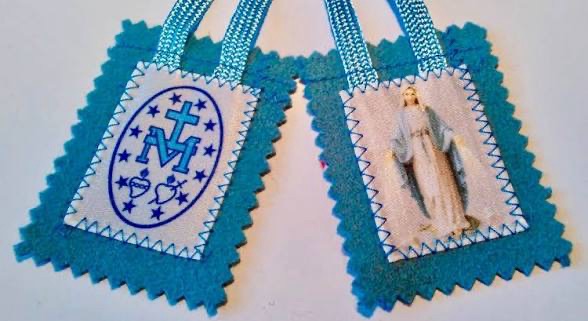
Rules governing the wearing of the Scapular of the Immaculate Conception in ages past specifically identified blue cloth as the necessary material. Historical accounts further note that one panel typically featured an image depicting the Immaculate Conception, while the other displayed Mary’ name. Contemporary instructions from Marian authorities describe the scapular as two pieces of blue cloth, one with an image of Mary, under the title of the Immaculate Conception. The Marian Fathers specifically connect the two panels with red cords, though red cords are not necessary or required universally.
⸻
What Does the Blue Scapular Symbolize?
The Grace of God
Mary’ devotion and her Immaculate Conception is primarily an act of divine grace. The scapular reminds the wearer that holiness begins not with our own efforts, but with God. Mary was granted a grace beyond what we know. When we wear the scapular we do not think that we share in her unique privilege. We look to her as a model of what God’s saving grace can do in a life.
⸻
Purity of Heart
Purity in this devotion should not be reduced only to sexual behavior.
It includes:
- Integrity of intention
- Freedom from deliberate sin
- Fidelity to one’s vocation
- Honesty before God
- Chastity according to one’s state in life
- A heart undivided in its desire to love God
Current Marian teaching states that individuals who have been formally invested in the scapular are invited to live chastely in accordance with their state in life and to strive to remain in God’s grace with Mary Immaculate as their example.
Chastity for the married person implies faithful and properly ordered married love. For the single person it means proper living of sexuality according to that state. For clergy and religious, chastity assumes the form which conforms to their promises or vows.
The scapular does not indicate that each person is to imitate the external station of life of a cloistered Religious Sister. It does call each wearer to holiness in the vocation granted to them.
⸻
Conversion
Prayer for the conversion of sinners has been part of the devotion since its earliest recorded history. By “conversion” we don’t mean changing from one religious bumper sticker to another. We mean turning from sin and turning to God. The person who wears the scapular is asked to pray not just for the conversion of others, but also for his or her own conversion on a continual basis. That’s an important distinction. If a devotion is only about getting everyone else to change, it can quickly become self-righteous. Let a scapular touching your body first ask you: Where do I need to be converted?
⸻
Marian Entrustment
The Blue Scapular expresses confidence in Mary’s maternal intercession.
The wearer asks Mary to help preserve and strengthen the life of grace, to intercede for sinners, and to lead people toward her Son.
Mary is the model, not the destination.
Her Immaculate Conception points toward the saving work of Christ, through whose merits she received every grace associated with her unique vocation.
⸻
Dedication to God
The current Confraternity of the Immaculate Conception describes the scapular as an outward declaration that the wearer wishes to dedicate his or her life to God as Mary did.
That does not mean the wearer makes religious vows merely by receiving the scapular.
It means that the physical garment represents an interior intention:
I wish to belong more completely to God.
⸻
Papal Authorization and the Growth of the Devotion
The Blue Scapular did not become a universal devotion immediately after Ursula’s death.
Its spread occurred gradually.
On January 30, 1671, Pope Clement X issued a brief granting the faculty to bless and invest the faithful with the scapular. Pope Clement XI later granted indulgences connected with the devotion, and subsequent popes expanded them. Historical summaries of those indulgences received further approval during the nineteenth century.
In 1894, a Confraternity of the Immaculate Conception was canonically erected at the Theatine Basilica of Sant’Andrea della Valle in Rome and was later raised to the status of an archconfraternity. Its statutes connected admission with blessing, investiture, and registration.
This history established the Blue Scapular as more than an isolated private devotion.
It became associated with recognized forms of ecclesial membership and authorized rites.
⸻
The Theatine Origin
The Blue Scapular’s original institutional home belongs to the Theatine spiritual family.
Ursula’s communities were founded in honor of the Immaculate Conception and were later placed under Theatine direction. The relationship continues through the Theatine Sisters and through the authority historically exercised by the Theatine superiors over blessing, investiture, and affiliation with the scapular devotion.
This means the Blue Scapular did not originally arise from the Marian Fathers.
The Marian Fathers became major later promoters of the devotion.
That distinction should be preserved.
⸻
The Marian Fathers and the Blue Scapular
The Congregation of Marian Fathers of the Immaculate Conception was founded in the seventeenth century by St. Stanislaus Papczyński.
Devotion to Mary’s Immaculate Conception and prayer for deceased souls became central parts of the congregation’s spirituality.
The Marian Fathers developed confraternities of the Immaculate Conception as a way for laypeople to participate in that mission. Their earliest constitutions already encouraged the establishment of such associations.
In 1733, Venerable Casimir Wyszyński approached the Theatine Fathers in Rome and received permission to bless and invest people with the Blue Scapular. Historical Marian records mention the formal establishment of a confraternity at Puszcza Mariańska in Poland in 1734.
The privilege was renewed several times.
The Theatines granted another authorization to the Marian congregation in 1911. In 1992, the Marian superior general obtained perpetual permission for himself and his successors to bless and confer the scapular. That permission was reaffirmed in 2005 and 2008.
The Blue Scapular therefore now belongs simultaneously to two connected histories:
- Its origin in Ursula Benincasa’s Theatine tradition
- Its extensive promotion and present-day confraternity life through the Marian Fathers
⸻
The Marian Confraternity of the Immaculate Conception
The current Marian Confraternity is a private association of the faithful whose members participate in the spirituality and apostolic mission of the Marian Fathers.
Its members seek to:
- Honor the Immaculate Conception
- Grow in Christian perfection according to their state of life
- Pray for deceased souls
- Promote devotion to Mary
- Practice prayer and works of mercy
- Live in the state of grace
- Wear the Blue Scapular as an outward sign of this commitment
The Marian form of the confraternity has a particularly strong emphasis upon prayer for souls in purgatory.
That emphasis comes from the charism of the Marian Fathers.
It should not be confused with the original purpose of Ursula Benincasa’s scapular, which centered especially upon the Immaculate Conception and the conversion of sinners.
Both belong legitimately to the devotion’s history, but they entered through different spiritual families.
⸻
Blessing, Investiture, and Enrollment
These terms should again be distinguished.
Wearing the Scapular
A person may wear a Blue Scapular as an expression of devotion to the Immaculate Conception without formally joining the Marian Confraternity.
The current Marian FAQ distinguishes simple wearing, formal investiture, and full enrollment.
Investiture
Investiture is the formal conferral of the scapular through an authorized rite.
Because the Blue Scapular historically belongs to a particular confraternity and spiritual family, faculties and delegation matter. Under the current Marian structure, a Marian priest or deacon—or another priest or deacon who has received the necessary authorization—may conduct the investiture.
Enrollment in the Confraternity
Formal confraternity membership includes:
- Application or admission
- Investiture
- Registration
- Acceptance of the confraternity’s obligations and spirituality
The rite is ordinarily conducted by a Marian priest or deacon. In circumstances involving distance, another priest or deacon may receive authorization from the Marian superior general to confer the scapular after the candidate has been accepted.
A person should not assume that purchasing and wearing the cloth automatically enrolls them in a confraternity.
⸻
What Commitments Are Traditionally Associated with It?
Current Marian guidance says that those invested with the Blue Scapular should desire to:
- Wear the scapular faithfully
- Live chastely according to their state in life
- Cultivate devotion to Mary in the mystery of her Immaculate Conception
- Pray for the conversion of sinners
- Pray for God’s mercy upon the world
Formal members of the Marian Confraternity accept additional practices, which may include:
- Regular prayer
- Frequent participation in the Eucharist
- Meditation upon the Rosary
- Prayer for deceased souls
- The Salve Regina
- The Chaplet of the Ten Evangelical Virtues of Mary or the Divine Mercy Chaplet
- Works of mercy and voluntary acts of self-denial
These additional confraternity obligations should not be imposed automatically upon every person who simply wears a Blue Scapular.
The object, investiture, and particular confraternity membership are related but distinct.
⸻
The Graces Associated with the Blue Scapular
Historical accounts say that Ursula asked Christ to extend the graces promised to her religious community to laypeople who would wear the small scapular devoutly and pray for sinners.
The language of “graces” should be understood in accordance with the Church’s teaching about sacramentals.
Sacramentals do not confer grace in the same manner as the sacraments. Through the prayer of the Church, they prepare believers to receive grace and help dispose them to cooperate with it.
The Blue Scapular may therefore support:
- Growth in devotion
- Greater resistance to sin
- Purity of intention
- Perseverance in prayer
- Marian intercession
- Concern for sinners
- Love for the deceased
- Greater cooperation with God’s grace
It does not operate independently of the wearer’s faith and conversion.
⸻
Does It Guarantee the Conversion of Another Person?
No.
The wearer may pray intensely for another person’s conversion.
Mary may be invoked as an intercessor.
God may offer abundant grace.
But a scapular is not a mechanism for overriding another person’s freedom.
The historical devotion speaks of prayer for conversion, not control over conversion.
It should never be presented as:
Place this on someone, and that person is guaranteed to become Catholic.
Such claims turn prayer into a formula and a human person into an object of spiritual coercion.
The more responsible understanding is:
The wearer commits to pray for sinners, trust God’s mercy, and bear witness through his or her own conversion.
⸻
Indulgences
Members of the current Marian Confraternity may obtain plenary indulgences on specified feast days and on the day of their admission, provided they fulfill the ordinary conditions established by the Church. These include sacramental confession, reception of the Eucharist, prayer for the pope’s intentions, and freedom from attachment to sin.
The indulgence is not contained inside the cloth.
It is not earned simply by wearing the scapular.
It belongs to the prayer and authority of the Church and requires the dispositions and actions established for receiving it.
⸻
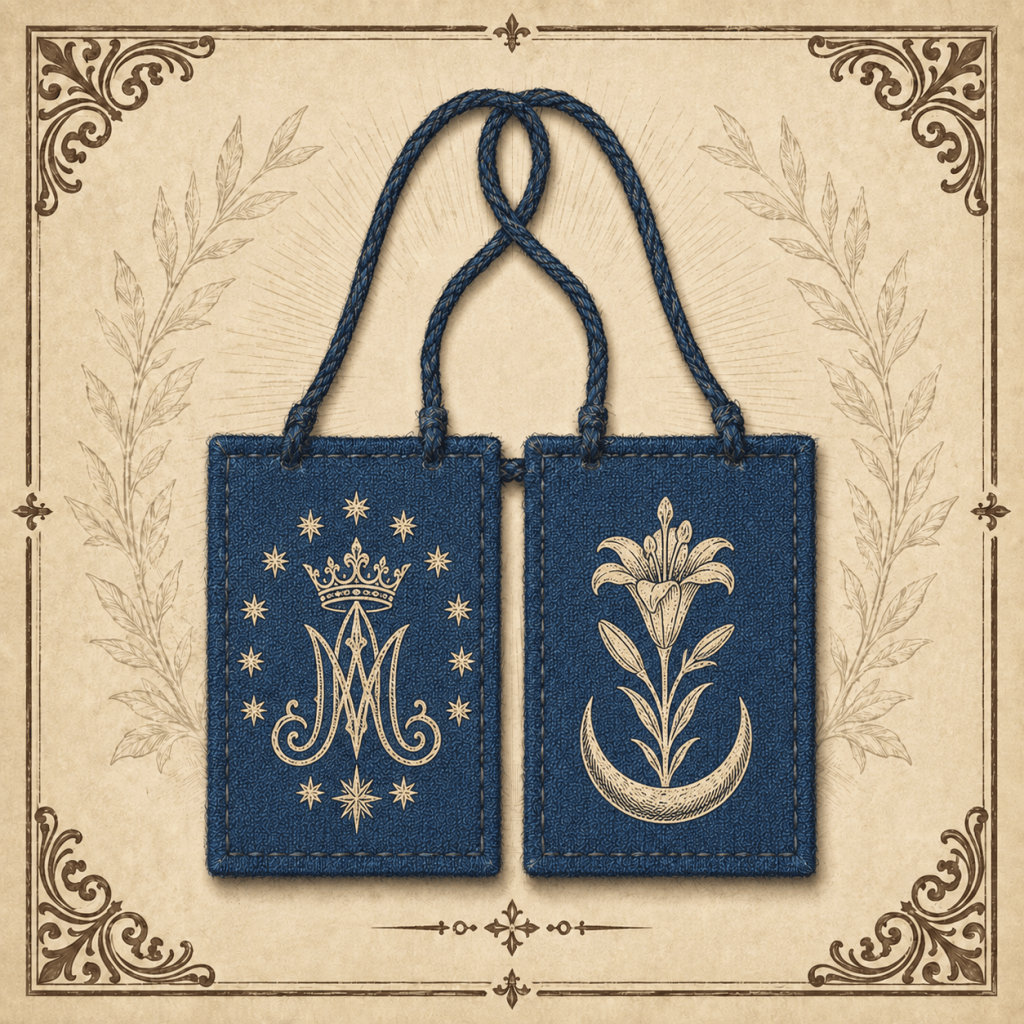
What Does the Traditional Blue Scapular Look Like?
The essential traditional form is simple:
- Two pieces of blue cloth
- Joined by cords or ribbons
- One panel worn in front
- One worn behind
Historical examples commonly include:
Front Panel
An image of Mary as the Immaculate Conception.
She may be shown:
- Standing upon a crescent moon
- Surrounded by stars
- Crushing or standing above the serpent
- Clothed in white and blue
- With hands folded in prayer
Back Panel
The name of Mary, a Marian monogram, or another symbol related to the devotion.
Older historical regulations emphasized the blue cloth itself rather than requiring one standardized piece of artwork.
The image supports the meaning.
The cloth remains the scapular.
⸻
Must the Cords Be Red?
No.
The Marian Fathers commonly use red cords to connect the two blue panels.
Current Marian guidance explicitly says that the red ribbons are customary within their tradition but are not a universal requirement.
The red may create a visual association with Christ’s love, sacrifice, or mercy, but it does not determine whether the scapular is authentic.
The defining color is the blue cloth.
⸻
Common Misunderstandings
“The Immaculate Conception means Jesus was conceived without sex.”
It does not.
It refers to Mary being preserved from original sin from the first moment of her own conception.
“Mary did not need Jesus to save her.”
Catholic teaching says Mary was saved by Christ in a unique and preventative manner through the merits of his saving work.
“The Blue Scapular guarantees conversion.”
It does not.
It is associated with prayer for conversion, not control over another person’s will.
“The Marian Fathers created it.”
They did not.
The devotion originated with Venerable Ursula Benincasa and the Theatine tradition. The Marian Fathers became important later promoters.
“Anyone wearing one is automatically a confraternity member.”
No.
Formal enrollment requires admission, investiture, and registration.
“Every Blue Scapular wearer has the Marian Confraternity’s full list of obligations.”
No.
Those obligations belong specifically to members of that association.
“Blue has one universal Catholic meaning.”
It does not.
In this devotion, the color comes particularly from Ursula’s vision and its connection with the Immaculate Conception.
“The vision is Catholic dogma.”
It is not.
The Immaculate Conception is dogma.
Ursula’s reported vision is private revelation and devotional tradition.
“The cloth itself dispenses grace.”
Sacramentals prepare and dispose the faithful to receive and cooperate with grace through the prayer of the Church. They do not function mechanically.
⸻
The Blue Scapular Today
The devotion remains active.
The Theatine Sisters continue the religious family founded by Ursula Benincasa, and the Theatine Order remains the historical source of the scapular’s ecclesial tradition.
The Marian Fathers continue to promote the Blue Scapular internationally through the Confraternity of the Immaculate Conception. They provide formation materials, formal statutes, investiture procedures, and spiritual practices for members and for those who wish to receive the scapular without joining the confraternity.
The devotion therefore remains more than an historical artifact.
But its living practice must still be presented accurately.
The Blue Scapular is not simply a blue version of the Brown Scapular.
It has its own founder, history, ecclesial relationships, spiritual emphasis, and expectations.
⸻
A Student’s Reflection
Before researching the Blue Scapular, I assumed its meaning would be relatively simple.
Blue is associated with Mary.
The scapular honors Mary.
That must be the entire explanation.
What I discovered was a devotion shaped by several layers of history.
It began with a contemplative woman in Naples.
It became connected with the Theatine family.
It received papal authorization.
It later entered deeply into the spirituality and apostolic work of the Marian Fathers.
It developed confraternities with their own obligations, prayers, and concern for deceased souls.
And beneath all of those historical layers is the mystery of the Immaculate Conception.
Mary’s purity is not presented as something she achieved by personal discipline alone.
It is grace.
That may be the most important meaning carried by the blue cloth.
The scapular calls the wearer to avoid sin and pursue holiness, but it does not suggest that holiness is self-created.
It begins with God’s initiative.
The wearer responds.
The devotion therefore holds together two truths:
Grace is God’s gift.
and:
Grace asks for our cooperation.
The Blue Scapular does not promise that I can control another person’s conversion.
It asks me to pray for conversion—including my own.
It does not allow me to claim Mary’s purity while refusing to confront the disorder within my own life.
It gives me a small piece of cloth that quietly asks:
If I honor the grace given to Mary, am I willing to live faithfully with the grace God has given me?
That question feels much more challenging than simply wearing blue.
It also feels much more meaningful.
⸻
Primary and Historical Sources
Joseph Hilgers, “Scapular,” The Catholic Encyclopedia, for the historical development, papal authorization, and nineteenth-century confraternity.
Catechism of the Catholic Church, paragraphs 490–493, on the Immaculate Conception and Mary’s redemption through Christ.
Pope Pius IX, Ineffabilis Deus, December 8, 1854.
Catechism of the Catholic Church, paragraphs 1667–1670, on sacramentals and cooperation with grace.
Pope Francis, Address to the Theatine Sisters of the Immaculate Conception, June 16, 2018.
Theatine Order resources on Ursula Benincasa and the Theatine Sisters of the Immaculate Conception.
Marian Fathers of the Immaculate Conception, history and spirituality of the Blue Scapular and the Confraternity of the Immaculate Conception.
National Shrine of The Divine Mercy, current confraternity statutes, obligations, investiture guidance, and frequently asked questions.

 The Living Rosary Archives