Catholic Guide to the Hail Mary Prayer
Part 1
See additional articles Part 2, Part 3, and Part 4
Among Catholic prayers there are few as instantly recognizable as the Hail Mary.
Recited countless times on the Rosary, prayed during personal devotions, and known in prayer books around Christendom, the Hail Mary holds a special place in Catholic prayer.
But unlike many traditional Catholic prayers which were penned at one point in history by a single individual, the Hail Mary grew over time.
Its origins are rooted in Sacred Scripture, early Christian doctrine, liturgical prayer, and private devotion.
Because of this, the Hail Mary is both ancient and remarkably modern.
The earliest portions of the prayer date back to the Gospel of Luke in the first century, while other aspects of the prayer would not take their definitive form until the late Middle Ages and sixteenth century liturgical reforms.
Catholic prayers often develop this way.
Scripture provides the words, Catholic doctrine adds precision, and private devotion adds a prayer that continues to echo through the centuries.
The Biblical Foundation
The first half of the Hail Mary is sourced nearly entirely from Scripture.
Even the opening greeting comes from another: the Archangel Gabriel at the Annunciation:
“Hail, full of grace, the Lord is with thee.”
— Luke 1:28
In this moment Gabriel announced to Mary that she had been chosen to bear the Son of God into the world.
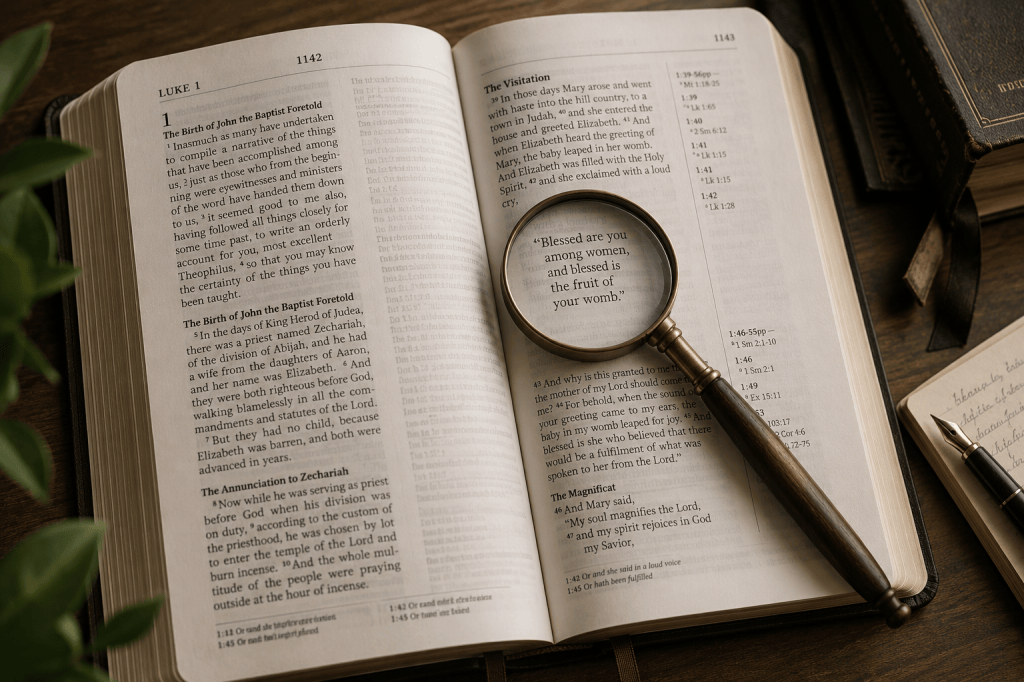
The second half comes from Elizabeth at the Visitation:
“Blessed art thou among women, and blessed is the fruit of thy womb.”
— Luke 1:42
In Elizabeth’s prayerful words we see recognition of both Mary’s singular role in salvation history and the child that she carried.
These two Scriptural greetings would provide the foundation of the prayer for centuries.
Long before they were combined into a standardized format, Christians would meditate on them, preach about them, and incorporate them into their worship.
The History of a Prayer Built from Scripture
Perhaps the most unique aspect of the Hail Mary is that the opening segment consists entirely of words spoken by others to Mary.
Gabriel speaks.
Elizabeth speaks.
When the Christian prays the Hail Mary he joins their voices in praise of Mary.
In this way, the first half of the prayer acts as a proclamation.
Together these scriptural quotes recall the events that took place during the Incarnation and affirm Mary’s singular role in God’s plan.
This scriptural foundation is why the Hail Mary enjoys a unique role among Catholic prayers.
It may not be Scripture from cover to cover, but its most recognizable lines are taken directly from the Gospel narrative.
Full of Grace… What does that Mean?
Christians have historically placed a lot of emphasis on the phrase “full of grace.”
Catholic theology interprets Gabriel’s greeting as indicating a special divine favor granted to Mary.
Traditionally, the Church has understood this greeting to point towards God’s preparatory work in Mary’s life in order to fulfill her calling as the Mother of Christ.
The greeting is both a compliment and a theological statement.
The focus is not Mary’s accomplishments, but on what God has done in her life.
This understanding would lay the groundwork for centuries of Catholic reflection on Mary and her holiness.
The Name of Jesus
In its earliest forms, the prayer would frequently end Elizabeth’s blessing with the line:
“Blessed is the fruit of thy womb.”
Over time Jesus’ name became appended to the conclusion of the line.
This small change served a large purpose.
It drove home the point that Jesus is the ultimate focus of the prayer.
The Hail Mary is Marian prayer, but the true culmination of the first half isn’t found in Mary, but in Jesus:
“Blessed is the fruit of thy womb, Jesus.”
Rather than being solely about Mary, the center of the prayer is Christological.
Mary is important because of who she bears.
History of the Petition
The second half of the prayer developed gradually through the prayers of ordinary Christians.
Today we pray:
Holy Mary, Mother of God, pray for us sinners, now and at the hour of our death.
Unlike the greeting, none of these words come from Scripture.
Rather they develop out of centuries of theology and devotion.
The title “Mother of God” is rooted in one of Christianity’s earliest doctrinal formulations.
In the year 431 AD, Christians at the Council of Ephesus affirmed the use of the title Theotokos, which means “God bearer” or more directly translated “Mother of God.”
The primary purpose of the council was not to elevate Mary, but to defend the full divinity of Christ against teachings that threatened to separate his divine and human natures.
If Jesus is both fully God and fully man, then Mary can rightly be called the Mother of God, because he whom she bore was truly God from the moment of his conception.
This title would find its way into the prayer.
Why Do Catholics Ask Mary to Pray for Us?
The petition:
pray for us sinners
summarizes a truth known by all Christians.
Death does not end our communion with God and his people.
Just as we pray for others on earth, we can ask the saints in heaven to pray for us before the throne of God.
So when Catholics pray the Hail Mary they aren’t worshiping Mary.
They are asking her to do what any friend would:
pray to God on their behalf.
The distinction has been made often by Catholic theologians and Church leaders.
Now and at the Hour of our Death…
Lastly we come to one of the most powerful lines in the prayer:
now and at the hour of our death.
The line contains two truths.
First, it is an admission that we need God’s grace in our daily lives.
Second, it acknowledges the Christian hope that we will be steadfast in our faith at the moment of death.
Christians throughout history have recognized death as a spiritual milestone.
We pray that Mary will intercede on our behalf throughout life, but we also pray that she will help us in those final moments as we pass from this life into the next.
This line would grow out of late medieval piety.
History of the Rosary & the Hail Mary
Within the context of Catholic devotion, the Hail Mary became the centerpiece prayer of the Rosary.
Its use as a prayer is directly tied to the rise of the Marian Psalter.
For centuries Christians throughout Europe would recite 150 Hail Mary prayers as a devotion parallel to the 150 Psalms in Scripture.
When Christians began attaching meditation on Christ’s life to decades of Hail Marys, the Rosary slowly began to develop.
Because of this, more than any prayer on the Rosary, the Hail Mary defines its history.
The Rosary did not adopt the prayer.
Rather, the Rosary was built around it.
For centuries, Catholics contemplated the mystery of Christ’s life, death, and resurrection on the cadence of the Hail Mary.
Popes on the Hail Mary
Throughout history various popes have affirmed the centrality of the Hail Mary by emphasizing the centrality of the Rosary in Catholic life.
Pope Leo XIII, the “Rosary Pope,” encouraged Catholics to pray the Rosary regularly and meditate on the Mysteries of Christ.
Pope Paul VI taught that the Rosary is a Gospel prayer whose structure of repeating the Hail Mary guides us into contemplation.
St. John Paul II called the Rosary a compendium of the Gospel.
Each referred to the importance of the Hail Mary prayer itself.
While each described the Rosary differently, they consistently reminded Catholics that the Rosary was meant to draw them deeper into meditation on Christ’s life.
The Hail Mary Will Continue…Doing What?
When Catholics pray the Hail Mary they are doing several things at once.
They are recalling Scripture.
Gabriel and Elizabeth’s words are repeated.
They are affirming Catholic doctrine.
The title Mother of God echoes throughout the prayer.
They are asking for Mary’s intercession.
But most importantly they are proclaiming their hope in Christ.
When Catholics pray the Hail Mary they pray it to Jesus.
The entirety of the prayer points towards him.
It concludes with his name and looks forward to both daily and eternal grace.
For that reason the Hail Mary is much more than a greeting, much more than a petition, and much more than a prayer about Mary.
When prayed with devotion, it joins Scripture, Catholic teaching, and private prayer into one concise act of faith.
Conclusion
Few prayers demonstrate the development of Catholic prayer better than the Hail Mary.
Parts of it were uttered in the first century.
Other parts would not take their final form for another fifteen centuries.
The entire prayer would come to be preserved through both private and public Catholic prayer.
When Catholics pray the Hail Mary they join with Christians from across two millennia.
From the lips of saints to the prayer books in Catholic churches today, few prayers weave together so much of Catholic history in so few words.
Timeline of Historical Developments
1st Century
• Gabriel greets Mary (Luke 1:28).
• Elizabeth blesses Mary (Luke 1:42).
431
• Council of Ephesus upholds title of Mother of God for Mary.
11th Century
• Biblical greetings begin to be prayed together.
13th Century
• “Jesus” is appended to the conclusion of the prayer.
14th–15th Centuries
• Prayers for Mary’s intercession added.
1568
• Standardization of prayer in the Roman Breviary by Pope Pius V.
19th–20th Centuries
• Popes reaffirm teaching on the Rosary.
Present Day
• Second most popular Christian prayer in the world.

 The Living Rosary Archives