The Invitations of Mary Series
©MS 2026
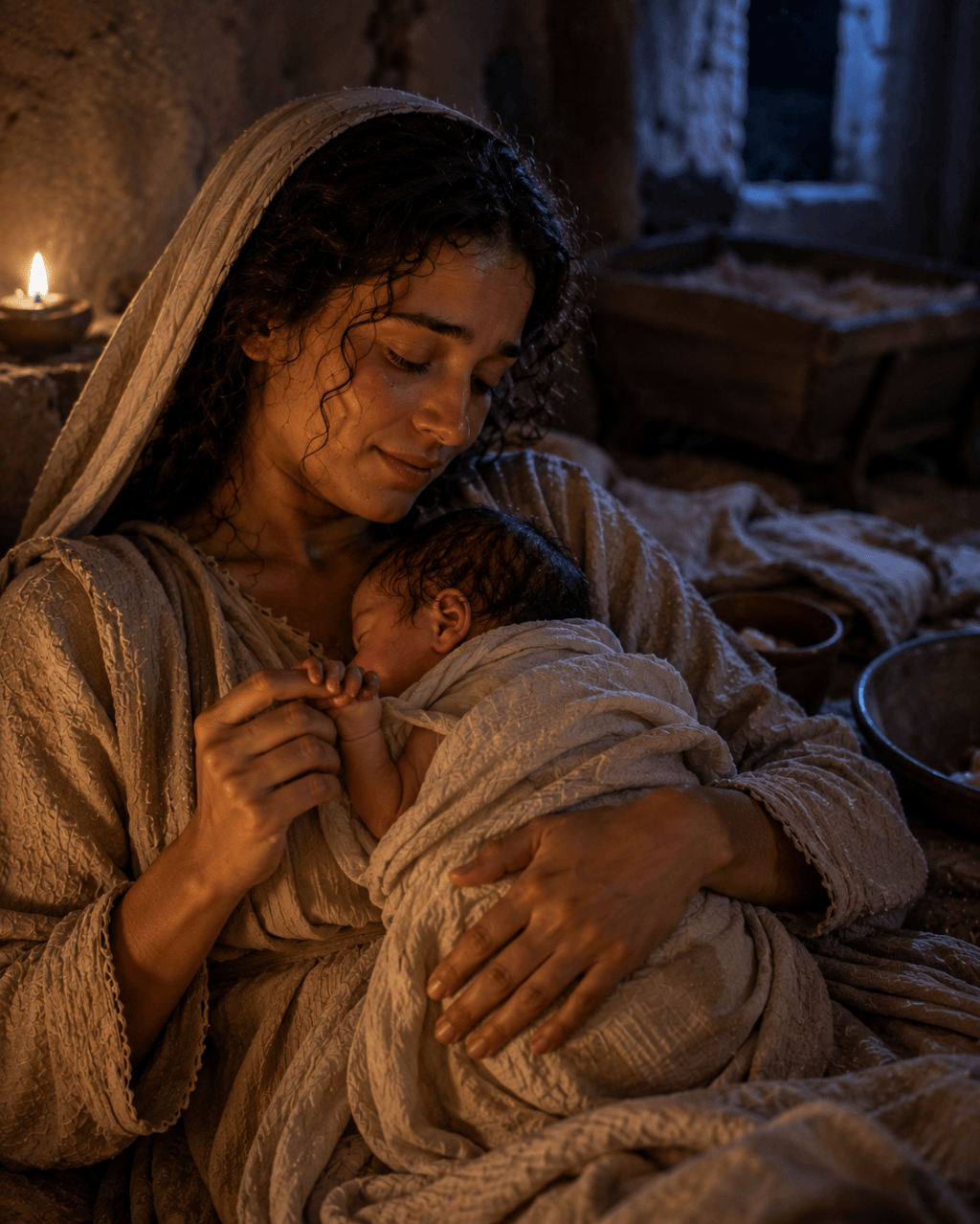
Eventually, the shepherds went home. Joseph stepped away. The voices faded. And for the first time, perhaps Mary could look at Jesus and think: You are really here.
Eventually, everyone left.
That part doesn’t make it into the Nativity scene.
The shepherds remain forever arranged around the manger.
Joseph remains nearby.
Animals stand patiently in the background.
Angels hover somewhere above.
Everyone gazes toward Jesus as though the night froze at the precise moment the world discovered him.
But real nights continue.
People eventually go home.
Oil lamps burn lower.
Conversations end.
Someone yawns.
Someone remembers how far they have to walk.
The shepherds, Luke tells us, eventually returned to their fields, glorifying and praising God for everything they had heard and seen.
And after they left—
there must have been quiet.
Maybe extraordinary quiet.
The kind that comes after too many things have happened in too little time.
And somewhere inside that quiet was Mary.
With her baby.
She had given birth.
Already, that would have been enough for one night.
Whatever the precise physical nature of Jesus’ birth—and Christian tradition has long contemplated its miraculous character—Mary had crossed from carrying him to holding him.
Her entire relationship with Jesus had changed within hours.
For months, he had been invisible.
Known through movement.
Weight.
Pressure.
Her changing body.
Then suddenly he had a face.
A cry.
Hands.
Hair.
Breath.
And before Mary could possibly comprehend that—
strangers arrived.
Shepherds.
Excited shepherds.
Possibly slightly overwhelming shepherds.
Men who had apparently been minding their own business outside Bethlehem when the night sky erupted with angels.
They came looking for her child.
Imagine that.
Mary has perhaps only just begun learning how to hold Jesus comfortably when someone arrives saying:
“We were told about him.”
Excuse me?
By whom?
Angels.
Of course.
Apparently angels were simply how this family received information now.
Luke tells us the shepherds repeated what had been told to them about Jesus.
Everyone who heard their story was amazed.
And then Luke gives us one of the most intimate sentences we have about Mary:
“But Mary was treasuring up all these things in her heart and meditating on them.”
— Luke 2:19
She treasured them.
She pondered them.
Which suggests something important.
Mary did not necessarily understand everything immediately.
She held things.
Turned them over.
Kept them.
Perhaps she needed quiet to do that.
And maybe, eventually, she finally got some.
The shepherds left.
Their voices disappeared into the night.
Maybe whoever else had helped with the birth withdrew too.
Perhaps Joseph remained for a while.
He checked the entrance.
Adjusted the lamp.
Moved something unnecessarily.
Looked at Jesus again.
Then Mary.
“You need anything?”
Mary thought.
“No.”
Joseph waited.
“You’re sure?”
There was probably a look.
Not The Look.
A tired version.
Joseph nodded.
Maybe he understood.
“I’ll be close.”
Mary smiled.
“Thank you.”
And perhaps he stepped away.
Not far.
Just enough.
For the first time since labor began—
nobody was asking Mary anything.
Nobody was telling her anything.
Nobody was staring at her baby.
Nobody was announcing prophecies.
Nobody needed an explanation.
There was only Jesus.
Maybe Mary looked around first.
That seems human.
The room probably looked different after everyone left.
During labor, perhaps she hadn’t noticed much.
During the shepherds’ visit, there had been voices and movement.
Now she could see the aftermath.
Cloths.
Water.
Their travel things.
The manger.
An oil lamp burning low.
Joseph’s belongings somewhere nearby.
Perhaps straw scattered beneath someone’s feet.
Nothing about it looked like the birthplace of a king.
It probably just looked tired.
Like Mary.
She might have thought:
So this is where it happened.
Not Nazareth.
Not her mother’s home.
Not somewhere carefully prepared.
Here.
Bethlehem.
A place they had reached exhausted because an emperor wanted people counted.
And somehow God had chosen this.
Mary may have been too tired to decide whether that was profound or ridiculous.
Maybe both.
Then Jesus made a sound.
And everything else disappeared.
Newborns make astonishing little noises.
Snorts.
Squeaks.
Grunts.
Tiny sighs.
They stretch their faces into expressions that seem impossibly dramatic for someone who has existed outside the womb for only a few hours.
Maybe Mary hadn’t known that.
Jesus moved.
She immediately looked down.
There.
Her son.
Still there.
Perhaps she touched him simply to reassure herself.
His cheek.
His forehead.
His tiny shoulder beneath the cloth.
Warm.
Real.
Breathing.
Maybe she counted his fingers again.
She had already counted them.
That did not matter.
One.
Two.
Three.
Four.
Five.
Other hand.
One.
Two.
Three.
Four.
Five.
Ten toes too.
Good.
Perhaps she examined his ears.
The shape of his nose.
His fingernails.
Maybe she was surprised that he had fingernails.
That seems like the kind of detail nobody tells you to expect.
God has fingernails.
What an absurd sentence.
What an extraordinary one.
Maybe she smiled.
And perhaps this was the first moment when Mary could really study his face.
Who did he look like?
That’s a fascinating question in a child whose conception had not involved a human father.
Did she see herself?
A curve around the mouth?
The shape of his eyes?
Something belonging to her family?
Perhaps she searched automatically.
Babies are studied for resemblance almost immediately.
“He has your nose.”
“He has his father’s eyes.”
But what did people say about Jesus?
Maybe Mary looked at him and wondered:
Will you look like me?
Perhaps that thought mattered more than we realize.
Because biologically, she was his human inheritance.
His flesh had grown from hers.
His body had been formed within hers.
Whatever mysteries surround the Incarnation, Jesus’ humanity was not abstract.
He received it through Mary.
Maybe she touched his tiny nose.
“My nose?”
Jesus did not offer an opinion.
Then perhaps something even stranger occurred.
Jesus opened his eyes.
Newborn vision is limited.
He would not have looked at Mary with the focused recognition of an older infant.
But perhaps his eyes opened.
Dark.
Uncertain.
Blinking against the low light.
And Mary stopped breathing for a second.
Because Gabriel had said:
Son of the Most High.
The shepherds had said:
Savior. Messiah. Lord.
And this child could barely see her.
Maybe that’s when the enormity became almost unbearable.
“You’re him.”
Perhaps she whispered it.
Not because Jesus needed informing.
Because Mary did.
“You’re really him.”
The child moved.
Maybe his mouth searched instinctively.
His head turned toward her.
And theology immediately surrendered to biology.
“Oh.”
Mary adjusted him.
Because the Savior of the world was hungry.
I love that thought.
Angels could fill the sky announcing:
Glory to God in the highest heaven, and peace on earth—
Meanwhile Jesus:
I would like milk.
Now.
Mary perhaps laughed quietly.
“Of course.”
And she fed him.
There may be no more startling image of the Incarnation.
The one through whom Christians believe all creation came into being—
unable to feed himself.
God choosing dependence.
Not pretending at it.
Not merely appearing small.
Actually small.
Actually hungry.
Actually requiring another human being’s body to sustain him.
And Mary provided what he needed.
Again.
As she had for nine months.
Maybe feeding hurt.
That’s another thing our sacred images rarely acknowledge.
Breastfeeding may be natural, but natural does not mean immediately effortless.
Mary was a first-time mother.
Jesus was a first-time baby.
Neither had done this before.
Perhaps he struggled to latch.
Perhaps Mary adjusted him.
Again.
Again.
“Come on.”
Maybe someone had shown her what to do.
Maybe instinct helped.
Maybe it took time.
Eventually—
there.
Jesus settled.
Mary exhaled.
Perhaps she looked down at him with an expression halfway between love and disbelief.
“That’s what you wanted?”
Apparently.
And then maybe Mary became thirsty.
Of course.
She looked toward the water.
Too far.
For a moment she considered calling Joseph.
Then remembered Article 18 and her lifelong insistence that she could do everything herself.
Maybe she looked at the sleeping—or eating—Jesus.
Looked at the water.
Looked back at Jesus.
Absolutely not moving.
“Joseph?”
Immediately from somewhere nearby:
“Yes?”
“Could you bring me water?”
Silence.
Mary narrowed her eyes.
He had better not be smiling.
Joseph appeared with the cup.
He was absolutely smiling.
“Don’t.”
“I didn’t say anything.”
“You’re thinking it.”
“I brought water.”
Mary took it.
“Thank you.”
Joseph kissed her forehead.
Then perhaps disappeared again.
Victory without celebration.
He had learned.
After Jesus finished eating, maybe he slept.
Not in the manger yet.
On her.
Mary leaned back.
Jesus curled against her chest.
His ear rested near her heart.
And perhaps something occurred to her.
He knows that sound.
Her heartbeat.
For his entire existence, it had surrounded him.
Before he heard Joseph’s voice clearly.
Before shepherds.
Before angels were announced to him by anyone.
Before the sounds of Bethlehem.
There had been Mary’s heart.
Constant.
Day and night.
Fast when she climbed a hill.
Slow when she slept.
Racing when Gabriel appeared.
Pounding when she saw Joseph after he knew.
Steady during quiet evenings.
Faster during the journey.
Whatever it had done during birth.
Jesus knew that rhythm.
Maybe that was why he settled there.
Home.
Perhaps Mary put her cheek against his hair.
Newborn smell.
Warm skin.
Milk.
Cloth.
Something entirely his own.
She breathed him in.
Maybe that’s when she cried.
Not dramatically.
Not from sorrow.
Just tears sliding quietly because there was finally enough silence for everything she had been holding back to arrive.
Gabriel.
Joseph.
Elizabeth.
The months of pregnancy.
The fear.
The journey.
The labor.
The shepherds.
Angels.
Messiah.
Lord.
Son of the Most High.
Her son.
It was too much.
Maybe Mary’s body simply released what her mind couldn’t organize.
She held Jesus tighter.
Not too tight.
Just closer.
And cried.
Did she feel happy?
Surely.
But perhaps happiness is too small a word.
Maybe she felt relief.
Wonder.
Fear.
Love.
Exhaustion.
Confusion.
Possessiveness.
Tenderness.
Responsibility.
A strange grief for the pregnancy that had just ended.
That’s something rarely discussed.
For nine months, Mary and Jesus had never been physically separate.
Then birth divided them.
Necessary.
Beautiful.
But still a separation.
Maybe she missed him inside her even while holding him.
That sounds contradictory.
Human beings are full of contradictions.
Perhaps motherhood began with one.
I am so glad you’re here.
and
I already miss the way you were mine before anyone else could reach you.
Because people had already begun reaching for him.
The shepherds came.
Others would come.
Soon Simeon would take Jesus into his arms.
Anna would speak about him.
Later, Magi would kneel.
Crowds would gather.
Disciples would follow.
People would touch him.
Demand things from him.
Love him.
Hate him.
Need him.
Eventually the whole world would claim him.
But that night?
For a little while?
Maybe Mary felt that he was simply hers.
Not selfishly.
Not permanently.
Just:
My baby.
She had earned the right to think it.
Perhaps she whispered things to him that nobody ever recorded.
Not prayers.
Not prophecy.
Mother nonsense.
“Hello.”
“You have very small ears.”
“Your hair is ridiculous.”
“You made me very sick.”
Maybe Jesus twitched.
“Yes, you did.”
“You kicked me constantly.”
Another tiny movement.
“I knew that was you.”
Perhaps Mary smiled.
“I wondered what you looked like.”
She traced one finger across his cheek.
“Now I know.”
Then perhaps she said something more serious.
“I don’t know how to do this.”
That might have been the most honest prayer of the night.
Gabriel had told her what Jesus would become.
Nobody had told her how to raise him.
How do you discipline the Messiah?
How do you teach the Son of God to walk?
What happens when he is sick?
Would he get sick?
Would he fall?
Would he scrape his knees?
Would he have nightmares?
Would he throw food?
Would he refuse to sleep?
Would Mary sometimes get it wrong?
Gabriel had been remarkably light on practical information.
Maybe Mary looked down.
“I don’t know what I’m doing.”
Jesus slept.
Apparently he wasn’t concerned.
And perhaps Mary remembered her own mother.
Whoever she was historically—the canonical Gospels never name Mary’s parents, though later tradition gives us Joachim and Anne.
Maybe Mary suddenly understood her differently.
Every mother had once held her baby like this.
Perhaps she remembered being cared for.
Songs.
Hands.
Stories.
Ways of wrapping cloth.
Little pieces of knowledge passed woman to woman without ever being written down.
Maybe she realized:
Someone once looked at me like this.
That’s an extraordinary transition.
To become the mother and suddenly understand the woman who mothered you.
Maybe she prayed.
Not because she felt she should.
Because there was nowhere else for all of it to go.
But perhaps the prayer was strange now.
She had spent her life praying to God.
Now she was holding—
what?
The mystery Christians would spend centuries articulating carefully:
Fully God.
Fully human.
Not half of either.
Her son.
Could Mary comprehend that theology that night?
Probably not in the formulations later councils would give us.
Maybe she didn’t need to.
Perhaps she simply said:
“Thank you.”
Then laughed softly because she wasn’t entirely certain whether she was saying it to God—
or to the baby lying against her.
Maybe somehow it was both.
Jesus stirred.
Mary froze.
Please don’t wake up.
There are prayers theologians write.
And there are prayers every exhausted new parent has prayed since the beginning of humanity:
Please stay asleep.
Jesus squirmed.
Mary didn’t move.
He made one tiny sound.
Settled.
Mary exhaled.
Perhaps she looked upward.
“Thank you.”
This miracle required no angelic confirmation.
And what about the future?
Did it intrude?
Maybe.
The shepherds had said Savior.
Gabriel had said kingdom.
Mary knew this child had a purpose beyond her.
But perhaps she deliberately refused to think about it.
Not tonight.
There would be time.
Tonight Jesus didn’t need to save Israel.
He needed sleep.
Mary didn’t need to understand God’s plan.
She needed rest.
The future could wait outside.
Maybe that itself was wisdom.
We sometimes try to live every future sorrow before it arrives.
Mary would have enough sorrow later.
Simeon’s sword.
Losing twelve-year-old Jesus in Jerusalem.
Watching him leave Nazareth.
Hearing rumors about opposition.
Following him toward Jerusalem.
The Cross.
But none of that had happened yet.
Tonight—
he was safe.
She was safe.
Joseph was nearby.
Let tonight be tonight.
Maybe the lamp flickered.
Mary looked toward it.
The room had become very quiet.
Outside, Bethlehem continued being Bethlehem.
Somewhere people slept.
Someone argued.
Someone tended an animal.
Someone’s baby cried.
Someone complained about the census.
Nobody knew history had divided itself into before and after only a short distance away.
Mary looked down.
Jesus’ fist rested against her clothing.
Tiny fingers slowly loosened in sleep.
She touched one.
It curled around hers.
There it was again.
That impossibly small grip.
Perhaps Mary smiled.
Closed mouth.
Tired.
Private.
No one there to see it.
This is the Mary I wish we could sit beside for a moment.
Not Queen of Heaven yet.
Not Our Lady of anything.
No crown.
No stars.
No blue mantle arranged perfectly around her.
Just Miriam.
Young.
Exhausted.
Hair falling loose.
Body recovering from birth.
Milk on her clothing perhaps.
A sleeping baby against her chest.
Wondering how something so small could possibly contain everything the angels had promised.
Maybe that’s what Luke means when he says she treasured these things.
Not that Mary immediately solved them.
She kept them.
Some mysteries aren’t meant to be solved the night they arrive.
Sometimes you simply hold them.
Literally, in Mary’s case.
Eventually Joseph may have returned.
He found Mary asleep.
Or almost asleep.
Jesus still on her chest.
Perhaps Joseph stood there for a while without waking her.
Maybe he gently pulled another covering over them.
Mary stirred.
“I’m awake.”
“No, you’re not.”
“I am.”
Joseph smiled.
“Go to sleep.”
Mary looked down at Jesus.
“I should put him in the manger.”
“I can.”
Mary hesitated.
There it was again.
The instinct:
No.
Not because Joseph couldn’t.
Because handing Jesus over still felt strange.
Perhaps Joseph understood.
He waited.
Eventually Mary nodded.
Very carefully, Joseph lifted Jesus from her.
Mary’s arms felt suddenly empty.
She watched every movement.
“Support his head.”
“I am.”
“Joseph.”
“I have his head.”
“Be careful.”
“I am being careful.”
The man who had probably worked around heavy timber, stone, sharp tools, and construction his entire adult life was apparently not qualified to transport a seven-pound human approximately three feet.
Mary watched anyway.
Joseph placed Jesus down.
Adjusted the cloth.
Turned.
Mary was still watching.
“He’s fine.”
“I know.”
She did not sound convinced.
Maybe Joseph came back and sat beside her.
Mary leaned against him.
For the first time all night, her arms were empty.
Joseph took her hand.
No words.
They looked toward the manger.
Jesus slept.
Maybe Mary whispered:
“Joseph?”
“Yes?”
“That’s our son.”
Joseph was quiet for a moment.
Then:
“I know.”
Perhaps his voice broke.
Mary squeezed his hand.
And there they sat.
Two completely unqualified first-time parents staring at the Savior of the world sleeping in a feeding trough.
No angels.
No shepherds.
No theology.
Just the absurd, terrifying reality:
We have a baby now.
But before Joseph came back—
I like imagining Mary had those few minutes.
Alone.
Because soon Jesus would belong, in some mysterious way, to everyone.
His life would be public.
His words would be repeated.
His body would be touched by crowds.
His death would be witnessed.
His resurrection proclaimed.
His name carried across continents Mary could never have imagined.
Millions would call her child Lord.
Millions would call her Mother.
But there was once a night when almost nobody knew.
A night when the shepherds finally disappeared down the road.
A night when Joseph stepped away.
A night when the lamp burned low.
And Mary could look at Jesus without anyone telling her what he meant.
No title necessary.
No prophecy requiring interpretation.
She didn’t have to understand him.
She only had to hold him.
Maybe she traced his tiny eyebrow.
Touched the soft hair at the back of his head.
Counted his fingers one more time.
Then drew him against her chest.
His breathing settled into the rhythm of hers.
Mary closed her eyes.
And perhaps, after everything—
the angels,
the fear,
the questions,
the journey,
the birth,
the strangers,
the impossible promises—
she finally whispered the simplest thing she could possibly say:
“Hello, my son.”
And in the quiet after Bethlehem’s first Christmas,
for just a little while,
the Mother of God didn’t need to be the Mother of God.
She could simply be
his mother.


