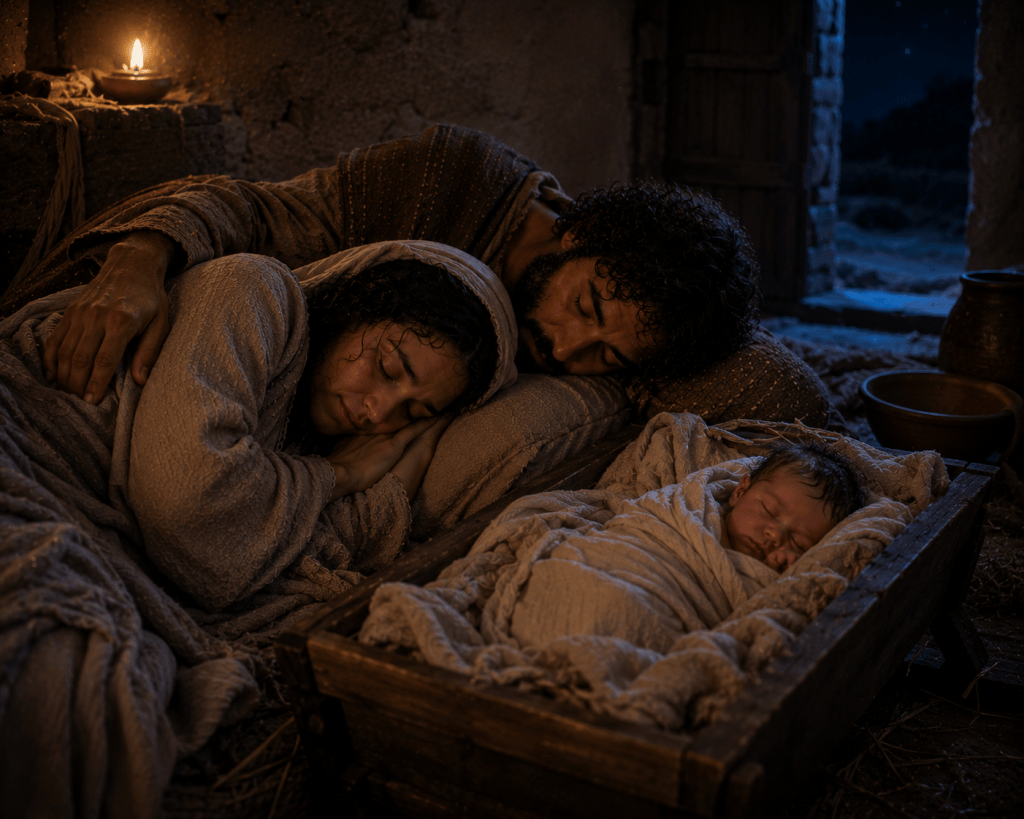
The Invitations of Mary Series
©MS 2026
Did he sleep easily? Cry loudly? Need to be held constantly?
Jesus cried.
I think we should probably begin there.
Not because Scripture tells us how often the newborn Jesus cried. It doesn’t.
Not because Catholic theology has settled whether Jesus was a particularly easy baby. It most certainly has not.
But because sometimes our images of the infant Jesus seem to suggest that he arrived already possessing the composure of a forty-year-old theologian.
He lies peacefully in Mary’s arms.
Eyes open.
One tiny hand raised suspiciously close to a blessing.
Perhaps a little light radiates from his head.
Everyone else gazes reverently.
And Jesus appears completely unbothered by the fact that he has just undergone the rather dramatic experience of being born.
Real newborns are considerably less dignified.
They cry.
They root.
They startle.
They sneeze.
They hiccup.
They make bizarre little grunting noises in their sleep.
They wake for reasons known only to themselves.
Sometimes they refuse to sleep anywhere except on another human being.
And if Christianity really means what it says when it insists that Jesus was fully human—
then perhaps Mary discovered very quickly that the Son of God was also very much a baby.
Maybe Jesus was easy.
That’s possible.
Perhaps he slept beautifully.
Mary fed him.
Wrapped him.
Held him until his body became heavy with sleep.
Then she carefully lowered him into the manger.
One hand beneath his head.
One beneath his body.
Slowly.
Slowly.
Jesus remained asleep.
Mary withdrew one hand.
Still asleep.
The other.
Still asleep.
She stared.
Success.
Maybe she took one silent step backward.
Then another.
She looked toward Joseph.
Joseph looked at her.
Neither dared breathe.
Mary finally lowered herself onto the bedding.
Closed her eyes.
And from the manger:
WAAAAAH.
Mary’s eyes opened.
Joseph looked at the ceiling.
Maybe Jesus wasn’t easy.
I like imagining Mary staring at him in disbelief.
“You were asleep.”
Jesus screamed.
“You were completely asleep.”
This information did not interest him.
Mary sat up.
Joseph moved toward the manger.
“I’ll get him.”
“No, I’ll—”
Then Mary stopped.
She was exhausted.
Joseph had already lifted him.
Progress.
Article 18 Mary would be proud.
Or horrified.
Possibly both.
Joseph held Jesus.
Jesus screamed louder.
Joseph froze.
Mary watched.
“What did you do?”
“Nothing.”
“He wasn’t crying like that before.”
“He was absolutely crying like this before.”
Jesus disagreed by finding another volume.
Joseph looked at Mary.
Mary looked at Joseph.
They had known this child for less than a day.
Already he was winning.
Maybe newborn Jesus hated being put down.
That possibility feels particularly delicious to me.
Because we spend so much theological language describing humanity’s longing for God.
Perhaps for the first weeks of his human life, God screamed whenever humanity put him down.
Mary holds him.
Peace.
Mary places him in the manger.
Outrage.
She picks him up.
Peace.
She tries again.
Outrage.
Mary stares at the tiny face tucked against her.
“You cannot possibly know what you’re doing.”
Jesus sleeps.
Suspiciously.
Maybe he wanted her constantly.
That would make biological sense.
Mary was everything familiar.
Her smell.
Her warmth.
Her voice.
Her heartbeat.
For nine months, Jesus had existed inside the rhythm of her body.
Then suddenly he was somewhere cold and enormous and bright.
There were unfamiliar sounds.
Unfamiliar air.
Space.
Gravity.
Hunger.
His own body doing things it had never needed to do before.
And there was one place where much of that became familiar again:
Mary’s chest.
Her heartbeat.
There.
That sound.
Home.
Maybe Jesus settled almost instantly when she held him there.
Mary noticed.
Of course she did.
Perhaps Joseph noticed too.
He had been walking Jesus for ten minutes.
Jesus remained furious.
Joseph bounced gently.
Nothing.
He adjusted his position.
Nothing.
He murmured.
Nothing.
Finally Mary held out her arms.
Joseph surrendered the baby.
Jesus reached Mary’s chest.
Silence.
Joseph stared.
Mary tried not to look smug.
She failed.
Joseph narrowed his eyes.
“That is unfair.”
Mary looked down at Jesus.
“I agree.”
Jesus sighed contentedly.
Joseph pointed.
“He knows.”
“He is several days old.”
“He knows.”
Mary laughed.
Maybe Joseph was right.
But perhaps there were nights when even Mary couldn’t soothe him.
That’s important too.
Maybe Jesus cried and Mary tried everything.
Hungry?
She fed him.
Still crying.
Wet?
Changed.
Still crying.
Cold?
Wrapped.
Still crying.
Too warm?
Unwrapped slightly.
Still crying.
She walked.
Rocked.
Sang.
Whispered.
Pressed her cheek against his hair.
Nothing.
And perhaps eventually Mary cried too.
Not because something was terribly wrong.
Because it was dark.
She hadn’t slept.
Her body was still recovering.
Her breasts hurt.
Jesus had been crying for what felt like six hundred years.
And she didn’t know what he needed.
Imagine that particular theological crisis.
The angel Gabriel had told Mary she would become the Mother of the Son of the Most High.
Nobody had mentioned:
Sometimes he will scream for forty-five minutes and you will have absolutely no idea why.
Maybe Joseph woke.
Or perhaps he had never actually fallen asleep.
“Give him to me.”
Mary shook her head.
“He wants me.”
“He doesn’t seem particularly happy with you either.”
Mary looked at him.
Joseph immediately realized that sentence could have been phrased more carefully.
“I mean—”
“Take him.”
Joseph took him.
Excellent.
Mary lay down.
Jesus continued crying.
Joseph walked.
Back.
Forth.
Back.
Forth.
Maybe Mary listened from the bedding.
Every cry activated something inside her.
She wanted to get up.
He’s crying.
Joseph had him.
He’s crying.
Joseph could handle him.
He’s crying.
Mary sat up.
Joseph pointed at her.
“Lie down.”
Mary stared.
Joseph had apparently developed courage.
“Joseph—”
“He is safe.”
Jesus screamed from his arms as though offering contradictory testimony.
Joseph continued walking.
“You need to sleep.”
Mary hesitated.
Then lay back.
Maybe that was one of the first difficult lessons of motherhood.
Her child could be unhappy—
and still be safe.
Perhaps Jesus finally settled against Joseph.
Not quickly.
Joseph had to earn it.
Maybe he discovered a particular rhythm.
Three slow steps.
Turn.
Three slow steps.
Turn.
A hand against Jesus’ back.
A quiet hum.
Eventually the crying weakened.
Then stopped.
Joseph froze.
Mary opened one eye.
“Don’t stop.”
“I wasn’t going to.”
Three steps.
Turn.
Three steps.
Turn.
Jesus slept.
Mary smiled.
Maybe Joseph looked down at him with immense satisfaction.
Then Jesus produced an enormous burp.
Joseph startled.
Mary laughed into the bedding.
“That came out of him?”
“Yes.”
Joseph looked genuinely impressed.
Perhaps fatherhood began there.
And Jesus probably did all the strange things newborns do.
Maybe he sneezed.
Joseph immediately panicked.
“What was that?”
Mary looked over.
“He sneezed.”
“Why?”
“Because people sneeze.”
“He’s very small.”
Mary stared at him.
“That doesn’t prevent sneezing.”
Another sneeze.
Joseph moved closer.
“Is he sick?”
“I don’t think so.”
“How do you know?”
“I don’t.”
Terrible answer.
Now both of them stared at Jesus.
Jesus slept peacefully, unaware that his first sneeze had generated a household medical conference.
Maybe he hiccuped.
Mary recognized those.
“Oh.”
Joseph looked over.
“What?”
“I know that.”
Jesus hiccuped again.
Mary smiled.
“He did that before.”
“Before?”
“When I was pregnant.”
Another hiccup.
Mary put her hand against his tiny body.
For months she had felt those rhythmic little movements from inside.
Now she could see them.
Perhaps that was strangely emotional.
Something invisible had become visible.
“There you are.”
Hiccup.
Joseph smiled.
Maybe Jesus smiled in his sleep.
Not a social smile yet.
Just one of those mysterious newborn expressions.
Mary saw it.
“Joseph.”
He came immediately.
“What?”
“Look.”
Jesus’ mouth twitched upward.
Joseph stared.
“Is he smiling?”
“I think so.”
They watched.
Another tiny smile.
Mary’s heart probably broke open.
Then Jesus’ face twisted into an expression of extraordinary offense.
A sound emerged.
Mary blinked.
Joseph looked at her.
“What was that?”
Mary smelled something.
“Oh.”
Joseph understood.
“Ah.”
The Son of the Most High required changing.
Again.
There is something almost uncomfortable about imagining Jesus this physically.
We are comfortable with Baby Jesus.
We are less comfortable with newborn Jesus.
Baby Jesus is clean.
Newborn Jesus spits up.
Baby Jesus blesses.
Newborn Jesus needs burping.
Baby Jesus rests serenely in Mary’s arms.
Newborn Jesus may have urinated on Joseph during a cloth change.
I sincerely hope he did.
Not because I wish indignity upon St. Joseph.
Because somewhere in Christian imagination I desperately want this scene:
Joseph removes the cloth.
Mary says:
“Wait—”
Too late.
Joseph freezes.
Mary covers her mouth.
Joseph looks down at himself.
Then at Jesus.
Then at Mary.
“Do not laugh.”
Mary is already gone.
Absolutely helpless.
She has just given birth, hasn’t slept properly in days, and now Joseph is standing there looking profoundly betrayed by an eight-pound infant.
“Mary.”
“I am sorry.”
She is not sorry.
Jesus kicks happily.
Joseph looks at him.
“You did that deliberately.”
Mary laughs harder.
“He cannot do anything deliberately.”
Joseph remains unconvinced.
Maybe that was the first time Mary laughed until her body hurt after childbirth.
Which probably made her stop laughing immediately.
“Ow.”
Joseph’s expression changed.
“You all right?”
“Yes.”
“Are you sure?”
Mary looked at him.
The Look.
Right.
He returned to changing Jesus.
But underneath the humor is something enormously important.
Jesus’ humanity was not a costume.
Christianity does not teach that God inhabited a human-shaped shell while remaining untouched by ordinary human existence.
The Church would eventually insist, against many competing ideas, that Jesus was truly human.
He grew.
Luke explicitly tells us that.
He became tired.
He became hungry.
He slept.
He wept.
His human body required what human bodies require.
There is no reason to imagine his newborn period as an elaborate performance in which he merely pretended to need Mary.
He needed her.
That dependency is part of the scandal of the Incarnation.
Perhaps Mary struggled with that.
Not theologically.
Emotionally.
Gabriel had told her who he was.
The shepherds had repeated what angels said.
And yet at three in the morning Mary could be holding Jesus thinking:
Why won’t you sleep?
How do those realities coexist?
Son of God.
Won’t sleep.
Messiah.
Needs burping.
King whose reign will have no end.
Has somehow lost one tiny sock.
Well, perhaps not a sock.
But whatever the first-century equivalent of Where did his other little cloth go? might have been.
Maybe holiness consisted partly in learning that these were not contradictions.
The enormous lived inside the ordinary.
Maybe Jesus was a noisy sleeper.
New parents often discover that newborn sleep is not exactly peaceful.
Grunts.
Whimpers.
Snorts.
Sudden movements.
Strange breathing patterns.
Mary lies awake listening.
Jesus makes a noise.
Her eyes open.
Silence.
She begins drifting.
Another noise.
Eyes open.
Joseph:
“He’s fine.”
Mary:
“How do you know?”
“He’s sleeping.”
“He made a sound.”
“He makes many sounds.”
“What if that one was different?”
Joseph opens one eye.
“Different how?”
Mary cannot explain.
It was simply different.
She gets up to check.
Jesus is fine.
Of course.
She returns.
Ten minutes later:
noise.
Mary’s eyes open.
Motherhood.
Perhaps she checked whether he was breathing.
Again.
And again.
Her hand near his chest.
There.
Rise.
Fall.
Good.
She lies down.
Then thinks:
Was that breathing too slow?
Up again.
Rise.
Fall.
Fine.
Joseph eventually notices.
“Mary.”
“I know.”
“He’s breathing.”
“I know.”
“Then sleep.”
“I am trying.”
Maybe Mary resented how easily Joseph could apparently accept this.
Then she noticed Joseph quietly getting up later to check too.
Ah.
He was simply pretending.
That made her love him more.
Maybe Jesus preferred one particular way of being held.
Against Mary’s left side.
His head tucked beneath her chin.
Perhaps she tried the other side.
Immediate protest.
“Oh, really?”
She switches him.
Silence.
“So we have preferences.”
Jesus sleeps.
Mary looks toward Joseph.
“He has preferences.”
Joseph, working nearby:
“I wonder where he gets that.”
Mary slowly turns her head.
Joseph does not look up.
Dangerous man.
Maybe Jesus hated being swaddled.
Or loved it.
Maybe he fought one arm free every single time.
Mary wraps him.
Five minutes later:
one tiny fist.
“How?”
She rewraps him.
Later:
fist.
Joseph:
“Maybe he wants his arm out.”
“He’ll get cold.”
“He seems determined.”
Mary looks at Jesus.
Jesus stretches triumphantly.
Fine.
One arm out.
Perhaps that became their compromise.
The first negotiated settlement between Mary and Jesus.
He was approximately six days old.
Or perhaps he loved being wrapped tightly.
The moment Mary swaddled him, his entire body relaxed.
Joseph watched.
“How did you do that?”
Mary shrugged.
“I don’t know.”
“Do it again.”
“I cannot make him more wrapped.”
Joseph considered.
Fair.
Maybe Mary became astonishingly skilled.
Fold.
Tuck.
Wrap.
Done.
Joseph attempted it once.
The result resembled a badly bundled loaf of bread.
Mary stared.
Joseph looked at his work.
“He’s covered.”
“That is certainly one way to describe it.”
Jesus’ foot emerged.
Then an arm.
Then somehow most of Jesus.
Joseph frowned.
Mary took over.
And perhaps Jesus was hungry constantly.
Mary feeds him.
He sleeps.
She puts him down.
Twenty minutes later:
rooting.
Mary stares.
“You cannot be hungry.”
Jesus is hungry.
“You just ate.”
Jesus does not recognize this argument as relevant.
Mary feeds him again.
Maybe she wonders where it all goes.
Joseph looks at Jesus.
Then at Mary.
“Again?”
“Yes.”
“He’s very small.”
“I know.”
“Where does he put it?”
Mary laughs.
“I don’t know.”
Perhaps there were moments when Mary wanted someone else to hold him.
That’s another thing sacred motherhood often doesn’t allow her.
We imagine Mary wanting endless physical closeness.
Maybe sometimes she did.
And maybe sometimes she thought:
Please take this child off my body for ten minutes.
She had carried him for nine months.
Now he wanted feeding.
Holding.
Rocking.
Warmth.
Her body was still the center of his world.
That can be beautiful.
It can also be exhausting.
Maybe Mary handed Jesus to Joseph and said:
“Take him.”
Joseph did.
“For how long?”
“Until I miss him.”
Joseph smiled.
“How long will that be?”
Mary lay down.
“Do not test me.”
Then perhaps five minutes later:
“What is he doing?”
Joseph looked down.
“Sleeping.”
“Is he warm?”
“Yes.”
“His head—”
“I have his head.”
“Don’t let the cloth—”
“Mary.”
She closed her eyes.
“I know.”
Three minutes.
“Joseph?”
“Yes?”
“Give him back.”
Joseph laughed.
Mary held out her arms.
“I miss him.”
Of course she did.
Maybe that’s what those first days were.
Contradictions.
Mary desperately wanting sleep and staring at Jesus instead.
Wanting someone else to hold him and wanting him back immediately.
Wishing he would stop crying and becoming alarmed when he was too quiet.
Wanting him to sleep and missing his eyes when he did.
Wondering whether she was doing anything correctly.
Learning him.
That’s what newborn life is partly about.
Not simply caring for a generic baby.
Learning this baby.
What does that cry mean?
What position does he like?
Does he want food?
Warmth?
Movement?
Quiet?
Mary didn’t automatically know everything because she was Mary.
Perhaps she learned Jesus the way mothers learn their children:
through repetition.
Attention.
Mistakes.
Trying again.
Maybe eventually she could distinguish his cries.
Joseph heard:
baby crying.
Mary heard:
hungry.
Or tired.
Or uncomfortable.
Or I have been placed down and consider this unacceptable.
Joseph:
“How do you know?”
Mary:
“I know.”
“When did you learn?”
She thought.
“I don’t know.”
Maybe that astonished her too.
The child who had once been mysterious even inside her was becoming familiar.
She knew his sounds.
His expressions.
The little movement he made before waking.
The way his mouth searched when hungry.
The particular sigh when finally comfortable.
Jesus was becoming not merely the child.
He was becoming Jesus.
Her Jesus.
The baby she knew.
And maybe he wasn’t an especially difficult newborn.
Maybe he wasn’t especially easy either.
Perhaps he was simply a baby.
Some nights good.
Some terrible.
Some days sleepy.
Some days apparently committed to preventing everyone else from sleeping.
Maybe he cried loudly.
Maybe his cry surprised Mary the first time she heard its full strength.
“How is something that small that loud?”
Joseph had no answer.
Perhaps Jesus liked being held.
Perhaps he startled when put down.
Perhaps he settled at Mary’s heartbeat.
Perhaps Joseph’s low voice soothed him.
Maybe he loved movement.
Maybe Joseph discovered he could work on certain things with Jesus strapped against him.
Mary walked in.
Stopped.
Joseph looked up.
Jesus was asleep against his chest.
Mary stared.
“How?”
Joseph smiled.
“I have no idea.”
That would be one of his greatest achievements.
And imagine Jesus waking in Joseph’s arms.
He looks around.
Maybe his face begins crumpling.
Joseph knows what’s coming.
“No, no, no.”
Too late.
Cry.
Mary appears from somewhere as though summoned by a supernatural maternal alarm.
“What happened?”
“He woke up.”
“Why?”
Joseph stares.
“I did not ask him.”
Mary takes Jesus.
Jesus settles.
Joseph sighs.
The family language continues.
Eventually there would be a first night when Jesus slept longer than usual.
Mary woke before he did.
Her eyes opened.
Something was wrong.
Silence.
She sat up.
Jesus slept.
She stared.
Still sleeping.
Mary leaned closer.
Breathing.
Good.
She lay back down.
Could not sleep.
Because now the baby was sleeping unusually well.
Which was apparently also alarming.
Perhaps motherhood was simply going to be like this forever.
She didn’t know yet.
There is a tenderness in imagining these completely unrecorded days.
Christian art gives us Jesus’ birth.
Then perhaps the Presentation.
Then the Magi.
Then Egypt.
The ordinary newborn days disappear between major events.
But Mary lived them.
Every hour.
Every feeding.
Every cry.
Every cloth changed.
Every tiny yawn.
Every moment of staring at him while he slept.
No Gospel writer recorded the first time Jesus sneezed.
Mary may have remembered.
Nobody recorded which side he preferred to sleep against.
Mary knew.
Nobody preserved the sound of his newborn cry.
Mary heard it enough that she could probably identify it from across a room.
These things were too ordinary for Scripture.
They may have been among the most precious things Mary ever possessed.
Because eventually Jesus stopped being a newborn.
That’s the cruelty of babies.
You are drowning in a stage while it is happening—
and then suddenly it is gone.
The tiny curled legs straighten.
The newborn smell fades.
The strange little noises disappear.
They become more alert.
Then they smile intentionally.
Then they reach.
Roll.
Sit.
Crawl.
Walk.
And the child you were desperately trying to survive at three in the morning exists only in memory.
Perhaps decades later Mary could still remember the weight of newborn Jesus asleep on her chest.
Exactly where his head rested.
The sound he made after feeding.
The way one hand escaped his wrapping.
Maybe she remembered nights she thought would never end.
And wished, just once, that she could have one back.
Especially later.
After he left Nazareth.
After crowds began surrounding him.
After people called him Teacher.
After Mary sometimes had to stand among others waiting to see him.
After Jerusalem.
After the Cross.
That thought catches me.
Did Mary ever remember holding Jesus while he cried as a newborn?
At Calvary, she would hear his voice in agony.
But once—
long before Rome touched him—
his cries had meant something she could fix.
Hungry.
Cold.
Hold me.
And Mary could.
She could gather him into her arms.
Press him against her chest.
Whisper:
“I’m here.”
And eventually he would settle.
There must have been terrible grief in remembering a time when her arms were enough.
But that comes later.
Not yet.
For now, Jesus is only a few days old.
It’s night.
He has been fed.
Changed.
Wrapped.
Walked.
Rocked.
Prayed over.
Begged.
Negotiated with.
Possibly accused by Joseph of intentionally urinating on him.
And finally—
finally—
Jesus is asleep.
Mary lowers him carefully.
One hand.
Then the other.
She waits.
Nothing.
She steps backward.
Still asleep.
Joseph watches from across the room.
Mary raises one finger toward him.
Do not speak.
Joseph nods.
They both move as though the floor itself might betray them.
Mary lies down.
Joseph settles nearby.
Silence.
Five seconds.
Ten.
Thirty.
A minute.
Mary’s eyes begin closing.
Then from the manger comes a tiny sound.
Both parents freeze.
Jesus squirms.
Mary stares into the darkness.
Joseph doesn’t move.
Another little sound.
Then—
silence.
Mary waits.
Jesus remains asleep.
She exhales.
Joseph whispers:
“Do you think—”
Mary’s eyes snap open.
The Look.
Joseph stops.
Right.
No talking.
Mary closes her eyes again.
And somewhere in Bethlehem, beneath a sky where angels had recently announced the arrival of the Savior of the world—
two exhausted first-time parents finally managed to get God to sleep.
For approximately three hours.
If they were lucky.

 The Living Rosary Archives