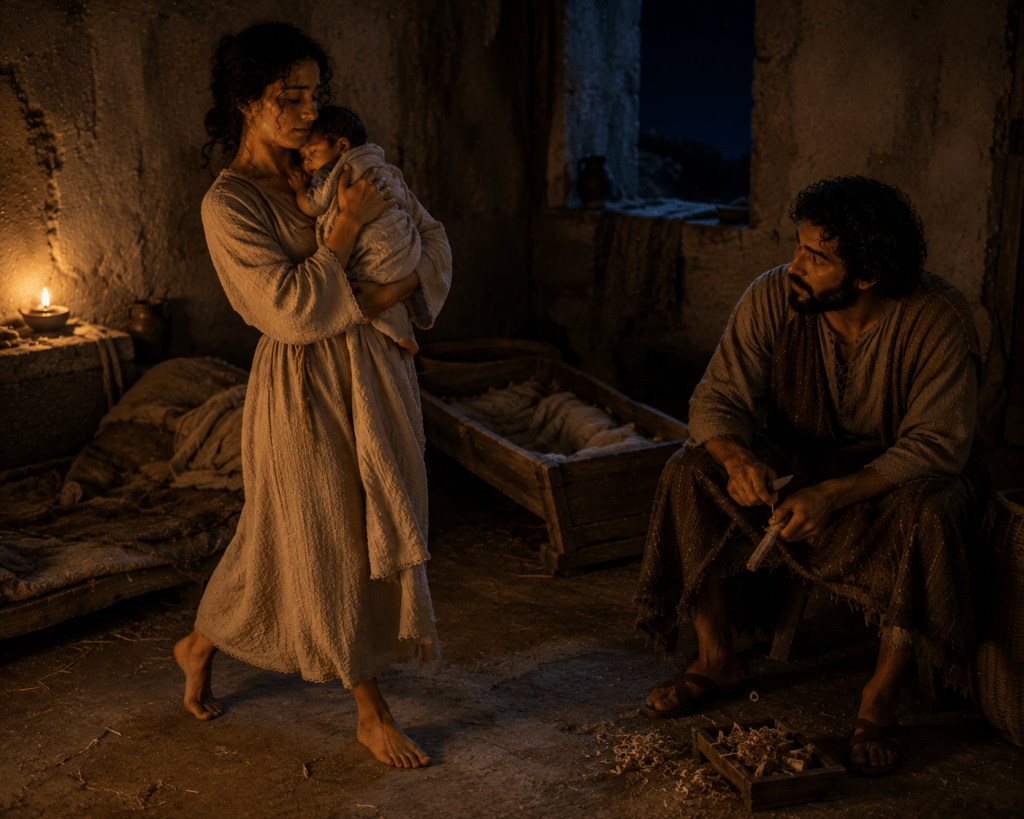
The Invitations of Mary Series
©MS 2026
There must have been nights when the Savior of the world was perfectly safe, perfectly fed, perfectly loved—and absolutely determined not to close his eyes.
It is three in the morning.
Or whatever counted as three in the morning when nobody had a clock.
The oil lamp is burning low.
Joseph is asleep.
Bethlehem is quiet.
Mary is exhausted.
Jesus is wide awake.
Not upset.
That would almost be easier.
He is simply—
awake.
Mary looks down at him.
Jesus looks vaguely in her direction with the unfocused seriousness of a newborn who has absolutely nowhere to be tomorrow.
“You should be sleeping.”
Jesus blinks.
Mary rocks him.
“You were asleep.”
Another blink.
“I saw you.”
Jesus remains unmoved by the evidence.
Mary closes her eyes.
Rocks.
Rocks.
Rocks.
Perhaps somewhere in the dark she thinks:
How can someone who has been alive for twelve days already be this bad at sleeping?
We don’t know what Jesus’ newborn nights were like.
The Gospels tell us nothing.
Perhaps he slept beautifully.
Perhaps Mary was astonishingly fortunate and Jesus settled easily between feedings.
Or perhaps he behaved like countless newborns before and after him and regarded nighttime as merely an interesting suggestion.
We cannot know.
But Christianity does insist on something important:
Jesus was genuinely human.
Not God pretending to be a baby.
Not an omnipotent adult consciousness performing infancy.
The mystery of the Incarnation is that the eternal Son truly entered human development.
Luke tells us later that Jesus grew.
The Letter to the Hebrews tells us that he shared in our humanity.
So whatever his particular temperament was, there really was an infant Jesus.
And somebody had to get him through the night.
Most often, that somebody was probably Mary.
Maybe nighttime began optimistically.
Jesus fed.
Mary changed him.
She wrapped him.
Held him.
His eyelids grew heavy.
There.
Finally.
Mary waited.
She had already learned the first law of newborn sleep:
Do not trust the first closed eye.
She continued rocking.
Jesus’ face relaxed.
His little mouth fell slightly open.
One hand loosened.
Mary waited longer.
Surely now.
She stood.
Carefully.
Every muscle in her body protested.
She moved toward wherever Jesus was sleeping.
Slowly.
She lowered him.
Still asleep.
One hand remained beneath his head.
Mary waited.
Removed it.
Nothing.
Other hand.
Nothing.
She straightened.
Jesus’ eyes opened.
Mary froze.
No.
No, no, no.
Perhaps if she remained completely still, he would reconsider.
Jesus stared into the darkness.
Mary stared at Jesus.
His face crumpled.
WAAAAAH.
Mary closed her eyes.
“Of course.”
Joseph stirred.
Mary immediately looked toward him.
“Go back to sleep.”
Joseph sat up.
“I can take him.”
“I’ve got him.”
“Mary.”
“I’ve got him.”
Article 18 Mary had returned.
Joseph probably recognized her.
He also recognized the futility of arguing at three in the morning.
Mary picked Jesus up.
Instant silence.
She stared at him.
“Oh, really?”
Jesus nestled against her.
Mary looked toward Joseph.
“Did you see that?”
“I did.”
“He was fine.”
“He appears to be fine now.”
“That isn’t the point.”
Joseph, possessing a survival instinct, did not ask what the point was.
Maybe Jesus wanted movement.
Not sitting.
Absolutely not.
Mary could sit while holding him for approximately six seconds before he objected.
So she stood.
Rocked.
Walked.
Back and forth.
Back and forth.
Across a space that was probably not very large.
Perhaps she developed a route.
Three steps.
Turn.
Four steps.
Turn.
Avoid Joseph’s foot.
Step around the basket.
Back again.
Jesus settled.
Mary stopped walking.
Jesus stirred.
Mary resumed.
“Seriously?”
He relaxed.
Mary looked down.
“You know I carried you everywhere for nine months.”
Jesus slept.
“I think you’ve misunderstood how this arrangement works now.”
Maybe she sang.
What did Mary sing to Jesus?
We don’t know.
Perhaps psalms.
Perhaps songs from her childhood.
Perhaps melodies her own mother had sung to her.
Maybe songs that were never written down because women had carried them through generations by memory.
She might have started with something beautiful.
Soft.
Intentional.
A song worthy of this child.
Twenty minutes later, after repeating every song she knew:
“You have two hands.”
Rock.
“And two feet.”
Rock.
“And I am very tired.”
Rock.
“And your father is somehow sleeping.”
From the bedding:
“I am awake.”
Mary looked over.
“Good.”
Joseph immediately regretted revealing himself.
“Take him.”
Joseph sat up.
Mary handed Jesus over.
Joseph tucked him against his chest.
Jesus remained quiet.
Mary lay down.
Closed her eyes.
Silence.
Wonderful silence.
Then—
crying.
Mary’s eyes opened.
Joseph was already walking.
“I have him.”
Mary sat up.
“I know.”
“Go to sleep.”
She remained sitting.
“Mary.”
“He’s crying.”
“I noticed.”
“Maybe he’s hungry.”
“You fed him.”
“Maybe he’s hungry again.”
“It has been twelve minutes.”
Mary stared.
Joseph looked at Jesus.
Then back at Mary.
“Can babies be hungry again after twelve minutes?”
“I don’t know.”
Neither of them knew anything.
This was reassuring.
Maybe Mary took him back.
Jesus rooted immediately.
Mary looked at Joseph.
Joseph raised his eyebrows.
Apparently yes.
Babies could be hungry again after twelve minutes.
Mary adjusted her clothing.
Jesus ate.
Joseph lay back down.
Mary looked at the top of Jesus’ tiny head.
“You cannot possibly need this much food.”
Jesus continued.
“Where are you putting it?”
Joseph, eyes closed:
“I asked you that yesterday.”
“Go to sleep.”
“I was trying.”
There must have been something strange about feeding Jesus in darkness.
During the day, there were things to do.
People.
Movement.
Noise.
At night, everything contracted.
Mary.
Jesus.
The small sounds of feeding.
His hand resting against her.
Perhaps one tiny fist opening and closing.
The weight of him.
The warmth.
Maybe sometimes Mary loved those hours.
That’s the contradiction.
She desperately wanted sleep.
And yet there may have been moments she wished she could preserve forever.
Nobody else had Jesus then.
No shepherds.
No curious visitors.
No people asking about what had happened.
No prophecies.
No angels.
Just her baby, hungry in the dark.
Perhaps Mary traced one finger over his hair.
“You’re going to sleep after this.”
Jesus continued eating.
“That wasn’t a question.”
He finished.
Mary burped him.
Waited.
Nothing.
She shifted him.
Pat.
Pat.
Pat.
Nothing.
“Come on.”
Joseph opened one eye.
“What?”
“Nothing.”
Mary tried again.
Then—
BURP.
A surprisingly substantial sound from an impossibly small person.
Joseph opened both eyes.
Mary looked down.
Jesus looked entirely innocent.
Joseph whispered:
“Impressive.”
Mary started laughing.
Quietly.
Because it was three in the morning and she had apparently reached the stage of exhaustion where a baby’s burp was comedy.
Jesus startled.
Mary stopped immediately.
“Sorry.”
His face crumpled.
“No, no, no.”
Too late.
Crying.
Mary looked at Joseph.
“This is your fault.”
“I didn’t burp.”
“You commented.”
“I whispered.”
“Too loudly.”
Joseph accepted the verdict.
Maybe some nights Jesus cried for no identifiable reason.
Those would have been the hard ones.
Mary checked everything.
Fed.
Clean.
Warm.
Not too warm.
Held.
Rocked.
Nothing.
Jesus cried.
Mary paced.
Jesus cried.
She changed positions.
Jesus cried.
She sang.
Jesus cried.
Eventually Mary might have whispered:
“What do you need?”
And of course there was no answer.
“What am I missing?”
Nothing.
Because sometimes babies cry.
Not every cry is a puzzle parents failed to solve.
But Mary wouldn’t necessarily have known that yet.
Maybe she assumed she was doing something wrong.
That thought interests me.
We give Mary the title Mother of God and unconsciously imagine that she must therefore have possessed perfect maternal confidence.
But why would she?
Holiness does not download childcare knowledge into someone’s brain.
Mary was a first-time mother.
She had probably helped with babies before. Women in close communities often did.
But knowing babies and knowing your baby are different things.
Perhaps there were nights when Mary genuinely did not know what Jesus needed.
Imagine how frightening that might have felt.
Gabriel had entrusted her with the Son of God.
And now she couldn’t make him stop crying.
Maybe exhaustion whispered something cruel:
You should know.
A good mother would know.
Perhaps Mary looked down at Jesus and felt completely inadequate.
Not sinful.
Not faithless.
Just overwhelmed.
Maybe Joseph saw it.
He reached for Jesus.
Mary shook her head.
“I don’t know what’s wrong.”
“Maybe nothing is wrong.”
“He’s crying.”
“Yes.”
“I can’t make him stop.”
Joseph held out his hands.
“That doesn’t mean you’re doing something wrong.”
Mary looked at him.
Maybe she didn’t believe him.
Joseph waited.
Eventually she handed Jesus over.
He continued crying.
Strangely, perhaps that helped.
Not Jesus.
Mary.
Because Joseph couldn’t fix it either.
Oh.
Maybe this wasn’t a test she was failing.
Maybe they simply had a crying baby.
There is an enormous difference.
Joseph walked.
Jesus cried.
Mary sat.
For once she didn’t immediately take him back.
She watched.
Joseph whispered something to Jesus.
“What are you saying?”
“Nothing.”
“You’re talking.”
“I am explaining the situation.”
Mary almost smiled.
“What situation?”
“That everyone would benefit if he went to sleep.”
“How is that going?”
Jesus screamed.
Joseph looked at her.
“Negotiations have stalled.”
Mary laughed.
And somehow that made the room survivable again.
Perhaps eventually Jesus exhausted himself.
The cries became smaller.
Then whimpers.
Then little shuddering breaths.
Joseph kept walking.
Mary watched Jesus’ eyelids close.
Neither parent spoke.
Joseph continued another few minutes.
Then he approached.
Mary held out her arms.
Joseph looked at her.
“You should sleep.”
“I will.”
“You don’t have to take him.”
“I know.”
But she wanted him.
Joseph gave Jesus back.
Mary settled against the bedding with him on her chest.
His breathing gradually deepened.
Maybe she rested her cheek against his hair.
And then—
for reasons known only to mothers—
Mary did not sleep.
She watched him.
This is one of the great absurdities of early parenthood.
You spend an hour begging the baby to sleep.
The baby finally sleeps.
And instead of immediately becoming unconscious, you stare at the baby.
Mary probably knew every part of his face by then.
Still, she looked.
His eyelashes.
His tiny nose.
The soft fullness of his cheeks.
His mouth making little movements in sleep.
The hand curled near his face.
Maybe she thought:
You are beautiful.
Then:
You are exhausting.
Then immediately:
You are beautiful.
Both true.
Maybe she kissed his forehead.
Jesus stirred.
Mary froze.
Why had she done that?
What possessed her?
He settled.
Good.
No more affection.
Affection was dangerous.
She would love him from a respectful distance of approximately four inches until morning.
Other nights might have been different.
Perhaps Jesus wasn’t crying.
He simply refused to sleep.
Wide awake.
Content.
Mary held him.
His eyes wandered vaguely around the room.
She had been trying for an hour.
Finally:
“Fine.”
She sat down.
“You win.”
Jesus blinked.
“We’re awake.”
Another blink.
“What would you like to discuss?”
Nothing.
“Politics?”
Jesus stared.
“Caesar?”
No response.
“I don’t care for him.”
Still nothing.
“Your father leaves his tools everywhere.”
From the darkness:
“I can hear you.”
Mary smiled.
“Good.”
Maybe Jesus made one of those tiny newborn almost-smiles.
Mary stared.
“Are you laughing at me?”
Joseph:
“He gets it from you.”
“Go to sleep, Joseph.”
Perhaps Mary told Jesus stories.
Not because he understood.
Because talking kept her awake.
Stories about Nazareth.
Elizabeth.
Zechariah.
Maybe John.
“You have a cousin.”
Jesus blinked.
“He’s older than you.”
Another blink.
“He was also announced by an angel.”
Mary considered.
“Our family has become strange.”
Joseph, from somewhere nearby:
“It was already strange.”
Mary looked over.
“Sleeping people don’t contribute.”
“I am not sleeping.”
“Then you can take the baby.”
Silence.
Mary smiled.
Thought so.
But perhaps Joseph did take him.
There may have been nights when Mary simply reached her limit.
Not gracefully.
Not with a serene Madonna smile.
She handed Jesus over.
“I can’t.”
Two words.
Maybe they frightened her the first time she said them.
I can’t.
But Joseph understood what they actually meant.
Not:
I cannot be his mother.
Not:
I don’t want him.
Just:
I cannot do another hour right now.
Joseph took Jesus.
“Sleep.”
Mary lay down.
Jesus cried.
She covered her ears.
Maybe she cried too.
Then slept anyway.
Because sometimes love looks like knowing you have nothing left and letting someone else carry what you cannot.
And perhaps Mary woke later in panic.
Silence.
Where was Jesus?
She sat up.
Joseph was across the room.
Asleep.
Jesus against his chest.
One of Joseph’s hands spread across the baby’s back.
Jesus’ tiny face tucked beneath his father’s chin.
Both breathing in almost the same rhythm.
Mary stared.
The sight probably did something to her.
Joseph—the man who had once considered quietly ending their betrothal because he couldn’t understand what had happened.
Joseph, who stayed.
Joseph, who walked beside her to Bethlehem.
Joseph, who held her through labor.
Joseph, who had been peed on during a cloth change and considered it a personal betrayal.
Now sleeping with Jesus against his chest as though his body had always known exactly where the child belonged.
Maybe Mary didn’t take Jesus back.
She lay down.
Watched them for another minute.
Then slept.
There would have been resentment sometimes.
I think we should allow that too.
Maybe Joseph slept through a feeding.
Mary looked at him.
Jesus ate.
Joseph slept.
Mary looked again.
How.
How could a person sleep through this?
Jesus made noises.
Joseph slept.
Mary shifted.
Joseph slept.
Mary began considering whether accidentally kicking him would constitute sin.
Probably.
She decided against it.
Mostly.
The next morning Joseph stretched.
“Did he sleep well?”
Mary stared at him.
Joseph stopped stretching.
Apparently not.
Maybe Mary said:
“Your turn tonight.”
Joseph nodded.
“Of course.”
Then nighttime arrived.
Jesus needed feeding.
There were limits to Joseph’s usefulness in that particular department.
Mary looked at him.
Joseph looked apologetic.
“This feels unfair.”
“It is.”
“I would if I could.”
“I know.”
She took Jesus.
Maybe Joseph got up anyway.
Brought water.
Adjusted the lamp.
Sat beside her.
Not because he could solve the problem.
Because she shouldn’t have to be awake alone.
That matters.
Sometimes partnership is not equal division.
Sometimes one person has to do the thing only they can do.
Love says:
Then I will sit awake beside you.
Perhaps some of Mary’s favorite memories were born in those terrible nights.
That’s how life works.
The things that exhaust us can become the things we miss.
Jesus asleep against her shoulder at dawn.
Joseph snoring softly nearby.
The first bird beginning somewhere outside.
The sky gradually changing.
Mary realizing:
We made it through another night.
Maybe she looked down.
Jesus finally, deeply asleep.
Of course.
Now morning had arrived.
Mary whispered:
“You have terrible timing.”
And perhaps that was when she understood something about motherhood.
Not through Elizabeth.
Not through advice.
Not through angels.
Through repetition.
Night after night.
Love was not always a feeling.
Sometimes love was standing up again.
The baby cries.
Stand.
Feed.
Change.
Walk.
Rock.
Put down.
Baby cries.
Stand again.
There was nothing dramatic about it.
Nobody applauded.
No shepherds came to witness the fourth feeding of the night.
No angels appeared because Mary had successfully transferred Jesus into the manger without waking him.
There was only the next need.
And Mary answering it.
Again.
Again.
Again.
Perhaps that was one of the first ways Jesus taught her what love would cost.
Not martyrdom.
Not yet.
Sleep.
Comfort.
Privacy.
Control over her own body.
Small sacrifices repeated until they became a life.
Centuries later, Christians would pray:
Holy Mary, Mother of God.
And perhaps sometimes we imagine that title in gold.
Cathedrals.
Icons.
Crowns.
Blue robes.
But Mother of God once meant:
Mary standing barefoot in the dark with spit-up on her shoulder.
Mother of God meant:
trying to remember which side Jesus fed from last.
Mother of God meant:
rocking him while her back hurt.
Mother of God meant:
whispering please, please, please while lowering him into bed.
Mother of God meant:
being so tired she couldn’t remember whether she had already checked his cloth.
Mother of God meant:
loving him at three in the morning when nobody was watching.
Maybe that’s where the title becomes most beautiful.
And Jesus?
Perhaps he eventually learned to sleep longer.
Perhaps Mary woke one morning and realized he had slept several hours.
She felt wonderful.
Then immediately terrified.
She checked him.
Breathing.
Good.
Back to bed.
Except now she was awake.
Of course.
Maybe she looked at Joseph.
He was asleep.
Jesus was asleep.
Everyone was asleep except Mary.
She stared at the ceiling.
“This is ridiculous.”
No one answered.
Years later, perhaps she remembered those nights.
When Jesus was five and slept sprawled sideways.
When he was ten and had to be called awake.
When he was twelve and she found him in the Temple after three days of terror.
When he was grown and traveling through Galilee.
Maybe she wondered where he slept.
Whether he ate enough.
Whether he was warm.
Motherhood probably didn’t stop asking those questions simply because Jesus became an adult.
Then came another night.
Gethsemane.
His disciples could not stay awake with him.
Mary wasn’t there in the Gospel account.
But when she later learned of it, I wonder whether something inside her broke at the thought.
Once, Jesus had been the one who couldn’t sleep.
And Mary had stayed awake with him.
Now he had asked his friends:
Stay awake with me.
And they couldn’t.
That’s later.
Far later.
For now, he is newborn.
Safe.
Loved.
Fed.
And absolutely refusing to sleep.
The lamp is nearly gone.
Mary has tried everything.
Jesus is against her shoulder.
She walks.
Three steps.
Turn.
Three steps.
Turn.
His eyes finally close.
Mary keeps walking.
She has learned.
Five minutes.
Ten.
Jesus becomes heavy against her.
That wonderful dead weight of a sleeping baby.
She approaches the manger.
Joseph wakes just enough to watch.
Mary lowers Jesus.
Slowly.
Slowly.
One hand away.
Then the other.
Jesus sighs.
Mary freezes.
Nothing.
She straightens.
Waits.
Still asleep.
She turns toward Joseph.
Joseph gives her the tiniest smile.
No words.
He knows better.
Mary lies down beside him.
Joseph pulls the covering over her.
Her eyes close.
Then from the manger:
a squeak.
Mary’s eyes open.
Joseph’s eyes open.
Both stare.
Silence.
Jesus settles.
Mary waits.
Another minute.
Nothing.
Finally she whispers:
“Joseph?”
“Mm?”
“If you ever tell anyone about this…”
He smiles into the darkness.
“About what?”
Mary closes her eyes.
Good answer.
And in the little room in Bethlehem, while the rest of the world slept completely unaware that God had entered it—
Mary finally slept too.
For perhaps an hour.
Maybe two.
Until a tiny voice in the darkness reminded her:
Mother of God.
Your baby needs you again.

 The Living Rosary Archives