
A Beneath the Veil personal reflection
©MS 2026
I did not expect to be angry about the Rosary today.
That sentence still feels strange to write.
We were driving home from lunch when traffic stopped us at an intersection in Irving. It was an ordinary Texas afternoon—hot, bright, cars everywhere, the kind of place where most of us are thinking about getting through the light, what we need from the grocery store, or whether we remembered to answer an email.
And then I saw the signs.
At first, I understood what I was looking at only in pieces.
A group of people standing along the road.
An American flag.
A Sacred Heart flag snapping in the wind.
Signs demanding that books be removed from the public library.
Signs using words like perverse and vile.
A sign equating LGBT people with people who groom children.
And then I heard the megaphone.
They were praying the Rosary.
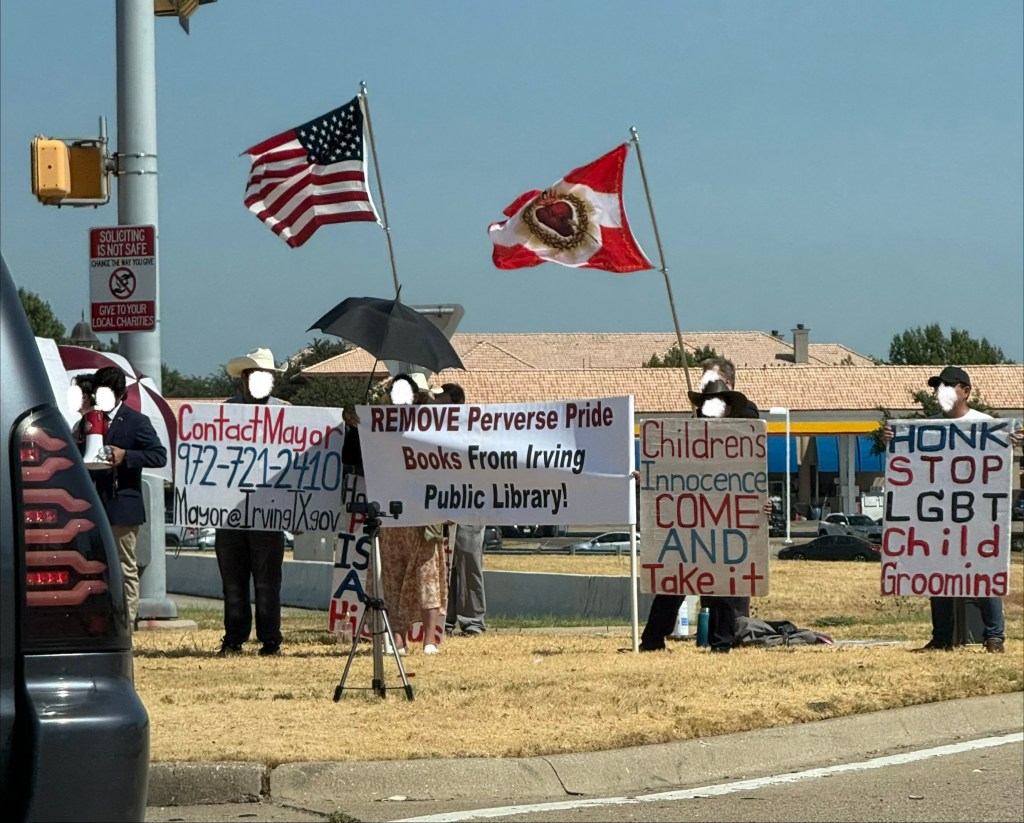
For a moment, my brain could not put those things together.
The Hail Mary was coming through a loudspeaker while people stood beneath Catholic imagery holding signs that reduced other human beings to accusations and disgust.
I have seen things like this online.
I know that religious protests exist. I know there are Catholics who believe political confrontation is part of their religious witness. I know there are organizations that hold public Rosary rallies.
Knowing those things intellectually did absolutely nothing to prepare me for hearing it.
Because this time the Rosary wasn’t on a webpage.
It wasn’t an argument happening somewhere far away.
It was coming through a megaphone beside my car.
And I felt sick.
Not embarrassed.
Not mildly uncomfortable.
Angry.
Deeply, viscerally angry.
Because somewhere along the way, the Rosary became personal to me.
It stopped being merely something Catholics do.
It stopped being a strand of beads with prayers attached to it.
I have spent an enormous amount of time studying rosaries—their materials, their histories, their prayers, the people who made them, the ways Catholics have carried them across centuries. I have held old ones in my hands and wondered who prayed with them before me. I have learned mysteries slowly. I have asked questions. I have gotten distracted halfway through decades. I have started over. I have sat quietly with beads between my fingers and discovered that repetition can sometimes make enough room inside my head for everything else to become quiet.
The Rosary has become one of the places where I am learning how to approach God.
And today I listened to it being projected outward like ammunition.
That may not have been how the people standing there understood what they were doing.
I need to say that because I cannot see inside another person’s heart.
Perhaps they believed sincerely that they were praying for people. Perhaps they thought they were defending children. Perhaps they believed every word written on those signs and believed that standing beside the road with rosaries was an act of faithfulness.
I cannot tell them what they felt.
I can only tell you what it felt like from where I was sitting.
It felt like prayer being aimed at somebody.
And I hated it.
I hated hearing words that have become sacred to me wrapped around contempt.
I hated looking at an image of the Sacred Heart—Christ’s heart exposed, wounded, burning—and seeing it flying above signs that spoke about other human beings with disgust.
I hated watching Catholic imagery become part of a political message that seemed determined to make another group of people into something monstrous.
Most of all, I hated what happened to the Rosary in that moment.
Because when I pray it, I don’t experience it as a weapon directed toward the world.
The movement is almost entirely the other way.
It keeps turning me back toward myself.
The Annunciation does not ask me what everybody else needs to surrender to God.
It asks me where I am refusing to say yes.
The Visitation does not give me a list of people who are failing at charity.
It asks whether I am willing to go toward another person.
The Sorrowful Mysteries do not leave me standing comfortably outside human cruelty, pointing at all the people who would have shouted in the crowd.
Eventually I have to wonder where I would have been standing.
Eventually I have to look at Christ carrying the Cross and ask what I do with the suffering of another person.
Eventually I have to look at the Crucifixion.
There is nowhere especially flattering to hide there.
Maybe that is part of what I love about the Rosary.
I have never needed fifty-three Hail Marys to help me identify everything that is wrong with everyone else.
There is already quite enough in me that needs conversion.
And perhaps that is why seeing the Rosary used this way hurt more than I expected.
I am still finding my way back into Catholicism. I am still learning. I am still reading, questioning, wrestling, accepting some things easily and sitting uncomfortably with others.
I am not a theologian.
I am not writing this because I have somehow solved the relationship between Catholic teaching, sexuality, politics, conscience, culture, and modern life.
I haven’t.
But I do know that there is a difference between believing that something is morally wrong and treating a human being as though their dignity disappeared because of it.
And I cannot understand how holding a Rosary makes contempt holy.
I cannot understand how calling another human being vile becomes more Christian because the Hail Mary is being said beside it.
I cannot understand why the Sacred Heart needs an enemy standing beneath it.
Perhaps that is because the Sacred Heart has begun to mean something different to me.
A wounded heart.
A heart that remains open.
A heart crowned with thorns.
A heart that loves at tremendous cost.
Not softness.
Not sentimentality.
Certainly not moral indifference.
But love.
And love becomes a very inconvenient word when the person in front of me is someone I have decided deserves my disgust.
I came home furious at those people.
That is also true.
For all of my thoughts about compassion and dignity, I was angry enough that compassion was not exactly the first thing flourishing inside me.
And eventually that realization became uncomfortable too.
Because if I am going to write about people turning prayer into a weapon, I have to ask what I am tempted to do with my own anger.
Do I simply reverse the direction?
Do I take all of my certainty, all of my disgust at what I witnessed, and aim it back at them?
Do I reduce them to a label?
Do I decide I already know everything about their faith, their motives, their lives, or their relationship with God because of one afternoon at an intersection?
That would be very easy.
It might even feel righteous.
And perhaps that is exactly the danger.
Religion can become an extraordinarily effective way of making anger feel sacred.
Maybe politics can too.
Maybe I am not immune simply because my anger happens to be directed at something I believe is cruel.
So I am left with an uncomfortable contradiction.
I am angry about what I saw.
I think I should be.
I think there are moments when anger is the appropriate response to watching human dignity treated carelessly.
But I don’t want that anger to transform me into another person standing on an imaginary corner shouting at strangers.
Which brings me, annoyingly, back to the Rosary.
The very thing that upset me.
Pick up the beads.
Begin with the Cross.
Not somebody else’s cross.
The Cross.
Christ.
The mysteries.
The slow repetition that gives the mind somewhere to rest while something deeper is allowed to move.
Maybe today I don’t need to pray the Rosary at anyone.
Not at the people holding the signs.
Not at the LGBT people those signs were targeting.
Not at a political party.
Not at a movement.
Maybe I need to pray it and let it do what prayer is supposed to do.
Change the person praying.
I don’t want my Rosary to become ammunition.
I don’t want Mary turned into a mascot for whichever political tribe wants to claim her.
I don’t want Jesus reduced to a banner that can be held over someone else’s head.
I don’t want prayer to become another method of shouting.
I want these beads to remain what they have slowly become for me:
A place to return.
A way of becoming quiet.
A way of looking at Christ long enough that I occasionally stop looking at everybody else.
I came home angry.
I am still angry.
Maybe I will be for a while.
But underneath that anger is something closer to grief.
Because I love the Rosary.
And today, for a few minutes at an intersection, I watched something I love used in a way that felt almost unrecognizable to me.
Perhaps all I can do with that feeling is bring it back to the thing itself.
Take the beads in my hand.
Begin again.
And before I ask God to change the people standing across the street, ask what still needs changing in me.
For now, this one remains beneath the veil.

 The Living Rosary Archives