Introduction
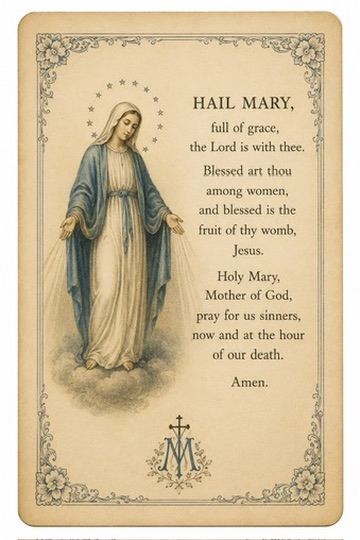
The Hail Mary is one of the most historically layered prayers in Christianity. Its origins span Scripture, doctrinal development, liturgical practice, and centuries of devotional use.
Unlike prayers composed by a single author, the Hail Mary emerged gradually. As a result, understanding its history requires consulting multiple categories of sources.
This guide identifies the principal sources used to study the Hail Mary and explains what each source contributes to our understanding of the prayer.
I. Primary Biblical Sources
The first half of the Hail Mary comes directly from Sacred Scripture. These passages form the foundation of the prayer.
Luke 1:28 – The Annunciation
“Hail, full of grace, the Lord is with thee.” – Spoken by the Archangel Gabriel.
Research Significance
This verse provides:
The opening greeting
The phrase “full of grace”
The phrase “the Lord is with thee”
Any study of the Hail Mary begins here.
Luke 1:42 – The Visitation
“Blessed art thou among women, and blessed is the fruit of thy womb.” – Spoken by Elizabeth.
Research Significance
This verse supplies the second major portion of the prayer and establishes the biblical blessing directed toward Mary and her child.
Luke 1:43 – Mother of My Lord
“And why is this granted me, that the mother of my Lord should come to me?”
Research Significance
This passage is frequently cited when discussing the theological foundations that eventually contributed to the title “Mother of God.”
Luke 1:48 – The Magnificat
“All generations shall call me blessed.”
Research Significance
Important for understanding the scriptural roots of Marian devotion and Christian reflection on Mary’s role in salvation history.
II. Ecumenical Councils
The councils did not compose the Hail Mary.
They provided the doctrinal framework that shaped portions of the prayer.
Council of Ephesus (AD 431)
Key Contribution:
Affirmation of the title: Theotokos (“God-bearer” or “Mother of God”)
Research Significance
Perhaps the most important doctrinal source for understanding the phrase: Holy Mary, Mother of God.
The council’s Christological teaching profoundly influenced later Marian prayer.
Council of Chalcedon (AD 451)
Key Contribution: Clarification of Christ’s divine and human natures.
Research Significance
Provides additional theological context for the Church’s understanding of Mary’s motherhood of Christ.
III. Early Church Fathers
The Church Fathers help explain how Christians understood Mary before the Hail Mary reached its final form.
St. Justin Martyr
Research Significance
One of the earliest writers to compare Mary and Eve.
Helpful for understanding early Marian theology.
St. Irenaeus of Lyons
Research Significance
Develops the Eve-Mary typology that became highly influential in later Christian thought.
St. Ephrem the Syrian
Research Significance
Provides evidence of flourishing Marian devotion in the East.
His hymns are particularly valuable for understanding early Christian reverence toward Mary.
St. Ambrose of Milan
Research Significance
Offers important commentary on the infancy narratives found in Luke’s Gospel.
IV. Medieval Sources
The medieval period witnessed the emergence of the Hail Mary as a recognizable devotional prayer.
Monastic Prayer Books: 11th–12th Centuries
Research Significance
Contain some of the earliest known examples of Gabriel’s and Elizabeth’s greetings being combined into a single prayer formula.
Marian Psalters: 12th–13th Centuries
Research Significance
Demonstrate the growing popularity of repeated Hail Mary devotion and help explain the eventual development of the Rosary.
Rosary Confraternity Sources: 15th Century
Research Significance
Provide evidence for the increasing standardization of the prayer throughout Europe.
V. Liturgical Sources
These sources reveal how the Church officially incorporated the Hail Mary into worship and devotional life.
Roman Breviary (1568): Promulgated by: Pope Pius V
Research Significance
The most important source for the standardization of the Hail Mary in its modern form.
Marks the transition from multiple local versions to a broadly uniform text.
Roman Ritual
Research Significance
Demonstrates the prayer’s place within official Catholic devotional practice.
VI. Catechetical Sources
These sources explain how the Church teaches and interprets the prayer.
Catechism of the Council of Trent
Research Significance
Reflects post-Reformation Catholic teaching concerning Marian doctrine and devotional practice.
Catechism of the Catholic Church
Especially: §§2673–2679
Research Significance
The most important modern explanation of the Hail Mary.
Discusses:
Scriptural foundations
Marian intercession
Theological meaning
Relationship between Mary and Christ
VII. Papal Documents
These documents reveal how the Church has understood and promoted the Hail Mary in modern times.
Pope Leo XIII: Major Rosary Encyclicals
Especially: Supremi Apostolatus Officio (1883)
Research Significance
Explains the role of the Hail Mary within Rosary devotion and demonstrates the growing emphasis on the Rosary in the modern era.
Pope Paul VI: Marialis Cultus (1974)
Research Significance
One of the most important modern documents on Marian devotion.
Provides a detailed explanation of the Hail Mary’s biblical and theological structure.
Pope John Paul II: Rosarium Virginis Mariae (2002)
Research Significance
Explains the Hail Mary’s contemplative role within the Rosary and emphasizes its Christ-centered character.
VIII. Claim-to-Source Guide
If researching: “Where do the words of the Hail Mary come from?”
Consult:
Luke 1:28
Luke 1:42
“Why is Mary called Mother of God?”
Consult:
Council of Ephesus (431)
Council of Chalcedon (451)
“How did the prayer develop over time?”
Consult:
Monastic prayer books
Marian Psalters
Medieval manuscripts
“When did the prayer become standardized?”
Consult:
Roman Breviary (1568)
“How does the Church explain the Hail Mary today?”
Consult:
Catechism of the Catholic Church §§2673–2679
Marialis Cultus
Rosarium Virginis Mariae
IX. Recommended Reading Order
For readers beginning research on the Hail Mary:
Luke 1:26–56: Read the entire Annunciation and Visitation narratives
Council of Ephesus (431)
Catechism of the Catholic Church §§2673–2679
Marialis Cultus
Rosarium Virginis Mariae
Conclusion
It would be impossible to point to any one source that could fully explain the Hail Mary prayer. Rather, the prayer’ origins can be found in the Gospel of Luke. Its language was shaped by the Christological debates of the early Church. Specific portions of the prayer developed over centuries of Christian piety. Finally, the way we say the prayer today was solidified through its incorporation into Catholic liturgy. Each type of source mentioned in this guide provides researchers with another important piece of the Hail Mary puzzle. Studying these sources will not only educate us about a prayer, but also reveal the rich history of prayer itself in Christianity.


