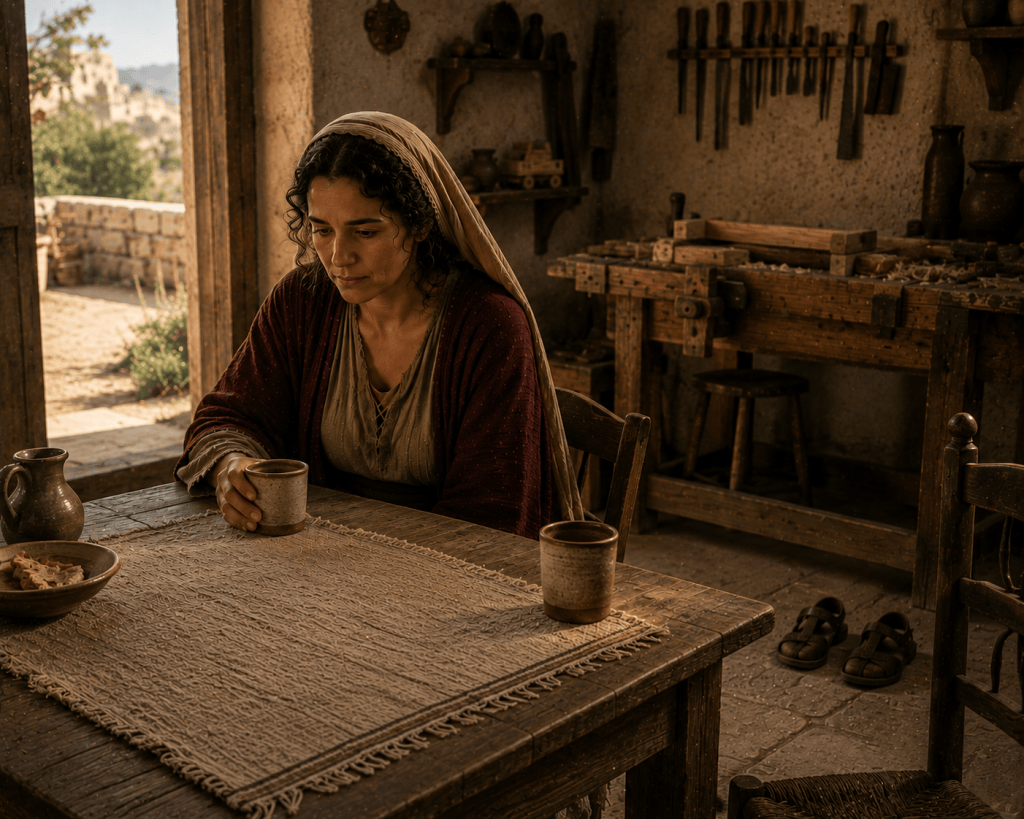
The Invitations of Mary Series
©MS 2026
Grief is not always the sound of weeping. Sometimes it is the absence of a sound you had stopped noticing years ago.
The house was too quiet.
Maybe that was the first thing Mary noticed.
Not immediately.
Immediately there had been people.
If Joseph died as we’ve imagined him—at home in Nazareth, with Mary and Jesus beside him—then death would have brought the community quickly into their house.
Neighbors.
Relatives.
People coming and going.
Low voices.
Footsteps.
Questions.
Prayers.
Lamentation.
Someone bringing food Mary had no interest in eating.
Someone taking something from her hands because she had apparently been holding it for ten minutes without realizing.
Someone asking Jesus what needed to be done.
Someone else answering before he could.
Joseph’s death would not necessarily have happened inside the private, sealed grief we often imagine today.
Jewish death and burial were communal.
The dead were buried promptly.
The bereaved were surrounded.
People came.
People stayed.
People mourned.
For a while, perhaps Mary couldn’t even hear Joseph’s absence.
There was too much noise.
And then—
everyone went home.
Maybe not all at once.
One person left.
Then another.
Someone touched Mary’s shoulder before going.
Someone embraced Jesus.
A woman said:
“I’ll come tomorrow.”
Mary nodded.
The door opened.
Closed.
Another conversation ended.
Another pair of footsteps disappeared.
Until finally—
there were only two people in a house that had held three for decades.
Mary.
Jesus.
And silence.
Perhaps they sat there for a while.
Neither spoke.
Because what was there to say?
Joseph was dead.
They both knew.
There are facts so enormous that saying them aloud does nothing.
The lamp made a tiny sound.
Mary heard it.
She had never noticed the lamp before.
Not like this.
A faint sputter.
Oil.
Flame.
The house settling.
Something outside.
A dog somewhere in Nazareth.
Someone calling to a child.
Footsteps passing.
Normal evening sounds.
And underneath them—
nothing.
No Joseph.
Mary might not have realized how much sound one person made simply by existing.
Joseph cleared his throat in the mornings.
He sighed when he sat down.
He muttered at things that refused to fit together properly.
His tools had rhythms.
Tap.
Tap.
Pause.
Scrape.
Tap.
Sometimes a louder sound followed by a word Mary pretended not to hear.
Something dragged across the floor.
Wood shifted.
A stool moved.
The workshop breathed because Joseph was inside it.
Now—
nothing.
Maybe Mary heard Jesus move.
She looked up too quickly.
For half a second—
just half—
her body expected Joseph.
Not because Jesus sounded like him.
Because someone moved.
And for decades, movement in the house might have been either of them.
Joseph?
No.
Jesus.
Of course.
Mary looked down again.
Maybe Jesus noticed.
He didn’t say anything.
The next morning was worse.
Because mornings had a sequence.
Joseph had been part of it.
Perhaps Mary woke before sunrise.
Lay still.
Something felt wrong.
She didn’t remember immediately.
That mercy lasted perhaps two seconds.
Then she did.
Joseph is dead.
Maybe she turned toward where he had slept.
Empty.
Not dramatically empty.
Just—
nothing there.
The covering perhaps folded.
Or perhaps not.
Maybe Mary hadn’t allowed anyone to touch it yet.
His side still looked as though a person should be occupying it.
She listened.
No breathing.
That might have been the first unbearable sound.
No breathing.
For years Mary had fallen asleep beside Joseph without listening to him breathe.
Why would she?
Sometimes he snored.
Apparently.
He denied it.
Mary knew better.
Maybe there had been nights when she nudged him.
“Joseph.”
Nothing.
“Joseph.”
A grunt.
“Turn over.”
“I’m asleep.”
“You’re snoring.”
“I don’t snore.”
“You are currently snoring.”
“That doesn’t make sense.”
“Turn over.”
He did.
Silence.
Blessed silence.
Now Mary would have given anything to hear him snore.
Perhaps she lay there waiting for a sound she knew would not come.
A cough.
A breath.
Fabric shifting.
Joseph getting up.
His feet touching the floor.
Nothing.
Eventually Mary got up because staying there was worse.
She began morning tasks.
Bodies survive grief through habit.
Water.
Food.
Fire.
Clothing.
Prayer.
The hands know what to do even when the mind doesn’t.
Maybe Mary reached automatically for three cups.
One.
Two.
Three.
She stopped.
Looked at the third.
No.
Perhaps she put it back.
Or maybe she couldn’t.
Maybe she left it on the table.
Jesus came in later.
Saw it.
Neither mentioned it.
Mary made too much food.
Of course she did.
You don’t spend twenty years calculating portions for three people and immediately become a household of two.
She prepared what she always prepared.
Jesus sat.
Mary looked at the food.
Too much.
Her throat tightened.
Jesus understood.
“It’s all right.”
Mary shook her head.
“I forgot.”
Jesus looked at the extra portion.
Maybe he said:
“I know.”
Not:
Don’t be sad.
Not:
It’s okay.
Because it wasn’t.
Just:
“I know.”
Perhaps they ate.
The scrape of a dish sounded too loud.
Jesus chewing.
Mary swallowing.
Outside, Nazareth was waking.
Someone hammered something.
Mary froze.
Tap.
Tap.
Tap.
Not Joseph.
Someone else.
Of course someone else owned a hammer.
The entire world had not agreed to stop carpentry because Joseph died.
Mary hated them for approximately three seconds.
Then hated herself for hating them.
Then perhaps realized grief didn’t care.
Tap.
Tap.
Tap.
She put down what she was holding.
Jesus looked at her.
“Mama?”
“I’m fine.”
They both knew she wasn’t.
Maybe she went outside.
The sound followed.
Somewhere down the road.
A carpenter.
A repair.
Someone building something.
An ordinary morning.
Mary stood in the doorway.
Joseph’s workshop was beside her.
Silent.
That contrast might have been worse than silence itself.
Because Joseph’s tools were still there.
Tools are unsettling after someone dies.
They are designed for hands.
Without hands, they become strangely incomplete.
A mallet.
A blade.
A measuring cord.
A plane.
Things Joseph had touched thousands of times.
The handles worn according to his grip.
Now waiting.
Mary could perhaps identify Joseph by sound alone.
Not consciously.
But she knew.
The particular rhythm of his work.
She knew the sound of frustration.
The sound of concentration.
The sound that meant something had gone wrong.
The sound that meant:
Do not go in there yet.
And the quieter rhythm that meant things were going well.
How many hours of Mary’s life had been accompanied by Joseph working in the next room?
She probably couldn’t count.
She had stopped hearing it years ago.
It was simply home.
That’s what happens with familiar sounds.
We stop noticing them.
Until they disappear.
Maybe Mary tried to work.
She kneaded bread.
The dough hit the surface.
Once.
Again.
The sound echoed strangely.
Had the house always echoed?
No.
Joseph had filled it.
Jesus was quiet too.
Maybe quieter than usual.
That mattered.
Because Joseph’s absence had changed Jesus’ sound.
Perhaps Jesus spent the first few days close to Mary.
Not hovering.
Just—
there.
If Mary went outside, Jesus appeared eventually.
If she sat, he sat somewhere nearby.
If someone came, he answered the door.
If she forgot to eat, food appeared.
Maybe Mary noticed.
Maybe she didn’t.
But Jesus was grieving too.
And perhaps Mary eventually heard that.
Not crying.
Maybe she heard him in the workshop.
For the first time.
A tool moved.
Mary stopped.
Another.
Then silence.
She walked toward the doorway.
Jesus stood at Joseph’s bench.
Not working.
Just holding something.
One of Joseph’s tools.
Mary didn’t enter.
She watched.
Jesus turned it in his hand.
His thumb moved over the handle.
Perhaps exactly where Joseph’s thumb had worn the wood smooth.
Then Jesus put it down.
Carefully.
Too carefully.
Mary understood.
Maybe she said:
“He always kept that there.”
Jesus looked toward her.
“I know.”
“He’d complain if anyone moved it.”
A small smile.
“I know.”
Mary stepped inside.
“He could never find anything.”
Jesus looked offended on Joseph’s behalf.
“He knew where everything was.”
“He asked me where things were every day.”
“That doesn’t mean he didn’t know.”
Mary stared at Jesus.
For a moment—
she laughed.
It surprised both of them.
A tiny laugh.
Wrong somehow.
Beautiful somehow.
Mary covered her mouth.
Then the laugh broke into tears.
Of course it did.
Jesus crossed the room.
Held her.
Maybe Mary cried against the chest of the child Joseph had once carried.
Except Jesus wasn’t a child anymore.
He was a grown man.
His arms around her.
One hand against the back of her head.
And perhaps something about that gesture belonged to Joseph.
Not intentionally.
Just learned.
Mary felt it.
That made her cry harder.
“I miss him.”
Maybe those were the first words.
Not:
Your father is dead.
Not:
God’s will.
Not:
He is at peace.
Just:
“I miss him.”
Jesus held her.
“I know.”
Maybe Jesus cried too.
I think we should let him.
The Gospels explicitly show an adult Jesus weeping at Lazarus’ death.
There is nothing un-Christian about imagining him grieving Joseph.
If Joseph died before Jesus’ public ministry, then Jesus lost the man who had raised him.
The man who taught him a trade.
The man whose voice he had heard since infancy.
The man he had called father.
That absence belonged to Jesus too.
Perhaps Mary felt his tears.
Then pulled back.
Looked at him.
Jesus wiped his face.
Mary reached automatically and did it for him.
A mother’s reflex from childhood.
Jesus let her.
For once.
Then maybe they both laughed slightly through tears.
Because Joseph would have hated this much fuss.
Or maybe not.
Perhaps he secretly would have enjoyed being missed.
Mary would have accused him of it.
The days continued.
Jewish mourning gave grief a communal structure rather than demanding immediate normalcy. In later Jewish tradition, the first seven days after burial became the intense mourning period known as shiva, with mourners remaining close to home while others came to them. We cannot simply transplant every later custom unchanged into first-century Nazareth, but the underlying pattern of communal mourning has ancient roots.
So perhaps for days the house filled and emptied.
People came.
Sat.
Remembered.
Prayed.
Brought food.
Mary heard Joseph’s name constantly.
“Joseph once made—”
“I remember when Joseph—”
“He helped us when—”
“Your husband was—”
At first maybe Mary couldn’t bear it.
Then perhaps she wanted more.
Tell me.
What did he say?
When was that?
I didn’t know that story.
Tell me again.
Grief becomes hungry for evidence that the person existed outside your own memory.
Maybe someone imitated Joseph.
His expression.
Something he always said.
Jesus laughed.
Mary stared.
Then laughed too.
There he was.
For half a second.
Not present.
But recognizable.
Eventually people came less often.
That’s when grief changed.
The world decided the emergency was over.
Mary’s grief had barely begun.
The house grew quiet again.
And perhaps that was when she began hearing ghost sounds.
Not supernatural ones.
Memory.
The brain is astonishingly good at completing patterns.
A noise outside.
Joseph coming home.
A cough.
Joseph.
Something falling in the workshop.
Joseph.
Footsteps.
Joseph.
Mary might turn her head before remembering.
Again.
And again.
And again.
Each time the body learns the loss a little more deeply.
Perhaps once she called:
“Joseph?”
The name left her mouth before she could stop it.
Silence.
Mary froze.
Jesus was in the other room.
He had heard.
Of course he had.
Neither moved.
Mary closed her eyes.
Then perhaps Jesus answered softly:
“Mama?”
Not pretending.
Not replacing him.
Just letting her know she wasn’t alone.
Mary breathed.
“Nothing.”
Jesus didn’t challenge it.
Maybe nighttime became the hardest.
The workshop had always been quiet at night.
So Joseph’s absence wasn’t there.
It was in the bed.
Mary lay down.
One side.
Empty.
Maybe she stayed on her own side for weeks.
Or months.
Wouldn’t cross the invisible line.
Joseph’s space.
Perhaps his smell remained for a while.
Fabric.
Wood.
Oil.
Sweat.
The ordinary scent of a person you have lived beside for decades.
Mary might have buried her face in something he wore.
Not because she was being dramatic.
Because smell disappears.
And some part of her knew it.
Eventually it faded.
That may have felt like another death.
Maybe she kept one garment longer than necessary.
Maybe everyone did.
Humans have always been humans.
There were other sounds Mary had to relearn.
The door opening.
For years she might have known Joseph’s entrance.
Every person has one.
Jesus entered differently.
Neighbors differently.
Joseph had a particular way of moving through the threshold.
Maybe he made a noise.
Maybe he always put something down immediately.
Maybe he called:
“Mary?”
Perhaps that had irritated her sometimes.
She was obviously home.
Where else would she be?
“Mary?”
“What?”
Just checking.
Now the door opened.
Mary’s heart lifted.
Wrong person.
Again.
Maybe Jesus started saying her name when he entered.
Not consciously at first.
“Mama?”
Mary answered.
“Here.”
Perhaps neither understood why that became important.
There was also Joseph’s laughter.
That might have been the sound Mary feared forgetting most.
Faces can be held in images of memory.
Voices are harder.
Maybe she tried to replay it.
Joseph laughing when Jesus was little.
Joseph trying not to laugh when Mary was annoyed.
Joseph laughing so hard once he had to sit down.
What did it sound like?
She knew.
Of course she knew.
But the harder she tried to hear it—
the farther away it became.
That frightened her.
What if I forget his voice?
Maybe she asked Jesus.
“Do you remember how your father laughed?”
Jesus looked at her strangely.
“Of course.”
“Do it.”
“What?”
“His laugh.”
“Mama.”
“Please.”
Jesus tried.
It was terrible.
Mary stared.
“That sounds nothing like him.”
“I told you.”
“You sound like a dying goat.”
Jesus laughed.
Mary laughed.
And then she stopped.
Because something in Jesus’ real laugh contained Joseph.
Not the sound.
The timing.
The way his shoulders moved.
Something learned through years of being loved by him.
Mary stared.
Jesus noticed.
“What?”
“Nothing.”
Again.
Always something.
Perhaps the house gradually found a new sound.
That’s what happens.
Not the old sound.
Never that.
A different one.
Jesus working at the bench.
At first his rhythm wasn’t Joseph’s.
Mary could tell.
Different pressure.
Different pauses.
Different habits.
But eventually Jesus’ work became part of the house.
Tap.
Scrape.
Pause.
Measure.
Tap.
Sometimes Mary listened.
And sometimes she could hear Joseph inside it.
Not literally.
In technique.
Joseph had taught those hands.
Like this.
Again.
Careful.
Twenty years of instruction surviving inside movement.
Maybe one afternoon Mary sat working while Jesus worked nearby.
For several minutes she forgot.
Not Joseph.
She didn’t forget Joseph.
She forgot to be actively grieving.
That’s different.
She simply existed.
Her hands moved.
Jesus’ tools sounded.
Sunlight entered.
Someone outside shouted.
Mary thought about dinner.
Then she realized she had been okay for perhaps five minutes.
And guilt arrived.
How could I be okay?
Joseph is dead.
Maybe she hated those five minutes.
Later she learned not to.
Grief cannot remain at maximum volume forever.
The body won’t allow it.
Eventually there are gaps.
Then longer gaps.
Then laughter.
Then an afternoon.
Then perhaps an entire morning when Joseph is remembered with warmth before pain.
That isn’t betrayal.
It is what survival sounds like.
Maybe Mary eventually moved Joseph’s cup.
Not threw it away.
Just moved it.
Maybe months had passed.
She picked it up.
Her hand stopped.
Then she put it somewhere else.
The table now had two places.
Mary.
Jesus.
Perhaps that was another tiny funeral.
And then one day Jesus would leave too.
Not die.
Not yet.
Leave.
Public ministry.
Jordan.
Galilee.
Roads.
Disciples.
Crowds.
Whatever Mary understood about that transition, eventually the house that had held three would hold one.
Imagine that silence.
Joseph gone.
Jesus away.
Mary alone inside the Nazareth home.
Perhaps she stood in the workshop doorway.
No tools moving now.
No Joseph.
No Jesus.
Only the bench.
Maybe that’s when she finally understood how much sound love makes.
Not declarations.
Not hymns.
Not angels.
Ordinary sound.
Someone coughing in another room.
A tool against wood.
A husband asking where something is that is directly in front of him.
A child laughing.
A chair moving.
Someone calling your name.
Breathing beside you at night.
We rarely call those sounds sacred while we have them.
They are annoying.
Repetitive.
Background.
Sometimes we wish everyone would just be quiet.
Then someone dies.
And quiet becomes unbearable.
Maybe Mary once thought back to the stable in Bethlehem.
Jesus crying.
Joseph moving around.
Animals.
Strangers arriving.
Chaos.
She might once have longed desperately for silence.
Years later—
she would have traded anything for that noise.
Perhaps this is what Joseph’s death changed most profoundly.
Not Mary’s theology.
Not Jesus’ mission.
The acoustics of home.
There was a sound that belonged to their family.
Three people.
Mary.
Joseph.
Jesus.
For decades they created it without noticing.
Then Joseph died.
And one entire register disappeared.
The house never sounded the same again.
How could it?
Maybe Mary eventually stopped expecting his footsteps.
Stopped turning at every cough.
Stopped making three portions.
Stopped waking surprised by the empty place beside her.
That doesn’t mean she stopped loving him.
It means her body finally learned what her mind had known since the burial:
Joseph is not coming home.
And perhaps years later, Mary could remember him without immediately hearing silence afterward.
Joseph became story.
Memory.
Gesture.
The way Jesus held a tool.
The phrase Mary still used because Joseph used it first.
The ridiculous thing on the shelf nobody had thrown away.
The husband who had once driven her crazy with some tiny habit she would now give anything to experience one more time.
Maybe she still talked to him occasionally.
Not because she believed he was physically there.
Because decades of conversation do not stop cleanly.
“You would have hated this.”
“Your son is impossible.”
“You were right about that.”
Perhaps she smiled afterward.
Maybe that’s how love continues speaking into absence.
But the first days?
No.
The first days were quieter.
Raw.
Unfamiliar.
Mary had to learn the sound of a world without Joseph in it.
Perhaps one evening, not long after his death, Mary sat beside Jesus.
The lamp burned.
Neither spoke.
Outside, Nazareth settled into night.
Jesus was doing something with his hands.
Mary listened.
Tap.
Scrape.
Pause.
Tap.
For a moment her chest tightened.
Joseph.
No.
Jesus.
Then another sound.
Jesus muttered under his breath because something wasn’t fitting correctly.
Mary looked up.
The exact tone.
The exact irritated exhale.
Not the same voice.
But unmistakably—
Joseph.
Mary’s mouth opened.
Then she smiled.
Jesus looked over.
“What?”
Mary shook her head.
“Nothing.”
Jesus narrowed his eyes.
She had that look again.
“What?”
Mary returned to her work.
“Your father.”
Jesus went still.
“What about him?”
Mary looked toward the tool in his hand.
Then back at her son.
“You sounded like him.”
Jesus looked down.
Maybe he smiled.
Small.
A little sad.
Then he returned to work.
Tap.
Scrape.
Pause.
Tap.
Mary listened.
The house was not the same.
It would never be the same.
There was still an absence inside every room Joseph had occupied.
But now, beneath the silence, something else remained.
Things he had taught.
Things he had repaired.
Things he had loved.
A woman who still knew exactly how his laugh sounded.
A son whose hands remembered everything his father had shown them.
Joseph no longer made noise in the house.
But he had spent decades teaching the house how to remember him.
And perhaps that is what Mary eventually heard when the silence stopped being unbearable:
Not Joseph returning.
Not death undone.
Something quieter.
The echo of a life that had been there long enough to leave its sound behind.


