The Invitations of Mary Series
©MS 2026
39. What Did Widowhood Change About Mary’s Daily Life?
Joseph’s death would not only have left Mary grieving. It would have removed one of the two people with whom she had built the machinery of an ordinary life.
There must have been things Mary did not know Joseph did.
Not because she was helpless.
Not because first-century women were incapable of managing their own households.
And certainly not because Joseph spent his days heroically rescuing Mary from every broken stool.
Simply because this is what happens when two people live together for years.
Work divides itself.
One person always notices when the oil is getting low.
The other remembers which neighbor borrowed the bowl.
One knows where the extra cloth is stored.
The other knows why the door sticks when the weather changes.
Nobody holds a meeting.
Nobody writes down responsibilities.
A household simply develops rhythms.
And after enough years, you stop noticing which parts belong to whom.
Until one person dies.
Then suddenly—
everything they used to carry becomes visible.
Maybe Mary discovered this three days after Joseph’s burial.
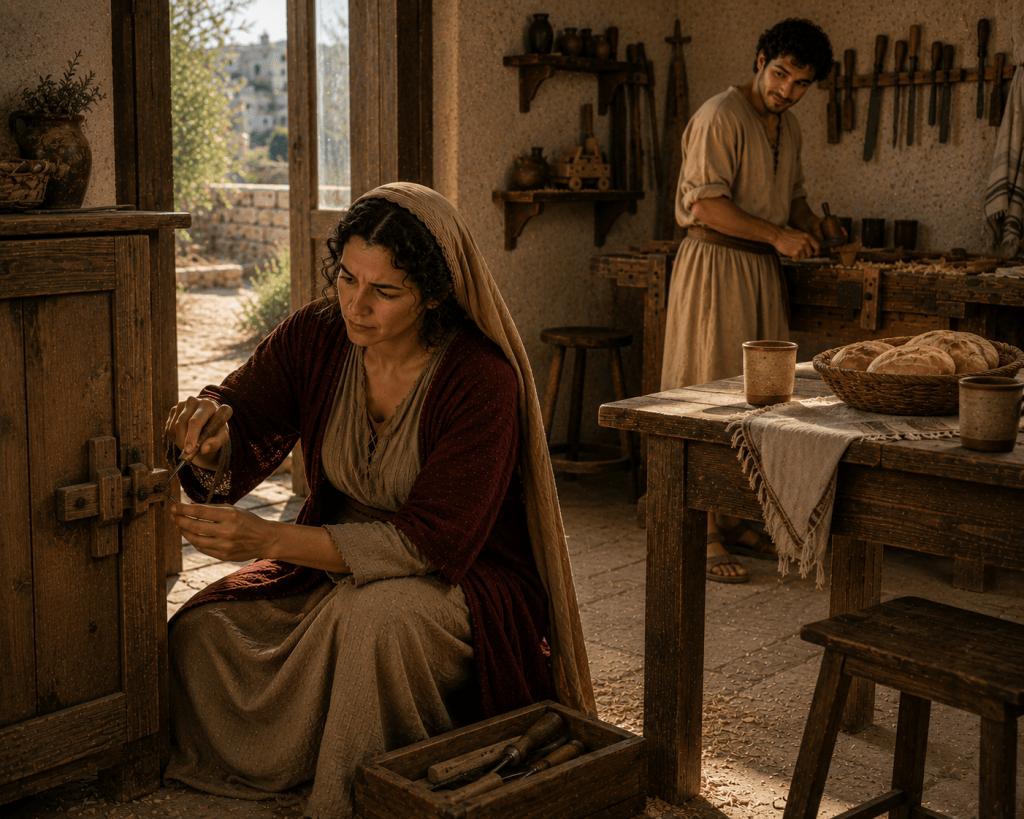
Something broke.
Of course it did.
Grief should exempt a person from household maintenance for at least six months.
Apparently objects do not respect mourning.
Maybe it was something stupid.
A hinge.
A stool.
A wooden latch.
Something Mary had watched Joseph repair dozens of times without ever paying particular attention.
She picked it up.
Looked at it.
And instinctively called:
“Joseph?”
Silence.
Mary closed her eyes.
Right.
Maybe Jesus heard from the workshop.
“What happened?”
Mary held up the broken thing.
Jesus came over.
Looked.
“Oh.”
“Can you fix it?”
Jesus gave her a look.
Mary immediately realized how ridiculous the question was.
He was a carpenter.
“Yes, Mama.”
“I know you can.”
“You asked.”
“I was thinking.”
Jesus took it from her.
Maybe he repaired it exactly the way Joseph would have.
Or almost.
Mary watched his hands.
Measure.
Adjust.
Test.
Something about the movement made her chest tighten.
Jesus noticed.
“What?”
“Nothing.”
He went back to work.
Perhaps Mary didn’t say:
Your father used to do that.
She didn’t have to.
They both knew.
But there would have been things Jesus didn’t know.
That mattered too.
Joseph and Mary had built the household together before Jesus was old enough to remember it.
Maybe Joseph knew which merchant would give them another week if money was tight.
Which roof tile had been patched twice and should really be replaced.
Which neighbor owned the ladder.
Which man in the village talked endlessly but did excellent work.
Which one charged too much.
Which family owed them money.
Which family would probably never be able to pay.
Where certain documents or agreements were kept.
Which tool belonged to whom.
Which customer had promised to return on Thursday.
Suddenly Jesus inherited questions.
“Papa handled that.”
Again.
And again.
Maybe Jesus found himself opening drawers.
Moving things.
“Mama, do you know where Papa kept—”
“No.”
“You don’t?”
“No.”
“He must have told you.”
“He did not.”
They searched.
Nothing.
Mary became irritated.
“Joseph.”
Jesus looked at her.
“What?”
“Nothing.”
“You’re angry with him.”
“He could have told someone where he put things.”
Jesus almost smiled.
Mary pointed at him.
“Do not.”
“I didn’t say anything.”
“He knew exactly where everything was and apparently believed he was immortal.”
Jesus failed.
He laughed.
Mary tried not to.
Failed too.
Maybe that was one of the strange things about widowhood.
Joseph could still annoy her.
Dead.
And somehow still capable of being impossible.
Perhaps Mary found that comforting.
Grief did not turn him into a flawless saint inside her memory.
He remained Joseph.
The man she loved.
The man who left important things in incomprehensible places.
And perhaps there were repairs Mary simply learned to do herself.
Why wouldn’t she?
Maybe something small broke and Jesus wasn’t home.
Mary stared at it.
She knew roughly what Joseph would have done.
She had watched him for decades.
So she went into the workshop.
Found the tool.
Tried.
Wrong.
Tried again.
Better.
Maybe Jesus came home and saw the repair.
He examined it.
Mary waited.
“Well?”
Jesus considered.
“It works.”
“That was not the question.”
“It works.”
“Jesus.”
He smiled.
“It isn’t how Papa would have done it.”
Mary glared.
Jesus added quickly:
“But it works.”
Mary nodded.
“Exactly.”
Perhaps later it broke again.
Nobody mentioned that.
But widowhood would have changed much more than repairs.
There was money.
That practical, unromantic reality.
Joseph had a trade.
If he died while Jesus was already an adult craftsman, perhaps Jesus had increasingly taken over the work anyway.
That would have protected Mary enormously.
The workshop did not disappear with Joseph.
Customers still came.
Work still needed doing.
Jesus could earn.
Perhaps there were other relatives too.
First-century Galilean life was not organized around the isolated nuclear household we often imagine. Kinship networks, neighbors, and village relationships mattered.
Mary probably did not become a solitary woman abandoned in a little house simply because Joseph died.
But her household changed.
Perhaps people began speaking to Jesus differently.
“Is the carpenter here?”
Once that meant Joseph.
Now—
Jesus stepped forward.
“Yes.”
Mary heard it the first time.
Maybe she stopped what she was doing.
The carpenter.
Not the carpenter’s son.
The carpenter.
Joseph’s identity had passed quietly into Jesus’ hands.
Mary wasn’t sure how she felt about that.
Proud.
Sad.
Both.
Probably both.
And then there were meals.
Meals may have been one of the hardest changes.
Before Joseph died, perhaps dinner meant three.
Mary.
Joseph.
Jesus.
Even as Jesus grew older and worked longer days, eventually there were familiar sounds:
Someone washing.
Someone sitting.
Joseph complaining about something.
Jesus arguing with him.
Mary telling both of them to eat before the food got cold.
Then there were two.
Mary.
Jesus.
At first perhaps they sat in their usual places.
Joseph’s remained empty.
Nobody deliberately chose that.
Neither wanted it.
Jesus sat where Jesus sat.
Mary sat where Mary sat.
And Joseph’s place remained—
Joseph’s.
Maybe Mary kept looking toward it.
Jesus noticed.
He looked too.
Neither said anything.
Eventually someone had to sit there.
Perhaps not for weeks.
Maybe months.
A cousin came.
A neighbor.
Someone visiting.
They moved toward the empty place without knowing.
Mary’s body reacted before her mind did.
“Not—”
The person stopped.
Mary froze.
Everyone looked at her.
She swallowed.
Then:
“Sorry. Sit wherever you like.”
The person chose somewhere else.
Maybe later Mary was embarrassed.
Jesus wasn’t.
“You don’t have to be.”
“I know.”
“You don’t.”
“I know.”
Eventually someone sat there.
And the world did not end.
That may have hurt too.
Who shared meals with Mary?
Probably more people than our paintings usually allow.
That is something I want us to remember.
Mary was not living in a vacuum waiting for Jesus’ ministry to begin.
There would have been relatives.
Neighbors.
Friends.
Women she had known for years.
People from the synagogue community.
People who had known Joseph.
People who knew Mary before she was a widow and after.
Maybe a neighbor named Miriam came often.
We don’t know her name.
We don’t know whether she existed.
But surely Mary had women around her.
Someone who arrived carrying bread without pretending she had come because Mary needed checking on.
“I made too much.”
Mary looked at the amount.
“You made too much specifically for me.”
“I don’t know what you’re talking about.”
“You live with six people.”
“Take the bread.”
Mary took the bread.
Maybe another woman came and sat.
Didn’t ask Mary how she was.
Bless her.
Instead:
“Do you know what my husband did?”
And launched directly into some absurd domestic complaint.
Mary listened.
Then laughed.
For an hour she was not Mary the widow.
She was Mary.
Friend.
Neighbor.
Woman at the table.
That might have mattered enormously.
Grief makes people strange around the bereaved.
They become careful.
Every conversation begins with:
How are you?
Every face softens.
Every silence becomes meaningful.
Sometimes perhaps Mary wanted someone to walk in and complain about a goat.
Maybe she had that person.
I hope she did.
And perhaps Jesus noticed when she needed company.
At first, constantly.
He stayed close.
He ate with her.
Worked nearby.
Found reasons to be in the house.
Maybe Mary eventually realized what he was doing.
“You don’t have to stay here.”
Jesus looked up.
“I’m working.”
“You have been working six feet from me for four days.”
“The light is good here.”
Mary looked toward the terrible light.
“Jesus.”
He smiled.
Maybe she let him stay.
But eventually Jesus had his own life.
Even before his public ministry, a grown man would have responsibilities beyond sitting beside his mother.
Work.
Community.
Synagogue.
Friends.
Obligations.
Mary would sometimes eat alone.
That was new.
Perhaps the first time she did, she hated it.
One bowl.
One cup.
No conversation.
Nobody reaching for something.
Nobody asking for more.
Nobody interrupting her.
Nobody saying:
“Did you hear what happened?”
Silence.
Mary ate quickly.
Maybe too quickly.
There seemed no reason to linger.
That might have been another change.
Meals stopped being an event when she was alone.
They became food.
Maybe she started eating standing up sometimes.
Jesus caught her.
“Mama.”
“What?”
“Sit down.”
“I am eating.”
“You are standing.”
“I can eat standing.”
“Sit.”
Mary stared at him.
There it was.
Joseph.
Not the voice.
The irritating certainty.
Mary sat.
Maybe Jesus put his own food down across from her.
“I thought you were going out.”
“I am.”
“You don’t have to eat again.”
“I know.”
“Are you hungry?”
Jesus considered.
“Yes.”
Mary knew he was lying.
He ate anyway.
Who noticed when Mary was lonely?
Jesus probably did.
But I don’t think he was the only one.
And that’s important.
Because sometimes our imagination makes Mary’s entire emotional world orbit Jesus.
She was his mother.
But she was also a woman with a community.
A widow.
A relative.
A neighbor.
Perhaps a friend.
Maybe an aunt.
Maybe someone people came to for advice.
Maybe someone who borrowed things and lent things and sat with other women while they worked.
Perhaps loneliness appeared in strange ways.
Not:
I am lonely.
Mary might never have said that.
Maybe she simply began taking longer to return borrowed things.
Because returning the bowl meant ten minutes of conversation.
Maybe she volunteered to help someone with something she didn’t particularly care about.
Maybe she lingered after synagogue.
Maybe she walked with another woman farther than necessary.
Maybe she accepted invitations she once would have declined because Joseph was waiting at home.
Now nobody was waiting.
That sentence alone might have hurt.
Nobody is waiting for me.
Except sometimes Jesus.
But Jesus was grown.
Soon, perhaps, Jesus would leave too.
Maybe Mary began developing a life that was not simply wife-and-mother.
That would have been another quiet transformation of widowhood.
For decades, her day had been structured around people.
Joseph’s work.
Jesus’ needs.
Household rhythms.
Meals.
Clothing.
Visitors.
Responsibilities.
Now some of those responsibilities disappeared.
What filled the space?
Perhaps prayer did.
Not because Mary became suddenly ethereal.
Because time existed.
Maybe mornings became slower.
Maybe she lingered longer after prayer.
Maybe Scripture she had heard all her life sounded different now.
Widows appear everywhere in Israel’s sacred tradition.
God’s concern for them is repeated again and again.
Protect the widow.
Do not exploit her.
Provide for her.
God hears her.
Mary had heard those words before.
Now she was one.
That must have changed them.
Perhaps she heard a reading about widows and thought:
That’s me.
Strange.
She had been daughter.
Wife.
Mother.
Now another word belonged to her.
Widow.
She might have hated it.
Maybe someone called her that.
“The widow of Joseph.”
Mary looked up.
Not angry.
Just startled.
Is that who I am now?
Joseph’s name remained attached to hers through absence.
That too is strange.
And there were nights.
Those probably remained hardest.
During the day there was work.
People.
Sound.
Jesus.
Tasks.
At night—
the house returned to two breaths.
Then sometimes one.
Maybe Mary developed small rituals.
She checked the door.
Put away the lamp.
Looked toward Joseph’s workshop.
At first she avoided it.
Later she didn’t.
Perhaps eventually she touched the edge of the bench when she passed.
Not every time.
Sometimes.
Maybe she talked to God more at night.
Not lofty prayers.
Just:
I miss him.
Again.
Weeks later:
I still miss him.
Months later:
I thought this would hurt less by now.
Years later:
I wish he could see Jesus.
That last one might have become enormous.
Because Jesus kept changing.
And Joseph wasn’t there to see it.
Perhaps Jesus did something wonderful.
Mary’s first instinct:
Wait until your father—
Then the thought stopped.
Maybe Jesus saw it happen.
“What?”
Mary shook her head.
“Your father would have been proud.”
Jesus went quiet.
Perhaps:
“I know.”
Or maybe:
“I wish he were here.”
That would have surprised Mary.
Because sometimes parents forget their adult children still need permission to miss someone.
Mary reached across the table.
Jesus took her hand.
Two people missing the same man differently.
As Jesus moved closer to thirty, perhaps something else began changing.
Mary may have sensed it.
The restlessness.
The increasing attention to things beyond Nazareth.
Conversations that stayed with him.
Trips.
Questions.
Prayer.
Long silences.
Whatever the hidden years contained, eventually they ended.
Maybe Mary recognized the pattern before Jesus said anything.
She had watched him become a man.
Now she was watching him become someone who was going to leave.
Again.
One evening he came home.
Mary had food ready.
Jesus sat.
She looked at him.
He looked back.
“What?”
Mary continued looking.
“Mama.”
“You’re going somewhere.”
Jesus stopped.
Not tonight perhaps.
Not tomorrow.
But she knew.
Maybe Jesus didn’t answer immediately.
Mary’s heart sank.
Because silence was an answer.
Joseph’s death had already taught her what an empty house sounded like.
Now another emptiness was approaching.
Different.
Not death.
But absence nonetheless.
Maybe that frightened her.
Who would repair things?
She could.
Badly, occasionally.
Who would earn?
She had community.
Family.
Perhaps arrangements could be made.
Who would eat with her?
Someone would.
Who would notice when she was lonely?
That question might have been harder.
Maybe Jesus worried about it too.
We know that years later, from the Cross, Jesus would explicitly entrust Mary to the beloved disciple:
“Here is your mother.”
Whatever precisely we make of that scene theologically and historically, the Gospel portrays Jesus thinking about Mary’s care even while dying.
So perhaps concern for her practical life was not foreign to him.
Maybe before his ministry he asked:
“Will you be all right?”
Mary hated the question.
“I am not eighty.”
“I didn’t say you were.”
“I can take care of myself.”
“I know.”
“You sound exactly like your father.”
Jesus smiled.
Mary didn’t.
Then did.
A little.
Perhaps Jesus said:
“I know you can.”
And that mattered.
Not:
Someone will take care of you because you are helpless.
But:
I know you can.
Because widowhood might have revealed something Mary herself had forgotten.
She was capable.
She had crossed dangerous roads.
Given birth away from home.
Fled into another country.
Raised a child.
Managed a household.
Worked.
Grieved.
Learned.
Adapted.
She had not survived all of that because Joseph did everything for her.
Joseph had been her partner.
Losing him hurt precisely because she didn’t want to do life without him, not because she was incapable of it.
Those are different things.
Maybe that distinction took time.
At first:
I can’t do this without Joseph.
Then:
I don’t want to do this without Joseph.
Eventually:
I am doing this without Joseph.
And finally, perhaps:
I wish Joseph were here to see the life I have learned to live.
Maybe one afternoon something broke again.
Years after his death.
Mary examined it.
Went to the workshop.
Selected a tool.
Fixed it.
Not beautifully.
But correctly.
She tested it.
Held.
Mary smiled.
Jesus came in.
Looked at the repair.
Then at her.
“You did that?”
“Yes.”
Jesus examined it.
Mary waited.
“Well?”
He looked impressed.
“It works.”
Mary narrowed her eyes.
Jesus laughed.
“No. Really. It’s good.”
Mary took the tool from him.
“Your father taught me.”
Jesus looked confused.
“When?”
“He didn’t.”
Mary put the tool away.
“I watched.”
Maybe that was true of more than carpentry.
Joseph had taught her things simply by living beside her.
How to wait before responding when angry.
How to check something twice.
How to leave room for silence.
How to trust a person without needing to understand everything about them.
How to keep going when afraid.
Perhaps Mary had taught Joseph just as much.
Marriage leaves skills behind.
And perhaps widowhood was partly discovering them.
Pieces of Joseph inside Mary’s habits.
Pieces of Joseph inside Jesus’ hands.
Things neither would have noticed while he lived.
Who repaired things?
Sometimes Jesus.
Sometimes a neighbor.
Sometimes Mary.
Who shared meals with her?
Jesus.
Relatives.
Women from Nazareth.
Neighbors.
Sometimes nobody.
Who noticed when she was lonely?
Probably all of them, at different times.
And sometimes—
nobody did.
Because that’s another truth we should allow.
Community does not eliminate loneliness.
People can love you deeply and still go home.
Eventually the door closes.
Eventually the dishes are put away.
Eventually there is one lamp.
One bed.
One person listening to the house settle.
Mary would have had nights nobody knew were difficult.
Meals nobody knew she ate alone.
Moments she turned to tell Joseph something and remembered.
Years after everyone else had stopped asking how she was doing.
That’s widowhood too.
But perhaps loneliness also taught Mary to recognize lonely people.
A woman sitting alone after synagogue.
A new widow who looked bewildered by all the food people had brought.
Someone whose house had suddenly become too quiet.
Mary knew.
She didn’t ask:
“How are you?”
Maybe she simply arrived.
With bread.
“I made too much.”
The woman looked at the amount.
“You made too much specifically for me.”
Mary smiled.
“I don’t know what you’re talking about.”
Perhaps grief became hospitality.
That feels like Mary.
Not because suffering automatically makes people saintly.
But because sometimes the thing that wounded us teaches us where other people hurt.
Years later, people might have known Mary’s house as somewhere you could sit.
Perhaps the carpenter’s widow always had water.
Bread.
A place at the table.
Maybe someone young came because she needed advice.
Someone grieving came because Mary did not flinch from grief.
Someone lonely came because Mary knew not to make loneliness embarrassing.
Maybe Mary never consciously decided to become that person.
She simply became her.
And perhaps that is what widowhood changed most.
Before Joseph died, Mary had spent much of her life building one particular home with one particular man.
After Joseph died, maybe home became something larger.
Not a place occupied by Mary, Joseph, and Jesus.
A place where people could come.
Sit.
Eat.
Be noticed.
Joseph’s chair eventually stopped being Joseph’s chair.
Someone sat there.
Then someone else.
Children perhaps.
Friends.
Neighbors.
Travelers.
The wood did not remember ownership forever.
Mary did.
That was enough.
And perhaps one evening years later, the table was crowded.
Someone had brought food.
Someone else was telling a story.
Jesus was away somewhere.
Joseph had been gone a long time.
Mary sat among people.
Laughter.
Cups.
Bread.
Conversation overlapping.
Someone asking for more.
Someone complaining.
Someone interrupting.
Noise.
Beautiful noise.
Mary looked around.
Maybe for one second she remembered the first breakfast after Joseph died.
Three cups.
Then two.
Silence.
She had thought the house would always sound empty.
It hadn’t.
Different people had filled it.
Different voices.
Not replacements.
Never replacements.
New life.
Someone called:
“Mary?”
She looked up.
“What?”
“You weren’t listening.”
Mary smiled.
“I was thinking.”
“About what?”
She glanced toward the workshop.
Joseph’s tools were still there.
Some used by Jesus now.
Some perhaps worn beyond usefulness.
The ridiculous little thing Jesus made as a child still somehow surviving on the shelf because apparently this family never threw anything away.
Mary looked back at the table.
“Nothing.”
But maybe inside:
You would have liked this, Joseph.
Then she reached for the bread.
Passed it.
Someone took it.
Conversation continued.
And perhaps that was the answer widowhood eventually gave her.
Joseph had been irreplaceable.
But irreplaceable did not mean nothing could ever fill the space around his absence.
Mary could learn to repair some things.
Ask for help with others.
Eat alone sometimes.
Invite someone over when she couldn’t bear to.
Let Jesus care for her without making him responsible for all her loneliness.
Let friends notice.
Notice them in return.
Build a life that did not erase Joseph but did not end with him either.
Maybe that is what survival looked like.
Not moving on.
Not letting go.
Not becoming untouched by grief.
Simply allowing life to become larger than the hole grief had made in it.
Joseph’s death changed Mary’s daily life because Joseph had been woven through it.
Everywhere.
Work.
Meals.
Money.
Sleep.
Conversation.
Parenthood.
Prayer.
Habit.
Home.
Pull one thread from fabric that old and everything shifts.
But the cloth does not necessarily unravel.
Sometimes the remaining threads tighten.
New ones are added.
The pattern changes.
Mary became a widow.
She remained a mother.
A neighbor.
A friend.
A woman capable of learning how to fix the stupid latch herself.
A woman who sometimes ate alone.
A woman who sometimes laughed at a crowded table.
A woman who missed her husband.
A woman who kept living.
And perhaps, eventually, when something broke, Mary no longer called Joseph’s name before remembering.
She simply picked it up.
Looked at it.
Thought for a moment.
Then smiled.
Because somewhere in the back of her mind she could almost hear him:
Not like that.
Mary adjusted her grip.
“Then you should have shown me properly.”
Silence.
She tried again.
And this time—
it held.


