The Invitations of Mary Series
©MS 2026
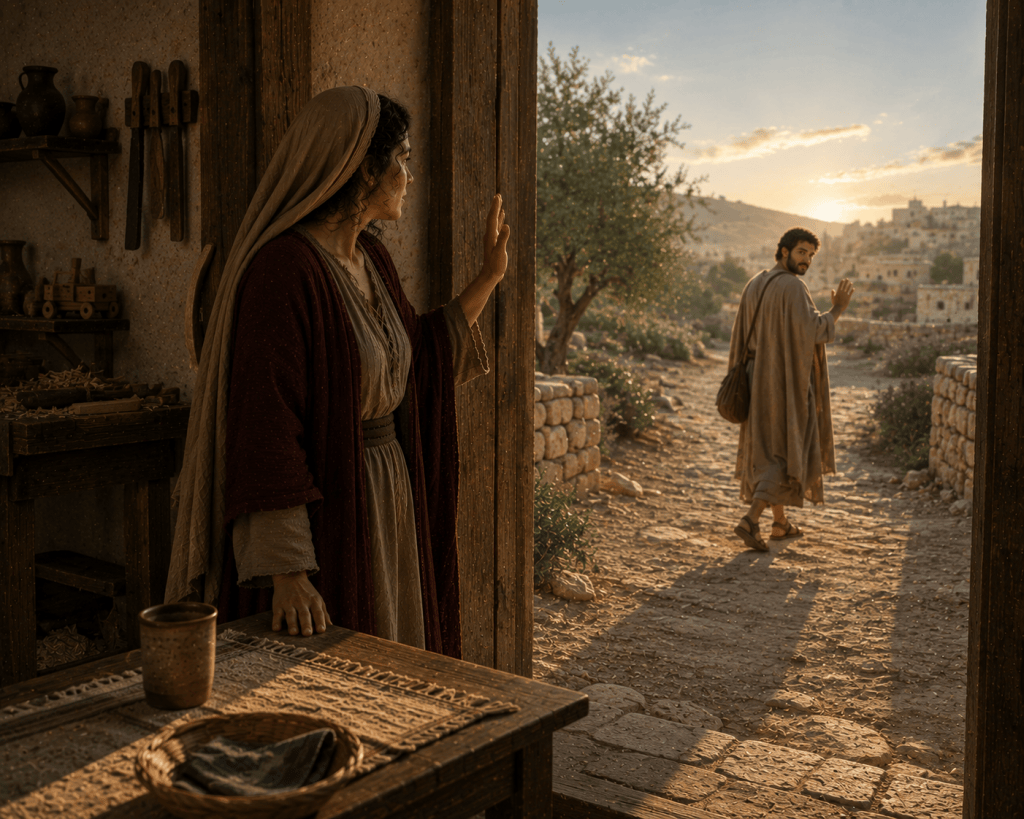
She had already learned how to lose one person from the house. Perhaps that made watching another walk away both easier—and infinitely harder.
There must have been a last morning.
Not the last time Mary saw Jesus.
Not a final goodbye.
Not yet.
Just the last morning when Jesus woke beneath the roof in Nazareth and lived there.
The last morning when his things belonged in that house because it was his home rather than the place he returned to visit.
The last time Mary could reasonably assume:
He’ll be here for dinner.
Scripture doesn’t give us that morning.
It doesn’t tell us whether Jesus sat Mary down and explained that he was leaving.
It doesn’t tell us whether she knew exactly where he was going.
It doesn’t tell us whether he packed anything.
It doesn’t tell us whether Mary cried.
The Gospels simply move.
Jesus is in Nazareth.
And then the hidden years are over.
John is preaching.
Jesus goes to the Jordan.
The carpenter becomes something else.
And Mary—
who had spent approximately thirty years raising him—
has to let him go.
Maybe she knew before he told her.
Mothers sometimes do.
Not because of supernatural insight.
Because you know the rhythms of someone you have lived beside for decades.
Something had changed.
Jesus had become quieter lately.
Or perhaps more restless.
Not unhappy.
That would have been easier.
Just—
oriented somewhere else.
Maybe Mary caught him standing outside one evening after work.
Not doing anything.
Looking toward the road.
She stopped in the doorway.
Jesus didn’t notice.
And something inside her sank.
Oh.
Perhaps she had seen that look before.
Joseph had looked toward roads when there was somewhere they needed to go.
People do that before journeys.
Their bodies begin leaving before their feet do.
Mary went back inside.
She didn’t ask.
Not yet.
Maybe Jesus began putting things in order.
That would have frightened her more.
A tool returned carefully to its place.
A customer told when something would be finished.
A debt settled.
A piece of work completed sooner than expected.
Nothing dramatic.
But Mary noticed.
Of course she noticed.
“You’re finishing everything.”
Jesus looked up.
“I usually finish things.”
“Not like this.”
He returned to his work.
Mary watched him.
“Jesus.”
He sighed softly.
Not irritated.
Caught.
Maybe that was when he told her.
“I need to go.”
Three words.
Perhaps Mary had known those words were coming since an angel told her thirty years earlier that this child belonged to a purpose larger than her house.
And still—
they hurt.
“Where?”
“The Jordan.”
“Why?”
“John is there.”
Mary knew of John.
Of course she did.
Elizabeth’s son.
The child who had leapt before either of them had drawn breath outside the womb.
Perhaps stories had reached Nazareth.
John in the wilderness.
John preaching repentance.
People going out to him.
Something happening.
Something beginning.
Mary looked at Jesus.
“When?”
Maybe he answered:
“Tomorrow.”
Tomorrow.
That word again.
Perhaps Mary hated it now.
Tomorrow had once meant Joseph would finish something.
Tomorrow had become the day life changed.
Now Jesus was using it.
“Tomorrow?”
“Yes.”
“For how long?”
And perhaps—
Jesus didn’t answer.
That would have been the moment.
Not I’m leaving.
He couldn’t tell her when he was coming home.
Mary sat down.
Maybe Jesus did too.
For a moment neither spoke.
She had known.
That’s what makes this so complicated.
Mary was not discovering that Jesus had a vocation.
Gabriel had told her before Jesus existed inside her body long enough to move.
Simeon had warned her.
Jesus himself had bewildered her at twelve:
Did you not know that I must be in my Father’s house?
Mary had kept those things.
Pondered them.
Carried them.
She knew Jesus did not belong solely to Nazareth.
She knew he did not belong solely to her.
But knowing something when your child is twelve—
and watching your thirty-year-old son prepare to walk out the door—
are different kinds of knowledge.
Maybe Mary wanted to say:
No.
That possibility matters to me.
Not because she would have stopped him.
Because love sometimes has two simultaneous truths.
I know you must go.
and
I desperately want you to stay.
Mary was allowed both.
Maybe she asked practical questions instead.
Mothers do this when the emotional questions are too large.
“What are you taking?”
“Not much.”
“You need another cloak.”
“I have one.”
“That one is worn.”
“It’s fine.”
“It is not fine.”
“Mama.”
“You don’t know how long you’ll be gone.”
Jesus looked at her.
Neither said anything.
Mary immediately regretted the sentence.
She stood.
Went to find the better cloak.
Perhaps Jesus smiled.
Not mockingly.
Because some things were easier to let her do.
Maybe Mary packed food.
Too much food.
Jesus looked at it.
“Mama.”
“What?”
“I am not crossing the desert.”
“You have to eat.”
“There will be food.”
“You don’t know that.”
“There are villages.”
“Villages do not guarantee food.”
Jesus looked at the pile.
Mary added something else.
“Mary.”
She froze.
He rarely called her that.
Maybe he didn’t.
Maybe that’s too strange between them.
Perhaps simply:
“Mama.”
Softly this time.
Mary stopped.
Jesus put his hand over hers.
“Enough.”
Mary looked at him.
Then at the food.
It was obviously enough.
She knew.
The food wasn’t the point.
Maybe she sat again.
Jesus sat beside her.
For a moment she couldn’t look at him.
“Are you coming back?”
There.
The real question.
Of course he was.
Nazareth appears again.
Mary appears again.
Jesus’ ministry would bring him through familiar places.
But Mary could not know the shape of the coming years from where she sat.
So perhaps Jesus answered carefully.
“Yes.”
Mary looked at him.
“When?”
“I don’t know.”
Not good enough.
But probably the truth.
Perhaps she nodded.
Because what else could she do?
Maybe she thought of Joseph.
Oh, Joseph.
This would have been one of those moments when his absence became new again.
Because this was something they were supposed to do together.
They had raised Jesus together.
Surely they were supposed to stand in the doorway together when he finally left.
Joseph should have been there.
He should have pretended not to be emotional.
Mary should have caught him being emotional anyway.
He should have checked Jesus’ sandals.
Asked whether he had enough money.
Given advice Jesus absolutely did not need.
Maybe Mary suddenly became furious that Joseph had missed this.
Not at Joseph.
At death.
You should be here.
Perhaps that thought hurt almost as much as Jesus leaving.
Maybe Mary went into the workshop that evening.
Jesus was putting away tools.
Joseph’s tools.
His tools now.
There were probably distinctions no longer worth making.
Mary leaned against the doorway.
“How long have you known?”
Jesus thought.
“A while.”
“And you didn’t tell me.”
“I wasn’t ready.”
Mary almost laughed.
“You weren’t ready?”
Jesus smiled slightly.
“No.”
That might have helped.
Because perhaps Mary had imagined Jesus walking toward his mission without hesitation.
But vocation can be certain without being emotionally effortless.
Jesus was human.
Leaving home meant leaving home.
Maybe he looked around the workshop.
Joseph’s bench.
The walls.
The tools.
Thirty years.
Perhaps Jesus picked up one of Joseph’s tools.
Turned it once in his hand.
Then put it back.
Mary saw.
Neither said his name.
They didn’t need to.
“What will happen to the work?”
Maybe Mary asked.
Jesus had arranged something.
Perhaps another craftsman would take certain customers.
Perhaps relatives would help.
Perhaps there was no neat business transition at all.
We don’t know.
But Jesus’ departure had practical consequences.
The Messiah did not leave an abstract theological household.
He left a house with expenses.
Repairs.
Food.
A widowed mother.
People who expected things.
Maybe that bothered Mary.
Not because she doubted him.
Because tomorrow still needed bread.
“What about you?” Jesus asked.
Mary looked at him.
“What about me?”
“Will you be all right?”
There it was.
Mary immediately became offended.
“I have survived without supervision for quite some time.”
“I know.”
“I can manage a house.”
“I know.”
“I repaired that latch.”
Jesus looked toward the latch.
Mary pointed.
“It still works.”
“I didn’t say anything.”
“You were thinking something.”
Jesus smiled.
Maybe Mary smiled too.
Then her face changed.
Because jokes can only hold grief for so long.
“I’ll be fine.”
Jesus looked at her.
Mary knew that look.
Joseph used to give her that look.
The one that said:
That was not the question.
Mary sighed.
“I’ll miss you.”
Jesus nodded.
“I’ll miss you too.”
Maybe that was enough.
No speech.
No declaration.
Just truth.
Perhaps they ate dinner together.
Their last dinner before the ministry began.
Maybe Mary made something Jesus loved.
She would deny this.
Jesus would know.
“You made this because I’m leaving.”
“I make this all the time.”
“No, you don’t.”
“Eat.”
Maybe they talked about ordinary things deliberately.
A neighbor.
Work.
Someone’s child.
A relative.
Anything except tomorrow.
Perhaps that was merciful.
And maybe Jesus ate more than usual because he knew Mary needed him to.
Afterward, perhaps he cleaned the table.
Mary protested.
“I can do that.”
“I know.”
He kept cleaning.
She let him.
The house grew quiet.
Mary knew she should sleep.
She didn’t want to.
Because sleeping would make morning arrive faster.
That is such a childish human instinct.
If I stay awake, tomorrow cannot come.
Of course it does.
Maybe Mary lay in bed.
Joseph’s side long empty.
Jesus sleeping somewhere else in the house.
For one final night—
she could hear another person breathing under her roof.
Perhaps she remembered every version of him.
Newborn.
That first smile.
Toddler laughter.
Fever.
The boy who wouldn’t sleep.
The child at dinner.
The twelve-year-old she lost in Jerusalem.
The adolescent whose voice cracked.
The young man at Joseph’s bench.
All of them sleeping somewhere inside the man who would leave tomorrow.
Maybe Mary cried.
Quietly.
Not because she wanted to burden Jesus.
Not because his leaving was wrong.
Because an era was ending.
She had spent nearly thirty years with one central earthly responsibility:
Raise him.
And now—
she had.
That must have been strange.
What do you do when the thing God entrusted to you no longer needs raising?
Perhaps Mary realized something almost frightening:
She had succeeded.
Jesus could leave because he was grown.
He could walk into the world because he had learned how to live in it.
Whatever mystery surrounded his identity, there was also something beautifully ordinary here.
Mary and Joseph had raised a child capable of leaving home.
That is one of the goals of parenthood.
And one of its cruelties.
Morning came.
Of course it did.
Maybe Mary had barely slept.
Jesus looked perfectly awake.
Unfair.
Perhaps she made breakfast.
Too much.
Again.
Some habits survive every transition.
Jesus ate.
Mary barely did.
Then he gathered his things.
Not much.
A cloak.
Sandals.
Whatever a traveler would reasonably carry.
No enormous pack.
No cinematic luggage.
Just enough.
Mary watched.
Maybe she corrected something.
“You tied that badly.”
Jesus looked down.
“It is tied.”
“Badly.”
“Mama.”
“Give it to me.”
He did.
Perhaps because he understood.
Mary retied it.
Slowly.
More slowly than necessary.
Her hands were close to his chest.
Jesus stood still.
She finished.
Then smoothed the fabric.
There.
Nothing else to fix.
Damn.
Maybe Mary looked up.
Jesus looked down at her.
He was so much taller now.
When did that happen?
Again.
Always.
Perhaps she touched his face.
Not because he was a child.
Because he was her son.
Her palm against his cheek.
Jesus leaned into it for just a second.
That might have undone her.
“Be careful.”
What a ridiculous thing to say to Jesus.
What else was she supposed to say?
“I will.”
“Eat.”
“I will.”
“Sleep somewhere safe.”
“Mama.”
“I’m serious.”
“I know.”
“Don’t—”
She stopped.
Don’t what?
Don’t become who you are?
Don’t go where God is calling?
Don’t let anything happen to you?
Don’t fulfill the prophecy I have spent thirty years pretending not to fear?
Mary swallowed.
“Come home when you can.”
Maybe Jesus’ expression softened.
“I will.”
And perhaps that was the closest thing she got to a promise.
Then he turned.
Walked.
Mary stood in the doorway.
This is where religious art would be tempted to make everything grand.
Golden light.
Jesus walking toward destiny.
Mary understanding perfectly.
Perhaps heaven itself pointing the way.
I don’t think it felt like that.
I think it felt like watching your son walk down a road.
His sandals against dust.
His pack over one shoulder.
Dark hair.
Familiar stride.
Maybe he turned once.
Of course I want him to turn once.
Mary lifted her hand.
Jesus did too.
Then he continued.
Mary watched.
She had probably watched him walk away thousands of times.
To work.
To synagogue.
To a neighbor.
Into town.
The difference was that every other time she knew roughly when he would return.
Now she didn’t.
Jesus became smaller.
Mary stayed.
Maybe she wanted to call him back.
Not forever.
Just:
Wait.
One more thing.
I forgot something.
Take more bread.
Your cloak.
Anything.
Something that would make him walk back toward her one more time.
She didn’t.
That might have been Mary’s first act of motherhood in Jesus’ public life:
She did not call him back.
She watched until she couldn’t see him.
Maybe even after.
Mothers do that.
Staring at the place where someone disappeared as though enough looking might bring them back into view.
Then—
silence.
Again.
Mary turned.
Went inside.
And there it was.
The house.
Joseph’s workshop.
Jesus’ things.
The table.
The latch she had repaired.
Everything exactly where it had been an hour earlier.
But something fundamental had changed.
Mary stood there.
Perhaps she had experienced this once already.
After Joseph’s burial.
The house looked the same.
The sound was wrong.
Now it happened again.
Except Jesus was alive.
That mattered.
But absence has its own acoustics.
Maybe Mary sat down.
Not crying now.
Just listening.
Nothing.
No Joseph working.
No Jesus working.
No conversation from another room.
No one asking where something was.
No one hungry.
No one coming in for dinner.
For the first time in perhaps thirty years—
Mary’s day belonged entirely to Mary.
That may not have felt liberating.
Not yet.
It may have felt terrifying.
What now?
That question interests me almost as much as Jesus leaving.
Because Mary’s story does not stop when Jesus walks toward the Jordan.
She has a life too.
What does she do with the morning after motherhood changes shape?
Maybe she cleaned.
Of course she did.
Human beings clean when reality becomes unmanageable.
She picked up Jesus’ cup.
Washed it.
Put it away.
Then stared at where she had put it.
Maybe she went into the workshop.
That might have been harder.
Jesus had left something unfinished.
Or perhaps, unlike Joseph, he hadn’t.
Everything was in order.
That might have been worse.
He had meant to leave.
Mary touched the bench.
Joseph’s bench.
Jesus’ bench.
Now—
just a bench.
Maybe she sat there.
For the first time.
She had stood in that doorway for decades watching the two people she loved work.
Now she occupied the empty space herself.
Perhaps she thought:
Well.
That is often what comes after enormous change.
Not revelation.
Not eloquence.
Just:
Well.
Then maybe someone knocked.
A neighbor.
Of course.
Life refuses to give us appropriately dramatic solitude.
Mary opened the door.
A woman stood there.
Perhaps the same imaginary friend who always made too much bread.
She looked past Mary.
“Jesus gone?”
Mary nodded.
“This morning.”
The woman looked at her.
Not pity.
Just understanding.
“Come eat with us tonight.”
Mary immediately said:
“I’ll be fine.”
The woman ignored this.
“Before sunset.”
“I have food.”
“I didn’t ask.”
Mary almost smiled.
Maybe Mary went.
That matters.
Because Jesus leaving did not mean Mary’s life emptied.
It changed.
Again.
Widowhood had already forced her to build relationships beyond the little triangle of Mary-Joseph-Jesus.
Now those relationships held her.
Family.
Friends.
Neighbors.
Community.
Perhaps the very life she had reluctantly learned after Joseph’s death became the thing that made Jesus’ departure survivable.
Maybe Joseph’s death had taught her:
Someone leaving does not mean love leaves with them.
She could survive an empty chair.
She could survive a quiet workshop.
She could survive dinner for one.
She didn’t like it.
But she knew how.
Perhaps that’s why Mary could let Jesus go.
Not without pain.
But without making her loneliness his responsibility.
That’s an extraordinary kind of maternal love.
She could have said:
Your father is gone.
You’re all I have.
Don’t leave me.
Maybe some part of her felt exactly that.
But she didn’t make it his burden.
She let him go.
And perhaps years later, standing at Cana while Jesus told her his hour had not yet come, Mary would encounter another threshold.
Again:
He is mine.
He is not mine.
I know him.
I do not fully understand him.
I must trust.
She had practiced this in Nazareth.
At a doorway.
Watching him leave.
Maybe Mary eventually learned where Jesus was.
News traveled.
John baptized him.
Something happened.
Then Galilee.
People began talking.
Have you heard?
The carpenter from Nazareth—
Mary hated that phrasing.
Yes.
She had heard.
Perhaps neighbors came with stories.
“He’s teaching.”
“I know.”
“They say crowds are following him.”
Mary stared.
“Crowds?”
Maybe she wasn’t prepared for crowds.
“They say he speaks differently.”
Of course he does.
Mary knew that voice before it could form words.
Then:
“They say he healed someone.”
And the world changed again.
Maybe Mary sat very still after hearing that.
Because there it was.
The hidden thing becoming visible.
Thirty years.
Gabriel.
Simeon.
The Temple.
All those mysteries kept in her heart.
Now other people could see something too.
Maybe part of her was proud.
Maybe part of her was afraid.
Because once the world discovers someone—
the world gets access to them.
And the world is not always gentle.
Perhaps Mary wished Joseph were there.
Again.
Always at thresholds.
You should see this.
You should hear what they’re saying about him.
You knew.
We both knew.
But did we know this?
No answer.
Maybe she told him anyway.
Quietly.
“Your son has apparently started attracting crowds.”
Pause.
“You would hate that.”
Maybe she smiled.
But that first morning—
before crowds,
before Cana,
before healings,
before disciples,
before conflict,
before anyone called him teacher—
Jesus was simply Mary’s son walking away from home.
And Mary was simply his mother standing in the doorway.
Perhaps that’s where the hidden life truly ended.
Not at the Jordan.
Not when the heavens opened.
Not when John saw him.
For Mary—
it ended when Jesus disappeared around the bend in the road.
She had been there when his life entered the world.
Now she was there when his life entered the world beyond her.
That is another kind of birth.
Maybe it hurt in some of the same places.
Thirty years earlier, Mary’s body had opened and Jesus had been separated from her for the first time.
She held him immediately afterward.
Kept him close.
Fed him.
Protected him.
Raised him.
Now another separation.
No blood.
No labor.
Just a road.
And perhaps motherhood is full of these smaller births.
The first step away.
The first night elsewhere.
The first secret.
The first decision you cannot make for them.
The first road they take without you.
Until finally—
they belong to their own life.
Mary had spent thirty years loving Jesus close.
Now she would have to learn how to love him at a distance.
That may have been one of the hardest lessons of her life.
And one she would need desperately later.
Maybe after Jesus disappeared from view, Mary whispered something.
Not:
Stay.
Not:
Come back.
Perhaps simply:
“Go.”
Not because she wanted him gone.
Because she loved him enough not to make him turn around.
Then she went inside.
The house was quiet.
Joseph was gone.
Jesus was gone.
Mary remained.
And perhaps, for the first time since Gabriel entered the life of a frightened teenage girl thirty years earlier, Mary stood inside a question that belonged almost entirely to herself:
Who am I now?
Not Joseph’s wife.
Not the mother of a child who needs raising.
Mary.
Still called.
Still living.
Still loved.
Still part of the story.
She just didn’t know yet what the next part would ask of her.
So perhaps she did what she had always done when she could not see what came next.
She kept what she knew.
She released what she could not keep.
And she trusted enough—
not to call him back.


