©MS 2026
The Black Scapular of the Seven Sorrows of Mary
A Servite Sign of Compassion at the Foot of the Cross
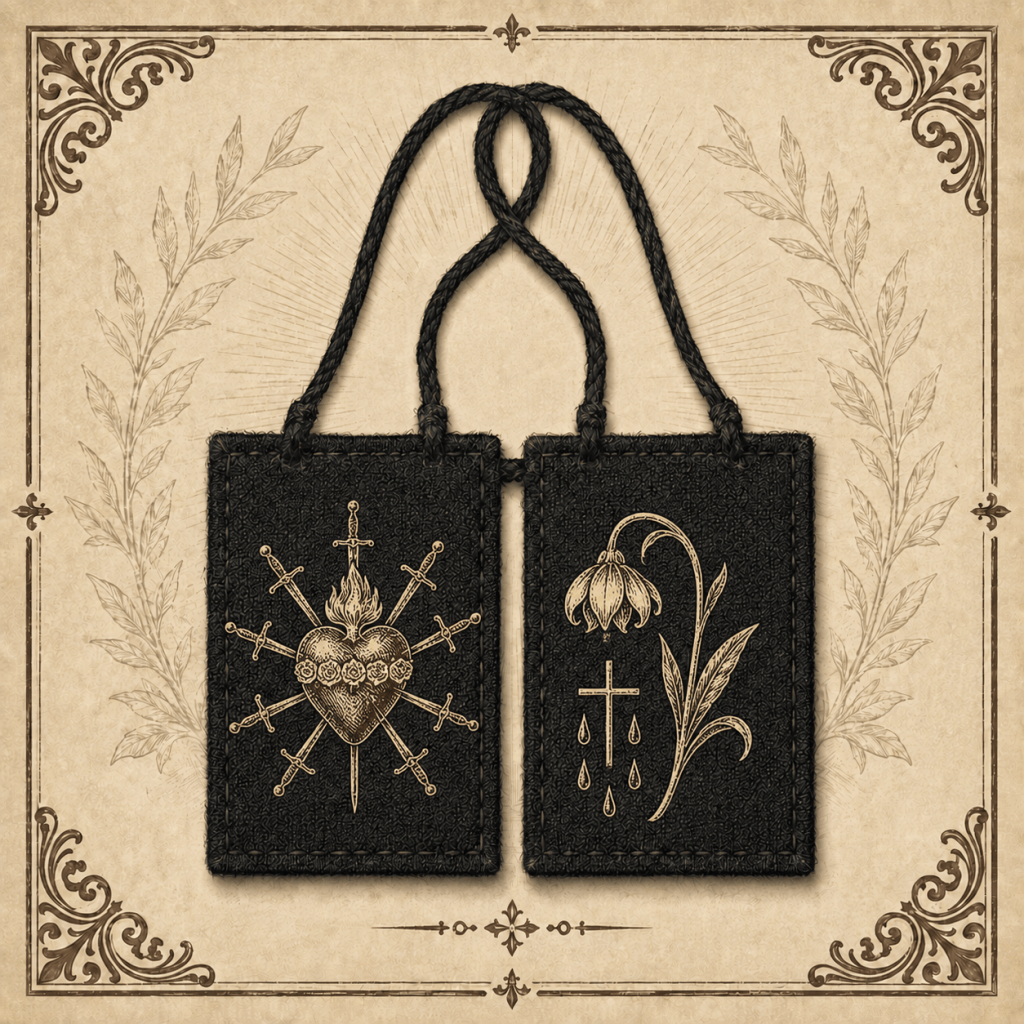
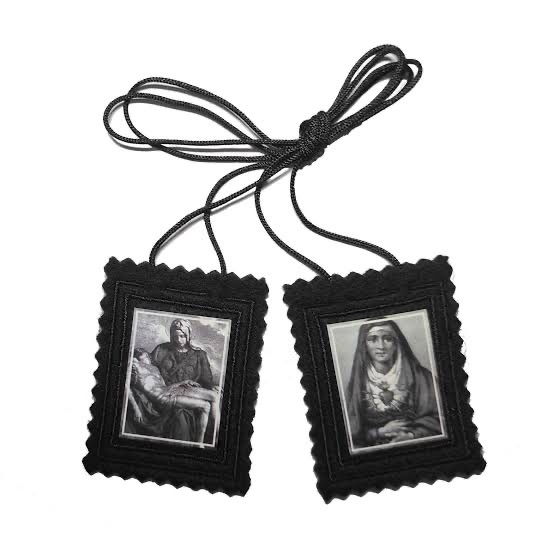
The Black Scapular of the Seven Sorrows of Mary is part of one of the oldest Marian religious families within the Catholic Church: the Order of Friar Servants of Mary (Latin: Ordo Fratrum Servorum Mariae), more commonly known as the Servites. The Scapular is simple in design. Two rectangles of black cloth are fastened by cords and worn over the shoulders. Often, an image of Our Lady of Sorrows is embellished on one side. The first descriptions of the scapular do not suggest that a specific image, inscription or ornamentation is necessary. But the devotion of the Black Scapular reaches deeper than mourning. When we wear the Black Scapular we stand at Mary’s side during Christ’s Passion. Through Mary we meditate on the suffering Christ experienced on the cross and throughout the world. Through Mary we learn to recognize Christ in those who are suffering; those who mourn, have been abandoned, are oppressed or are afraid. The Black Scapular does not ask that we simply look sad. It asks that we be compassionate.
⸻
At a Glance
| Full Name | Scapular of the Seven Sorrows—or Seven Dolours—of the Blessed Virgin Mary |
| Common Name | The Black Scapular |
| Traditional Color | Black |
| Associated Tradition | Order of Friar Servants of Mary, or Servites |
| Devotional Focus | Mary’s sorrows, the Passion of Christ, compassion, service, and solidarity with those who suffer |
| Historical Origin | Developed among lay confraternities associated with the Servite Order |
| Single Founder or Apparition? | No historically documented single origin has been established |
| Traditional Form | Two pieces of black cloth joined by cords |
| Traditional Image | Our Lady of Sorrows, often with a sword or seven swords piercing her heart |
| Confraternity Association | Confraternity of the Seven Sorrows of Mary |
| Formal Investiture | Historically administered through the Servite Order or priests receiving the proper faculty |
| Feast | Our Lady of Sorrows, September 15 |
| Does It Guarantee Protection or Salvation? | No |
| Central Meaning | To remain with Mary beside the suffering Christ and to serve Christ in suffering humanity |
The historical scapular tradition is documented in early twentieth-century Catholic reference works, while the continuing spiritual emphasis on Mary at the Cross remains central to the modern Servite Order.
⸻
The Order of the Servants of Mary
The Servite Order’s origins are traditionally placed in Florence in 1233. Legend has it that seven men of some means would go on to renounce their wealth and comforts and flee from society to live a life of common prayer, poverty, penance, and brotherhood. These men are now commemorated together as the Seven Holy Founders. They would eventually settle at Monte Senario outside of Florence. The first lengthy account of the Order’s origins, the Legenda de origine Ordinis, was not penned until about 80 years later. As such, the Order recognizes the distinction between the historical record and the spiritual tradition by which the founders have come to be remembered. The Order received its final papal approbation in 1304. The Servites did not simply exist to meditate on sorrow.
Their spirituality rests upon:
- Service to God and humanity
- Fraternal communion
- Attention to the Word of God
- Mercy toward those in need
- Marian discipleship
- Peace and reconciliation
- Presence beside human suffering
The Order’s official spirituality describes Mary as both the servant of the Lord and the mother who participates in her Son’s saving suffering. Her presence at the Cross became one of the most characteristic elements of Servite identity.
⸻
Did the Seven Founders Begin with the Seven Sorrows?
Some older devotional histories claim that devotion to Mary’s sorrows was adopted as the main devotion of the Order by the Seven Founders as early as 1239. The development of this devotion within the Order is likely more gradual. It is true that the founders were Marian penitents from the beginning, and Mariolatry at the Passion became more and more characteristic of the Servite Order throughout the succeeding centuries.
According to the Order’s own concise historical/spiritual presentation, this devotion “…developed and gave rise to more specific prayers, feasts, the Servite Crown, and Via Matris.” A votive Mass of the Seven Sorrows was approved for the Servites in 1668. Our Lady of Sorrows was declared patroness of the Order in 1692, and she continues to be celebrated in the current Servite calendar on September 15 as the Order’s principal patroness. The devotion is therefore ancient in the Order. We should not necessarily assume that its currently fully articulated form was practiced in exactly the same way during the Order’s infancy.
⸻
Where Did the Black Scapular Come From?
In contrast to other scapular devotions, there is no single well-known visionary or apparition or well-documented moment of origin associated with the Black Scapular. Rather it developed through lay association with the Servite Order. Following ecclesiastical approbation of the Order in the thirteenth century, laymen and women began forming confraternities of the Sorrows of Mary, communities which spiritually connected members with the Servites. Members of these communities would later adopt the use of a small black scapular, based on the black habit worn by the Order. It is impossible to pinpoint the date of origin for when the small scapular first began to be used. That isn’t historically uncommon. The first examples of devotional scapulars typically developed over time as lay confraternities based their scapulars on portions of the religious habit miniaturized for lay use as signs of membership.
The Black Scapular should not be seen as something which was introduced suddenly at one moment in time, but rather as a miniature version of the Servite religious habit for those members and associates living secular lives outside of the friary or convent.
⸻
Why Is It Black?
The most direct historical reason is simple:
It reflects the black habit of the Servite Order.
The full Servite habit traditionally includes a black tunic and scapular. Lay associates adopted the same color when wearing the smaller devotional form.
Black also naturally became associated with:
- Mourning
- Sorrow
- Penitence
- The Passion
- Mary’s grief
- Solidarity with those who suffer
These meanings reinforce the devotion, but the scapular is not black because Catholicism assigns one universal meaning to the color.
It is black because it belongs to the Servite family.
⸻
What Are the Seven Sorrows?
Christian devotion gradually identified seven principal moments of sorrow in Mary’s life.
The number seven carries biblical associations with completeness or fullness. The Seven Sorrows therefore represent not only seven isolated events, but the fullness of Mary’s participation in the suffering surrounding her Son’s life and Passion.
The traditional mysteries are:
1. The Prophecy of Simeon
Simeon foretells that Jesus will be opposed and that a sword will pierce Mary’s own soul.
Scriptural foundation: Luke 2:34–35
2. The Flight into Egypt
Mary and Joseph flee with Jesus to escape Herod’s attempt to kill the child.
Scriptural foundation: Matthew 2:13–15
3. The Loss of the Child Jesus in Jerusalem
Mary and Joseph search for Jesus for three days before finding him in the Temple.
Scriptural foundation: Luke 2:41–52
4. Mary Meets Jesus on the Road to Calvary
Mary encounters her condemned Son as he carries the Cross.
Devotional foundation: This meeting belongs to Christian devotional tradition and the Stations of the Cross; it is not narrated explicitly in the canonical Gospels.
5. Mary Stands at the Foot of the Cross
Mary remains beside Jesus during his Crucifixion and receives the beloved disciple as her son.
Scriptural foundation: John 19:25–27
6. Jesus Is Taken Down from the Cross
Mary receives or remains with the body of her Son after his death.
Scriptural and devotional foundation: The removal of Jesus’ body is narrated in the Passion accounts, while the familiar image of his body placed specifically in Mary’s arms is developed through Christian tradition and sacred art.
7. Jesus Is Placed in the Tomb
Mary witnesses or contemplates the burial of her Son.
Scriptural and devotional foundation: Matthew 27:57–61; Mark 15:42–47; Luke 23:50–56; John 19:38–42
The Church’s Directory on Popular Piety recognizes the traditional devotion to seven particular incidents of sorrow in Mary’s life and relates it closely to the Via Matris, the Way of the Sorrowful Mother.
⸻
Not Every Sorrow Is Recorded in the Same Way
The Seven Sorrows are a devotional structure.
Several are directly narrated in Scripture.
Others are contemplative reconstructions developed through liturgy, preaching, art, and popular devotion.
This does not make them meaningless or deceptive.
It means they should be described accurately.
The devotion gathers the biblical and traditional memory of Mary’s suffering into a prayerful sequence. It does not claim that the Gospels provide a numbered list titled “The Seven Sorrows.”
⸻
What Does the Black Scapular Symbolize?
Standing with Mary at the Cross
The central Servite image is Mary standing beside the Crucified Christ.
She does not flee from suffering.
She cannot remove the Cross.
She remains.
John Paul II described Mary’s perseverance beneath the Cross as the culmination of her pilgrimage of faith. Her suffering becomes a school of compassion rather than despair.
The scapular therefore symbolizes spiritual presence:
I will not automatically turn away because another person’s pain makes me uncomfortable.
⸻
Compassion Rather Than Observation
The English word compassion comes from roots meaning to suffer with.
Devotion to Our Lady of Sorrows is not intended to produce fascination with tragedy. It is meant to form the capacity to remain present, tender, and faithful when suffering cannot be immediately solved.
John Paul II connected Mary’s sorrow with the compassion of the Good Samaritan: the willingness to stop beside the wounded person rather than crossing to the other side.
⸻
Union with the Passion of Christ
The scapular ultimately directs attention toward Jesus.
Mary’s sorrow matters because of her relationship with her Son and her participation in the events of his saving Passion.
The memorial of Our Lady of Sorrows follows the Feast of the Exaltation of the Holy Cross. Paul VI described September 15 as an occasion to contemplate the suffering Mother together with the Son lifted upon the Cross.
The scapular is Marian.
Its center remains Christ.
⸻
Service to Suffering Humanity
The Servite understanding of Mary’s sorrow does not end at Calvary as an event in the past.
The Order’s constitutions use Mary at the foot of the Cross as a model for standing beside people in whom Christ continues to suffer. Servite spirituality therefore connects devotion with service to the sick, poor, grieving, oppressed, divided, or abandoned.
The Black Scapular quietly asks:
At whose cross am I willing to remain?
⸻
Mourning with Hope
Christian sorrow is not intended to become hopelessness.
Mary’s experience does not end at the tomb.
The Resurrection does not erase what she endured, but it places suffering within a larger promise.
The wearer is therefore invited to hold grief and hope together—to acknowledge pain truthfully without treating pain as the final word.
⸻
The Scapular and the Servite Confraternity
The Black Scapular became associated with the Confraternity of the Seven Sorrows of Mary, a lay association spiritually connected with the Servite Order.
Historical accounts describe confraternity members as sharing in the spiritual benefits of the Order and wearing the black scapular as a visible badge of that affiliation.
The scapular did not make a layperson a Servite friar, nun, sister, or member of the Secular Order.
It represented a different degree of association.
This distinction remains important:
- Wearing a scapular devotionally
- Being formally invested
- Joining a confraternity
- Entering the Secular Servite Order
are not automatically the same act.
The Secular Order has its own formation, rule, commitments, and approved structure.
⸻
Blessing, Investiture, and Enrollment
Historical sources state that priests could receive authorization from the Prior General of the Servites to enroll members in the confraternity and to bless and invest them with the scapular.
That tells us that formal enrollment historically belonged to an authorized Servite structure rather than being created privately by the wearer.
For current practice, the safest approach is to contact:
- A Servite friar or parish
- A recognized Servite province
- The Servite General Curia
- A priest who has confirmed that he possesses or may receive the proper faculty
I did not locate a current universal English-language enrollment ritual or public set of confraternity statutes on the official Servite websites consulted for this article.
That absence should not be filled with assumptions.
A historical rite may exist without every older obligation or indulgence remaining unchanged today.
⸻
What Commitments Belong to the Scapular?
The broad spiritual commitments are clear:
- Devotion to Mary in her Sorrows
- Meditation upon the Passion of Christ
- Prayer
- Conversion
- Compassion toward those who suffer
- Service to the Church and humanity
- Spiritual association with the Servite tradition
Some contemporary devotional sources list more specific obligations, such as wearing the scapular continuously, praying for fifteen minutes each day for the Church and the Servite Order, reciting particular Marian prayers, and performing works of mercy.
However, I did not find those exact obligations stated in the current official Servite materials reviewed for this article.
They should therefore be presented cautiously.
Before treating any modern list as universally binding, a prospective confraternity member should ask the Servite authority conducting the enrollment:
What promises, prayers, or practices am I actually accepting under the current statutes?
That is more responsible than copying requirements from devotional websites without verifying their present canonical status.
⸻
The Graces of the Black Scapular
Like every Catholic scapular, the Black Scapular is a sacramental.
It does not confer grace mechanically.
It does not replace Baptism, the Eucharist, Reconciliation, prayer, repentance, or charity.
Its spiritual fruit comes through:
- The prayer of the Church
- Meditation on Christ’s Passion
- Mary’s intercession
- Conversion of life
- Growth in compassion
- Participation in the Servite spiritual family
- Cooperation with God’s grace
The object assists the person.
It does not act independently of the person’s faith and response.
⸻
What About the “Seven Promises”?
Popular devotional literature frequently presents seven promises allegedly given by Mary to those who honor her Sorrows.
These promises are often attributed to revelations received by St. Bridget of Sweden and may include peace in families, consolation in suffering, spiritual protection, enlightenment concerning divine mysteries, and assistance at death. A number of modern Catholic devotional sites repeat these claims.
Evidence Check
Claim: Mary formally attached seven guaranteed promises to the Black Scapular itself.
Assessment: Not established by the official Servite or Vatican sources reviewed for this article.
Evidence Category: Popular private-revelation tradition frequently associated with the broader Seven Sorrows devotion.
Important Distinction: A promise associated in popular literature with prayers honoring Mary’s Sorrows is not automatically a promise attached canonically to the Black Scapular or its confraternity.
The scapular’s documented historical identity rests upon the Servite habit, the confraternity, and devotion to Mary’s Sorrows—not upon a set of guaranteed outcomes.
Private revelations may support devotion.
They do not create doctrine, override human freedom, or turn a sacramental into a spiritual contract.
⸻
Indulgences and Historical Claims
Historical sources record indulgences granted to the Servite confraternity and note that a summary was approved by the Congregation of Indulgences in 1888. Other devotional histories report earlier indulgences under Pope Paul V in 1611.
These historical grants should not simply be copied into a modern article as though nothing changed.
In 1967, Paul VI reformed the Church’s system of indulgences. The reform abolished the older practice of treating indulgences as attached to devotional objects themselves and emphasized instead the properly disposed person performing the indulgenced work.
Therefore:
- An old indulgence list is historically relevant.
- It is not automatically a current list.
- The cloth itself does not contain an indulgence.
- Current indulgenced acts and confraternity privileges must be verified under present Church norms.
⸻
What Does the Traditional Scapular Look Like?
Historically, the essential requirement was black cloth.
Older descriptions say that no particular ornament was universally prescribed, although the front panel commonly displayed an image of the Mother of Sorrows.
Modern examples may include:
- Mary with seven swords piercing her heart
- Mary standing beneath the Cross
- The sorrowful or Immaculate Heart of Mary
- The Pietà
- The Servite emblem
- The words “Our Lady of Sorrows”
- Images of the Seven Holy Founders
These images explain the devotion.
They are not the scapular’s essential substance.
The black cloth, joined and worn over the shoulders, preserves the connection to the Servite habit.
⸻
The Seven Swords
Our Lady of Sorrows is frequently shown with one or seven swords piercing her heart.
The sword comes from Simeon’s prophecy:
A sword will pierce your own soul.
The seven swords visually represent the Seven Sorrows.
They do not suggest that Mary experienced only seven painful moments. They condense an entire life of faithful participation in Christ’s mission into a recognizable devotional symbol.
⸻
The Servite Rosary or Chaplet of the Seven Sorrows
The Black Scapular is closely related to the Servite Rosary, also called the Chaplet or Crown of the Seven Sorrows.
Its structure ordinarily includes seven groups of prayers, one for each sorrow, accompanied by meditation upon the corresponding mystery.
The prayer developed within Servite spirituality alongside the Via Matris and other devotions honoring Mary’s compassion in the Passion. The Servite Order identifies the Crown of Our Lady of Sorrows and the Via Matris among the characteristic expressions of its Marian tradition.
The chaplet is an especially appropriate prayer for someone wearing the scapular.
That does not prove that every wearer is canonically obligated to recite it daily.
⸻
The
Via Matris
The Via Matris Dolorosae—the Way of the Sorrowful Mother—is structured similarly to the Stations of the Cross.
Rather than following the Passion only through the physical steps of Jesus, it contemplates salvation history through Mary’s sorrowful pilgrimage.
The Vatican describes its present devotional form as developing from earlier practices and later receiving approval from the Apostolic See. Servite sources identify their Order as especially responsible for bringing the devotion into its recognizable form.
The scapular, chaplet, and Via Matris therefore belong to the same spiritual world:
- Remembering
- Remaining
- Suffering with
- Praying
- Serving
- Hoping
⸻
The Feast of Our Lady of Sorrows
The memorial of Our Lady of Sorrows is celebrated throughout the Latin Church on September 15, immediately after the Exaltation of the Holy Cross.
The placement is deliberate.
The Church contemplates first the saving Cross of Christ and then Mary’s faithful presence beside it. Paul VI called the feast an occasion to relive a decisive moment in salvation history and to venerate the suffering Mother together with her Crucified Son.
Within the Servite Order, Our Lady of Sorrows is celebrated as principal patroness.
⸻
Common Misunderstandings
“The Black Scapular is the same as every other black scapular.”
It is not.
Other black scapulars are associated with the Passionists, St. Benedict, and additional devotions. The color alone does not identify the scapular.
“The Seven Founders received this exact small scapular from Mary.”
The small devotional scapular developed later among lay confraternities. Stories involving the founders and a black habit belong to Servite spiritual tradition, but the historical origin of the small scapular is gradual and not tied to one verifiable apparition.
“Wearing it guarantees protection at death.”
No authoritative source reviewed here establishes an automatic guarantee attached to the cloth.
“The seven promises are officially attached to the scapular.”
The popular promises belong to a wider private-revelation tradition concerning the Seven Sorrows. They should not automatically be presented as the canonical privileges of the scapular.
“Devotion to sorrow means Catholics should remain miserable.”
The devotion seeks compassion, fidelity, and hope—not permanent emotional desolation.
“Mary’s suffering competes with Christ’s.”
Her sorrow is contemplated because of her union with Christ and participation in his mission. The Passion of Jesus remains the center.
“The scapular is only about private grief.”
Servite spirituality moves outward from Mary’s sorrow toward service beside the crosses carried by other people.
“Buying one enrolls me in the confraternity.”
Purchase and formal enrollment are not the same thing.
⸻
The Black Scapular Today
The Servite Order remains active internationally, and Our Lady of Sorrows remains central to its official spirituality and liturgical life. Its members describe their vocation as remaining with Mary beside the “countless crosses” upon which Christ continues to suffer in his brothers and sisters.
The scapular itself is less commonly encountered than the Brown Scapular, but the spirituality it represents remains alive through:
- Servite friars, nuns, sisters, and secular members
- The memorial of Our Lady of Sorrows
- The Servite Rosary
- The Via Matris
- Ministries to the sick and grieving
- Prayer for peace and reconciliation
- Service among those experiencing suffering
The Black Scapular is therefore not merely an antique badge of mourning.
It belongs to a living religious family whose spiritual question remains painfully current:
Will we remain near those whose suffering the world would rather avoid?
⸻
A Student’s Reflection
Before researching the Black Scapular, I assumed it would be primarily about grief.
Black cloth.
Seven swords.
A sorrowful Mary.
The symbolism seemed obvious.
What I found was not a devotion asking Christians merely to contemplate sadness.
It asks them to practice presence.
Mary cannot stop Simeon’s prophecy.
She cannot prevent the flight into Egypt.
She cannot remove the Cross from her Son’s shoulders.
She cannot make Calvary painless.
But she remains.
That may be what the scapular is asking the wearer to carry.
Not an explanation for suffering.
Not a promise that suffering will disappear.
A willingness to remain beside it without turning away.
The Servite interpretation makes that even more demanding.
The Cross is not only something that happened to Jesus two thousand years ago. Christ continues to be wounded in people who are sick, grieving, hungry, abused, displaced, persecuted, lonely, or forgotten.
To wear the Black Scapular while ignoring those people would be to wear the symbol without accepting its meaning.
The color black remembers sorrow.
The Servite charism asks what I will do because I remembered.
Perhaps that is the deepest difference between sentiment and devotion:
Sentiment feels something in the presence of suffering.
Devotion remains—and serves.
⸻
Primary and Historical Sources
- Order of Friar Servants of Mary, official history of the Order and the Seven Holy Founders.
- Order of Friar Servants of Mary, official presentation of Servite spirituality, Marian inspiration, service, and Mary at the Cross.
- Servite liturgical calendar, identifying Our Lady of Sorrows as principal patroness of the Order on September 15.
- Congregation for Divine Worship, Directory on Popular Piety and the Liturgy, especially its treatment of the Seven Sorrows and the Via Matris.
- Pope Paul VI, Marialis Cultus, on the memorial of Our Lady of Sorrows.
- Pope John Paul II, homily for Our Lady of Sorrows, September 15, 1987, on Mary’s pilgrimage of faith and compassion for suffering humanity.
- Joseph Hilgers, “Scapular,” The Catholic Encyclopedia, for the historical confraternity, black cloth, investiture, and nineteenth-century indulgence summary.
- Pope Paul VI, Indulgentiarum Doctrina, on the modern reform and proper understanding of indulgences.


