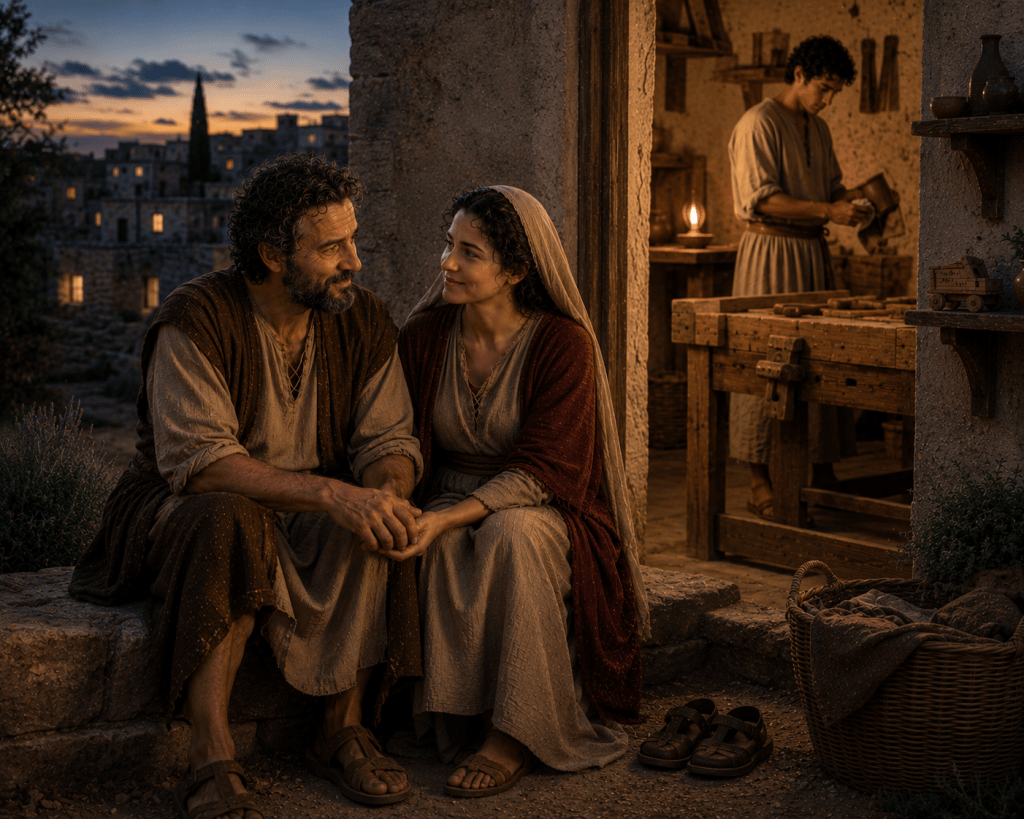
The Invitations of Mary Series
©MS 2026
Scripture never tells us when Joseph died. It simply grows quiet about him. So perhaps their last day together did not feel like an ending at all.
Before we imagine this one, there is something we have to admit.
We do not know how Joseph died.
We do not know when.
We do not know how old he was.
We do not know whether his death came suddenly or after a long illness.
We do not even have a canonical Gospel scene in which Mary becomes a widow.
Joseph is simply there—
and then, eventually, he isn’t.
The last time the canonical Gospels explicitly place Joseph in the story is when Jesus is twelve, during the family’s journey to Jerusalem. Later, Jesus is known through Joseph’s trade and family, but Joseph himself disappears from the narrative. By the Crucifixion, Jesus entrusts Mary to the beloved disciple, something long taken as an indication that Joseph had already died. But Scripture never tells us when that happened.
There is a much later Christian text called The History of Joseph the Carpenter that gives Joseph an elaborate death scene. It imagines him becoming ill at Nazareth with Mary and Jesus beside him, and eventually being mourned and buried. But that work comes centuries after the New Testament and cannot be treated as historical documentation of what happened.
So this one is different from some of the others.
We are stepping deliberately into the silence.
And I think I want to imagine the simplest possibility:
Joseph became ill.
Not dramatically.
Not suddenly collapsing in the workshop.
Just—
ill.
And on the last ordinary day before anyone understood that this illness would be the one from which he did not recover,
Mary and Joseph lived their life.
Maybe Joseph woke first.
Or maybe Mary did.
After decades of marriage, perhaps neither really knew anymore.
There were sounds that belonged to morning.
Fabric shifting.
Someone clearing a throat.
The first movement toward the door.
The scrape of something being moved.
Maybe Mary opened her eyes and Joseph was already sitting on the edge of their sleeping place.
“You’re up.”
Joseph grunted.
Mary watched him.
Something about the grunt was different.
“You all right?”
“Fine.”
Mary continued watching.
Joseph knew that look.
“What?”
“You sound terrible.”
“I just woke up.”
“You sound terrible when you’re awake too.”
Joseph looked over at her.
Mary smiled.
There.
An ordinary marriage.
Perhaps Joseph had been tired lately.
Nothing frightening.
People get tired.
Work had been heavy.
His back bothered him sometimes now.
His hands were stiff in the mornings.
Maybe he’d developed a cough a few days earlier.
Or perhaps there was no cough at all.
Maybe it was simply one of those vague illnesses that begins with:
I don’t feel quite right.
Mary touched his forehead.
Joseph pulled back.
“I’m not a child.”
“I didn’t say you were.”
“You’re checking for fever.”
“Yes.”
“That is what you did when Jesus was a child.”
Mary put her palm back against his forehead.
“And remarkably, it still works on adults.”
Joseph sighed.
Maybe he wasn’t feverish.
Not much.
Mary let him go.
That mattered later.
Perhaps she would remember that.
He wasn’t even very warm.
How could something fatal begin so quietly?
Jesus was grown by then.
For the version of this story we’ve been building, perhaps he was somewhere in his twenties.
A man.
Working.
Strong.
Capable.
Maybe he came in and found his mother staring suspiciously at Joseph.
“What?”
“Your father says he’s fine.”
Jesus looked at Joseph.
Joseph looked at Jesus.
Jesus looked back at Mary.
“He doesn’t look fine.”
Joseph betrayed.
By his own son.
“Thank you.”
“I didn’t say he was dying.”
Joseph pointed toward Jesus.
“See?”
Mary turned.
“Nobody said anything about dying.”
And nobody had.
That word had not entered the house.
Not yet.
Maybe Joseph ate breakfast.
Less than usual.
Mary noticed.
Of course she noticed.
“You’re not eating.”
“I’m eating.”
“You’ve eaten three bites.”
“Were you counting?”
“Yes.”
Joseph looked at Jesus.
Jesus had learned long ago when not to participate.
He became extremely interested in his own food.
Perhaps Joseph intended to work.
Of course he did.
He got up.
Mary said:
“No.”
Joseph stopped.
“What?”
“You’re staying home.”
“I am home.”
“You know what I mean.”
“I have work.”
“Jesus can do it.”
Jesus looked up.
Apparently he had just been volunteered.
Joseph frowned.
“I can work.”
Mary folded her arms.
There are moments in marriage when discussion remains theoretically possible but has ceased to be useful.
Joseph recognized one.
“Fine.”
Mary nodded.
“Fine.”
Maybe he worked anyway.
Not much.
Something small.
Sitting at the bench rather than standing.
Jesus beside him.
Mary passed through once and saw them.
Joseph explaining something.
Jesus listening.
Or perhaps by then the roles had begun to reverse.
Jesus saying:
“Sit. I’ll do it.”
Joseph:
“I am sitting.”
“Then remain sitting.”
Mary almost smiled.
He had learned that tone from someone.
Joseph looked toward her.
“This is your fault.”
Mary continued walking.
Maybe the day was beautiful.
I think I want it to be.
That makes it harder somehow.
No storm.
No strange darkness.
No ominous wind.
Just Nazareth.
Sunlight.
Someone’s laundry moving outside.
Children shouting somewhere.
A neighbor calling to another.
Bread baking.
Wood being worked.
Goats behaving badly.
Life.
Nothing in creation announcing:
Joseph has very little time left.
Because that’s usually how death enters ordinary life.
The world does not change its lighting for us.
Perhaps Mary and Joseph sat together sometime that afternoon.
Not because they knew they should.
Because Joseph was tired.
Mary brought him water.
“Drink.”
“I have been drinking.”
“Not enough.”
“You don’t know that.”
“I know everything.”
Joseph looked at her.
“Of course.”
Mary sat beside him.
Maybe they watched Jesus working.
The grown man at the bench.
Joseph’s bench.
Perhaps Joseph had already begun doing less of the physical work.
Jesus had taken over naturally.
No formal handover.
No day when Joseph said:
This belongs to you now.
It simply happened.
Joseph’s hands became slower.
Jesus’ became more capable.
Work moved toward the younger man.
Maybe Joseph watched Jesus for a while.
“He’s better than I was at that age.”
Mary glanced at him.
“You’d never tell him.”
“No.”
“Why?”
“He knows.”
Mary smiled.
“You should tell him anyway.”
Joseph considered this.
Perhaps later he did.
Maybe that was one of the last things Joseph ever said to Jesus about their work.
We don’t know.
That’s the unbearable freedom of an unwritten story.
It could have been something profound.
Or:
“That joint is crooked.”
Honestly, I prefer the second.
Because neither of them knew they were supposed to be making final statements.
Maybe Joseph fell asleep that afternoon.
That was unusual.
Mary found him sitting somewhere, head tilted awkwardly, asleep in daylight.
She stopped.
Watched his chest.
Rise.
Fall.
Something uneasy moved through her.
Not fear yet.
Just attention.
She put a covering over him.
Joseph woke.
“I wasn’t asleep.”
“You were snoring.”
“I don’t snore.”
Mary stared at him.
Joseph closed his eyes again.
Perhaps Mary sat nearby instead of returning immediately to whatever she had been doing.
She had things to do.
There were always things to do.
But she stayed.
Maybe she mended something.
Worked with her hands.
Listened to Joseph breathe.
No revelation.
No voice from God.
Just an instinct:
Stay here for a little while.
When Joseph woke, maybe he caught her watching.
“What?”
“Nothing.”
“You’re staring.”
“I am allowed to look at my husband.”
Joseph smiled slightly.
That line sounded familiar.
How long had they been married by then?
We don’t know.
But in the imaginative timeline we’ve been building, perhaps more than twenty years.
Long enough that they had accumulated an entire private language.
Looks.
Sounds.
Habits.
Arguments they no longer bothered having.
Stories neither needed to finish.
Joseph knew which household problem Mary would ignore for six months.
Mary knew exactly how long Joseph would insist he could repair something before admitting it needed replacing.
They knew how the other slept.
Ate.
Worried.
Prayed.
Went quiet.
Laughed.
They had become familiar.
Maybe that was the greatest intimacy of all.
We spend so much time imagining the extraordinary beginning of their marriage.
Gabriel.
Pregnancy.
Joseph’s dream.
Bethlehem.
Shepherds.
Egypt.
But eventually—
they had to become an ordinary married couple.
And perhaps by this point they had been ordinary together far longer than they had been extraordinary.
Maybe Mary made dinner.
Joseph complained he wasn’t hungry.
Mary gave him food anyway.
Jesus sat with them.
Perhaps they talked about something completely stupid.
A customer.
A neighbor.
A roof that needed repairing.
Someone in the village who had once again made a terrible decision involving an animal.
Maybe Jesus made Joseph laugh.
A real laugh.
Joseph coughed afterward.
Mary’s eyes went immediately to him.
Joseph waved her off.
“I’m fine.”
Again.
Maybe that was their last family dinner.
And nobody knew.
That’s the part I keep returning to.
If Mary had known—
would she have listened differently?
Would she have memorized the way Joseph’s hand rested on the table?
Would she have watched his face while he laughed?
Would she have asked Jesus to repeat whatever ridiculous thing he had said just to hear Joseph laugh again?
Would she have noticed exactly what he ate?
What he wore?
Where the lamp sat?
Which cup he used?
We want last moments to become sacred because they are last.
But usually they become sacred afterward.
At the time, they are just Tuesday.
Perhaps Joseph went outside after dinner.
Mary followed.
“You should be resting.”
“I have been resting all day.”
“Exactly.”
“That doesn’t even make sense.”
“It makes sense to me.”
Joseph sat anyway.
Mary sat beside him.
Maybe evening was cooling.
Nazareth settling.
Jesus was inside putting something away.
Mary and Joseph had a few minutes alone.
Not a grand final conversation.
What would they possibly say?
Mary, let us now review our marriage because I may die shortly.
No.
Joseph probably said something about tomorrow.
That’s what would make it hurt.
“Tomorrow I’ll finish that.”
Or:
“I need to speak to Eli tomorrow.”
Or:
“When I feel better, we should—”
Tomorrow.
People who don’t know they are dying make plans.
Mary answered.
“Fine.”
Maybe:
“Not unless you’re feeling better.”
Joseph sighed.
“Yes, Mary.”
Perhaps he reached for her hand.
Not because death was coming.
Because after decades together, sometimes his hand simply found hers.
Their fingers rested together.
Older than when they first touched.
Joseph’s rough from work.
Mary’s marked by work of another kind.
Neither young anymore.
Though perhaps Mary was still only somewhere around forty, depending on the chronology we’re imagining.
They had lived an entire lifetime already.
Maybe Mary looked at him.
Joseph noticed.
Again:
“What?”
She smiled.
“Nothing.”
There was always something.
Perhaps Joseph squeezed her fingers.
Maybe he said:
“You worry too much.”
Mary looked at him.
“You give me things to worry about.”
Joseph smiled.
“I suppose.”
Jesus came outside.
“Are you two coming in?”
Mary looked toward him.
“In a minute.”
Jesus nodded.
Then perhaps:
“Papa?”
Joseph looked up.
“Tomorrow, don’t start without me.”
Joseph frowned.
“I know how to work without you.”
Jesus smiled.
“I know.”
Then went inside.
Joseph watched him go.
Maybe there was pride in his face.
Mary saw it.
“You should tell him.”
Joseph knew what she meant.
“I will.”
Did he?
Maybe.
Maybe not.
We don’t know.
That night Joseph went to bed.
Mary beside him.
Perhaps he was restless.
Perhaps not.
Maybe he slept perfectly well.
Maybe Mary did too.
That possibility feels important.
She may not have spent their final ordinary night staring at him prophetically.
She may have rolled over.
Pulled the covering toward herself.
Joseph pulled it back.
Mary tugged.
Joseph sighed.
A marriage.
Maybe she fell asleep first.
Maybe Joseph did.
Maybe one of them whispered:
“Goodnight.”
And the other answered.
No significance attached.
They had said it thousands of times.
Then morning came.
Perhaps Joseph was worse.
Not dying.
Just clearly ill now.
Mary touched his forehead again.
This time—
warm.
“Joseph.”
“I know.”
That would frighten her more than anything.
No argument.
No:
I’m fine.
Just:
“I know.”
Jesus came.
Saw his father.
His expression changed.
“Papa?”
Joseph tried to sit up.
Jesus helped him.
And perhaps that was the beginning.
The point after which the days were no longer ordinary.
We don’t know whether Joseph’s final illness lasted hours.
Days.
Weeks.
Months.
If there was one at all.
But if there was time, Jewish life around death would have been intensely communal. Burial was traditionally carried out quickly, ideally the same day when circumstances allowed, and the dead were accompanied to burial rather than left to the family to manage alone. The closest mourners then entered an intense period of mourning associated with seven days—the ancient roots of what became the practice of shiva.
So Mary would not necessarily have been left alone to somehow manage Joseph’s death.
People would come.
Family.
Neighbors.
The community that had known Joseph as carpenter, husband, father, neighbor.
There would be practical things to do because death, infuriatingly, creates work.
The body cared for.
Burial prepared.
People notified.
Food brought.
Prayers.
Lamentation.
The dead honored.
The bereaved surrounded.
Jewish mourning tradition places the grieving family within a community rather than expecting them immediately to resume ordinary life.
But before any of that—
there was still Joseph.
And perhaps the later apocryphal tradition preserved something emotionally beautiful even if we cannot treat its details as history.
The History of Joseph the Carpenter imagines Joseph dying at home with Mary and Jesus present. Jesus closes Joseph’s eyes after death, and the people of Nazareth gather to mourn him.
We cannot say that happened.
But I understand why Christians imagined it.
Because if Joseph died before Jesus’ ministry—
then the man who had once held the infant Jesus may eventually have been held by him.
Perhaps Joseph became weaker.
The carpenter who had carried wood could no longer stand without help.
The man who carried Jesus into Egypt now leaned on Jesus to cross a room.
Maybe Joseph hated that.
“I’m fine.”
Jesus looked at him.
“No, you’re not.”
Joseph glared.
Jesus had learned from Mary.
Maybe Mary cared for Joseph.
Water.
Cloths.
Food when he could eat.
Blankets when he was cold.
The thousand unremarkable acts humans perform when someone they love becomes ill.
And perhaps she remembered doing the same for Jesus.
Except this was different.
Jesus always got better.
Children get sick.
Then they run outside again.
Joseph wasn’t getting better.
At some point Mary knew.
Maybe before anyone told her.
Bodies tell us things.
Perhaps she went somewhere alone.
Just for a minute.
Pressed both hands against something solid.
A wall.
A table.
Closed her eyes.
No.
Not yet.
They had survived too much together.
Bethlehem.
Egypt.
Fear.
Poverty perhaps.
Parenthood.
Ordinary years.
Surely after all of that they were entitled to grow old.
But life does not negotiate that way.
Maybe Mary prayed.
Not beautifully.
Again.
She had a habit of being placed in situations where polished prayer became impossible.
Please.
Not yet.
Please.
Let him stay.
Would she have asked Jesus?
That question hurts.
Because by then she knew who her son was.
Maybe she knew enough to wonder.
Could he heal Joseph?
Would he?
Should she ask?
But we cannot know when Jesus’ miraculous ministry began in relation to Joseph’s death, because we do not know when Joseph died.
So perhaps Mary never had that question available to her.
Perhaps Jesus was simply her son beside her husband’s bed.
Power hidden.
Mission not yet begun.
And death remained death.
Maybe Joseph knew before Mary accepted it.
Or maybe Mary knew first.
Maybe nobody said the words.
They didn’t need to.
And perhaps there came an evening when Jesus left them alone for a little while.
Not far.
Just enough.
Mary sat beside Joseph.
Joseph’s eyes were closed.
She thought he was asleep.
Then:
“Mary.”
“I’m here.”
Maybe he opened his eyes.
Looked at her.
The girl he had once almost sent away quietly.
The young woman he took to Bethlehem.
The mother he watched become fierce over their child.
The woman who crossed into Egypt beside him.
The wife who had annoyed him.
Laughed with him.
Argued.
Worked.
Aged.
Stayed.
What do you say after a lifetime?
Maybe nothing profound.
Maybe Joseph looked at her and said:
“You need to sleep.”
Mary almost laughed.
“You’re telling me?”
“Yes.”
“No.”
“Mary.”
“No.”
Joseph knew that tone.
Argument over.
Perhaps he smiled.
Small.
Tired.
And Mary took his hand.
I don’t want to imagine Joseph delivering a perfect final speech.
Real dying people are not responsible for giving the living beautiful closure.
Maybe he was too tired.
Maybe words became difficult.
Maybe there were things he never said because he thought there would be another day.
That would be more honest.
Maybe Mary never got a final:
I love you.
Maybe she didn’t need one.
She had twenty years of evidence.
Or thirty.
However long they had.
Love had been:
Get behind me on the road.
Drink this.
I’ll carry it.
You sleep.
I’ll take Jesus.
Move over.
You’re stealing the blanket.
Eat something.
I’ll fix it.
I’ll go with you.
I’m here.
Maybe that was their language.
And when Joseph died—
if Mary was beside him—
perhaps there was no dramatic moment.
One breath.
Then another.
Then a pause that lasted too long.
Mary waited.
Joseph didn’t breathe again.
“Joseph?”
Nothing.
Maybe she knew immediately.
Maybe she didn’t.
“Joseph.”
Jesus came.
And then the world changed.
Perhaps Mary made a sound she had never heard herself make.
Or perhaps she made none.
Grief does not always arrive as crying.
Maybe she simply stared.
Because Joseph had been there for so long that his absence was physically impossible to understand.
There.
His hand.
His face.
His clothing.
Everything Joseph-shaped remained.
Except Joseph.
Jesus might have sat beside him.
His father.
We need not diminish that relationship because Christians confess another Father.
Joseph had raised him.
Protected him.
Fed him.
Taught him.
Worked beside him.
Loved his mother.
Jesus could grieve.
Perhaps Jesus closed Joseph’s eyes.
The later apocryphal story imagines exactly that.
Maybe Mary watched his hand move across Joseph’s face.
Those same hands Joseph had once taught to hold a tool.
Now gentle against the face of the man who taught him.
We cannot know.
But I understand why someone once imagined it.
Then the community came.
Because death does not remain private for long.
Someone heard.
Someone told someone.
Neighbors arrived.
Women came to Mary.
Men helped Jesus.
Practical questions began.
Burial could not simply wait indefinitely while grief caught up; Jewish tradition pressed toward prompt burial, while mourning itself would be given time afterward.
Maybe Mary resented the speed.
He had just died.
How could anyone already be talking about burial?
But this was how the dead were honored.
Joseph would not be left unattended.
He would be cared for.
Accompanied.
Returned to the earth.
Maybe Mary helped prepare him.
Or perhaps others did.
We should be careful about projecting every later Jewish funeral custom unchanged backward into first-century Galilee.
But the Gospel accounts themselves show Jewish burial involving washing or preparation, linen wrappings, spices or aromatics, and placement in a tomb.
Joseph’s community would have known how to bury its dead.
They had done this before.
Mary had not done this with him before.
That was the difference.
Perhaps someone tore a garment in mourning.
Perhaps lamentation filled the house.
Some practices familiar from later Jewish mourning traditions have ancient roots, but we shouldn’t make our hypothetical Joseph funeral into a modern shiva scene transported wholesale into Nazareth.
The safest thing is simpler:
the family mourned, and the community surrounded them.
Jesus went with Joseph’s body.
Of course he did.
Mary too.
Perhaps half of Nazareth followed.
Joseph the carpenter.
Joseph who repaired things.
Joseph who knew everyone’s measurements and everyone’s business.
Joseph who didn’t talk much.
Joseph who married that very young woman under unusual circumstances all those years ago.
Joseph who raised Jesus.
Gone.
Earth.
Stone.
Prayer.
Grief.
Then eventually—
home.
And that might have been the cruelest part.
Home.
Because everything there knew Joseph.
His tools.
His cup.
His place at the table.
The thing he’d promised to finish tomorrow.
Tomorrow.
Maybe Mary walked inside after the burial and stopped.
The workshop was quiet.
Jesus behind her.
Neither moved.
Joseph’s bench.
His tools exactly where he’d left them.
A piece of unfinished work.
Perhaps Mary stared at it.
Jesus did too.
“He said he’d finish that.”
Maybe Mary’s voice broke there.
Not during burial.
Not when people came.
Here.
At a half-finished piece of wood.
Because grief is rude that way.
It waits through ceremony and then destroys you over an ordinary object.
Jesus put his arm around her.
Mary leaned against him.
The son they had raised together now holding her upright.
And then came mourning.
People brought food.
People sat with them.
People remembered Joseph.
Someone told a story Mary had heard fifty times.
This time she wanted to hear it again.
Someone laughed.
Then apologized for laughing.
Mary perhaps said:
“No.”
Tell it.
Let Joseph still be funny.
At night the house became quiet.
That was harder.
Mary went to where she had slept beside Joseph for years.
One place occupied.
One empty.
Perhaps she lay down.
Then reached unconsciously toward him.
Nothing.
That might have been when widowhood became real.
Not at the grave.
In bed.
Her hand finding empty space.
And perhaps Mary remembered the previous ordinary day.
The last one.
Joseph complaining she was fussing.
Jesus working.
Dinner.
The evening air.
Joseph’s hand finding hers.
Tomorrow I’ll finish that.
She had not memorized it.
She had not known she needed to.
Maybe she tried desperately to reconstruct it.
What did we eat?
What was he wearing?
What did he say after dinner?
Did I kiss him?
Did I tell him I loved him?
Did I get irritated with him?
Oh God, did I get irritated with him?
Probably.
They were married.
Maybe she wished she could have that day again.
Not to say anything profound.
That’s the surprising part.
Maybe she wouldn’t spend it telling Joseph how much he meant to her.
Maybe she would simply pay attention.
Watch him eat.
Listen to him complain.
Hear him laugh.
Sit beside him outside.
Feel his hand around hers.
Go to sleep knowing he would be there in the morning.
Just once more.
An ordinary day.
And maybe that’s the ache hidden inside Joseph’s disappearance from Scripture.
We don’t receive his death scene.
There is no canonical farewell.
Joseph simply stops appearing.
One of the most important people in Mary’s life leaves the written story almost silently.
Perhaps that is strangely appropriate for him.
Joseph’s entire Gospel presence is quiet.
He receives dreams.
Gets up.
Acts.
Protects.
Works.
Returns.
Raises the child.
Then Scripture moves on.
But Mary couldn’t simply move on.
There would have been a first morning without him.
A first meal without him.
A first problem she instinctively turned to tell him about.
A first time something funny happened and she thought:
Wait until Joseph hears—
and then remembered.
A first night.
A first Sabbath.
A first anniversary.
Grief would enter ordinary life exactly where Joseph had once occupied it.
And Jesus would grieve too.
Maybe mother and son discovered new things about each other then.
Mary had lost her husband.
Jesus had lost the man who raised him.
Neither loss was identical.
Neither needed to compete.
Perhaps eventually Jesus returned to the workshop.
Not immediately.
But eventually.
Work still existed.
Someone needed something repaired.
Life has an almost offensive habit of requiring continuation.
Jesus stood at Joseph’s bench.
Maybe for a long time he didn’t touch anything.
Then he picked up one of Joseph’s tools.
Held it.
His father’s hand had worn the handle smooth.
Jesus’ hand fit exactly where Joseph’s had.
Mary saw him from the doorway.
The image we just imagined for the previous article.
Except now we understand what might be underneath it.
Why Mary stopped.
Why seeing Jesus at that bench might catch somewhere deep inside her.
There used to be two.
Now there was one.
And maybe that is how Joseph remained.
Not through apparitions.
Not through speeches.
Through habits.
Jesus bracing wood the way Joseph taught him.
Mary making too much food because she still calculated for three.
A tool hanging where Joseph put it.
A joke nobody could tell quite the same way.
A place at the table that took too long to stop looking empty.
Would Mary have known their last ordinary day was the last?
Probably not.
That’s what makes it ordinary.
If they had known, it would have become something else.
A vigil.
A farewell.
A day measured against death.
But perhaps they were given something gentler.
One last day in which Joseph was not yet the dying Joseph.
He was simply—
Joseph.
Her husband.
Jesus’ father.
The carpenter.
The man who insisted he was fine when he obviously wasn’t.
The man who stole the blanket and denied snoring.
The man who would finish that tomorrow.
And Mary was not yet the widow.
She was his wife.
She could still be annoyed with him.
Still tell him to drink water.
Still roll her eyes.
Still sit beside him without understanding that someday she would give almost anything to sit beside him exactly like that again.
Maybe there is mercy in not knowing.
Because if Mary had known—
she might have spent the whole day grieving a man who was still sitting beside her.
Instead, perhaps she got one final ordinary day.
Bread.
Work.
Jesus.
Dinner.
A little argument.
A little laughter.
Joseph’s hand finding hers as evening settled over Nazareth.
Nothing miraculous.
Nothing historically important.
Nothing anyone thought to write down.
Then later, after burial and mourning and the terrible first nights without him, perhaps Mary understood what that day had been.
The last one.
And maybe she discovered something we all eventually discover about the people we love:
You almost never know when you are standing inside a memory you will someday ache to have back.
Mary had spent years keeping mysteries in her heart.
Perhaps now she kept something much simpler.
Not Gabriel.
Not shepherds.
Not Simeon’s prophecy.
Not Jesus in the Temple.
Just Joseph.
Sitting beside her.
Tired.
Alive.
His rough hand around hers.
And Mary saying something completely unimportant.
Because she thought—
as almost everyone does—
that there would be time to say the important things tomorrow.


