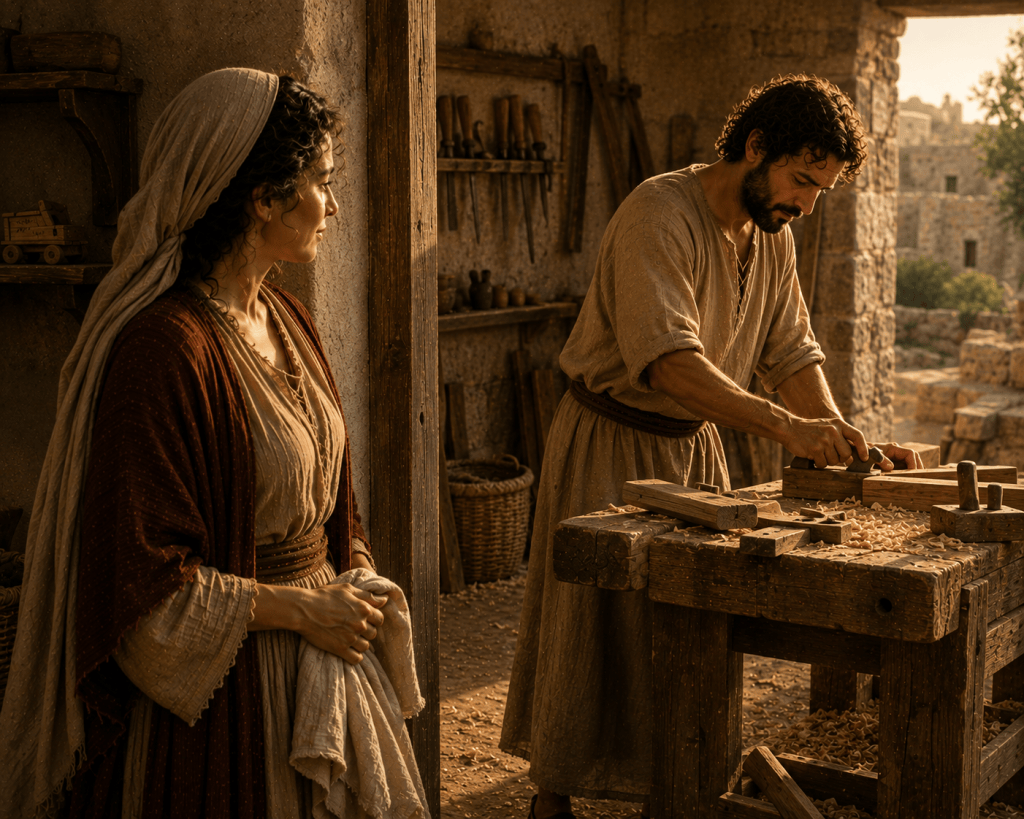
The Invitations of Mary Series
©MS 2026
36. What Did Mary Notice as Jesus Stopped Being a Boy and Became a Man?
Childhood rarely announces when it is leaving. Perhaps Mary only realized it was ending when she began noticing all the little things Jesus no longer needed her to do.
There probably wasn’t a morning when Mary woke and thought:
My son’s childhood is over.
Children don’t usually grow that way.
There is no clean dividing line.
No final day of boyhood followed by the first morning of manhood.
Instead, things disappear.
Quietly.
You stop helping them dress.
Then one day you realize you cannot remember the last time you did.
They stop reaching automatically for your hand in a crowd.
They stop asking you to cut something for them.
They stop climbing into your lap.
They stop calling for you in the night.
Their shoes become larger.
Their voices change.
Their bodies begin taking up adult space.
And somewhere inside all of those small disappearances—
the child is leaving.
Not going anywhere.
Just becoming someone else.
Perhaps Mary discovered this slowly.
And then all at once.
Maybe it began with his hands.
Joseph noticed first.
Jesus was perhaps thirteen or fourteen, working beside him.
Joseph handed him something heavy.
Something that, a year earlier, Joseph would have carried himself.
Jesus took it.
No struggle.
Joseph looked at his hands.
Then at his shoulders.
“Hm.”
Jesus looked over.
“What?”
“Nothing.”
Joseph continued working.
But later perhaps he said to Mary:
“He’s getting strong.”
Mary glanced toward Jesus.
“I know.”
She did know.
Of course she knew.
She washed his clothes.
She knew they didn’t fit the way they had six months ago.
She knew how quickly his sandals became too small.
She knew how much more he ate.
She knew his wrists had lost that last softness of childhood.
Still—
when Joseph said it aloud, something changed.
He’s getting strong.
Not:
He’s getting bigger.
Strong.
A man’s word.
Maybe Mary started noticing Jesus beside Joseph.
For years, Joseph had towered over him.
Papa and boy.
One tall.
One small.
Then the difference began shrinking.
Slowly.
Jesus’ head reached Joseph’s shoulder.
Then higher.
Mary could probably measure time by it without trying.
One day she saw them standing beside each other.
Joseph said something.
Jesus answered.
And Mary stopped what she was doing.
Not because of the conversation.
Because suddenly—
they looked like two men talking.
Not entirely.
Jesus was still young.
His face still belonged partly to the boy she knew.
But something about the proportions had changed.
Shoulders.
Height.
The way he stood.
The space he occupied.
Mary stared perhaps a second too long.
Jesus noticed.
“What?”
“Nothing.”
He narrowed his eyes.
Apparently adults were still using that answer.
Mary went back to her work.
Maybe it was his voice.
That would have been impossible not to notice.
One day the familiar voice cracked halfway through a sentence.
Jesus stopped.
Joseph looked up.
Mary looked up.
Silence.
Jesus’ expression immediately said:
Nobody. Say. Anything.
Joseph looked down.
Mary pressed her lips together.
Jesus continued.
His voice betrayed him again.
Joseph coughed suspiciously.
Jesus glared.
“Papa.”
“I didn’t say anything.”
“You’re laughing.”
“I am not.”
Mary turned away.
Jesus looked at her.
“Mama.”
That finished her.
She laughed.
Jesus groaned.
Two traitors.
Perhaps months later Mary heard him call from another room.
“Mama?”
And she stopped.
Because the voice was deeper.
Not fully a man’s yet.
But not the little voice that had called:
Mama, look.
Mama, come here.
Mama, where is it?
Mama, I can’t sleep.
The word was the same.
The voice wasn’t.
Maybe that hurt a little.
Not badly.
Just enough to notice.
Perhaps she missed his child’s voice before she realized it was gone.
That’s the cruelty of some endings.
Nobody tells you:
Pay attention. This is the last time.
There had been a final toddler mispronunciation.
A final time he needed help reaching something.
A final time Mary lifted him.
A final time he fell asleep against her.
A final time he climbed into her lap without thinking.
Mary probably did not recognize any of them as final.
Why would she?
There was always tomorrow.
Until there wasn’t.
Maybe one evening she looked at him sitting at the table.
His knees no longer fit comfortably where they once had.
He shifted.
Joseph looked.
“You’re too big for that.”
Jesus looked offended.
“I’ve always sat here.”
“You’ve also grown.”
Jesus moved slightly.
The table remained unconvinced.
Mary smiled.
“Your father’s right.”
Jesus looked between them.
“Where am I supposed to sit?”
Joseph indicated another place.
Jesus moved.
Just like that.
His childhood seat was gone.
Mary looked at the empty space.
Ridiculous thing to feel emotional about.
She felt emotional anyway.
Maybe Jesus began eating like a young man.
Mary put food down.
Jesus ate.
Then looked at what remained.
Mary looked at him.
“You’re still hungry?”
“A little.”
Joseph laughed.
Mary gave Jesus more.
A month later she stopped asking.
She simply made more.
Perhaps his clothes became a constant problem.
“This is too short.”
“It was fine.”
“Last month.”
Jesus looked down.
His wrists were visible.
Mary tugged at the sleeve as though perhaps fabric could be persuaded through maternal authority.
No.
“Take it off.”
“Mama.”
“You cannot wear this.”
“It’s fine.”
“You look like you’ve stolen clothing from a smaller person.”
Joseph, from somewhere nearby:
“It does look a little short.”
Jesus turned.
“I don’t remember asking you.”
Mary looked at Joseph.
Joseph wisely returned to his work.
Maybe Mary made or altered something larger.
Then larger again.
And perhaps she had one of Jesus’ old garments folded somewhere.
Not intentionally sentimental.
Just something that hadn’t been given away yet.
One day she picked it up.
Held it.
And couldn’t understand how he had ever fit inside it.
That happens with children.
Their former size becomes unbelievable.
You were this small?
But she remembered.
Of course she remembered.
Maybe Jesus’ face changed.
The roundness disappeared.
Jaw becoming more defined.
Features settling.
Perhaps the first faint shadow of facial hair appeared.
Mary noticed.
Jesus probably noticed considerably more.
Joseph definitely noticed and said nothing.
Until perhaps one morning Jesus stood near him while Joseph was shaving or trimming his beard.
Watching.
Joseph looked at him.
Jesus looked away.
Joseph continued.
A moment later:
“Do you want me to show you?”
Jesus tried to sound indifferent.
“I know how.”
Joseph raised an eyebrow.
“You’ve never done it.”
“I’ve watched.”
“Ah.”
Jesus hated that ah.
Mary, passing through, immediately understood the entire situation.
She kept walking.
This was Joseph’s territory.
Maybe later Jesus emerged with a tiny nick.
Mary saw it.
Said nothing.
Jesus touched his face.
“Don’t.”
“I didn’t say anything.”
“You were going to.”
“I was not.”
Joseph appeared behind him.
Mary looked at Joseph.
Joseph looked at the nick.
Then at Jesus.
He too said nothing.
Jesus stared at both parents.
“This family is impossible.”
Mary smiled.
Still her boy.
Mostly.
But perhaps there were deeper changes too.
Jesus began wanting privacy.
Not secrecy.
Just space.
Maybe Mary entered somewhere without thinking.
Jesus startled.
“Mama.”
“What?”
“Can you knock?”
Mary stopped.
Knock?
She had changed his diapers.
She had bathed him.
She had wiped vomit from his face.
She had seen every possible version of this human body.
Now apparently she needed to knock.
Mary stared at him.
Jesus stared back.
And then she understood.
“Oh.”
Not rejection.
Adolescence.
“Of course.”
She stepped back.
Perhaps she felt strangely embarrassed.
Not because she had done anything wrong.
Because the rules had changed while she wasn’t looking.
The next time she knocked.
Jesus answered.
Maybe Mary stood outside for half a second afterward thinking:
Well. Apparently we live like this now.
Perhaps he began spending more time away from home.
Not disappearing.
They had all learned that lesson.
Very thoroughly.
But Jesus had friends.
Work.
Synagogue.
Relatives.
Community.
He could go places without Mary.
He could go places without Joseph.
“Where are you going?”
“With Jacob.”
“When will you be back?”
“Before dinner.”
Mary nodded.
Then:
“Before dinner.”
“I heard you.”
“I’m making sure.”
Jesus smiled.
“I’ll be back.”
And he was.
Maybe after Jerusalem he became especially good about telling them.
“I’ll be at Eli’s.”
“I’m going with Papa.”
“We’re going down to—”
“I’ll be back before sunset.”
Small courtesies born from three terrible days.
Mary noticed.
She appreciated every one.
Perhaps there came a day when Mary sent Jesus somewhere alone that she once would have accompanied him.
A real errand.
Something important enough to require responsibility.
She gave him instructions.
Jesus listened.
Then:
“I know, Mama.”
Mary stopped.
Not irritated.
Because he did know.
He genuinely did not need the rest of the instructions.
She handed him what he needed.
“Be careful.”
“I will.”
Then Jesus left.
Mary watched him walk away.
Not a child wandering down the road.
A young man carrying family business.
People greeted him.
He answered.
Someone stopped him to speak.
He stood there confidently.
Mary eventually went inside.
There was nothing to supervise.
Maybe other people started treating him differently before she did.
That could have been the real shock.
Someone came to the house asking:
“Is Jesus here?”
Not asking for Mary.
Not Joseph.
Jesus.
A neighbor needed help.
Or wanted his opinion.
Or needed something repaired.
Mary turned.
Jesus came.
They spoke.
Then Jesus left with the man.
Mary remained standing there.
Joseph looked at her.
“What?”
She shook her head.
“Nothing.”
But something had happened.
The world had begun recognizing her son as someone separate from her.
Maybe women in the village noticed too.
That could have been interesting.
Mary was not oblivious.
Jesus was becoming a young man.
Perhaps someone mentioned a daughter.
Casually.
Too casually.
“She and Jesus seem to get along.”
Mary looked at the woman.
The woman smiled.
Mary suddenly understood.
Oh.
Oh.
Maybe she went home and told Joseph.
Joseph stared at her.
“What did you say?”
“Nothing.”
“You didn’t encourage her?”
“Joseph.”
“I’m asking.”
Mary looked toward wherever Jesus was.
Her son.
Apparently eligible for speculative matchmaking now.
This was unacceptable.
Also completely normal.
Also complicated for reasons Mary herself may not have understood.
Would Mary have known Jesus would never marry?
Scripture doesn’t tell us when or how she understood the shape of his vocation.
So perhaps she didn’t.
Maybe there was a period when the ordinary expectations of village life still surrounded him.
Marriage.
Household.
Children.
Work.
The life young men lived.
Perhaps Mary wondered.
Would he marry?
Would there be another woman in his life someday who knew him in ways Mary did not?
Would Mary become a grandmother?
Would Jesus build his own home?
Would he remain nearby?
Maybe those thoughts existed.
Why wouldn’t they?
She did not possess the Gospel already bound and printed.
She was living forward.
And perhaps the uncertainty from the Temple remained underneath all of it.
My Father’s house.
Something about Jesus’ life would not be ordinary.
Mary knew that much.
But what did that exclude?
She didn’t know.
So maybe she didn’t build conclusions.
She waited.
She had become good at that.
Maybe Jesus’ work changed too.
He stopped merely helping Joseph.
He became useful.
Then skilled.
Then perhaps genuinely good.
Joseph no longer said:
“Hold this.”
He said:
“What do you think?”
That would have caught Mary’s attention.
She had heard Joseph teach Jesus for years.
Measure here.
Hold it this way.
Again.
Careful.
Now:
“What do you think?”
Jesus examined the problem.
Answered.
Joseph listened.
Maybe disagreed.
They discussed it.
Two craftsmen.
Mary stood nearby.
There it was again.
Two men.
Perhaps one day Joseph handed Jesus a tool without instruction.
Jesus took it.
Used it.
Returned it.
Neither thought anything of it.
Mary did.
Because she remembered tiny hands being repositioned.
Like this.
Try again.
There.
She remembered Jesus looking up at Joseph after doing something correctly for the first time.
Did you see?
Now Joseph didn’t need to watch.
He trusted Jesus’ hands.
Maybe those hands became rough.
That might have surprised Mary.
The baby’s hands she had kissed.
The toddler fingers that curled around hers.
The little hands that collected rocks.
Now calluses.
Small cuts.
Wood dust.
Adult hands.
Perhaps Jesus came inside one evening and Mary noticed blood on one knuckle.
“What happened?”
“Nothing.”
“That is blood.”
“It’s a scratch.”
“Let me see.”
“Mama.”
“Jesus.”
He held out his hand.
Mary examined it.
Barely anything.
She knew that.
She cleaned it anyway.
Jesus tolerated this.
Some things apparently remained negotiable.
Maybe Mary noticed that she had to reach higher to touch his face.
That’s the image that gets me.
When Jesus was little, Mary could simply bend down.
Then they were eye level.
Then one day—
she had to look up.
Perhaps she was straightening something near his collar.
Jesus stood patiently.
Mary finished.
Then realized her hand was resting against his cheek.
He had to tilt his face down toward her now.
Mary froze.
Not visibly.
Inside.
When did that happen?
Maybe Jesus smiled.
“What?”
Mary shook her head.
“Nothing.”
He had inherited that answer too.
Perhaps the first moment she truly knew childhood was ending wasn’t dramatic at all.
Maybe Jesus came home one afternoon.
He had been working with Joseph somewhere away from the house.
Mary heard footsteps.
Two sets.
Joseph entered first.
Jesus behind him.
They were dusty.
Tired.
Talking about work.
Joseph put something down.
Jesus did the same.
Mary looked at them.
And for one strange second she saw Joseph at Jesus’ age.
Not literally.
But the resemblance of adulthood.
The way Jesus carried himself.
The ease with which he occupied his body.
The tone of his voice.
His hands.
His shoulders.
Something had settled.
Mary stared.
Jesus noticed.
“What?”
There was that question again.
Mary smiled.
“You’re hungry.”
Jesus blinked.
“Yes.”
Of course.
Some things did not change.
She put food down.
Jesus sat.
Joseph sat beside him.
And Mary suddenly remembered another table.
A little boy whose feet did not reach the floor.
A child who needed help.
A child who talked too much while chewing.
A child who brought rocks inside.
Where had he gone?
Nowhere.
He was sitting right there.
That might be the strangest part of raising someone.
The child doesn’t leave.
He becomes.
The toddler is inside the boy.
The boy is inside the young man.
Mary could still see all of them if Jesus turned his head a certain way.
Maybe when he laughed.
That might have been where childhood stayed longest.
His voice changed.
His body changed.
His hands changed.
But then Joseph said something ridiculous.
Jesus laughed.
And suddenly he was five again.
Mary looked up instinctively.
There.
There you are.
Then the laugh faded.
The young man’s face returned.
Perhaps Mary began collecting those flashes.
The boy inside the man.
Jesus asleep with one arm beneath his head.
Boy.
Jesus concentrating with his tongue slightly against his lip.
Boy.
Jesus bringing home some completely unnecessary object because he found it interesting.
Still boy.
Jesus saying “Mama” in a particular tone when he wanted something.
Absolutely boy.
Maybe mothers always retain access to versions of their children the rest of the world can no longer see.
And yet she had to respect the man emerging.
That must have required adjustment.
Perhaps Mary gave an instruction one day.
Jesus paused.
Not disobedient.
But she heard herself.
It was something she would have said to a ten-year-old.
He was sixteen.
Maybe seventeen.
Jesus did it anyway.
But Mary thought afterward:
I didn’t need to tell him that.
So next time—
she didn’t.
Maybe that’s how letting go actually happened.
Not one enormous surrender.
A thousand tiny acts of restraint.
Don’t remind him.
He remembers.
Don’t follow.
He knows the way.
Don’t fix it.
He can.
Don’t answer for him.
He has a voice.
Don’t hold him where childhood held him.
Let him become.
Perhaps that was harder precisely because Jesus was good.
If he had been reckless, Mary could have justified constant intervention.
But Jesus increasingly demonstrated that he could be trusted.
So she had to trust him.
The boy who once disappeared in Jerusalem became a young man who told her where he was going.
The child who needed Joseph’s hand guiding his became someone Joseph trusted with work.
The little boy who asked endless questions became someone other people came to with theirs.
Maybe Mary was proud.
Terribly proud.
And perhaps pride carried grief inside it.
Not bad grief.
The tender grief of successful motherhood.
You spend years teaching someone not to need you for everything.
Then one day—
they don’t.
And somehow you are supposed to celebrate.
Mary probably did.
Maybe she also went somewhere private afterward and cried for five minutes.
Both can be holy.
Joseph may have understood.
Perhaps Mary was unusually quiet one evening.
“What?”
“Nothing.”
Joseph waited.
He knew better.
Mary looked toward Jesus, who was doing something outside.
“He doesn’t need me much anymore.”
Joseph followed her gaze.
Maybe he smiled.
“He needs you.”
“You know what I mean.”
Joseph did.
He thought.
Then perhaps:
“He needs you differently.”
Mary looked at him.
That was worse.
Because it was true.
Differently.
Not less.
Jesus no longer needed Mary to wash his face.
He might need her to listen.
He no longer needed her to hold his hand crossing a crowded place.
He might need a home he could return to.
He no longer needed her to tell him how to do everything.
He might need someone who knew him before anyone else did.
Someone before crowds.
Before disciples.
Before controversy.
Before people began deciding what they thought about him.
Mama.
Perhaps Mary began discovering that motherhood does not disappear when childhood does.
It changes shape.
You stop carrying the child.
Then you become somewhere the adult can set things down.
And perhaps there came one evening when Mary finally knew.
Not suspected.
Knew.
Jesus came home later than usual.
Not late enough to worry.
Just after a long day’s work.
Mary was sitting outside.
Joseph perhaps nearby.
Jesus approached along the road.
And Mary looked up.
For a second she didn’t recognize him.
Not truly.
Just that tiny perceptual delay when you see someone at a distance.
A tall young man.
Broadening shoulders.
Long stride.
Work-worn clothing.
Dark curls.
Then:
Jesus.
Her heart did something strange.
Because she had not first seen her boy.
She had seen a man.
Jesus reached the house.
“Mama.”
Mary looked up at him.
There it was.
The familiar voice inside the unfamiliar depth.
“You’re late.”
“Not very.”
“You’re still late.”
Jesus smiled.
Joseph looked away, wisely.
Mary stood.
Maybe Jesus bent and kissed her cheek.
A grown son’s casual affection.
Then he went inside.
Mary remained outside for one second longer.
Perhaps that was it.
No angel.
No announcement.
No rite marking the exact end of childhood.
Just Mary watching her son duck slightly through a doorway he once ran beneath without thinking.
And realizing:
Oh.
The little boy is gone.
Not gone.
Never gone.
But finished.
That particular version of Jesus would exist now only in memory.
The newborn curled against her chest.
The toddler laughing at something ridiculous.
The feverish child she watched through the night.
The little boy at dinner.
The seven-year-old arranging rocks.
The twelve-year-old she thought she had lost forever.
All still Jesus.
All unreachable.
Maybe Mary went inside.
Jesus was eating.
Of course.
Joseph was talking to him.
Mary looked at both.
And perhaps she thought of Gabriel again.
“You will conceive and give birth to a son.”
A son.
Gabriel had said nothing about how quickly sons grow.
Angels leave out a remarkable amount.
Maybe Mary sat down.
Jesus looked over.
“What?”
Apparently she was staring again.
“Nothing.”
“Mama.”
“What?”
“You’re doing it.”
“Doing what?”
“Looking at me.”
“I am allowed to look at you.”
Jesus smiled.
“I didn’t say you weren’t.”
Mary reached over.
Maybe she brushed one dark curl away from his forehead.
He let her.
There.
For one second her hand remembered the shape of a much smaller head.
Then Jesus returned to whatever he was saying to Joseph.
Mary listened.
The voice was a man’s now.
Mostly.
She could still hear the boy inside it.
Maybe she always would.
We don’t know exactly when Jesus’ childhood ended.
Scripture gives us twelve-year-old Jesus in the Temple and then almost immediately gives us Jesus as an adult beginning his public life.
Nearly two decades disappear between those scenes.
But Mary lived them.
She saw every inch of that missing growth.
Every garment outgrown.
Every deepening note in his voice.
Every new strength in his hands.
Every responsibility assumed.
Every moment Joseph needed to teach him a little less.
Every moment Mary needed to remind him a little less.
She watched the child entrusted to her become a man capable of walking toward a life she could not control.
And perhaps that was the real beginning of Mary’s letting go.
Not Cana.
Not the beginning of his ministry.
Not Calvary.
Earlier.
Nazareth.
A boy growing taller.
A voice becoming deeper.
A hand becoming rough with work.
A door he no longer needed her to open.
A road he could walk without her.
Maybe that’s where Mary learned the strange discipline every mother eventually faces:
Love him enough to let him become someone you cannot keep small.
She could miss the boy.
She could treasure him.
She could remember every version.
But she could not ask the man to remain a child simply because childhood had once made him easier to hold.
So perhaps Mary stood one evening in the doorway.
Jesus and Joseph were outside.
Working.
The sun was low.
Joseph handed Jesus something heavy.
Jesus took it easily.
They spoke.
Joseph listened to his answer.
Then nodded.
No instruction.
No correction.
Just respect.
Mary watched.
She remembered tiny Jesus sitting beside Joseph, desperately serious about some meaningless piece of wood.
Like this.
Try again.
There.
Now Joseph asked:
“What do you think?”
And Jesus answered.
Joseph trusted him.
Mary’s chest tightened.
Not with fear.
Not exactly sadness.
Something more complicated.
Pride.
Love.
Loss.
Wonder.
Jesus looked toward her.
Caught her watching.
“Mama?”
Mary smiled.
Closed-mouth.
Soft.
“Dinner.”
“I’ll be there.”
Not:
Come now.
Not:
Don’t forget.
Not:
I told you already.
Just:
“Dinner.”
Jesus nodded.
“I know.”
Mary went inside.
And this time she didn’t remind him again.
Because he knew.
Because he would come.
Because somewhere along the way, without asking permission—
the little boy she had spent years teaching how to live had become a young man who knew how to find his own way home.


