The Invitations of Mary Series
©MS 2026
Mary asked her son why he had frightened them so badly. Jesus answered her. And Scripture does something remarkable: it tells us that Mary did not understand.
They went home.
That might be the strangest part.
After three days of searching.
After Jerusalem.
After the Temple.
After Mary finally saw Jesus sitting safely among the teachers.
After:
“Child, why have you treated us like this?”
After Jesus answered:
“Why were you searching for me? Did you not know that I must be in my Father’s house?”
Luke gives us no moment in which everything suddenly makes sense.
No angel appears afterward to explain what Jesus meant.
No narrator tells us Mary smiled because she finally understood the mystery.
Instead, Luke says something much more interesting:
“But they did not understand what he said to them.”
And then they went home.
I wonder what that walk back to Nazareth was like.
Not the first hour.
We imagined that already.
Jesus probably stayed conspicuously close.
Mary probably looked at him more often than necessary.
Joseph may have done the same.
Perhaps Jesus noticed.
Perhaps he understood why.
They had found him.
The panic was over.
But something else had begun.
Because Mary now had an answer she could not make fit.
“Did you not know?”
Maybe those words bothered her.
Not because Jesus had said them cruelly.
There is nothing in Luke suggesting cruelty or contempt.
Perhaps that made them harder.
Jesus seemed to think Mary and Joseph should have understood.
But they hadn’t.
Mary had been visited by Gabriel.
She had carried Jesus.
Elizabeth had recognized something extraordinary in her pregnancy.
Shepherds had come.
Simeon had taken Jesus into his arms and spoken astonishing things.
Anna had spoken about him.
Mary had spent twelve years knowing that her son belonged to God in some extraordinary way.
And still—
she hadn’t known.
Maybe Mary walked beside Jesus and thought:
What did you expect me to know?
That you would stay behind?
That you would be in the Temple?
That we shouldn’t have searched?
That somehow I should understand what your Father requires of you?
Which part?
Jesus had given her an answer.
It had not answered nearly enough.
Perhaps she tried again somewhere on the road.
Not angrily this time.
“Jesus?”
He looked at her.
“What did you mean?”
Maybe Jesus knew exactly which sentence she meant.
“My Father’s house?”
“Yes.”
He answered.
Perhaps he tried to explain.
We don’t know.
Luke doesn’t give us that conversation.
Maybe there wasn’t one.
Maybe Jesus simply repeated the idea in another way and Mary discovered that changing the words didn’t change the mystery.
She knew who the Father was.
That wasn’t the problem.
The problem was what Jesus’ relationship with the Father meant for the life they were living together.
Did it mean Jesus would leave?
When?
Did it mean there were places he would go without telling them?
Surely not.
Did it mean something was beginning now?
Was twelve significant?
Was Jerusalem significant?
Was the Temple significant?
Was she supposed to do something?
Was Joseph?
Were they supposed to stop treating him like an ordinary boy?
But how could they?
He still needed dinner.
He still needed somewhere to sleep.
He still lived in their house.
He was still twelve.
And perhaps Mary did what human beings often do when something is too large to understand all at once.
She returned to the practical.
“Are you thirsty?”
Maybe Jesus was.
She handed him water.
Mystery temporarily postponed.
I love that possibility.
The Mother of God has just received a bewildering statement about her son’s relationship with his heavenly Father.
And then perhaps she has to make sure the boy drinks enough water for the journey home.
Because revelation does not cancel ordinary responsibility.
Sometimes you carry theology in one hand and someone’s lunch in the other.
Joseph must have been thinking too.
Luke says they did not understand.
Not Mary alone.
Joseph didn’t understand either.
Maybe that mattered.
Mary didn’t have to sit beside a husband who somehow grasped everything while she struggled.
They were both bewildered.
Perhaps later, when Jesus walked a little ahead of them, Mary looked at Joseph.
“What do you think he meant?”
Joseph watched Jesus.
“I don’t know.”
Mary waited.
Joseph thought longer.
Still:
“I don’t know.”
And perhaps there was comfort in that.
Not resolution.
Companionship.
Maybe Mary said:
“He thought we should know.”
Joseph looked at her.
“I know.”
“Did you?”
“No.”
Immediate.
Certain.
No pretending.
No attempt to become spiritually impressive after the fact.
Joseph had been terrified too.
He had searched too.
He had stood in the Temple equally confused.
He didn’t know.
Maybe Mary needed that.
Because there is a particular loneliness in believing everyone else understands something you don’t.
Joseph didn’t.
They could walk home confused together.
And then Luke tells us something almost startling after Jesus’ declaration of divine sonship:
“Then he went down with them and came to Nazareth, and was obedient to them.”
Jesus went home.
The boy who had just spoken about his Father returned to the house of Mary and Joseph.
And obeyed them.
Whatever had happened in Jerusalem did not dissolve the family.
Joseph was still his earthly father.
Mary was still his mother.
Jesus still lived under their care.
Maybe the first morning back in Nazareth felt strange.
Mary woke.
For one terrible second perhaps she remembered the days when she had awakened without knowing where Jesus was.
Then she heard him.
Movement nearby.
A voice.
Something ordinary.
Jesus was home.
Her body relaxed.
Then perhaps she remembered his words.
My Father’s house.
There they were again.
Jesus came to breakfast.
Maybe he looked exactly the same.
That might have been unsettling.
How can someone say something that rearranges your understanding of him—
then ask for bread?
Mary handed it to him.
Jesus ate.
Joseph said something.
Jesus answered.
Morning continued.
Perhaps Mary watched him differently for a while.
Not dramatically.
Just more.
Jesus worked beside Joseph.
Mary looked over.
My Father’s house.
Jesus carried water.
My Father.
Jesus laughed at something.
Did you not know?
Jesus fell asleep.
Mary stood near him.
Son of the Most High.
Her son.
The Father’s Son.
Joseph’s son in every way that had made a human home possible.
How did all of those things fit together?
Mary did not know.
Scripture says so.
That matters enormously to me.
Because Christians sometimes speak about Mary as though faith meant immediate comprehension.
Gabriel speaks.
Mary understands.
Simeon speaks.
Mary understands.
Jesus speaks.
Mary understands.
Calvary comes.
Mary understands.
Everything neatly received and perfectly interpreted.
But Luke doesn’t give us that woman.
Luke gives us a woman who sometimes ponders.
A woman who keeps things.
A woman who receives words before she understands them.
Earlier in Luke, after the shepherds came, we are told:
“Mary was treasuring up all these things in her heart and meditating on them.”
And after the Temple episode, Luke returns to almost the same image:
“His mother kept all these things in her heart.”
Maybe that’s what Mary did with what she couldn’t understand.
She didn’t solve it.
She kept it.
That is different.
To keep something is not necessarily to comprehend it.
Sometimes keeping means:
I don’t know what this means yet.
But I believe it matters.
So I will not throw it away.
Maybe Mary had an interior place filled with sentences like that.
Gabriel:
“He will be great.”
Simeon:
“A sword will pierce your own soul.”
Jesus:
“Did you not know that I must be in my Father’s house?”
Things she could not completely connect.
Perhaps she didn’t try to force them together.
Maybe she simply held them.
We sometimes want faith to behave like a puzzle.
Receive enough pieces.
Arrange them correctly.
Understand God’s plan.
Done.
Mary’s faith appears much less comfortable than that.
She receives pieces years apart.
Some frightening.
Some beautiful.
Some contradictory from where she stands.
And there is no picture on the box.
Perhaps she asked God about it.
That seems almost inevitable.
Maybe one evening after Jesus was asleep, Mary prayed.
Not:
Thank you for revealing this mystery which I now fully comprehend.
Perhaps:
What did he mean?
Silence.
What am I supposed to do with that?
Silence.
Is something changing?
Silence.
Do I need to prepare?
Silence.
Please help me understand.
Maybe still silence.
What then?
Mary got up the next morning.
That might be faith too.
She made breakfast.
She worked.
She prayed.
She loved Joseph.
She raised Jesus.
She waited.
Perhaps every so often she tried the sentence again.
My Father’s house.
Turn it.
Look at it from another side.
What does it tell me about him?
What does it tell me about God?
What does it tell me about myself?
Nothing entirely settled.
Back into the heart it goes.
Keep it.
Maybe this became a pattern between Mary and Jesus as he grew older.
He was thirteen.
Fourteen.
Fifteen.
Perhaps increasingly there were moments when Mary caught glimpses of an interior world she could not fully access.
That is ordinary adolescence.
But with Jesus, there was something more.
He belonged to her household.
Yet his identity could never be contained by it.
Maybe she began learning the painful difference between knowing your child deeply and knowing everything about your child.
No mother gets the second.
Not even Mary.
That is strangely comforting.
Mary knew Jesus better than any human being ever had.
She knew the newborn smell of him.
The sound of his cry.
The expression he made when he disliked food.
How he slept.
How he laughed.
What his footsteps sounded like.
Which stories made him ask questions.
How he behaved when tired.
What his hand felt like in hers.
She knew the child.
And still—
she did not always understand him.
Love did not require complete understanding.
That’s important.
Mary did not say:
I cannot understand you, therefore I cannot trust you.
Nor:
Because I love you, I must pretend I understand.
She seems to have done something harder.
She allowed mystery to remain mystery.
Maybe that changed the way she mothered him.
Before Jerusalem, perhaps Mary assumed that if something important were happening with Jesus, she would know.
Why wouldn’t she?
She had known nearly everything about his life.
Then the Temple taught her:
Not always.
There are things between Jesus and the Father that do not originate with her.
That must have been humbling.
Maybe painful.
And necessary.
Perhaps she became more attentive without becoming controlling.
Jesus goes somewhere.
“When will you be back?”
He tells her.
Mary nods.
She wants to ask more.
Sometimes she does.
Sometimes she doesn’t.
Learning when to hold and when to release may be one of the hardest parts of motherhood.
Mary was not exempt.
Joseph might have helped.
He had always loved Jesus without possessing him.
Perhaps there was something in Joseph’s fatherhood Mary could learn from now.
Joseph knew from the beginning that Jesus came to him through surrender.
He had not conceived this child.
He had received him.
Maybe Mary had received Jesus too, of course.
But she had also carried him inside her own body.
There is a different intimacy there.
Perhaps letting go came differently for each of them.
Maybe one afternoon Jesus and Joseph were working.
Mary watched from the doorway again.
Jesus was older now.
His hands more capable.
He no longer needed Joseph to guide every movement.
Joseph explained something.
Jesus disagreed.
Joseph listened.
Jesus demonstrated.
Joseph considered.
Then perhaps Joseph smiled.
“You’re right.”
Mary watched.
Something small.
Something enormous.
Jesus was becoming someone who could know things his parents did not.
Of course he was.
Every child does.
But this child—
Maybe Mary remembered the Temple.
Did you not know?
No.
She hadn’t.
Perhaps someday she would.
And then years continued.
That’s the astonishing part.
There is no Gospel episode immediately after the Temple in which twelve-year-old Jesus performs his first miracle.
No public revelation.
No dramatic fulfillment.
He goes back to Nazareth.
And the hidden years resume.
For nearly two more decades, as far as the Gospel chronology suggests.
Imagine carrying a mystery that long.
Mary might have expected something.
Thirteen.
Nothing.
Fourteen.
Nothing.
Fifteen.
Jesus grows.
Sixteen.
Work.
Seventeen.
Nazareth.
Eighteen.
Ordinary life.
Twenty.
Still home.
Twenty-five.
Still hidden.
At some point perhaps Mary stopped wondering every morning whether today would be the day.
Or perhaps she never stopped.
Jesus became a man.
And still those words remained.
My Father.
What will the Father ask of him?
When?
Perhaps Joseph died somewhere during those hidden years.
Scripture does not tell us when or how, so we cannot know.
But Christian tradition generally places his death before Jesus’ public ministry.
If so, the mystery Mary carried became lonelier.
There was no longer another person who had stood in the Temple and heard those words with her.
No one else to ask:
“Do you remember?”
Joseph remembered.
Until he wasn’t there.
Then Mary carried that too.
Maybe after Joseph’s death, Jesus took on more responsibility.
Perhaps Mary watched him work.
Joseph’s movements appearing unexpectedly in his hands.
The way he measured.
The way he held a tool.
The way he paused before answering.
And perhaps the Temple seemed very far away.
Jesus was still here.
Still Nazareth.
Still her son.
Then one day—
he left.
Not disappeared.
Not this time.
He was a man.
Maybe he told her.
Maybe they both knew something had shifted.
The Gospels don’t give us the farewell.
But eventually Jesus’ public ministry begins.
And suddenly perhaps the sentence from twelve years old starts opening.
I must be about my Father’s things.
Oh.
This.
Maybe.
Then reports came.
Jesus teaching.
Jesus gathering disciples.
Jesus speaking with authority.
Jesus healing.
Jesus traveling.
Jesus saying things people didn’t understand.
Mary may have heard stories.
Perhaps she heard people arguing about him.
Some astonished.
Some offended.
Some devoted.
Some suspicious.
And maybe she thought:
They don’t understand him either.
Perhaps that was strangely familiar.
Then Cana.
Mary tells Jesus:
“They have no wine.”
Jesus responds in a way interpreters have discussed for centuries.
Something about the relationship between them has matured.
Mary does not receive a detailed explanation.
She simply tells the servants:
“Do whatever he tells you.”
I wonder whether twelve-year-old Jesus in the Temple is somewhere behind that sentence.
Mary had learned something.
Not necessarily to understand everything Jesus said before acting.
But to trust the person speaking.
That is different from blind certainty.
She knew him.
Even when she didn’t understand him.
And perhaps that is what those hidden years taught her.
Faith isn’t:
I understand what God is doing.
Faith can sometimes be:
I know enough about who God is to remain here while I do not understand what God is doing.
Mary had practice.
Years of it.
That matters when we eventually reach Calvary.
Because there, almost nothing will make sense.
This is the child Gabriel said would receive David’s throne.
This is the child Simeon called salvation.
This is the child who spoke of his Father’s house.
And now he is dying.
How do those things fit?
From the foot of the Cross, perhaps they don’t.
Not yet.
Maybe Mary had spent decades learning not to discard a promise simply because present circumstances made it incomprehensible.
Keep it.
Hold it.
Wait.
That doesn’t make the waiting easy.
It makes it possible.
I wonder whether Mary ever became frustrated with not knowing.
I hope we allow her that.
Maybe there were days when pondering felt less poetic than religious art makes it look.
Perhaps pondering sometimes looked like:
I have thought about this for twelve years and I still don’t understand.
Perhaps she asked God again.
Still nothing.
Maybe she got irritated.
Maybe she cried.
Maybe she wished Gabriel would come back and explain the rest.
He had been remarkably concise considering the amount of information she was apparently expected to live on for the next several decades.
“Do not be afraid.”
Wonderful.
Could we perhaps have received a little more detail?
What happens when he’s twelve?
When does his ministry begin?
What does Simeon’s sword mean?
How will I know when to hold on?
How will I know when to let go?
Nothing.
Mary got a promise.
Then a life.
She had to live the distance between them.
Perhaps that’s why I increasingly love the phrase:
She kept these things in her heart.
Not understood.
Not resolved.
Not explained.
Kept.
There is tremendous patience in that word.
Maybe Mary had learned this from pregnancy.
You carry something you cannot yet see.
You know it is real because it changes you.
You wait for revelation to arrive in its own time.
Perhaps pondering was another kind of pregnancy.
A truth growing quietly inside her before she knew its final shape.
And maybe some truths never became completely clear during Mary’s earthly life.
We don’t know.
Faith is not necessarily rewarded with a complete explanation.
Sometimes the mystery remains larger than us.
Mary’s greatness may not be that she possessed answers unavailable to everyone else.
Perhaps part of her greatness is that she could live faithfully without demanding them.
She could say:
I don’t understand.
And still make dinner.
I don’t understand.
And still pray.
I don’t understand.
And still love my son.
I don’t understand.
And still trust God.
I don’t understand.
And still get up tomorrow.
There is something deeply human about that.
Because most of us live with unanswered things.
Why did this happen?
What is God doing?
Did I misunderstand?
Am I supposed to wait?
Act?
Let go?
Hold on?
Sometimes there is no Gabriel.
No dream.
No sign.
Only something we have received and cannot yet interpret.
Maybe Mary would understand that kind of faith better than anyone.
Not because she never questioned.
Because Scripture lets us see that she did not always understand.
And she stayed.
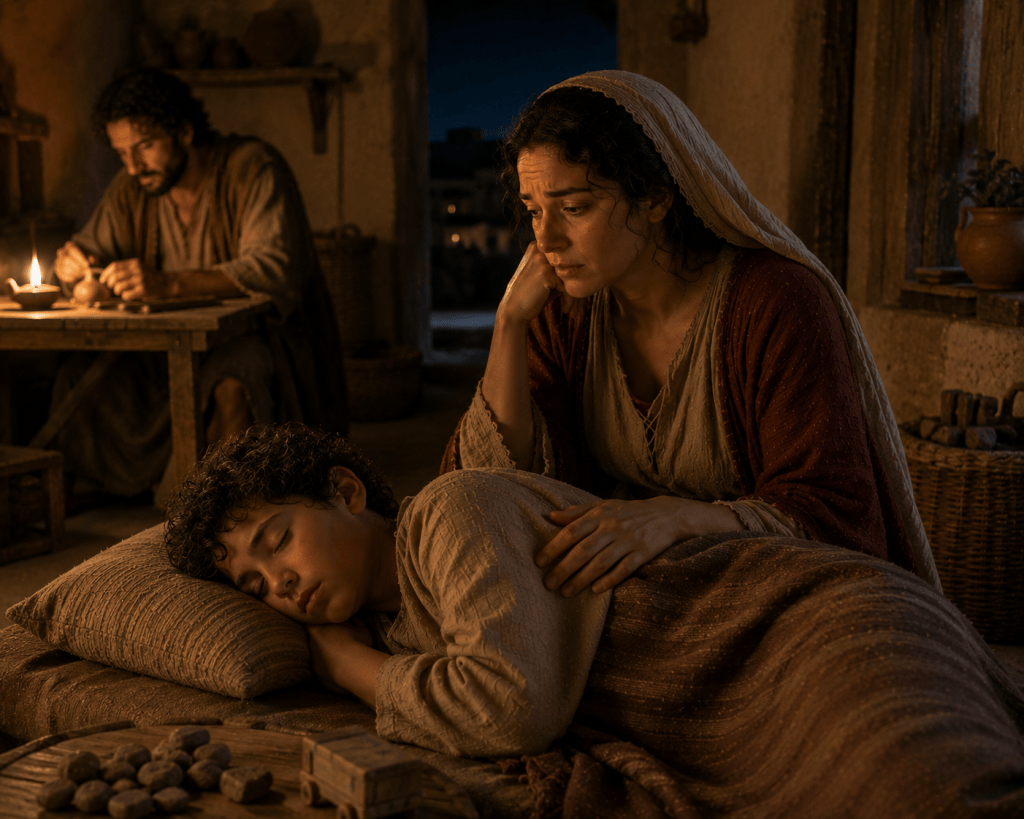
So perhaps the evening after they returned from Jerusalem, Mary found Jesus asleep.
Twelve years old.
Home again.
She stood near him.
Maybe she had been checking on him far too often since they returned.
She didn’t care.
His face was relaxed.
Young again.
Not the astonishing boy among the teachers.
Not the mysterious Son speaking about his Father.
Just Jesus asleep in the house.
Her boy.
Mary sat beside him.
Perhaps she touched one curl away from his forehead.
And the words returned.
“Did you not know?”
Mary looked at him.
Maybe she whispered:
“No.”
Not ashamed.
Just true.
“No. I didn’t.”
Silence.
Jesus slept.
Perhaps she continued:
“I still don’t.”
No answer.
She wasn’t expecting one.
Maybe she smiled slightly.
Because he was here.
That was enough for tonight.
Mary stood.
Pulled the covering higher over his shoulder.
Turned down the lamp.
And carried the unanswered question with her.
Not as failure.
Not as evidence that her faith was insufficient.
As something entrusted to her.
Something she would keep.
Tomorrow Jesus would wake.
Joseph would work.
Mary would make bread.
Someone would need water.
Something would need repairing.
Jesus would probably forget something she had asked him to do.
Nazareth would continue.
And somewhere underneath all of it—
the question would remain.
My Father’s house.
What does that mean for you?
What does that mean for me?
Where will it take you?
When?
Mary didn’t know.
So she did something far harder than solving the mystery.
She lived beside it.
For years.
She let Jesus grow without requiring herself to understand every part of who he was becoming.
She allowed God’s promise to remain larger than her comprehension.
And when something did not make sense—
she did not throw it away.
She kept it.
Turned it over.
Waited.
Loved.
Maybe that is what pondering really was.
Not serene certainty beneath a blue veil.
Not Mary sitting peacefully because she possessed some secret explanation of everything.
Perhaps pondering was the courage to say:
I don’t understand this yet.
But I will make room for it anyway.
And perhaps that is why Luke tells us she kept these things in her heart.
Because Mary did not need every mystery to become an answer before she could continue loving the God who gave it to her.
Sometimes she simply carried the question.
And went home.

 The Living Rosary Archives