The Invitations of Mary Series
©MS 2026
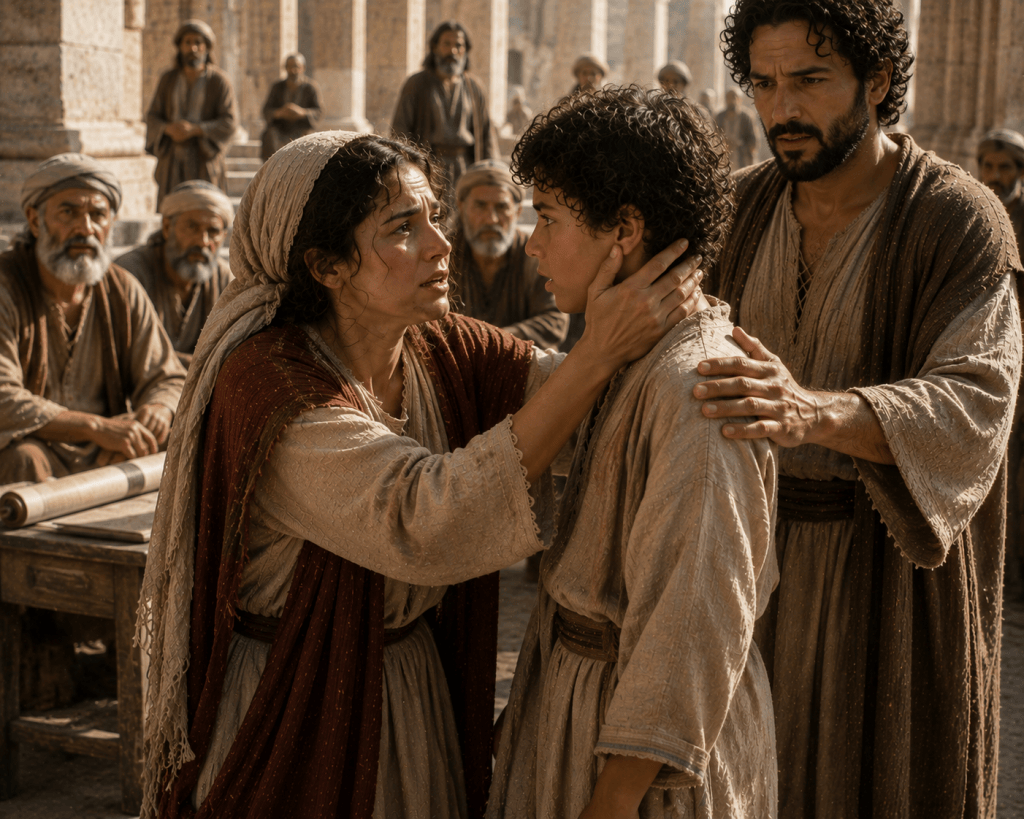
Mary found Jesus safe, surrounded by teachers, apparently completely unconcerned—and then had to reconcile the overwhelming desire to hold him with the equally overwhelming desire to ask what on earth had possessed him.
There he was.
Maybe that was all Mary could think at first.
Not:
The Temple.
Not:
The teachers.
Not:
Why is everyone listening to my twelve-year-old?
Not even:
What is he doing here?
Just—
There.
There.
There.
There.
Her eyes found him.
And the entire world started again.
Three days.
Luke tells us:
“After three days they found him in the temple, sitting among the teachers, listening to them and asking them questions.”
Three days of searching.
Three days of asking strangers.
Three days of retracing steps.
Three days of wondering.
Three days of imagining possibilities Mary probably spent the rest of her life trying to forget.
Then she walked into the Temple—
and saw dark curls she knew.
A familiar profile.
The tilt of his head when he was listening carefully.
Maybe she recognized him from behind.
Mothers can do that.
The shape of his shoulders.
The way he sat.
Something completely ordinary and unmistakable.
Jesus.
Perhaps Mary stopped walking.
Joseph nearly ran into her.
“What?”
She couldn’t answer.
She just pointed.
Joseph followed her hand.
And there he was.
Their son.
Alive.
Unhurt.
Safe.
Sitting among the teachers as though the previous three days had been completely normal.
I wonder what relief that enormous feels like inside a human body.
Maybe Mary’s knees weakened.
Actually weakened.
Not poetic trembling.
The sudden physical collapse that happens when terror releases its grip all at once.
Perhaps Joseph caught her arm.
Mary didn’t notice.
She was staring at Jesus.
Breathing.
He was breathing.
Talking.
Listening.
Fine.
He was fine.
Maybe she laughed once.
A strange little involuntary sound.
Half sob.
Half laugh.
Because she had imagined him injured.
Lost.
Frightened.
Hungry.
Alone.
Perhaps worse.
And instead Jesus was sitting in the Temple having what appeared to be the most interesting conversation of his young life.
Of course he was.
Of course.
Then perhaps the relief lasted approximately seven seconds.
Because once Mary’s body understood:
He is alive.
Another thought arrived immediately behind it:
WHAT WERE YOU THINKING?
That transition may be one of the most universal experiences of parenthood.
Your child disappears.
You find them.
First:
Thank God.
Then:
Do you have any idea what you just put me through?
The desire to clutch them against your chest and the desire to demand an explanation do not arrive sequentially.
They arrive together.
You can be crying with relief while furious.
Apparently Mary could too.
Because Luke preserves what she said.
And it is not:
“My beloved Son, how blessed I am to find you dwelling within your Father’s house.”
No.
Mary says:
“Child, why have you treated us like this?”
There she is.
I love that sentence.
Not because Mary is angry.
Because she is real.
“Why have you treated us like this?”
There is emotion inside that question.
Fear.
Confusion.
Relief.
Exhaustion.
Probably anger.
Perhaps hurt.
Mary doesn’t hide any of it behind reverent language.
Then she continues:
“Look, your father and I have been searching for you in great anxiety.”
In other words:
Do you have any idea what you have done to us?
Maybe Jesus looked up when he heard her voice.
“Mama?”
And perhaps that almost broke her again.
Because she hadn’t heard him say it for three days.
That voice.
Normal.
Familiar.
Alive.
Maybe she crossed the remaining distance quickly.
Jesus stood.
Mary reached him.
And whatever she had intended to say disappeared for a moment.
She grabbed him.
Not graceful.
Not restrained.
Both arms around him.
Hand against the back of his head.
Jesus pressed against her.
Maybe surprised.
“Mama—”
Mary held tighter.
Joseph reached them.
Perhaps his hand went immediately to Jesus’ shoulder.
Then his face.
Checking.
Parents do that even when the evidence is obvious.
Are you hurt?
Jesus wasn’t.
Joseph pulled him into an embrace too.
Maybe the three of them stood there for one strange moment while the teachers watched.
Jesus safely enclosed between the two people who had spent three days imagining life without him.
Then Mary pulled back.
Hands still on Jesus’ shoulders.
Looked at his face.
Fine.
Absolutely fine.
And now—
now she could be furious.
“Where have you been?”
Jesus blinked.
Mary already knew the answer.
Bad question.
She tried again.
“Why did you stay here?”
Perhaps Jesus’ expression changed.
Not guilty.
Confused.
That might have been worse.
Because Mary had expected him to know.
To look ashamed.
To say:
I’m sorry. I didn’t realize.
Instead he seemed genuinely puzzled by her confusion.
Luke gives us Jesus’ response:
“Why were you searching for me? Did you not know that I must be in my Father’s house?”
And I can only imagine Mary staring at him.
Because—
No.
Apparently they did not know.
Luke explicitly tells us that next:
“But they did not understand what he said to them.”
Mary didn’t understand.
Joseph didn’t understand.
The Gospel doesn’t rescue them from that.
Maybe there was a long silence.
Jesus looked at Mary.
Mary looked at Jesus.
Joseph looked between them.
Perhaps one of the teachers nearby found the exchange fascinating.
Mary did not care.
“Did you not know—”
Mary may have heard only that much before something inside her objected.
Did we not know?
No.
She had not known.
She had searched streets.
Asked strangers.
Walked until her feet hurt.
Gone without proper sleep.
Probably barely eaten.
Called his name until her throat ached.
She had spent three days not knowing whether her child was alive.
And now her twelve-year-old was asking why she had been looking for him.
I would like to believe Mary had at least one internal moment of:
Boy.
Perhaps Joseph sensed it.
Maybe his hand rested very gently against Mary’s back.
Not restraining her.
Just:
I’m here.
Because he too had just been called, indirectly, something complicated.
Jesus said he had to be in his Father’s house.
And standing right there was Joseph.
The man Mary had just called:
your father.
That exchange is extraordinary.
Mary:
“Your father and I…”
Jesus:
“My Father…”
Something has shifted.
For twelve years, Jesus had belonged inside their ordinary family life.
Mama.
Papa.
Home.
Nazareth.
Joseph’s workshop.
Mary’s table.
Prayer.
Neighbors.
Dinner.
Rocks.
Stories.
Work.
And suddenly, in the Temple, Jesus articulated an allegiance that extended beyond them.
Not against them.
But beyond them.
Perhaps Mary felt it.
Even if she didn’t understand it yet.
Her son had an interior life she could not completely enter.
A calling she could not completely manage.
A relationship with the Father that did not pass through her.
He was twelve.
And perhaps, for the first time, Mary caught a glimpse of the fact that raising Jesus would eventually require letting him belong somewhere she could not follow.
But again—
I don’t think Mary reached that theological conclusion standing there.
Later?
Certainly she pondered.
Luke tells us she treasured these things in her heart.
But first?
I think she was a mother who had not slept properly in three days.
Maybe she said:
“You left without telling us.”
Jesus started to answer.
“You left Jerusalem without telling us where you were.”
“I thought—”
“No.”
That word.
Not shouted.
Just firm.
Jesus stopped.
“You tell us.”
Maybe Mary touched her own chest.
“You tell me.”
Then Joseph.
“You tell your father.”
Jesus looked at Joseph.
Joseph’s face was tired.
Jesus may finally have understood something he had not understood from inside the Temple.
They had been afraid.
Not inconvenienced.
Not confused.
Afraid.
Maybe Jesus looked at Mary differently then.
At the dust on her clothes.
The exhaustion around her eyes.
Joseph’s face.
Perhaps he realized what those three days had been for them.
Scripture does not tell us whether Jesus apologized.
We shouldn’t invent certainty where there is none.
But Luke tells us something very important immediately afterward:
“Then he went down with them and came to Nazareth, and was obedient to them.”
He went home.
With them.
Maybe before they left, Mary still couldn’t stop touching him.
Hand on his shoulder.
Then his back.
Then his hair.
As though if physical contact broke, he might disappear again.
Jesus probably noticed.
Maybe he tolerated it for a while.
Then:
“Mama.”
“What?”
“I’m right here.”
Mary looked at him.
Wrong thing to say.
“Yes.”
Her hand remained exactly where it was.
“I can see that.”
Joseph might have been quieter.
Perhaps his fear had converted into exhaustion.
He looked at Jesus.
Really looked.
Then:
“Are you hungry?”
Of course.
Because Joseph was Joseph.
Jesus thought.
“A little.”
Mary turned.
“A little?”
He had been away from them for three days.
Who had fed him?
Where had he slept?
Luke doesn’t tell us.
Suddenly Mary had twelve additional questions.
“When did you last eat?”
Jesus hesitated.
Mary’s eyes narrowed.
Joseph intervened.
“We’ll get food.”
Good plan.
One problem at a time.
Maybe Jesus started telling them about the teachers.
He was excited.
That’s another possibility that makes this encounter almost painfully human.
What if Jesus had just experienced something profound?
He had been listening.
Asking questions.
Talking about Scripture.
The people around him were astonished by his understanding.
Perhaps twelve-year-old Jesus felt intellectually alive in a way he had never experienced before.
He wanted to tell Mary and Joseph.
“They were talking about—”
Mary stared at him.
Jesus stopped.
Perhaps now was not the time.
Joseph almost smiled.
Later.
Definitely later.
Can you imagine the walk out of the Temple?
Jesus between them.
Mary holding his hand.
He was twelve.
Possibly too old to need Mama holding his hand everywhere.
Today?
Absolutely not.
He could object tomorrow.
Mary’s fingers closed around his.
Jesus looked down.
Then at her.
Said nothing.
Good decision.
Maybe Joseph walked on Jesus’ other side.
Not holding him.
Just close.
Very close.
Their little family formation restored.
Except it wasn’t exactly the same.
Something had changed.
Perhaps Mary was still angry.
Relief does not erase anger.
That’s important.
We sometimes treat anger after fear as though it means the relief wasn’t genuine.
It may mean precisely the opposite.
Mary could be overwhelmingly grateful that Jesus was safe and deeply upset that he had frightened them.
Both.
“I cannot believe you did that.”
“I didn’t mean—”
“Three days, Jesus.”
“I was here.”
“We didn’t know you were here.”
“But—”
“Exactly.”
Joseph looked straight ahead.
He had wisely determined that this conversation belonged primarily to mother and son.
Then Mary may have said the sentence every child eventually hears:
“You could have told us.”
Jesus perhaps had no answer.
Because yes.
From Mary’s perspective, the entire catastrophe might have been prevented by a sentence.
I’m staying at the Temple.
Of course, the theological significance of Luke’s story goes much deeper than a failure of family communication.
But Mary’s nervous system had spent three days searching.
She was allowed to care about the practical details.
Perhaps Jesus tried again.
“I thought you would know.”
That might have stopped her.
Because there was no disrespect in it.
He truly thought they would know.
Did you not know that I must be in my Father’s house?
Maybe Jesus had assumed something about Mary that Mary herself did not yet understand.
He thought she knew him.
She did.
Better than anyone.
But not completely.
That realization might have hurt.
Parents eventually discover this about every child.
The baby you once knew entirely develops thoughts you haven’t heard.
Questions you didn’t give them.
Relationships beyond you.
Places where they belong without you.
At twelve, that process is beginning in earnest.
And perhaps for Mary it arrived with theological force.
Jesus was hers.
And he wasn’t.
He belonged to her.
And he belonged to the Father.
She had been entrusted with him.
She could not possess him.
That distinction had always existed.
Now it had spoken aloud.
Maybe Mary looked at Jesus and saw, for just a second, someone older.
Not physically.
Something in him.
A certainty.
A direction.
Then he shifted.
And there was her twelve-year-old again.
Hair messy.
Probably hungry.
Completely unaware of how close his mother was to alternating between kissing his face and strangling him.
Humanity restored.
They found food.
Jesus ate.
Mary watched him.
Too closely.
Jesus noticed.
“What?”
“Nothing.”
He ate.
Mary continued watching.
“Mama.”
“What?”
“You’re watching me.”
“Yes.”
“Why?”
Mary stared at him.
He reconsidered the question.
Joseph looked down at his food.
Very wise man.
Perhaps halfway through the meal, Mary’s anger cracked.
Not disappeared.
Cracked.
Jesus did something ordinary.
Reached for bread.
Said something.
Made a familiar expression.
And suddenly she had to look away because tears came again.
He’s here.
Still here.
She had spent three days imagining the possibility that she would never see that face again.
Now he was complaining about something in his food.
Beautiful.
Complain all you want.
Jesus noticed.
“Mama?”
Mary wiped her face.
“I’m fine.”
He knew that phrase.
Adults were apparently allowed to say it while visibly not fine.
He leaned slightly toward her.
Maybe Mary pulled him close.
Again.
This time Jesus didn’t protest.
And perhaps that was when the anger finally became something else.
Not forgiveness exactly.
There may have been nothing sinful to forgive.
Understanding?
Not yet.
Luke explicitly says they didn’t understand.
Maybe simply:
reconnection.
You’re here.
We’re together.
We will figure out the rest later.
Joseph might have put his hand against the back of Jesus’ neck.
A familiar paternal gesture.
Jesus leaned into it.
And maybe Joseph finally spoke about what had happened.
Quietly.
“Don’t do that to us again.”
Jesus looked at him.
Joseph wasn’t angry.
That may have made the sentence heavier.
“We thought something happened to you.”
Jesus’ face softened.
Maybe now he understood.
Not the theology.
The fear.
His parents loved him enough that his absence had hurt them.
Perhaps Jesus said:
“I didn’t know.”
Joseph nodded.
“I know.”
Then:
“Now you do.”
That feels like Joseph.
No lecture required.
Mary might have looked between them.
The man who had spent three days searching for a son who wasn’t biologically his.
The Son who had just named another Father.
There was no competition in Joseph.
Perhaps that moved Mary too.
Jesus’ divine sonship did not make Joseph withdraw.
He still checked whether Jesus had eaten.
Still walked beside him.
Still took him home.
Still fathered him.
And then they left Jerusalem.
Again.
Imagine Mary approaching the city gate this time.
Three days earlier she had entered desperately scanning every face.
Now Jesus walked beside her.
Perhaps she looked at him every few minutes.
Still there.
A little later:
still there.
Jesus noticed.
Eventually he sighed.
“Mama.”
“I didn’t say anything.”
“You keep looking at me.”
Mary looked forward.
“I have no idea what you’re talking about.”
Joseph smiled.
Jesus looked at him.
“Papa.”
“I’m staying out of it.”
They walked.
Perhaps eventually Jesus began telling Joseph something about the Temple.
Joseph listened.
Mary listened too.
This time she was ready.
What did they ask?
What did you ask them?
What did you mean?
Some answers made sense.
Some didn’t.
Some Mary would carry for years.
Luke tells us:
“His mother treasured all these things in her heart.”
That line can sound peaceful.
Almost decorative.
Mary treasuring memories like precious jewels.
But what exactly was she treasuring?
Not only beautiful things.
Confusing things.
Frightening things.
Things she did not understand.
Perhaps treasuring did not mean she liked them.
Maybe it meant she refused to discard them simply because they didn’t make sense yet.
She kept them.
Turned them over.
Waited.
Maybe that evening, when they stopped for the night, Jesus fell asleep before either parent.
Mary watched him.
Of course she did.
Joseph sat beside her.
For a while neither spoke.
Then Mary whispered:
“Three days.”
Joseph exhaled.
“I know.”
“I thought—”
She stopped.
Joseph didn’t ask her to finish.
He knew.
He had thought it too.
Mary leaned against him.
Joseph’s arm came around her.
Their son slept nearby.
Safe.
After a while Mary said:
“I was so angry with him.”
Joseph was quiet.
“I know.”
“I wanted to hold him and shake him at the same time.”
Joseph’s mouth moved slightly.
“What?”
“Nothing.”
“Joseph.”
“I understand.”
Mary looked at sleeping Jesus.
“So do I.”
Perhaps she went over once before sleeping.
Adjusted whatever covered him.
Touched his hair.
Jesus didn’t wake.
Mary left her hand there.
One breath.
Two.
Three.
Warm.
Alive.
Here.
Then she whispered:
“Do not ever do that to me again.”
Jesus slept peacefully.
The Son of God had no idea he was being sternly addressed.
Or perhaps he did.
Who knows.
The next morning, they continued toward Nazareth.
Jesus stayed conspicuously close.
Maybe not because Mary ordered him.
Because he understood now.
At some point he walked ahead several paces.
Mary’s body reacted before her mind did.
“Jesus.”
He turned immediately.
There.
Mary breathed.
Jesus waited until they caught up.
Then continued beside them.
Small kindness.
Eventually Nazareth appeared.
Home.
The same doorway.
The same workshop.
The same table.
The rocks still where Jesus had left them.
Perhaps that detail undid Mary.
Three days earlier those rocks had belonged to a missing child.
Now their owner walked inside and immediately noticed someone had moved one.
“Who touched these?”
Mary stared.
Joseph stared.
Jesus began rearranging them.
And just like that—
ordinary life resumed.
Except Mary was not quite the same.
Neither was Joseph.
Neither, perhaps, was Jesus.
Because something had been revealed in Jerusalem.
Not fully understood.
Just glimpsed.
Jesus was growing.
His life was opening outward.
Mary would not always know where he was going.
She would not always understand why.
And someday, she would have to follow him into mysteries far more frightening than this one.
But not yet.
Today she had found him.
That was enough.
So how much of Mary’s reaction was relief?
Probably enough to make her knees weak.
Enough to make her cry.
Enough to grab a twelve-year-old boy who was rapidly becoming too old to be grabbed by his mother in public and hold him anyway.
Enough to touch his face just to prove he was real.
Enough to thank God without words.
And how much was:
What were you THINKING?
Apparently enough that Luke remembered her asking about it.
Because Mary does not greet Jesus with serene theological insight.
She says:
“Why have you treated us like this?”
That might be one of my favorite things Scripture ever lets Mary say.
It gives us permission to let her be a mother.
Not merely the woman who pondered.
Not merely the woman who obeyed.
Not merely the woman who stood faithfully beneath the Cross.
A mother who had been frightened out of her mind and finally found her kid.
Alive.
Safe.
And apparently having the time of his life discussing Scripture with scholars.
Maybe Mary hugged him.
Maybe she cried.
Maybe she touched his face.
Maybe she thanked God.
And then perhaps she pulled back, looked directly into those familiar dark eyes, and said something remarkably close to what mothers have been saying for thousands of years:
“Do you have any idea what you just put us through?”
Jesus had answers for the teachers.
He had astonished everyone with his understanding.
He had questions that made learned men listen.
But standing in front of Mary?
Maybe for one brief moment—
the twelve-year-old Son of God discovered that there are some questions for which even an extraordinary answer is not going to get you out of trouble with your mother.


