The Invitations of Mary Series
©MS 2026
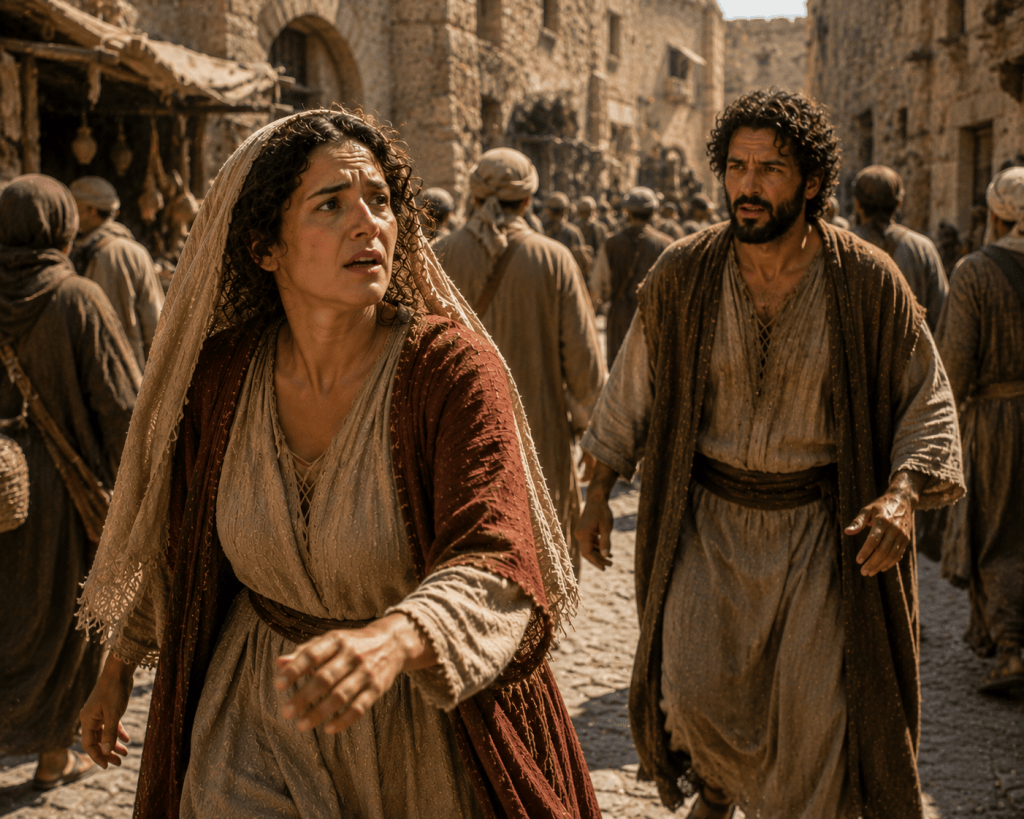
Before Mary found him in the Temple, there was a mother turning around in a crowd and realizing her child was not where she thought he was.
At first, Mary probably wasn’t afraid.
That’s the part I keep thinking about.
There must have been a moment when Jesus was missing—
and nobody knew yet that he was missing.
They were traveling home from Jerusalem after Passover.
Luke tells us Mary and Joseph were part of a group returning from the feast, and that they assumed twelve-year-old Jesus was somewhere among their relatives and acquaintances.
That makes sense.
This wasn’t necessarily three people traveling alone down an empty road.
There were people around them.
Family.
Friends.
Neighbors.
Children moving between adults.
Conversation.
Luggage.
The ordinary disorder of a traveling group.
Jesus was twelve.
Not a toddler who needed to remain within arm’s reach.
He knew these people.
Mary trusted him.
Joseph trusted him.
Perhaps Jesus had spent much of the journey walking with cousins or friends anyway.
So when Mary hadn’t seen him for a while—
she wasn’t afraid.
Not yet.
Maybe she simply asked:
“Where’s Jesus?”
And someone said:
“I thought he was with Joseph.”
Mary nodded.
Reasonable.
Then continued what she was doing.
Perhaps later she saw Joseph.
Alone.
That might have been the first tiny shift.
“Where’s Jesus?”
Joseph looked at her.
“I thought he was with you.”
There is a sentence capable of changing the temperature of the entire world.
Mary probably didn’t panic immediately.
Because there were obvious explanations.
“He was with the others.”
“Which others?”
“I don’t know. I saw him earlier.”
“When?”
Mary thought.
That question suddenly mattered.
“When did you last see him?”
She tried to remember.
Jerusalem?
No.
Surely not.
Maybe sometime after they left.
Hadn’t she?
There had been so many people.
She had heard his voice.
Hadn’t she?
Mary looked behind them.
People walking.
Children.
Animals.
Dust.
No Jesus.
“Jesus!”
Nothing.
Perhaps Joseph called too.
“Jesus!”
Someone looked over.
“What?”
“Have you seen Jesus?”
“Not recently.”
The first person.
No problem.
Someone else.
“Have you seen Jesus?”
“I thought he was with the boys.”
Which boys?
They asked.
No.
Someone had seen him earlier.
Maybe.
Was it today?
Was it before they left?
Nobody was certain.
And I imagine that was when Mary’s body knew before her mind was willing to admit it.
Something was wrong.
There is a particular progression when you cannot find your child.
At first:
He’s nearby.
Then:
Where is he?
Then:
This isn’t funny anymore.
And finally—
something happened.
Perhaps Mary hadn’t reached the last one yet.
But she was moving toward it very quickly.
Luke tells us:
“Assuming that he was in the group of travelers, they went a day’s journey. Then they started to look for him among their relatives and friends.”
A day’s journey.
That detail makes the story much more frightening than the polished phrase Finding in the Temple sometimes allows.
Mary and Joseph didn’t lose sight of Jesus for ten minutes.
They had traveled.
By the time they realized he was not among the group, Jerusalem was behind them.
How far?
We cannot reconstruct their exact movements from Luke’s brief account.
But far enough that returning required a journey.
And before Mary knew Jesus was safely sitting in the Temple—
there was simply:
He isn’t here.
Maybe she began walking faster through the group.
“Jesus?”
Faces turned.
Not him.
“Jesus!”
A boy with similar hair.
Her heart jumped.
He turned.
Wrong child.
Keep moving.
She checked with relatives.
Nothing.
Friends.
Nothing.
Someone said:
“I saw him this morning.”
“Where?”
“I don’t remember.”
“With whom?”
“I thought he was with you.”
Again.
That sentence.
Mary’s breathing changed.
Joseph was searching too.
Perhaps they separated.
“You check ahead.”
“I’ll go back.”
“Meet here.”
Mary nodded.
Then immediately:
“No.”
Joseph stopped.
“What?”
“What if he comes looking for us?”
A problem.
If both parents moved, and Jesus returned to where they had been—
“Someone stays here.”
Maybe a relative offered.
“I’ll stay. Go.”
Mary went.
Now she was calling loudly.
No concern about appearing foolish.
No quiet dignity.
No serene Blessed Virgin.
“JESUS!”
Because somewhere between the third and tenth person saying no, embarrassment ceases to exist.
There is only your child.
Perhaps someone tried to reassure her.
“He’s twelve, Mary.”
She knew.
“He probably went ahead.”
Then why hadn’t anyone seen him?
“He’s responsible.”
She knew.
“Jesus wouldn’t wander away.”
She knew.
That was part of the problem.
Jesus wasn’t careless.
If he wasn’t where he was supposed to be—
why?
Maybe she started remembering everything she had ever told him.
Stay with the group.
Tell us where you’re going.
Don’t go too far.
Wait for us.
Jesus had listened.
Usually.
He was twelve now.
Growing independent.
Perhaps there had been moments lately when Mary had deliberately given him more freedom.
Go.
I’ll see you later.
Stay with your cousins.
Come back before we leave.
Normal.
Healthy.
Necessary.
And suddenly every bit of freedom she had given him might have felt like a mistake.
When did I last see him?
Mary tried again.
She could picture Jesus in Jerusalem.
During the feast.
Walking beside Joseph.
Speaking to someone.
Eating.
Sleeping.
Praying.
But after departure?
Everything blurred.
She had not been monitoring him because she had not believed she needed to.
That’s what trust does.
You stop checking every thirty seconds.
Until something goes wrong.
Then your mind punishes you for having trusted at all.
I should have checked.
Maybe that thought came first.
Then:
I should have known.
Then:
How did I not know?
And finally the cruelest:
What kind of mother doesn’t know where her child is?
Mary was human.
I can imagine that thought finding her.
Holiness does not necessarily make us immune to self-accusation.
Joseph returned.
No Jesus.
Mary saw the answer before he spoke.
“Nothing?”
Joseph shook his head.
“Did you check—”
“Yes.”
“What about—”
“Yes.”
“The others?”
“I asked.”
Mary looked around.
The crowd that had felt safe an hour earlier now looked enormous.
Too many faces.
Too many directions.
Too many places a twelve-year-old boy could disappear.
And perhaps Joseph said:
“We’re going back.”
Of course.
Jerusalem.
They had to return.
Maybe Mary nodded immediately.
Maybe she was already gathering what she needed.
No debate.
No hesitation.
Back.
And then came the thought I imagine Mary desperately did not want to think:
What if he isn’t in Jerusalem?
What if he had been on the road and something happened?
What if he had become separated?
What if he was injured?
What if someone had taken him?
What if—
No.
Stop.
Back to Jerusalem.
Find him.
But fear does not obey instructions.
Especially maternal fear.
Mary had already once fled with this child because his life was threatened.
Matthew tells us Herod had sought to destroy him.
Mary knew, in a way most parents desperately hope never to know, that there had been people who wanted her son dead.
Jesus was older now.
Herod the Great was gone.
They had returned home years ago.
But bodies remember fear.
Maybe Mary’s did too.
Perhaps somewhere beneath the immediate panic was an older terror awakening.
Someone wanted him once.
No.
That was years ago.
But someone wanted him.
Stop.
Joseph is here.
Go back.
Find Jesus.
Maybe Mary prayed.
But perhaps not beautifully.
This is not necessarily the moment for composed prayer.
Maybe she couldn’t find words.
God, please.
Where is he?
Please.
Please.
Please.
Or perhaps something sharper:
You gave him to me.
That thought would be terrifying.
God had entrusted Jesus to her.
Gabriel had appeared to her.
She had carried him.
Fed him.
Protected him.
Taken him into Egypt.
Brought him home.
Watched fevers.
Held him when he cried.
Raised him for twelve years.
And now—
she had lost him.
That phrase must have been unbearable.
I lost Jesus.
Not metaphorically.
Literally.
Mary did not know where her son was.
Maybe Joseph saw the panic escalating.
“Mary.”
She was moving too quickly.
“Mary.”
“What?”
“We will find him.”
“How do you know?”
Joseph stopped.
Perhaps there was no good answer.
Because reassurance becomes dangerous when you cannot promise the outcome.
So maybe Joseph didn’t say:
“He’s fine.”
He couldn’t know.
Instead:
“We’re going back.”
Concrete.
True.
Something to hold.
“We’ll check the road. We’ll ask everyone coming from Jerusalem.”
Mary nodded.
Yes.
Do something.
Movement was better than standing still.
Perhaps someone offered them food before they left.
Mary couldn’t eat.
Joseph insisted she take it.
Not eat it.
Just take it.
Water too.
They were about to retrace a day’s travel.
Their bodies still existed even if fear made that fact offensive.
Mary carried the food.
Maybe hours later she realized she had been gripping it in her hand without noticing.
Then they began back.
And every person coming toward them became possibility.
“Have you seen a boy?”
Twelve years old.
Dark hair.
Traveling alone.
His name is Jesus.
Have you seen him?
No.
No.
No.
Maybe.
Where?
No, different boy.
No.
Sorry.
No.
How many times can a mother’s heart rise and fall in an hour?
Maybe Mary learned.
A figure in the distance.
Could be him.
Closer.
Not him.
A child’s voice.
Jesus?
No.
A boy running.
Wrong boy.
Again.
Again.
Again.
Perhaps Joseph called Jesus’ name until his voice became rough.
Mary too.
The name that usually required no urgency.
Jesus, dinner.
Jesus, come here.
Jesus, your father needs you.
Jesus, wash.
Jesus, listen.
Jesus, goodnight.
Now:
JESUS!
The same name transformed by fear.
I wonder whether Mary became angry.
Fear often does that.
Maybe she was furious with him.
Where are you?
What were you thinking?
You know better.
How could you do this?
Then immediately ashamed of the anger.
Because if he appeared right now, she would not care.
He could have broken every household rule they possessed.
Just let him appear.
She would never be angry again.
A promise no frightened parent has ever successfully kept.
Maybe she imagined finding him.
She would grab him.
Check him.
Face.
Hands.
Arms.
Are you hurt?
Then hold him.
Then perhaps yell at him.
Then hold him again.
She didn’t know.
Just—
let me find him.
And maybe this is where the theological knowledge became almost useless again.
Gabriel had told Mary who Jesus was.
Simeon had spoken over him.
Mary had treasured these things.
She knew God had purposes for her son.
Surely those purposes weren’t ending because a twelve-year-old became separated from a traveling group.
Surely.
But the human body does not always accept surely.
Her heart was racing anyway.
Her mouth was dry.
Her stomach hurt.
Her mind was creating terrible possibilities faster than faith could dismiss them.
And perhaps Mary did exactly what she had done years earlier when toddler Jesus had a fever.
She kept moving.
She asked for help.
She stayed close to Joseph.
She prayed however she could.
She did the next thing.
Then the next.
Then the next.
Faith did not mean she felt no fear.
It meant fear did not stop her from searching.
We know the ending.
That’s the difficulty of entering this story imaginatively.
We know where Jesus is.
He’s safe.
He’s in the Temple.
Luke tells us that after three days Mary and Joseph found him sitting among the teachers, listening and asking questions.
Everyone who heard Jesus was amazed.
We can read the beginning without panic because the ending is already printed on the page.
Mary couldn’t.
For her, there was no next verse yet.
There was only the road back to Jerusalem.
And three days.
Three.
Days.
Whatever precise way Luke counts that period, the narrative deliberately gives us duration.
This was not a brief misunderstanding.
Mary and Joseph searched.
Imagine the first night.
But we’re not there yet.
This is only the first hour.
The hour when fear was still becoming fear.
The hour when Mary moved from:
He’s probably with someone else.
to:
No one has seen him.
to:
We have to go back.
Maybe that transition was the worst part.
The moment certainty disappeared.
Perhaps one hour earlier Mary had been talking to someone.
Maybe laughing.
Perhaps discussing something completely unimportant.
Dinner.
Travel.
Someone’s family news.
Jesus was somewhere nearby.
She believed.
Then suddenly the entire universe narrowed to one question:
Where is my son?
Nothing else mattered.
I imagine Joseph checking their belongings once.
Not because Jesus could possibly be inside a bag.
Because panic makes you verify ridiculous things.
Maybe he checked places already checked.
Asked people already asked.
Mary did too.
“You asked them.”
“I know.”
“You already checked there.”
“I know.”
Neither criticized the other.
Search again.
Maybe reality changed.
Maybe Jesus appeared in the place he wasn’t five minutes ago.
Please.
At some point the traveling group had to continue.
People had homes to reach.
Children to manage.
Animals.
Obligations.
Perhaps some relatives stayed.
Perhaps others promised to watch for him.
The world continued functioning.
That can feel almost insulting when you’re afraid.
How can everyone keep walking?
Jesus is missing.
But carts move.
People talk.
Someone laughs at something far away.
A child complains.
The sun continues lowering.
The world has not noticed that Mary’s world has stopped.
Joseph touched her arm.
“Ready?”
Mary looked toward Jerusalem.
The road they had just traveled.
Now they would undo it.
“Yes.”
Maybe her voice didn’t sound like hers.
They began walking.
Fast.
And perhaps Mary looked back once at the group.
The place where Jesus was supposed to have been.
Empty.
Then forward.
Jerusalem.
Find him.
Maybe the first hour ended without revelation.
No angel came.
That’s important.
Gabriel did not appear and say:
Do not be afraid, Mary. Your son is safe in the Temple.
Joseph received no dream explaining where to go.
No star pointed toward Jesus.
No supernatural reassurance.
They had to search.
That fascinates me.
God could have told them.
The Gospel does not say he did.
Mary and Joseph had to endure not knowing.
Perhaps that is one of the most human moments in Mary’s life preserved explicitly in Scripture.
Because when she finally finds Jesus, Mary does not pretend she had been serene.
She tells him.
Luke gives her words:
“Child, why have you treated us like this? Look, your father and I have been searching for you in great anxiety.”
Great anxiety.
There it is.
Mary says it herself.
Not:
We trusted completely and therefore experienced no distress.
Not:
I knew God would protect you, so I wasn’t worried.
She tells Jesus they were anxious.
She lets the fear be true.
And I love that she says:
“Your father and I.”
Joseph’s fear mattered too.
They searched together.
They worried together.
Whatever those three days contained, Mary wasn’t the only parent whose heart was breaking.
Joseph had lost his boy too.
The boy who ran toward him.
Worked beside him.
Brought him rocks.
Argued about goats at dinner.
Called him Papa.
Missing.
Maybe during that first hour Mary looked at Joseph and saw something she had rarely seen.
Fear.
Not the controlled concern of a father dealing with a fever.
Not vigilance.
Fear.
His jaw tight.
Eyes scanning every face.
Calling Jesus.
Again.
Again.
Perhaps that frightened Mary more.
Because Joseph was supposed to say:
He’s here.
I found him.
Everything is fine.
But Joseph didn’t know either.
So they went back together.
Two parents on a road.
Calling for their child.
No answer.
And somewhere ahead of them, in Jerusalem, twelve-year-old Jesus was apparently sitting among teachers.
Listening.
Asking questions.
Completely absorbed.
Perhaps he felt safe.
Perhaps he believed his parents understood where he would be.
His response when they finally found him suggests something about his own understanding:
“Did you not know that I must be in my Father’s house?”
And Luke immediately tells us:
they did not understand what he said to them.
That matters too.
Jesus knew something they did not.
For perhaps the first time in his childhood, the distance between who Jesus was and Mary’s ability to understand him became painfully visible.
But that comes later.
Right now Mary isn’t pondering theology.
She isn’t considering Jesus’ relationship with the Father.
She isn’t contemplating his mission.
She is walking back toward Jerusalem.
Too quickly.
Scanning every person.
Her throat raw from calling his name.
Her mind trying not to imagine what she might find.
Joseph beside her.
And perhaps one thought repeating with every step:
Please let him be there.
Please.
Please.
Please.
Years later, Mary would lose sight of Jesus again.
Jerusalem again.
Passover again.
Crowds again.
But next time she would know exactly where he was.
And that would be worse.
She would see him taken.
See him condemned.
Follow as far as she could.
At twelve, Mary could search Jerusalem believing she might find Jesus safe around the next corner.
At Calvary, there would be no such hope.
Not until something happened that even she could not yet understand.
But again—
not today.
We don’t need to make every childhood fear foreshadow the Cross.
This moment is terrible enough on its own.
Her twelve-year-old is missing.
Let Mary be his mother.
Perhaps she stumbled on the road.
Joseph caught her arm.
“Slow down.”
“We don’t have time.”
“We can’t search if you’re hurt.”
Mary hated that he was right.
She slowed slightly.
For approximately thirty seconds.
Then sped up again.
Joseph followed.
Of course he did.
Maybe she finally took the water someone had given her.
One swallow.
Her stomach rejected the idea of food.
Keep walking.
A traveler approached.
Joseph called:
“Excuse me.”
Mary was already studying the man’s face.
“Have you seen a boy traveling alone?”
The description again.
Twelve.
Dark curls.
From Nazareth.
His name is Jesus.
The traveler thought.
Mary stopped breathing.
“No.”
Her body sagged.
“I’m sorry.”
“Thank you.”
Keep walking.
The sun had moved.
That’s how Mary might have known an hour had passed.
An hour.
Only an hour.
Already it felt impossible.
She had no idea there would be more.
No idea they would search until the Temple.
No idea that when she finally saw Jesus, relief and anger and confusion would collide so violently that the words would simply come out:
Why have you done this to us?
For now she still had the fantasy that finding him would end everything.
Find Jesus.
Hold him.
Then the world can begin again.
Maybe that was the first hour.
Not screaming.
Not melodrama.
Something worse.
A steadily tightening circle.
He’s with relatives.
No.
He’s with friends.
No.
He’s ahead.
No.
Someone saw him.
When?
Before we left.
Check again.
No.
Call him.
Nothing.
Ask Joseph.
He doesn’t know.
Ask everyone.
Nobody knows.
Look back toward Jerusalem.
And finally—
the thought Mary had been refusing to let fully form:
My child is missing.
She had once carried Jesus inside her body.
Then against her chest.
Then on her hip.
Then by the hand.
Eventually he walked beside her.
Then a little ahead.
Then sometimes beyond where she could see him.
That’s what raising a child requires.
You loosen your grip as they grow.
And perhaps at twelve, for one terrible hour, Mary discovered the fear hidden inside that necessary act:
I let him walk beyond my sight.
And now I cannot find him.
So Mary turned back toward Jerusalem.
Joseph beside her.
The road stretched ahead.
No miracle came to shorten it.
No angel came to reassure them.
There was only distance.
Dust.
Strangers.
Questions.
And the name they kept calling into the crowd.
“Jesus!”
No answer.
Again.
“Jesus!”
Nothing.
Mary kept walking.
Because somewhere in that city was her boy.
Son of the Most High.
Messiah.
Promised King.
All of that could wait.
Right now he was twelve years old.
And his mother did not know where he was.
So she searched.
Not serenely.
Not without fear.
Scripture itself refuses us that sanitized version.
With great anxiety.
And perhaps the first hour of Mary’s panic teaches us something quietly important about her humanity:
Knowing your child belongs to God does not mean you stop being terrified when you cannot find him.
Sometimes faith looks much less like calm certainty—
and much more like a frightened mother walking back down the road,
calling her son’s name,
and refusing to stop until he answers.


