The Invitations of Mary Series
©MS 2026
Most of Jesus’ earthly life appears to have been spent this way: waking, eating, working, learning, praying, laughing, sleeping—and doing it all again tomorrow.
Nothing happened that day.
No angel came.
No star appeared.
Nobody received a prophecy.
There were no shepherds outside.
No Magi arrived carrying strange and expensive gifts.
Nobody was healed.
Water remained water.
The bread on the table remained exactly the amount of bread Mary had made.
The dead stayed dead.
The blind did not see.
No crowds gathered outside the house asking Jesus to teach them.
Nobody called Mary blessed.
Nobody called Joseph righteous.
Nobody called Jesus anything more extraordinary than his name.
It was Tuesday.
Or whatever the equivalent of an entirely unremarkable weekday felt like in first-century Nazareth.
And sometime shortly after sunrise, Mary probably said something like:
“Jesus, get up.”
Maybe Jesus was seven now.
Old enough that waking him no longer required feeding him.
Young enough that waking him still occasionally required negotiation.
“Jesus.”
Nothing.
Mary moved whatever covering was over him.
“Morning.”
A muffled sound.
“What?”
Another sound.
Mary leaned closer.
“I cannot understand you when your face is buried.”
Jesus turned his head.
“I’m awake.”
His eyes were closed.
Mary looked at him.
“You are not.”
“I am.”
“Then open your eyes.”
Silence.
Mary waited.
One eye opened.
Technically compliant.
Mary sighed.
“Both.”
Somewhere nearby Joseph was already awake.
Perhaps that was deeply irritating.
Some people wake with the sun and apparently feel no resentment about it.
Joseph might have been one of them.
Mary was not necessarily impressed.
Maybe she walked past him.
“You’re cheerful.”
Joseph looked up.
“Good morning.”
“That wasn’t an invitation.”
Joseph smiled.
Mary continued toward whatever needed doing.
Marriage.
Eventually Jesus emerged.
Hair everywhere.
One side of his face still marked from sleep.
Bare feet.
Deeply unconvinced that morning had been necessary.
Joseph looked over.
“Good morning.”
Jesus grunted.
Mary pointed.
“Words.”
“Good morning.”
Better.
Joseph handed him something to eat.
Jesus sat.
And slowly returned to humanity.
Perhaps that was how the day began.
Not with the Magnificat.
Breakfast.
There is something almost shocking about how little the Gospels tell us about Jesus’ life in Nazareth.
Luke gives us the episode in the Temple when Jesus was twelve.
Then the narrative jumps forward.
Suddenly Jesus is an adult.
Approximately thirty years of earthly life—
and we know almost nothing.
Christians sometimes call these the hidden years.
And they really are hidden.
We don’t know what games Jesus played.
We don’t know what chores Mary gave him.
We don’t know what Joseph taught him first.
We don’t know which neighbors knew him well.
We don’t know what made him laugh hardest.
We don’t know whether he liked lentils.
We don’t know whether Mary ever had to remind him twice to bring something inside.
We don’t know what ordinary evenings sounded like.
Scripture simply doesn’t tell us.
And perhaps there is something beautiful about that.
Because if the Christian claim is true—
if God really became human—
then God spent an astonishing amount of the Incarnation doing things nobody considered important enough to record.
Jesus ate breakfast.
Jesus washed.
Jesus dressed.
Jesus learned.
Jesus worked.
Jesus rested.
Jesus went to synagogue.
Jesus observed Sabbath.
Jesus participated in Jewish family and communal life.
Jesus slept.
Then morning came again.
Years passed this way.
Not hours.
Years.
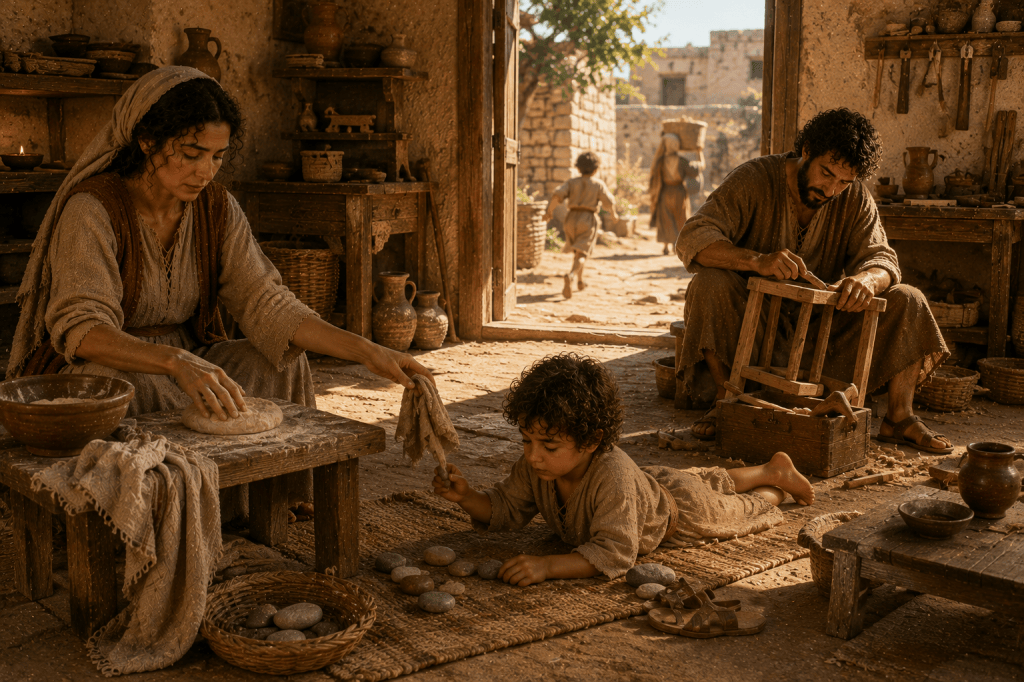
Maybe Mary spent part of this particular morning making bread.
Nothing miraculous about it.
Grain had to be prepared.
Dough had to be worked.
Food did not appear simply because the Son of God happened to live in the house.
Wouldn’t that have been convenient?
Mary looks at the empty storage jar.
Jesus looks at Mary.
Mary looks at Jesus.
Jesus is perhaps old enough now to understand exactly what she is thinking.
“No.”
“I didn’t say anything.”
“You were thinking something.”
Mary raises an eyebrow.
Apparently this family has inherited that phrase.
“I was merely observing that you will someday feed thousands of people.”
Jesus stares.
Mary points toward the grain.
“Today you can help me with this.”
Maybe he did.
Because ordinary households require work.
Water had to be fetched.
Food prepared.
Clothing washed and repaired.
Floors swept.
Things carried.
Things cleaned.
Things put away.
Animals, if they had any responsibility for them, required attention.
Family obligations existed.
Neighbors needed things.
Work did not stop being work because salvation history was happening quietly inside the house.
Perhaps Mary gave Jesus chores.
Of course she did.
“Take this to your father.”
Jesus takes it.
“Come back.”
“I know.”
“You said that yesterday.”
“I came back yesterday.”
“Eventually.”
Jesus leaves.
Mary watches him go.
Seven years old.
Already a lawyer.
Joseph was working.
Jesus delivered whatever Mary sent.
Then stayed.
Naturally.
Mary had specifically said come back.
But Joseph was doing something interesting.
Jesus watched.
“What are you making?”
“A stool.”
“For who?”
“Judah.”
“Why?”
“Because he needs one.”
“What happened to his old one?”
Joseph stops.
He has learned where this road goes.
“I don’t know.”
“Why?”
Joseph looks toward the doorway.
Mary is nowhere to be seen.
No rescue coming.
He sighs.
“Would you like to help?”
Question successfully redirected.
Jesus nods.
Twenty minutes later Mary realizes Jesus has not returned.
She waits.
Still nothing.
“Jesus?”
From the workshop:
“Yes?”
“Did I tell you to stay with your father?”
Silence.
Joseph becomes very interested in the stool.
Jesus calls back:
“No.”
“And yet?”
Jesus looks at Joseph.
Joseph whispers:
“Go.”
Betrayal.
Jesus returns.
Mary holds out her hand.
The original item she had asked him to bring back.
Jesus looks down.
He has forgotten it.
Of course.
He turns around.
Mary closes her eyes.
Nothing miraculous happened in Nazareth that morning.
Nothing at all.
Maybe Mary went to the market.
Maybe Jesus came with her.
Perhaps by seven he knew half the people they passed.
Someone greeted Mary.
Someone greeted Jesus.
Someone asked after Joseph.
A woman stopped them and began telling Mary something that could have been communicated in three sentences but required fourteen.
Jesus stood beside her.
Then shifted.
Then leaned against Mary.
Then looked around.
Then examined something on the ground.
Then interrupted.
“Jesus.”
“Sorry.”
The woman continued.
Jesus waited.
For an amount of time he considered heroic.
Then:
“Mama.”
Mary placed one hand gently against his shoulder.
Not yet.
He sighed.
Martyrdom.
Eventually they moved on.
Jesus carried something.
Mary carried more.
“Can I have that?”
“No.”
“Why?”
“Because we’re buying what we need.”
“I need that.”
“You learned it existed twelve seconds ago.”
Jesus considered this.
Still needed it.
Mary continued walking.
Some arguments transcend millennia.
Maybe they saw someone who needed help.
Nothing dramatic.
An older neighbor carrying something heavy.
Mary stopped.
“Jesus.”
He already knew.
He took part of the load.
No miracle.
No sermon.
Nobody wrote it down.
They simply helped.
Maybe someone gave Jesus a fig.
He thanked them.
A dog followed him for half the walk home because Jesus had made the catastrophic error of sharing something.
Mary noticed.
“Don’t.”
Jesus looked at her.
“I didn’t.”
“You are thinking about it.”
Jesus looked at the dog.
Then at the food.
Mary knew.
“If you feed him, he will follow us home.”
Jesus broke off a tiny piece.
The dog ate it.
Mary sighed.
The dog followed them home.
Jesus looked delighted.
Mary looked at him.
“I told you.”
“He likes us.”
“He likes your fig.”
Same thing, apparently.
Maybe Joseph came outside when they arrived.
He looked at the dog.
Then Mary.
Then Jesus.
“No.”
Jesus hadn’t even spoken.
Mary almost laughed.
“That’s what I said.”
Jesus looked between both parents.
Hopeless.
The dog eventually went elsewhere.
Jesus survived the tragedy.
Barely.
Lunch.
Work.
Heat.
Dust.
The ordinary progression of a day.
Perhaps in the hottest part of the afternoon everything slowed.
Joseph stopped working for a while.
Mary sat.
Jesus disappeared somewhere nearby with other children.
Their voices carried back toward the house.
Running.
Calling.
Arguments.
Laughter.
Maybe Mary could recognize Jesus’ voice among all of them.
Mothers can do that.
She didn’t need to see him.
He was nearby.
Safe.
Playing.
Perhaps there were rules.
“Stay where I can hear you.”
Jesus agreed.
Then gradually the voices moved farther away.
Mary’s head lifted.
“Jesus!”
A distant:
“Yes!”
“Closer!”
A pause.
Then the voices began returning.
Mary continued what she was doing.
No divine omniscience required.
Just maternal acoustics.
Maybe Jesus played games whose rules adults did not understand.
A stone was apparently extremely important.
This line could not be crossed.
That wall was something else entirely.
Someone was king.
Someone else disputed the legitimacy of the king.
Jesus was involved in negotiations.
Mary listened from a distance.
Children have always constructed entire civilizations between lunch and dinner.
By evening, none of it existed anymore.
Perhaps Jesus came home dirty.
Not metaphorically.
Actually dirty.
Dust on his knees.
Dust on his face.
Something in his hair.
Mary stared.
“What happened?”
“Nothing.”
Mary looked at him.
Whatever happened had clearly involved the entire landscape.
“Wash.”
“I washed earlier.”
“You were not covered in dirt earlier.”
Jesus looked at his arms as though only now discovering them.
“Oh.”
“Yes. Oh.”
Maybe Joseph walked by.
Jesus looked at him for support.
Joseph examined the child.
Then looked at Mary.
“Wash.”
Two against one.
Unjust household.
Perhaps Jesus complained about the water.
“It’s cold.”
“Yes.”
“Why?”
“Because it isn’t warm.”
“I don’t like it.”
Mary handed him the cloth.
“You liked being dirty.”
Jesus thought about this.
Fair.
Maybe that evening Joseph repaired something in the house.
Not for a customer.
Their own.
A hinge.
A stool.
A storage chest.
Something that had been making an irritating sound for three weeks.
Mary had mentioned it.
Once.
Then again.
Then perhaps in increasingly specific language.
Joseph had said:
“I’ll fix it.”
Today was apparently the day.
Mary heard the sound stop.
She looked over.
Joseph looked extremely pleased with himself.
Mary tested it.
Silence.
“Thank you.”
Joseph smiled.
Jesus looked between them.
“What was wrong with it?”
Mary and Joseph both began explaining.
Differently.
They stopped.
Looked at one another.
Jesus waited.
This was going to be good.
Maybe Mary cooked dinner.
Jesus helped.
“Not that much.”
He stopped.
Mary looked.
Too much.
“Jesus.”
“You said put it in.”
“I said some.”
“That is some.”
Joseph, from nearby:
“I’m staying out of this.”
Mary turned.
“You are not helping.”
“I specifically said I wasn’t.”
Maybe the food still tasted fine.
Maybe it didn’t.
They ate it anyway.
Not every meal Mary made was necessarily wonderful.
That feels almost scandalous to say about the Blessed Virgin, but surely holiness does not confer supernatural seasoning ability.
Perhaps Mary made something once and knew immediately it was bad.
Joseph ate.
Jesus ate.
Nobody spoke.
Mary took a bite.
Looked at them.
“You can say it.”
Joseph continued chewing.
Jesus looked at Joseph.
Joseph looked at Jesus.
Danger.
Mary waited.
Jesus finally said:
“It’s different.”
Joseph closed his eyes.
Mary stared.
“Different.”
Jesus nodded.
Mary began laughing.
Joseph joined.
Dinner was saved.
The food was not.
Maybe after dinner they cleaned together.
Jesus carried dishes.
Joseph put things away.
Mary wiped the table.
Jesus tried to leave.
“Where are you going?”
“Outside.”
“We aren’t finished.”
Jesus looked at the table.
“It looks finished.”
Mary handed him something.
“Now it isn’t.”
He sighed.
Again:
martyrdom.
Then perhaps came evening prayer.
The rhythms of Jewish life would have shaped the household in ways modern Christian imagination sometimes flattens.
Jesus was raised in a Jewish family.
He learned Scripture within that world.
Prayer.
Blessing.
Sabbath.
Festival.
Synagogue.
The stories of Israel were his family’s stories.
Maybe Joseph recited something Jesus was learning.
Jesus joined.
Maybe Mary corrected a word.
Perhaps Jesus asked a question.
Joseph answered.
Another question.
Mary answered.
Another.
Joseph looked at Mary.
Mary looked at Joseph.
They had created this problem by teaching him language.
Maybe some evenings Joseph told Scripture stories.
Jesus had heard them before.
That did not matter.
Children request repetition.
“Tell the Moses one.”
“You know the Moses one.”
“Tell it.”
Joseph began.
Jesus corrected details.
“I thought I was telling it.”
“You forgot that part.”
“I was getting there.”
“You didn’t say it.”
Mary worked nearby, listening to the two of them debate the Exodus.
Maybe she smiled.
Imagine Mary listening to Joseph tell Jesus about Abraham.
Isaac.
Jacob.
Joseph.
Moses.
David.
Prophets.
Promises.
And Jesus listening.
The child through whom Christians believe those promises would ultimately be fulfilled—
sitting on the floor asking:
“Then what happened?”
The hidden life is almost unbearably strange when you look at it closely.
But perhaps nobody thought about that most evenings.
Maybe that’s important too.
Mary could not spend every second staring at Jesus thinking:
Incarnate Word.
She would never have gotten anything done.
Sometimes Jesus was simply:
“Jesus, move your sandals.”
“Jesus, your father called you.”
“Jesus, wash your hands.”
“Jesus, bring that here.”
“Jesus, leave your cousin alone.”
“Jesus, it’s time for bed.”
The extraordinary became woven into ordinary address.
God-with-us apparently also meant:
God, please put that back where you found it.
Perhaps bedtime came.
Jesus was suddenly not tired.
A remarkable recovery from the child who had been exhausted an hour earlier.
“I can stay up.”
“No.”
“Why?”
“Because it’s bedtime.”
“I’m not tired.”
Mary looked at him.
Joseph looked at him.
Jesus yawned.
Nobody commented.
He narrowed his eyes.
They had seen nothing.
Maybe he climbed into bed.
Mary kissed him.
Joseph did too.
Jesus asked for water.
He had already had water.
Still thirsty.
Water.
Then another question.
Then something critically important he had forgotten to tell them all day.
“Mama?”
“Yes?”
“Tomorrow can I—”
“Tomorrow.”
“But—”
“Tomorrow.”
Silence.
Then:
“Papa?”
Joseph answered from across the room.
“No.”
“You don’t know what I was going to ask.”
“I know enough.”
Mary laughed.
Jesus was offended.
Eventually quiet.
Real quiet.
Jesus asleep.
Joseph finishing something.
Mary sitting nearby.
Perhaps that was when she finally had time to think.
Not every night.
Some nights she probably went directly to sleep because she was exhausted.
But maybe occasionally she looked across the room.
Joseph.
Jesus.
Home.
Nothing had happened.
And maybe she felt content.
That’s what I keep coming back to.
Nothing happened.
And yet an entire life was happening.
We are naturally drawn to the dramatic parts of Scripture.
The Annunciation.
Visitation.
Nativity.
Flight into Egypt.
Finding Jesus in the Temple.
Baptism.
Miracles.
Transfiguration.
Last Supper.
Gethsemane.
Cross.
Resurrection.
Ascension.
These are the moments that become feast days.
Paintings.
Stained glass.
Rosary mysteries.
Theology.
But they represent a remarkably small portion of Jesus’ earthly lifespan.
If Jesus lived approximately thirty-three years, then the overwhelming majority of his life was not public ministry.
It was hidden.
Nazareth.
Ordinary time in the most literal sense.
Years.
Thousands of mornings.
Thousands of meals.
Countless conversations that disappeared as soon as they were spoken.
Work nobody preserved.
Jokes nobody recorded.
Small injuries.
Sweeping.
Shopping.
Visiting.
Praying.
Sleeping.
Growing.
The Son of God spent most of the Incarnation doing things human beings routinely dismiss as nothing.
That feels significant.
Maybe holiness isn’t always recognizable while it’s happening.
Perhaps sometimes holiness looks like bringing water.
Making dinner.
Teaching a child.
Finishing your work.
Helping a neighbor.
Apologizing.
Resting.
Keeping Sabbath.
Laughing at something stupid.
Repairing the thing you promised you’d repair.
Putting the sandals away.
Starting again tomorrow.
Mary’s life in Nazareth may have contained long stretches where she received no new revelation whatsoever.
Think about that.
Gabriel came once.
The shepherds came once.
Simeon spoke once.
Anna spoke once.
Then?
Years.
Mary had to live between extraordinary encounters.
She had to trust what she had been told while Jesus did absolutely ordinary things.
Perhaps there were mornings when the prophecy felt almost impossible to connect with the child currently complaining about washing his face.
He will be great.
Yes.
He is also refusing to put on his sandal.
Both true.
Maybe Mary occasionally looked at Jesus across the room and remembered.
Son of the Most High.
Jesus sneezed.
Throne of David.
Jesus dropped something.
His kingdom will have no end.
“Mama, where did you put my—”
Mary closed her eyes.
There it was.
The kingdom of God.
Looking for something directly in front of him.
Perhaps that is part of the mystery of Nazareth.
God did not merely enter human suffering.
He entered human ordinariness.
The waiting.
Repetition.
Domestic work.
Growing up.
The years when nothing appears to be happening.
Christianity could have told a story in which Jesus arrived as an adult.
Instead, he was born.
And then he grew.
Slowly.
One day at a time.
Mary had to wait too.
For whatever came next.
Perhaps she didn’t know when Jesus’ public life would begin.
Maybe every year she wondered.
Is it now?
No.
Another year.
Jesus worked beside Joseph.
Another Passover.
Another harvest.
Another winter.
Another birthday, however their household marked the passage of his years.
Still Nazareth.
Still home.
Still ordinary.
And perhaps Mary learned not to treat those years as a waiting room.
That’s important.
The hidden life wasn’t simply the part before Jesus’ real life began.
It was his real life.
These days counted.
Joseph’s workshop counted.
Mary’s table counted.
The synagogue counted.
Neighbors counted.
Family counted.
The quiet formation of a human life counted.
God apparently considered thirty hidden years worth living.
Maybe that is why I find Nazareth increasingly beautiful.
There is no pressure there to produce a miracle.
No audience.
No performance.
No one asking Jesus to prove who he is.
He can simply belong.
Mary does not need to be Queen of Heaven today.
She can make bread.
Joseph does not need to be Patron of the Universal Church.
He can fix the stool.
Jesus does not need to save the world before bedtime.
He can play outside.
Tomorrow is enough.
Maybe one particular evening Mary stood in the doorway.
Jesus was outside with Joseph.
Not working.
Not learning anything important.
Just sitting.
Joseph had finished for the day.
Jesus was beside him.
Perhaps they were throwing little stones toward some mark in the dirt.
Joseph threw.
Missed.
Jesus laughed.
“You missed.”
“I know.”
Jesus threw.
Worse.
Joseph looked at him.
Jesus looked at Joseph.
Neither said anything.
Mary watched.
The sky was turning gold.
Someone nearby was preparing dinner.
A dog barked.
Voices carried between houses.
Dust hung in the evening light.
Nothing supernatural.
Nothing worthy of a Gospel verse.
Mary almost called them in.
Then waited.
One more throw.
Joseph missed again.
Jesus laughed.
Mary smiled.
Maybe she didn’t know she would remember that evening.
Why would she?
There had been hundreds like it.
That’s the strange thing about ordinary memories.
Sometimes decades later they become precious precisely because nothing happened.
The person was simply there.
The house still sounded right.
Everyone you loved was still alive.
Nobody knew anything was ending.
You would give anything to stand in that doorway again.
Perhaps after Joseph died, Mary remembered ordinary days more than dramatic ones.
Not Egypt.
Not fear.
Not uncertainty.
Maybe she remembered Joseph complaining about a stubborn hinge.
Jesus bringing home rocks.
The sound of tools.
Dinner conversation.
The way Joseph said her name from another room.
The completely unimportant things that become enormous after someone is gone.
And perhaps after Jesus left Nazareth—
she missed the same things again.
His sandals near the door.
His voice asking where something was.
The extra bread needed at dinner.
Someone moving through the house.
Presence has a sound.
So does absence.
Then after Calvary?
I wonder whether Mary ever wished desperately for one completely ordinary day.
Not resurrection theology.
Not visions.
Not answers.
Just—
Nazareth.
Joseph alive.
Jesus seven.
Bread baking.
Someone needs water.
The stool squeaks.
Jesus has forgotten what she asked him to bring.
Nothing happening.
Nothing about to happen.
Everyone home.
Maybe that’s one reason ordinary life becomes sacred in memory.
Because we rarely know we’re inside the days we will someday ache to return to.
But on this particular day, Mary doesn’t know any of that.
Thank God.
She doesn’t need to.
Jesus is seven.
Joseph is alive.
Dinner is almost ready.
The house is warm.
Mary stands at the doorway.
“Come eat.”
Joseph gets up.
Jesus throws one final stone.
Misses terribly.
Joseph laughs.
Jesus protests that the throw did not count.
They walk toward her still arguing about it.
Mary steps aside to let them in.
“Wash first.”
Jesus groans.
Joseph points toward the water.
“Listen to your mother.”
Jesus goes.
Joseph passes Mary.
She looks at him.
“He gets that from you.”
Joseph stops.
“Gets what?”
Mary walks inside.
Joseph follows.
“Mary.”
She doesn’t answer.
He knows she’s smiling.
They eat.
They talk.
They pray.
Jesus tells them something he forgot to mention earlier.
Joseph says something that makes Mary laugh.
Mary reminds Jesus to finish chewing.
Eventually the table is cleared.
The lamp burns low.
Jesus falls asleep.
Joseph lies beside Mary.
Outside, Nazareth becomes quiet.
No angel comes.
No prophecy is spoken.
No miracle occurs.
Nobody writes down what happened.
Morning will come.
They will do much of it again.
And perhaps that’s the wonder of the hidden years.
The Incarnation did not make every day extraordinary.
Instead—
God entered the ordinary day and stayed there.
For years.
Long enough to make bread and work and chores and family dinners and tired evenings part of the story too.
Nothing happened that day in Nazareth.
Nothing miraculous.
Nothing anyone thought worth remembering.
Mary simply had her husband.
Joseph had his wife.
They had their boy.
And for one more completely ordinary day—
everyone was home.

 The Living Rosary Archives