The Invitations of Mary Series
©MS 2026
There are ways we fall in love with someone before marriage. And then there are ways we discover them afterward, when we watch them love someone else.
Mary knew Joseph before he was a father.
She knew the sound of his voice.
She knew how he worked.
She knew whether he was patient when something went wrong and what his face looked like when he was trying not to laugh.
She probably knew the particular way he became quiet when he was thinking.
She knew his habits.
Some she loved.
Some, as we have already imagined, may have made her quietly wonder whether sanctity required tolerating a man who left wood shavings where they did not belong.
She knew Joseph.
And then Jesus was born.
And Mary met someone new.
Joseph the father.
Perhaps she first saw him in Bethlehem.
Not when he initially held Jesus.
That moment might have been too overwhelming for both of them.
Joseph had spent months preparing to become the father of a child who was not biologically his, a child whose conception had required an angel to explain.
There was no ordinary path into this.
No familiar script.
Then suddenly there was a baby.
A real one.
Tiny.
Warm.
Crying.
Needing someone to support his head.
Maybe Joseph held Jesus like something made of glass.
Mary watched him.
“Support his neck.”
“I am.”
“A little more.”
“Like this?”
“Yes.”
Joseph barely breathed.
Jesus shifted.
Joseph froze.
Mary almost smiled.
“He’s all right.”
“I know.”
He clearly did not know.
Not yet.
Neither of them did.
But perhaps Mary watched Joseph look down at Jesus and saw the exact moment something changed.
Not obligation.
Not duty.
Not:
God has entrusted this child to me, therefore I will fulfill my responsibility.
Something far less formal.
Love.
Immediate, frightening, defenseless love.
Joseph touched one finger to Jesus’ hand.
The tiny fingers closed around it.
And Joseph’s face changed.
Mary saw it.
Maybe that was the first thing she loved about watching Joseph become a father:
He let Jesus matter to him completely.
That wasn’t guaranteed.
We know the story so well that Joseph’s acceptance can feel inevitable.
It wasn’t.
Before Jesus was born, Joseph had every reason to imagine a very different life.
Marriage to Mary.
Children of his own.
A household built in the ordinary way.
Then Mary’s pregnancy disrupted everything.
Matthew tells us Joseph intended to divorce her quietly before the angel appeared to him in a dream.
Then Joseph chose to stay.
But staying was only the beginning.
There is a difference between accepting responsibility for a child and allowing that child to become yours.
Perhaps Mary watched Joseph cross that distance.
Maybe it took approximately three seconds.
Jesus cried.
Joseph responded.
Jesus needed changing.
Joseph learned.
Jesus wouldn’t sleep.
Joseph walked.
Jesus became sick.
Joseph worried.
Jesus laughed.
Joseph discovered he would do increasingly ridiculous things to hear it again.
Little by little, fatherhood stopped being something Joseph had agreed to.
It became who he was.
And Mary got to watch.
Maybe she loved how serious he was about it at first.
Joseph wanted to do everything correctly.
“How long should he sleep?”
Mary stared at him.
“I don’t know.”
“You don’t know?”
“Why would I know?”
Joseph paused.
Fair.
Perhaps they both looked at Jesus.
The alleged source of information was asleep.
Useless.
Maybe Joseph asked older fathers questions.
Mary might have overheard.
Not dramatic questions.
Practical ones.
When do they start eating this?
Is that normal?
When did yours walk?
How long did the fever last?
When should I worry?
And perhaps Mary loved that Joseph wasn’t too proud to admit he didn’t know.
There is something deeply reassuring about a man who doesn’t mistake fatherhood for automatic expertise.
Joseph learned Jesus.
Just as Mary did.
Maybe she loved the way Joseph carried him.
At first carefully.
Then confidently.
Newborn Jesus held against his chest.
Older baby Jesus sitting against his hip.
Toddler Jesus riding on his shoulders.
Eventually a sleepy little boy draped completely across him after some family gathering had gone too late.
Perhaps Mary looked over one evening and saw Joseph carrying a sleeping Jesus home.
Jesus’ arms hanging loosely around Joseph’s neck.
His cheek pressed against his father’s shoulder.
Joseph walking more slowly so he wouldn’t wake him.
Mary beside them.
And something inside her simply softened.
Look at them.
Maybe she loved the way Jesus reached for Joseph.
That might have been unexpectedly emotional.
Babies go through stages.
Preferences.
Mama might be everything for a while.
Then one day Joseph comes through the doorway and Jesus’ entire body changes.
Papa.
Arms out.
Urgent.
Mary is currently holding him.
Apparently this arrangement has become unacceptable.
“You were perfectly happy two seconds ago.”
Jesus reaches harder.
Joseph smiles.
Mary hands him over.
Immediate satisfaction.
Wonderful.
Mary has been dismissed.
But perhaps she loved it.
Because Jesus didn’t merely accept Joseph.
He wanted him.
Imagine what that meant to Joseph.
He had no biological claim on this child.
No shared blood.
No physical resemblance that could prove anything to anyone.
But toddler Jesus didn’t understand theological complications.
He understood:
That is Papa.
Papa came home.
I want Papa.
Maybe Mary watched Joseph’s face the first time Jesus ran toward him.
Perhaps Joseph crouched automatically.
Jesus collided with him.
Joseph caught him.
And Mary saw something in Joseph’s expression that made her turn away for a second.
Because some moments are so intimate that even witnessing them feels like standing somewhere sacred.
Maybe she loved how patient Joseph was when teaching.
Jesus would eventually learn Joseph’s craft.
That must have begun very small.
Not with dangerous tools.
With watching.
Questions.
So many questions.
“What are you doing?”
“Measuring.”
“Why?”
“So I know where to cut.”
“Why?”
“So it fits.”
“Why?”
Joseph looked toward Mary.
Mary continued whatever she was doing.
Absolutely not.
This was his problem.
Later Joseph might have given Jesus simple tasks.
“Hold this.”
Jesus held it.
“Don’t move.”
Jesus moved.
“Jesus.”
“I didn’t.”
Joseph looked at him.
Jesus became still.
“Right there.”
Joseph worked.
Jesus watched.
Maybe Mary watched too.
Not obviously.
She had her own things to do.
But every so often she looked over.
Joseph explaining.
Jesus concentrating.
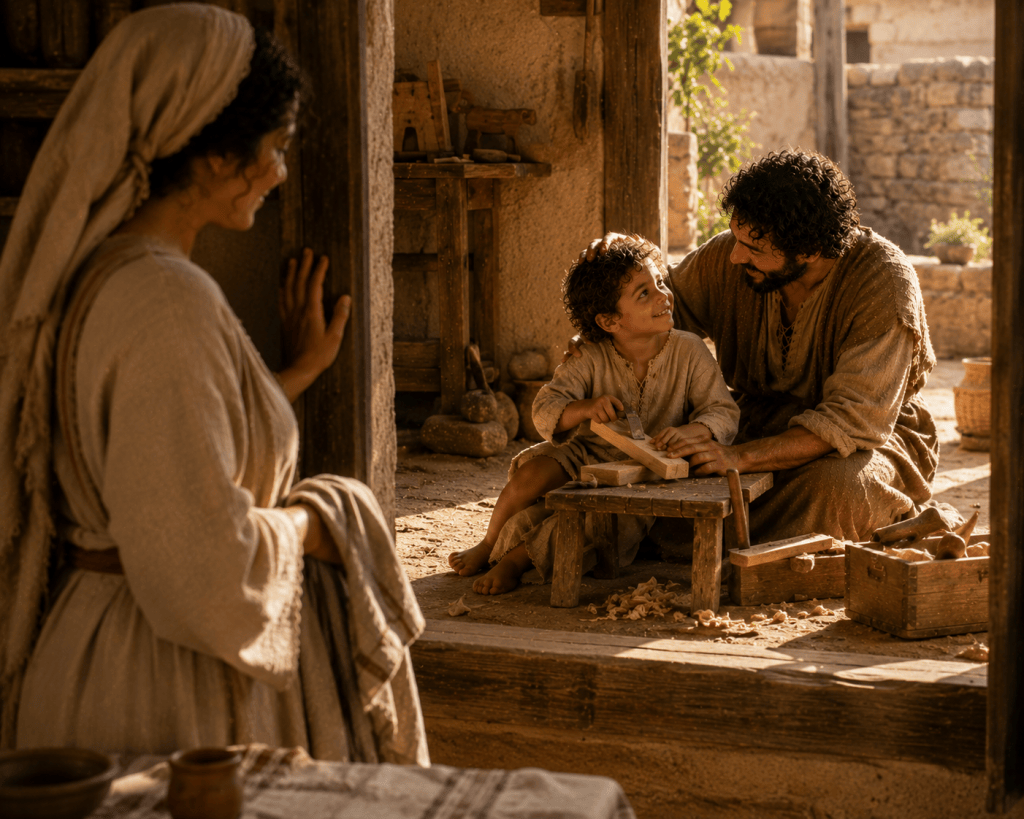
Two dark heads bent over the same piece of wood.
And perhaps Mary thought:
He is teaching him how to make things.
That must have been extraordinary in a way neither man fully understood.
Christian theology would eventually call Jesus the Word through whom all things were made.
And Joseph taught him how to make a table.
How to measure.
How to smooth rough wood.
How to choose the right tool.
How to repair what was broken instead of replacing it.
How to work carefully when nobody was watching.
How to finish what he started.
The Creator entered human life willing to be taught by a carpenter.
And Mary watched it happen.
Perhaps she loved Joseph’s pride.
Not vanity.
That unmistakable parental pride when a child does something approximately competent for the first time.
Jesus makes something.
It is terrible.
Objectively.
A small piece of wood that was intended to become something recognizable and has instead become a theological mystery.
Jesus presents it.
Joseph studies it.
Mary waits.
“What is it?”
Jesus tells him.
Joseph looks again.
Of course.
Now that he knows, the resemblance is obvious.
“It is very good.”
Mary looks at Joseph.
Joseph refuses eye contact.
Jesus beams.
Later, when Jesus is gone:
Mary picks up the object.
“What is this?”
Joseph whispers:
“I don’t know.”
“You told him it was good.”
“He worked very hard.”
Mary smiles.
There he is.
Papa.
Maybe Joseph kept it.
That would make Mary love him even more.
Years later she finds it tucked somewhere among Joseph’s things.
The terrible little object.
“You kept this?”
Joseph looks offended.
“Of course.”
“It doesn’t even stand.”
“It isn’t supposed to.”
“You don’t know what it’s supposed to do.”
Joseph takes it from her.
“It was his first.”
That ends the argument.
Mary understands.
Maybe she loved how Joseph protected Jesus without making him afraid of the world.
That’s a difficult balance.
Especially after Egypt.
Whatever precise historical circumstances surrounded the family’s flight, Matthew gives us Joseph receiving the warning and taking Mary and Jesus away from danger.
Joseph knew something many fathers desperately wish they didn’t:
Someone could hurt my child.
That knowledge could have made him controlling.
Fearful.
Overprotective.
Perhaps instead he learned vigilance.
Watch.
Prepare.
Know where Jesus is.
Teach him what matters.
But still let him run.
Let him climb.
Let him explore.
Let him become capable.
Maybe Mary struggled with this more than Joseph sometimes.
Jesus climbs something.
Mary:
“Jesus.”
Joseph:
“He’s fine.”
“He’s too high.”
“He’s three feet off the ground.”
“He could fall.”
“He could.”
Mary looks at Joseph.
This is not reassuring.
Joseph stands nearby anyway.
Not touching Jesus.
Just close enough.
Jesus climbs.
Slips slightly.
Mary’s heart leaves her body.
Joseph’s hands rise.
Jesus catches himself.
Looks delighted.
Joseph smiles.
Mary does not.
Not yet.
Later Jesus runs toward her.
“I did it!”
Mary looks at Joseph.
Joseph gives her the smallest smile.
She knows.
Yes.
He did.
Perhaps Mary slowly learned that protecting Jesus sometimes meant allowing him to discover what his own body could do.
Joseph helped her with that.
And perhaps Mary helped Joseph with the opposite.
Jesus falls.
Joseph waits to see whether he’s hurt.
Mary already knows from the cry.
“That one hurt.”
She goes.
Joseph follows.
They learned each other’s instincts.
Neither parent always right.
Neither always calm.
Both becoming better because the other was there.
Maybe Mary loved the physical affection between them.
We sometimes make Joseph strangely formal with Jesus in religious art.
A protective hand.
A solemn gaze.
Perhaps a lily somewhere nearby.
But fathers and little boys can be wonderfully undignified.
Maybe Joseph wrestled with him.
Jesus attacked.
Joseph dramatically collapsed.
Mary did not even look up anymore.
“Papa!”
“I have been defeated.”
Jesus climbed onto him.
Joseph groaned.
“Too strong.”
Jesus laughed.
“Again.”
“No.”
“Again!”
Joseph opened one eye.
Jesus waited.
Joseph grabbed him.
Chaos resumed.
Mary moved the cup farther from the edge of the table.
Experience.
Maybe Jesus climbed Joseph constantly.
Children do this to trusted adults.
Joseph sits down.
Mistake.
Jesus appears.
Knee.
Lap.
Shoulder.
Back.
Joseph is apparently furniture now.
“Jesus.”
No response.
“Why are you on me?”
“I’m sitting.”
“There are other places to sit.”
“I like here.”
Joseph looks at Mary.
Mary smiles.
Nothing she can do.
Joseph belongs to Jesus now.
Perhaps Mary loved hearing them laugh together.
Not because Joseph was always the funny one.
Because Jesus had a particular laugh with his father.
Maybe rougher.
Louder.
The laugh that came from being tossed slightly into the air or chased around the house or hearing Joseph tell a story with increasingly ridiculous exaggeration.
Mary could recognize it from another room.
She didn’t need to know what was happening.
Jesus was with Joseph.
He was happy.
That was enough.
Maybe she loved how Joseph listened to him.
Really listened.
Children tell terrible stories.
They begin in the middle.
Introduce six people you’ve never met.
Forget the point.
Become distracted by something unrelated.
Return seven minutes later to the original subject without warning.
Jesus:
“And then Eli said—”
Joseph:
“Which Eli?”
“The one I told you.”
“You’ve told me about three Elis.”
“No, the other one.”
Joseph nods.
Naturally.
Continue.
Mary watches Joseph give this story the same attention he might give an adult.
Maybe that mattered to her.
Because Jesus was little.
But Joseph never treated him as though little meant insignificant.
Perhaps Joseph sometimes corrected him.
Fatherhood wasn’t only tenderness.
Jesus needed boundaries.
Instruction.
Expectations.
Sinlessness did not mean knowledge of every household rule arrived automatically.
“Put it back.”
“I was using it.”
“You didn’t ask.”
Jesus hesitates.
Joseph waits.
Jesus puts it back.
“Thank you.”
No humiliation.
No need to dominate.
Just:
This is how we live together.
Maybe Mary loved that too.
Joseph’s authority didn’t require Jesus to fear him.
And maybe there were times Joseph got it wrong.
He was human.
Perhaps he misunderstood what Jesus meant.
Was too tired.
Answered too quickly.
Assumed something.
Then realized.
Maybe Mary watched Joseph crouch so he could look Jesus in the face.
“I was wrong.”
That might have mattered more than perfect fatherhood ever could.
Imagine Jesus learning that adults can apologize.
That authority can admit error without collapsing.
That love repairs.
Perhaps Mary loved Joseph most in moments like that.
Not when he looked strong.
When he was humble.
Maybe she loved watching Jesus imitate him.
That probably happened.
Children imitate the people they admire.
Joseph crosses his arms.
Jesus crosses his.
Joseph leans against the doorway.
Jesus leans.
Joseph rubs his beard while thinking.
Jesus, who does not possess a beard, rubs his chin.
Mary notices.
Says nothing.
Joseph notices.
Also says nothing.
Jesus continues.
Eventually Mary has to turn away.
Maybe Jesus wanted his own little work apron or belt.
Wanted to carry something Joseph carried.
Walk beside him.
Do what Papa did.
Joseph leaves for work.
Jesus:
“I’m coming.”
“You’re staying with Mama.”
“I can help.”
“You can help me later.”
“I can help now.”
Joseph looks at Mary.
Mary raises an eyebrow.
This is apparently a negotiation between men.
Joseph crouches.
“I need you to help Mama this morning.”
Jesus looks at Mary.
This assignment appears considerably less appealing.
Mary tries not to look offended.
Joseph whispers something to him.
Jesus considers.
Then nods solemnly.
After Joseph leaves, Jesus announces:
“Papa said I’m in charge.”
Mary turns.
“He absolutely did not.”
Maybe Joseph did say something suspiciously close to it.
They would discuss that later.
But perhaps what Mary loved most was not any individual thing Joseph did.
Maybe it was the fact that he never treated Jesus as less his because Jesus was not his by blood.
That is where Joseph’s fatherhood becomes almost unbearably beautiful.
The Gospels preserve no biological paternity for Joseph.
And yet people knew Jesus through him.
“Is this not the carpenter’s son?”
Jesus belonged socially to Joseph’s household.
Joseph gave him lineage.
Protection.
A home.
A trade.
A name within the community.
And presumably years of ordinary fathering nobody bothered to record.
Joseph’s fatherhood was not based on possession.
It was based on presence.
I am here.
Again.
Tomorrow.
And the day after that.
Mary may have understood the enormity of that better than anyone.
She knew exactly what Joseph had chosen.
Every time Jesus called him father—
whatever Aramaic form of Abba or familiar paternal address passed between them—
Mary knew Joseph had earned that relationship one ordinary day at a time.
Not biologically.
Relationally.
Jesus cried.
Joseph came.
Jesus asked.
Joseph answered.
Jesus fell.
Joseph picked him up.
Jesus learned.
Joseph taught.
Jesus grew.
Joseph stayed.
Fatherhood constructed through thousands of small acts.
Perhaps Mary fell in love with him differently because of it.
There is a kind of love that happens when you watch someone love your child.
It can reveal things courtship never could.
Patience you didn’t know they possessed.
Gentleness.
Ridiculousness.
Fear.
Protectiveness.
Tenderness.
The strange ability to become fascinated by a child’s extremely uninteresting rock.
Jesus runs inside.
“Papa!”
Joseph looks up.
“What?”
“Look.”
A rock.
Joseph examines it.
Mary watches.
“That’s a good one.”
Jesus nods.
He knew Papa would understand.
Mary has no idea what distinguishes this rock from the seventeen rocks already living near the doorway.
Joseph apparently does.
Later:
“Why are we keeping all of these?”
Joseph:
“They’re his.”
“They are rocks.”
“He likes them.”
Mary stares at him.
Joseph shrugs.
Fatherhood.
Maybe she loved how Jesus softened him.
Not because Joseph had been hard before.
But children find places in adults nobody else reaches.
Perhaps Joseph was reserved with others.
Careful.
A man accustomed to responsibility.
Then Jesus came running.
“Papa!”
And Joseph’s entire face opened.
Mary saw it happen thousands of times.
Maybe she never got tired of it.
And maybe Joseph softened Jesus too.
Not morally.
Humanly.
Jesus learned what it felt like to be someone’s son.
That’s an astonishing thought within Christian theology.
The eternal Son already existed in relationship to the Father.
But in the Incarnation, Jesus also entered a human family and experienced human sonship.
Being carried when sleepy.
Being taught.
Being corrected.
Being protected.
Being watched proudly.
Being called in for dinner.
Having someone say:
“Let me see.”
“Try again.”
“Careful.”
“Good.”
“I’ve got you.”
Perhaps Joseph gave Jesus the human experience of a father’s arms.
I wonder whether Mary ever watched the two of them from a distance and deliberately didn’t interrupt.
Joseph working.
Jesus beside him.
Late afternoon light.
Jesus talking.
Joseph listening.
Maybe she had come to call them for dinner.
Then stopped in the doorway.
Because Jesus was explaining something with enormous seriousness.
Joseph leaned closer.
Answered.
Jesus laughed.
Joseph laughed.
Mary stayed where she was.
Just watching.
There are moments you don’t enter because they’re beautiful without you.
Not exclusion.
Love.
They have something that belongs to them.
And Mary was glad.
Perhaps she thought about Gabriel.
The angel had told her what Jesus would be.
Son of the Most High.
King.
Holy.
But Gabriel hadn’t told her this.
That Jesus would sit on Joseph’s shoulders.
That Joseph would teach him to hold a tool.
That Jesus would bring him rocks.
That they would develop private jokes.
That Jesus would fall asleep against Joseph’s chest.
That sometimes Jesus would ask for Papa instead of Mama.
That watching them love one another would become one of the quiet joys of her life.
Angels tell you the important things.
Apparently they leave out some of the best ones.
And maybe one evening Mary saw them asleep.
Jesus had insisted he wasn’t tired.
Naturally.
Joseph had sat down with him for a moment.
Now both were asleep.
Jesus curled against Joseph’s side.
Joseph’s head tilted awkwardly against the wall.
One arm still around Jesus.
Mary stood nearby.
She could wake them.
She probably should.
Joseph’s neck would regret this.
Instead she looked.
Her husband.
Her son.
Neither biologically related to the other.
Yet there was no distance between them at all.
Maybe Mary smiled.
Not the smile of the Queen of Heaven.
Just a wife looking at her husband thinking:
You are such a good father.
Did she ever tell him?
I hope so.
Perhaps not dramatically.
Joseph is cleaning up after dinner.
Jesus has finally gone to sleep.
Mary says:
“You’re good with him.”
Joseph looks over.
“With who?”
Mary stares.
Joseph smiles.
“I know who.”
She continues what she’s doing.
“You are.”
Joseph becomes quiet.
Maybe praise makes him uncomfortable.
Mary knows this.
So she lets the silence sit.
Then Joseph says:
“He makes it easy.”
Mary looks at him.
They both know this is objectively false.
Jesus had spent half the afternoon asking questions and then become furious because his bread broke incorrectly.
Mary raises an eyebrow.
Joseph laughs.
“All right. Not always.”
Then maybe he becomes serious.
“I love him.”
Mary’s hands stop.
Not because this is new information.
Because sometimes hearing something you already know still matters.
“I know.”
Joseph looks toward wherever Jesus is sleeping.
“I don’t know if I do any of it right.”
Mary watches him.
Perhaps she thinks of Bethlehem.
Egypt.
Sleepless nights.
Fevers.
First steps.
The terrible wooden object Joseph kept.
Rocks by the doorway.
Jesus running toward him.
Papa.
Again.
Again.
Again.
“You do.”
Maybe Joseph looks at her.
Mary smiles.
“You do.”
There would eventually be a last time Mary watched Joseph father Jesus.
Again, we don’t know when.
We don’t know how Joseph died.
We don’t know Jesus’ age.
We don’t know what Mary saw.
And we should resist filling those silences with certainty.
But if Joseph died before Jesus’ public ministry, then Mary eventually had to watch Jesus lose the man who had raised him.
And she lost the man she had watched become his father.
That grief would have belonged to both of them.
Maybe afterward Mary saw Joseph everywhere in Jesus.
A gesture.
The way he held a tool.
The way he broke bread.
A phrase.
The way he tilted his head when listening.
Perhaps Jesus had learned some things so thoroughly from Joseph that they had simply become part of him.
That’s another way parents remain.
Years later, when people called Jesus the carpenter, Mary might have heard Joseph inside the word.
Who taught him?
Joseph.
When Jesus used images of building, foundations, doors, yokes, measurements, stones—
did Mary ever wonder how much of the workshop remained inside his imagination?
We cannot know.
But Jesus spent most of his earthly life in hiddenness.
Those hidden years mattered.
Joseph mattered.
And perhaps that was ultimately what Mary loved most.
Joseph knew Jesus belonged first to God.
He knew the child had a purpose beyond their home.
He knew he could not possess him.
And still Joseph gave himself completely to the years he had.
He did not say:
He isn’t really mine.
He said, through thousands of ordinary actions:
He has been entrusted to me.
So I will love him.
Today.
Feed him.
Teach him.
Carry him.
Listen to his terrible stories.
Keep his terrible woodworking.
Examine his rocks.
Sit beside him when he’s sick.
Tell him when he’s wrong.
Apologize when I am.
Laugh with him.
Let him climb me like furniture.
Walk beside him.
And someday—
let him go.
Maybe that’s what Mary saw one afternoon.
Jesus was perhaps six or seven now.
Joseph sat outside the workshop.
Jesus beside him.
They were working on something small.
Jesus’ brow furrowed in concentration.
Joseph watched his hands.
“No. Like this.”
He reached over.
Adjusted Jesus’ grip.
“Try again.”
Jesus did.
Better.
Joseph smiled.
“There.”
Jesus looked up.
Proud.
Joseph put a hand against the back of his head and pulled him close enough to kiss his curls.
Jesus objected immediately.
“Papa.”
Joseph laughed.
Mary watched from the doorway.
She had come to call them for dinner.
She waited.
Just one more second.
Because there they were.
The Son she had carried.
The man who had chosen to become his father.
No angel.
No prophecy.
No miracle.
Just Joseph showing Jesus how to make something with his hands.
And Jesus looking at Joseph as though there were no one in the world he would rather learn from.
Perhaps Mary leaned against the doorway and smiled.
She had loved Joseph before Jesus.
But watching him become Papa—
maybe that gave her an entirely new reason to fall in love with him.

 The Living Rosary Archives