©MS 2026
The Green Scapular of the Immaculate Heart of Mary
A Vincentian Sign of Conversion, Mercy, and Hope
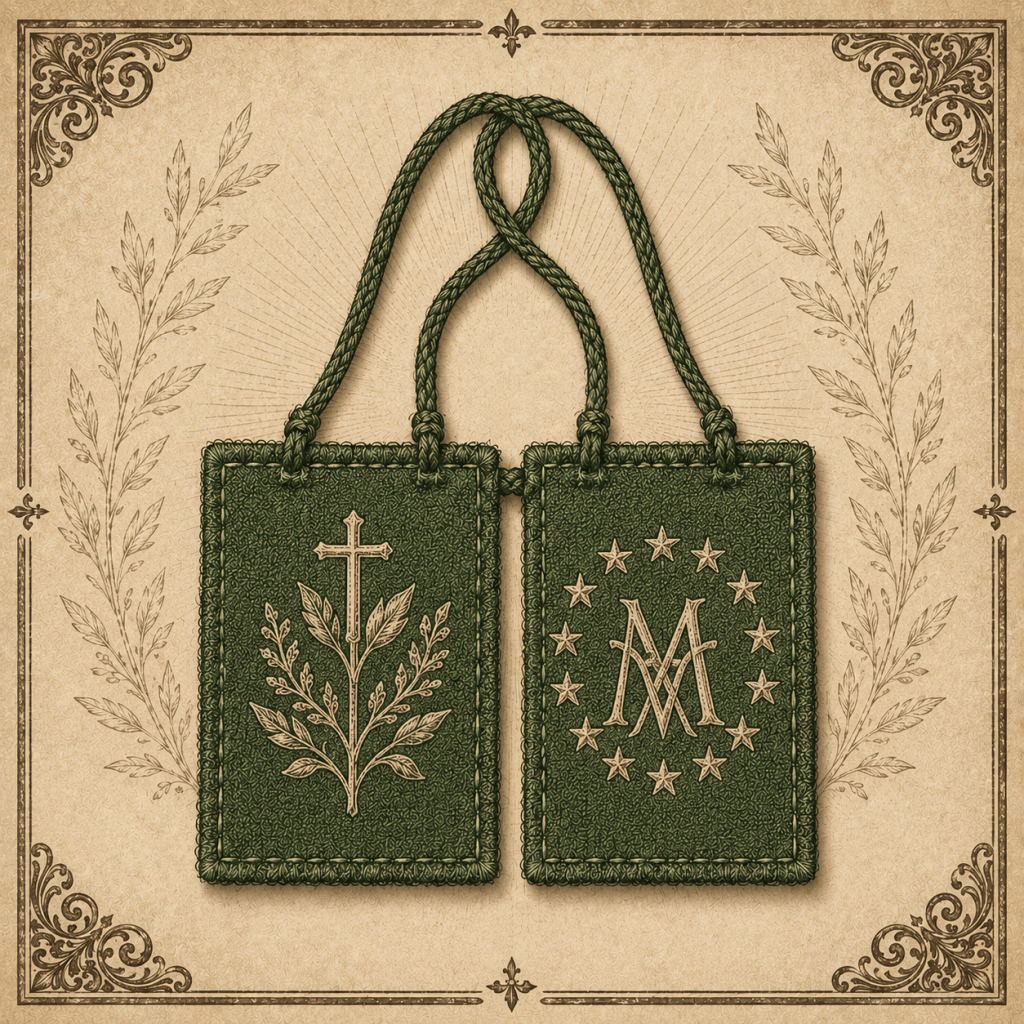
The Green Scapular is different from every scapular we have studied up to this point. It did not grow out of the habit of a religious order. It is not two panels worn across the chest and back. It is not a confraternity badge. There is no investiture or enrollment. The Green Scapular is one piece of green cloth with two devotional images–one on each side–hung from a green cord. It traces its origins back to nineteenth-century France and a Daughter of Charity of St. Vincent de Paul named Sister Justine Bisqueyburu.
In her memoirs, she claims that the Blessed Virgin Mary appeared to her on numerous occasions in 1840 and eventually revealed to her the image of a devotional article associated especially with the Immaculate Heart of Mary, the conversion of sinners, and praying for those nearing death.
The Green Scapular is often referred to as a sacramental for conversion. Be careful with that description. It doesn’t convert others by force. It doesn’t supersede freedom. It doesn’t ensure that someone will return to the Church just because you put the cloth near them. Instead, its true meaning is discovered in persevering prayer, trust in God’s grace, Mary’s intercession, and the hope that merciful love can reach a heart closed off for decades. Its prayer is short: Immaculate Heart of Mary, pray for us now and at the hour of our death. Thus, the Green Scapular holds within its two moments on a single thread: Now. When those who are lost can still be found. And the hour of death, when we must place every human life into God’s hands.
⸻
At a Glance
| Full Name | Green Scapular of the Immaculate Heart of Mary |
| Common Name | The Green Scapular |
| Traditional Color | Green |
| Associated Tradition | Daughters of Charity and the wider Vincentian family |
| Person Associated with Its Origin | Sister Justine Bisqueyburu, D.C. |
| Traditional Origin | A series of apparitions beginning January 28, 1840 |
| Scapular Design Revealed | September 8, 1840 |
| Location of First Apparitions | Chapel of the Daughters of Charity at Rue du Bac, Paris |
| Location of Scapular Vision | Blangy, France |
| Devotional Focus | The Immaculate Heart of Mary, conversion, perseverance, healing, and prayer at the hour of death |
| Traditional Form | One piece of green cloth with an image on each side, suspended from a green cord |
| A Traditional Two-Panel Scapular? | No |
| Connected to a Religious Habit? | No |
| Connected to a Confraternity? | No |
| Formal Investiture Required? | No |
| Enrollment Required? | No |
| Blessing Recommended? | Yes, traditionally by a priest |
| Traditional Prayer | “Immaculate Heart of Mary, pray for us now and at the hour of our death.” |
| Central Meaning | Trusting prayer for conversion and final perseverance through Mary’s intercession |
| Does It Guarantee Conversion or Healing? | No |
Vincentian sources describe the Green Scapular as a single cloth devotional badge rather than the miniature front-and-back habit represented by most traditional scapulars.
⸻
A Scapular That Is Not Quite a Scapular
The Green Scapular is called a scapular because that is the name through which the devotion became known.
Structurally, however, it is more accurately described as a cloth badge.
A traditional devotional scapular usually contains:
- Two separate cloth panels
- Joined by two cords
- One panel worn over the chest
- One panel worn over the back
- A historical relationship with a religious habit, order, or confraternity
The Green Scapular has:
- One piece of cloth
- An image on each side
- One cord
- No origin in a religious habit
- No confraternity into which the wearer is enrolled
A treatise on scapular devotion put out by the Carmelites states categorically that the Green Scapular is correctly referred to as a cloth badge and not a scapular in the strict sense of the word because it is comprised of only one panel. That doesn’t make it a counterfeit or spiritually worthless. It just means that the term scapular is being used in a looser sense than it is with regard to the Brown, Blue, Black, Red, and White scapulars we have looked at so far. This also answers the question of why there is no rite of investiture for the Green Scapular. There is no habit, confraternity, or spiritual order to receive the person into.
⸻
The Daughters of Charity and Rue du Bac
The origins of the Green Scapular are connected to the Company of the Daughters of Charity of St. Vincent de Paul. St. Catherine Labouré, whose story we have just recounted, also belonged to this religious family. Founded by St. Vincent de Paul and St. Louise de Marillac, the Daughters of Charity were created for active work with the poor, sick, abandoned, elderly, orphaned, and vulnerable. They were not an enclosed order; they were created to be in the streets, the hospitals, schools, on battlefields, and in people’s homes to provide practical assistance where it was needed most. Context matters. The Green Scapular didn’t arise in some otherworldly spiritual universe that ignored human need. Sister Justine would spend much of her religious life working in education, health care, hospital administration, and direct service to war and disease. Vincentian sources remember her less as a public visionary than as a competent Daughter of Charity who quietly performed her arduous ministries. The devotion is therefore part of a spiritual tradition where prayer and mercy are supposed to issue outward. Conversion isn’t just about your personal religion. It should result in charity.
⸻
Sister Justine Bisqueyburu
Marie-Justine Bisqueyburu was born on November 11, 1817, at Mauléon in southwestern France. Bisqueyburu grew up in part under the care of extended family members and was educated by Catholics. Young Bisqueyburu felt a calling with the Daughters of Charity and joined them in 1839 after a period of formation. She would later spend time at the community’s motherhouse on Rue du Bac in Paris to further her training. Later placements would find her teaching in Blangy and working in Constantinople, Paris, Algiers, Italy, and Carcassonne. Sister Justine became skilled in nursing and the administration of hospitals. Vincentian hagiographies note that she administered a military hospital in Algiers and tended to soldiers wounded by fighting during wars throughout the nineteenth century. Bisqueyburu spent her last years in Carcassonne, where she died in 1903. Sister Justine never sought publicity as a visionary. Vincentian Sources assert that Bisqueyburu only discussed the alleged apparitions with her superiors and her spiritual advisor Father Jean- Marie Aladel, C.M., who had also played an important role in the beginnings of the devotion to the Miraculous Medal. Bisqueyburu remained silent about her experiences otherwise. Sister Justine has never been beatified or canonized, so she should not be referred to as “Saint” or “Blessed.” The proper title is Sister Justine Bisqueyburu.
⸻
The First Apparition: January 28, 1840
Sister Justine while praying in the chapel at Rue du Bac during her formation reported on January 28, 1840 the first of several apparitions of the Blessed Virgin Mary. Sister Justine stated Mary appeared wearing a white gown and pale blue mantle and had her hair uncovered. Mary held her heart out near her breast and seemed to have flames rising from it. No words were spoken. This apparition happened several times, perhaps more than five, throughout Sister Justine’ s formation years. All the early apparitions seem to be personal visits to strengthen Sister Justine’s relationship with Mary and were not at first given for a public devotion. It was only later that the scapular was seen.
⸻
September 8, 1840: The Scapular Is Shown
Soon after receiving the habit of the Daughters of Charity, Sister Justine was sent as a teacher to Blangy. On September 8, 1840, the Feast of the Nativity of the Blessed Virgin Mary, she wrote a report detailing another apparition. Mary appeared as she had previously but held something in her left hand. It was small and green. Made of one piece of green cloth hanging from a green cord, on one side was Our Lady as Sister Justine had come to know her: clothed in white and blue, holding her flaming heart. On the reverse was the Heart of Mary alone. It was on fire, pierced by a sword, topped with a cross and surrounded by the words: Immaculate Heart of Mary, pray for us now and at the hour of our death. Sister Justine claimed to have experienced an interior illumination telling her that the object was to be widely disseminated and particularly employed in prayer for the conversion of souls. This visitation falls into the category of private revelation. It is not part of the deposit of faith. Catholics are not required to believe that this apparition happened to believe in Mary’Virgin intercession, our need for conversion, or the efficacy of praying for the dying. The Catechism says of even authenticated private revelations, they do not improve upon Christ’s complete revelation; at best they help us more fully live out the faith during a certain period or circumstance.
⸻
Why Is It Green?
Unlike the Brown, Black, and White scapulars already examined, the Green Scapular did not take its color from the habit of a religious order.
The most historically direct explanation is:
It is green because green was the color shown in Sister Justine’s reported vision.
Later devotional interpretations associate green with:
- Hope
- Renewal
- Healing
- New life
- Spiritual growth
- Conversion
- The return of life to a heart that had become spiritually barren
These meanings fit the purpose of the devotion.
But they should be described as spiritual interpretations rather than a formally defined Catholic color code.
There is no universal rule stating that every green Catholic object represents conversion or healing.
In this devotion, the color belongs first to the reported design.
⸻
The Front Image: Mary Holding Her Heart
One side of the Green Scapular shows the Blessed Virgin as Sister Justine reported seeing her.
Mary traditionally appears:
- Wearing a white dress
- Covered with a pale blue mantle
- With her hair uncovered
- Holding her heart
- Surrounded by rays or light
The image emphasizes Mary’s maternal concern and interior love.
She is not shown holding a crown, a weapon, or an instrument of authority.
She presents her heart.
In biblical and devotional language, the heart represents the interior person:
- Love
- Memory
- Intention
- Sorrow
- Faithfulness
- Compassion
- The place where God’s Word is received
The image therefore does not invite devotion to a physical organ separated from Mary’s life.
It points toward the interior life of the woman who received Christ, followed him, suffered with him, and remained faithful to him.
⸻
The Reverse Image: The Immaculate Heart
The reverse side contains the devotion’s most recognizable symbol:
- A heart surrounded by flames
- Pierced by a sword
- Surmounted by a cross
- Encircled by the prayer for intercession
The sword recalls Simeon’s prophecy to Mary:
“A sword will pierce your own soul.” It points to her suffering as related to Christ’ Second part of the prayer clearly states Christ’ mission and Passion. The flames symbolize fire of love. The cross over her heart points out the proper orientation of this devotion: we do not honor Mary’s heart separate from that of Christ. Mary’s love, sorrow and advocacy are rightly understood through her relationship with Jesus. Vatican’s Directory on Popular Piety states that devotion to the Immaculate Heart entails contemplation of Mary’s interior life in relation to the whole work of salvation accomplished by her Son— from the Incarnation to the Cross, Resurrection and outpouring of the Holy Spirit. Pope John Paul II explained that the Church honors Mary’s Immaculate Heart as the sign of her holiness, her love for God and Jesus, and her motherly compassion towards those redeemed by his grace.
⸻
Why “Immaculate” Heart?
The word immaculate does not mean that Mary’s heart was physically different from other human hearts.
It refers to Mary’s unique holiness and to the Catholic doctrine that she was preserved from original sin by the grace of God from the first moment of her conception.
The devotion therefore honors:
- Her openness to grace
- Her freedom from sin
- Her complete response to God
- Her maternal love
- Her faithfulness to Christ
- Her compassion for humanity
The Green Scapular presents that heart as interceding for hearts still divided, wounded, resistant, frightened, or far from God.
Its purpose is not to create a contrast in which Mary is pure and everyone else is merely condemned.
It places Mary’s Immaculate Heart before the believer as an image of what grace can accomplish.
⸻
What Does the Green Scapular Symbolize?
Conversion
Conversion is the devotion’s central purpose.
Catholic conversion is not limited to a non-Catholic becoming Catholic.
It includes:
- Turning away from sin
- Returning to God
- Reconciliation after estrangement
- Renewal of neglected faith
- Repentance
- Acceptance of mercy
- Continued purification within the Christian life
The Catechism describes conversion as the first work of grace and also as an ongoing task for the entire Church. Even the baptized remain in need of continuing repentance and renewal.
The Green Scapular may therefore be used in prayer for someone who has never believed, someone who has left the Church, or someone who is outwardly practicing but inwardly resistant to conversion.
That includes the person giving the scapular.
⸻
Hope for the Spiritually Distant
The Green Scapular has often been given in circumstances where ordinary religious conversation appears impossible.
A loved one may be:
- Hostile toward faith
- Wounded by the Church
- Indifferent
- Addicted
- Estranged from family
- Unwilling to pray
- Approaching death after many years away
- Unable to communicate because of illness
The devotion gives the person praying something simple to do when persuasion is no longer possible or would be harmful.
Not control.
Not argument.
Prayer.
The scapular becomes a visible expression of hope that no life is beyond the reach of God’s mercy.
⸻
The Hour of Death
The prayer printed upon the scapular echoes the conclusion of the Hail Mary:
Pray for us now and at the hour of our death.
The “hour of death” is not intended primarily as a threat.
It recognizes the moment when human control ends and the person stands entirely within the mystery of God.
Prayer for a “happy death” in older Catholic language does not necessarily mean:
- A painless death
- A sudden miracle
- Freedom from illness
- Death surrounded by ideal circumstances
It means dying reconciled with God, assisted by grace, and spiritually prepared for the final passage.
The Green Scapular’s prayer asks Mary to remain present both in the ordinary present moment and in that final moment.
⸻
Perseverance
Conversion is not only a dramatic beginning.
It must be followed by perseverance.
A person may experience a moment of repentance and later return to old patterns.
Someone may resume the sacraments but still require healing, formation, and support.
Someone may begin seeking God while remaining confused or frightened.
The scapular’s prayer is therefore not only:
Help this person change.
It is also:
Help this person remain open to grace.
⸻
Mercy
The Green Scapular emerged within the Vincentian family, whose spirituality repeatedly brings prayer into contact with human need.
Mercy in this devotion should not become sentimental passivity.
It may involve:
- Patient accompaniment
- Medical treatment
- Addiction support
- Reconciliation
- Listening to religious trauma
- Respecting boundaries
- Offering practical help
- Continuing to love someone whose choices cannot be controlled
The scapular may accompany such acts.
It cannot replace them.
⸻
Is the Green Scapular a Sacramental?
When blessed by the Church, the Green Scapular is used as a sacramental.
The Catechism describes sacramentals as sacred signs instituted by the Church. They do not confer grace in the same way as the sacraments. Through the Church’s prayer, they prepare believers to receive grace and help dispose them to cooperate with it.
This means the Green Scapular does not:
- Create faith mechanically
- Erase sin automatically
- Replace Baptism
- Replace confession
- Force conversion
- Guarantee bodily healing
- Ensure salvation independently of Christ
Its spiritual value comes through:
- Prayer
- The Church’s blessing
- Trust in God
- Mary’s intercession
- The recipient’s eventual response to grace
- The conversion of the person praying
- Concrete love and mercy
The cloth is a sign.
God is the source of grace.
⸻
What Graces Are Traditionally Associated with It?
Vincentian devotional accounts associate the Green Scapular particularly with:
- Conversion
- Return to the sacraments
- Reconciliation with the Church
- Repentance before death
- Strengthening of faith
- Spiritual healing
- Physical healing
- Protection in moments of danger
- Perseverance
The most consistent historical emphasis is conversion, especially for those who possess little or no faith.
Claims of physical healing also became widespread.
Vincentian literature contains numerous testimonies of cures and recoveries attributed to prayer with the Green Scapular. These testimonies belong to devotional history and may be meaningful to the people involved, but they do not establish a universal promise that illness will be cured.
Evidence Check
Claim: The Green Scapular guarantees physical healing.
Assessment: Not supported as a universal or automatic promise.
Evidence Category: Devotional testimonies and reports of favors.
Supported Belief: Catholics may pray for healing and seek Mary’s intercession while also using appropriate medical care and remaining open to God’s will.
A person should never be discouraged from receiving medical or psychological treatment because someone has placed a Green Scapular nearby.
⸻
Does It Guarantee Conversion?
No.
Catholic teaching describes faith and conversion as works of grace that involve the person’s freedom.
God initiates.
Grace invites.
The human person must respond.
The Catechism teaches that God’s grace and human freedom cooperate and that faith is not produced through coercion.
The Green Scapular therefore cannot make another person believe against his or her will.
It may express prayer that:
- Resistance will soften
- Misunderstanding will be clarified
- Wounds will be healed
- A person will become open to truth
- Grace will be recognized
- Fear will give way to trust
- Repentance will become possible
But the scapular is not a spiritual lever.
Mary’s intercession does not abolish the dignity or freedom of the person for whom she prays.
⸻
What Does “Confidence” Mean?
Traditional accounts say that the graces associated with the Green Scapular are related to the confidence with which it is used.
This can sound as though a person must generate an intense enough emotional certainty to make the scapular work.
That is not a healthy interpretation.
Confidence should mean:
- Trust in God’s mercy
- Perseverance in prayer
- Hope without demanding a timetable
- Reliance upon Mary’s intercession
- Acceptance that grace may work in ways we do not see
- Refusal to despair about another person
It does not mean:
- Assuming God owes us a miracle
- Blaming ourselves when someone does not convert
- Believing weak emotion invalidates prayer
- Measuring faith by whether the desired result occurs
- Treating devotion as a technique
Christian hope trusts God.
It does not control him.
⸻
Blessing, Investiture, and Enrollment
The Green Scapular differs sharply from the previous scapulars in the series.
Blessing
The scapular is traditionally blessed by a priest using an ordinary blessing for devotional objects.
Investiture
No formal investiture is required.
There is no habit or confraternity into which the person is being ceremonially received.
Enrollment
There is no Green Scapular confraternity requiring registration.
No enrollment is necessary.
Vincentian sources consistently describe the Green Scapular as a devotional badge rather than the badge of a confraternity. They state that a priest’s blessing is sufficient and that no special investiture ceremony is required.
This makes the Green Scapular one of the simplest scapular devotions to use.
It also means people should not invent an enrollment ceremony, claim membership in an organization that does not exist, or describe themselves as formally invested when no such rite belongs to the devotion.
⸻
How Is It Used?
Traditional Vincentian instructions describe several ways the Green Scapular may be used.
It may be:
- Worn around the neck
- Carried in a pocket or bag
- Kept near the person
- Placed by a bed
- Placed in a room
- Given to someone for whom prayers are being offered
The traditional invocation is prayed daily:
Immaculate Heart of Mary, pray for us now and at the hour of our death.
When the intended recipient will not or cannot pray, the person offering the scapular traditionally says the prayer on that person’s behalf.
No specific novena, chaplet, litany, or number of repetitions is universally required.
The prayer is short enough to be sustained faithfully.
⸻
May It Be Placed Near Someone Without Their Knowledge?
This is one of the most distinctive—and sensitive—questions surrounding the Green Scapular.
Traditional devotional instructions say that when someone refuses to wear it, the scapular may be placed nearby, in a room, near a bed, or among the person’s belongings, while another person offers the prayer.
The spiritual principle behind this practice is understandable:
A person may refuse a devotional object, but another person may still pray for them.
However, prayer for someone does not grant unlimited permission to disregard privacy, property, or personal boundaries.
There is a meaningful difference between:
- Keeping a scapular in one’s own home while praying for a loved one
- Placing it unobtrusively near a hospital bed with appropriate permission
- Giving one as a gift
- Quietly carrying it while praying for someone
and:
- Hiding objects in someone’s private property after being explicitly told not to
- Using the scapular to manipulate or frighten someone
- Claiming secret spiritual control over another person
- Treating the person’s boundaries as irrelevant because the intention is religious
Catholic prayer respects human dignity.
The Catechism teaches that faith must be free and that each person is to be recognized as a responsible human being.
A person can always pray for another.
The devotional object should not become an excuse for violating trust.
⸻
Can the Recipient Be Unaware of the Scapular?
Traditional accounts say yes.
The devotion was intended particularly for those who would not themselves willingly practice it.
But the recipient’s lack of knowledge does not mean the object is secretly acting upon them.
The person praying is asking God to offer grace and asking Mary to intercede.
The hidden scapular does not bypass the recipient’s will.
It represents the prayer of the person who placed or carried it.
The conversion, if it occurs, remains the free response of the person receiving grace.
⸻
Does the Recipient Have to Be Catholic?
No confraternity or enrollment requirement limits the devotion to practicing Catholics.
Historically, it has been used especially in prayer for:
- Nonbelievers
- Non-Catholics
- Catholics who have left the Church
- People unwilling to receive the sacraments
- People nearing death
- Those who are spiritually indifferent
The Green Scapular should not be used as a symbol of contempt for another person’s current beliefs.
The prayer should arise from love, not superiority.
Its proper tone is:
May this person know God’s mercy.
Not:
May I win.
⸻
What About the Person’s Actual Wounds?
Some people leave Catholic practice because of:
- Abuse
- Clerical misconduct
- Rejection
- Shame
- Poor catechesis
- Family coercion
- Political hostility
- Intellectual doubt
- Experiences of hypocrisy
- Trauma
It is easy to call such a person “fallen away” without listening to what happened.
Prayer for conversion should not become a way to avoid accountability.
Sometimes the person praying may also need conversion:
- From defensiveness
- From religious pride
- From refusing to listen
- From minimizing another person’s pain
- From attempting to control
- From confusing pressure with evangelization
The Green Scapular’s image is a heart.
That should matter.
A devotion to the heart of Mary should form a heart capable of compassion.
⸻
The Prayer on the Scapular
The complete devotional practice can be contained in one sentence:
Immaculate Heart of Mary, pray for us now and at the hour of our death.
Each phrase carries meaning.
Immaculate Heart of Mary
The prayer appeals to Mary in her holiness, love, faithfulness, and maternal compassion.
Pray for us
Mary is asked to intercede.
She is not treated as the source of grace independent of God.
Now
Conversion is not postponed entirely until death.
Grace is needed in the present moment.
And at the hour of our death
The prayer asks for perseverance, reconciliation, mercy, and final trust in God.
The word our is also important.
The prayer does not say only:
Pray for that difficult person.
It includes the one praying.
Both giver and recipient remain in need of mercy.
⸻
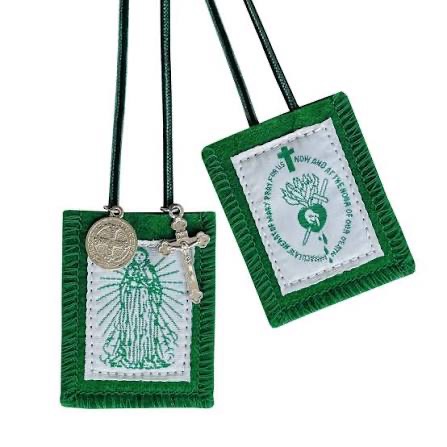
What Does the Traditional Green Scapular Look Like?
The traditional form consists of:
- One rectangular piece of green cloth
- A green cord
- An image on each side
One Side
Mary appears in white and blue, holding her flaming heart.
The Reverse Side
The Immaculate Heart appears:
- Surrounded by flames
- Pierced by a sword
- Surmounted by a cross
- Encircled by the invocation
Some versions show rays emerging from the heart.
Some add blood drops.
Some use printed images sewn onto green felt.
Manufacturing details vary, but the historic devotional identity is built around:
- Green cloth
- The image of Mary holding her heart
- The pierced and flaming Heart of Mary
- The prayer
Vincentian descriptions consistently identify these features.
⸻
Must It Be Made of Wool?
Green cloth, felt or wool are traditional materials. I didn’t find any current universal ecclesiastical mandate demanding one exact material composition. The lack of dependence of an investiture or confraternity ceremony on the object allows for less strictness regarding material than is the case for some older regulated form scapulars. To best maintain the integrity of the object as a scapular badge, a traditionally made cloth form is preferable. However, one should refrain from stating all modern fabric forms are invalid without current documented evidence.
⸻
Papal Approval: What Can Be Documented?
Modern devotional sources commonly state that Pope Pius IX approved or authorized the Green Scapular in 1863 and again in 1870.
A frequently repeated account says that Pius IX authorized the Daughters of Charity to make and distribute it.
The official Vincentian summaries located for this article consistently identify 1870 as the year of papal approval or authorization. Some later devotional histories add an earlier authorization in 1863.
I did not locate the original papal document or an entry in the Acta Sanctae Sedis during this research.
That means the cautious archival wording is:
Vincentian and later Catholic sources report that Pope Pius IX authorized the Green Scapular’s manufacture and distribution, with 1870 consistently cited and 1863 also appearing in later accounts.
It would be less responsible to call the act a solemn doctrinal approval without identifying the actual document and its legal form.
Evidence Check
Claim: Pius IX issued a formal dogmatic approval declaring Sister Justine’s apparitions unquestionably supernatural.
Assessment: Not supported by the sources reviewed.
Supported Claim: Catholic and Vincentian sources report papal authorization for making and distributing the Green Scapular.
What That Means: The devotion was permitted and encouraged as compatible with Catholic faith.
What It Does Not Mean: Every reported apparition detail became doctrine or was declared historically certain.
⸻
Why Was There a Delay?
The reported scapular vision occurred in 1840, but widespread distribution did not begin immediately.
Vincentian accounts describe hesitation and delays involving communication between Sister Justine, her superiors, and Father Aladel. Sister Justine herself did not publicly advocate for the devotion.
The scapular gradually spread after ecclesiastical permission and reports of conversions or favors increased interest.
This slower development distinguishes the Green Scapular from a carefully organized confraternity devotion.
It grew through:
- Individual distribution
- Prayer for specific people
- Vincentian networks
- Testimonies of conversion
- Hospital and missionary settings
- Lay devotional use
Its simplicity made it easy to carry across borders and into circumstances where formal enrollment would have been impractical.
⸻
The Green Scapular and the Miraculous Medal
The Green Scapular is often compared with the Miraculous Medal because both originated within the Daughters of Charity at Rue du Bac.
The reported Miraculous Medal apparitions occurred to St. Catherine Labouré in 1830.
Sister Justine’s first reported apparition followed approximately ten years later, in 1840.
Father Jean-Marie Aladel was connected with both women’s accounts.
But the two devotions are distinct.
The Miraculous Medal
Emphasizes Mary conceived without sin, the distribution of grace, and the prayer:
O Mary, conceived without sin, pray for us who have recourse to thee.
The Green Scapular
Emphasizes the Immaculate Heart, conversion, and prayer:
Immaculate Heart of Mary, pray for us now and at the hour of our death.
They share a religious family and Marian setting.
They should not be treated as interchangeable objects.
⸻
The Green Scapular and the Fivefold Scapular
The Green Scapular is not part of the traditional Fivefold Scapular.
The Fivefold Scapular combines:
- White Scapular of the Most Blessed Trinity
- Brown Scapular of Our Lady of Mount Carmel
- Black Scapular of the Seven Sorrows
- Blue Scapular of the Immaculate Conception
- Red Scapular of the Passion
Those five are traditional two-panel confraternity scapulars associated with religious families.
The Green Scapular developed later, has one panel, and has no confraternity or investiture.
Its absence from the Fivefold Scapular does not mean it was rejected.
It belongs to a different category of devotional object.
⸻
Common Misunderstandings
“The Green Scapular is just a green version of the Brown Scapular.”
It is not.
It has no connection with the Carmelite habit, confraternity, or Simon Stock tradition.
“It is a traditional two-panel scapular.”
It consists of one cloth badge with an image on each side.
“I must be formally invested.”
No investiture is required.
“I must enroll in a confraternity.”
No Green Scapular confraternity exists.
“It guarantees that another person will convert.”
It does not.
Conversion involves grace and the person’s free response.
“The recipient does not need free will because the scapular works secretly.”
The scapular cannot override human freedom.
“I can violate someone’s boundaries because I am trying to save them.”
Prayer does not justify deception, intrusion, or coercion.
“It guarantees a cure.”
Physical cures have been reported devotionally, but no universal guarantee exists.
“A happy death means a painless death.”
Traditionally, it means dying reconciled with God and assisted by grace.
“The reported apparitions are Catholic dogma.”
They are private revelation, not part of the deposit of faith.
“Papal authorization means every historical claim has been proven.”
Permission to distribute a devotion is not identical to a solemn declaration regarding every supernatural detail.
“The cloth itself performs the conversion.”
The object is a sacramental sign. God gives grace.
“Only the recipient needs conversion.”
The prayer says pray for us.
⸻
The Green Scapular Today
The Green Scapular remains actively remembered and distributed within parts of the Vincentian family.
Recent FAMVIN formation materials continue to commemorate Sister Justine, the 1840 apparition tradition, and the scapular’s association with conversion, healing, and prayer at the hour of death.
It is less institutionally structured than the Brown or Blue Scapulars.
There is:
- No international confraternity registry
- No formal investiture program
- No required order membership
- No widely published modern statute
That simplicity is probably part of its continued appeal. One may pray. One may pray for another person’s conversion. One may commit a broken relationship to Mary’s intercession. The lack of official liturgy, however, also leaves room for hyperbole. Some modern sellers and websites of Catholic devotionals make claims of guaranteed conversion, absolute protection from spiritual attack or physical healing that goes beyond what the historical and theological evidence can support. The Green Scapular ought to be offered with both hope and hesitation. Hope, that there is no person unreachable by grace. Hesitation, because no sacramental allows us to control God or another person.
⸻
A Student’s Reflection
The Green Scapular surprised me more than any of the scapulars we have studied so far.
It is called a scapular, but it is not a habit made small.
It has no confraternity.
No investiture.
No membership.
No religious rule attached to it.
It is almost startlingly simple.
One piece of cloth.
One prayer.
One person praying for another.
That simplicity may be why the devotion has become so closely associated with people who cannot or will not pray for themselves.
The person who has left the Church.
The person who does not believe.
The person whose anger has become a wall.
The person whose illness has taken away speech or awareness.
The person approaching death after decades of distance.
Those situations can make the people who love them feel helpless.
The Green Scapular gives that helplessness a form.
But researching it also revealed a danger.
Love can quietly become control.
Concern for someone’s soul can become refusal to respect the person standing in front of us.
Prayer can become a substitute for listening.
A devotional object can become something hidden, imposed, or used as though another human being’s freedom were simply an obstacle to overcome.
The Church’s understanding of conversion does not permit that.
Grace invites.
Grace moves.
Grace softens.
But grace does not reduce the person to a project.
Perhaps the Green Scapular’s prayer protects against that temptation because it does not say:
Immaculate Heart of Mary, make them change.
It says:
Pray for us.
The giver is included.
The believer is included.
The person who thinks she already understands is included.
The person praying for another’s conversion may need conversion from pride, impatience, fear, or the need to control the outcome.
And the phrase now and at the hour of our death reminds me that both people stand beneath the same mercy.
One may appear close to God.
One may appear far away.
Neither can see the whole interior life of the other.
Neither saves the other.
Both are dependent upon grace.
The Green Scapular is therefore not a tool for secretly taking possession of someone else’s soul.
It is a small sign that allows us to say:
I cannot force this heart open.
I cannot know everything happening within it.
I cannot do the work that belongs to God.
But I can love.
I can pray.
I can remain hopeful.
And I can ask Mary, whose own heart remained faithful through uncertainty and sorrow, to pray for both of us.
That may be the real meaning of the green.
Not certainty.
Hope.
⸻
Primary and Historical Sources
- Vincentian Family, historical summaries of the Green Scapular, Sister Justine Bisqueyburu, and the apparition tradition of 1840.
- Father Marie-Édouard Mott, C.M., The Green Scapular and Its Favors, for the early biographical and devotional history preserved within the Vincentian tradition.
- FAMVIN, recent formation resources on Sister Justine and the continued place of the Green Scapular within Vincentian devotional memory.
- Catechism of the Catholic Church, paragraphs 66–67, on private revelation and its relationship to the definitive revelation of Christ.
- Catechism of the Catholic Church, paragraphs 1667–1670, on sacramentals and cooperation with grace.
- Catechism of the Catholic Church, paragraphs 1987–2002, on grace, conversion, freedom, and human cooperation with God.
- Congregation for Divine Worship, Directory on Popular Piety and the Liturgy, on devotion to the Immaculate Heart of Mary.
- Pope John Paul II, address concerning devotion to the Hearts of Jesus and Mary, September 22, 1986.
- Father William Saunders, “Different Kinds of Scapulars,” for the Green Scapular’s traditional use, blessing, papal authorization tradition, and distinction from confraternity scapulars.


