The Rosarium Series
©MS 2026
Dark wood, regional craft, and a material that feels as though it already belongs in the hand.
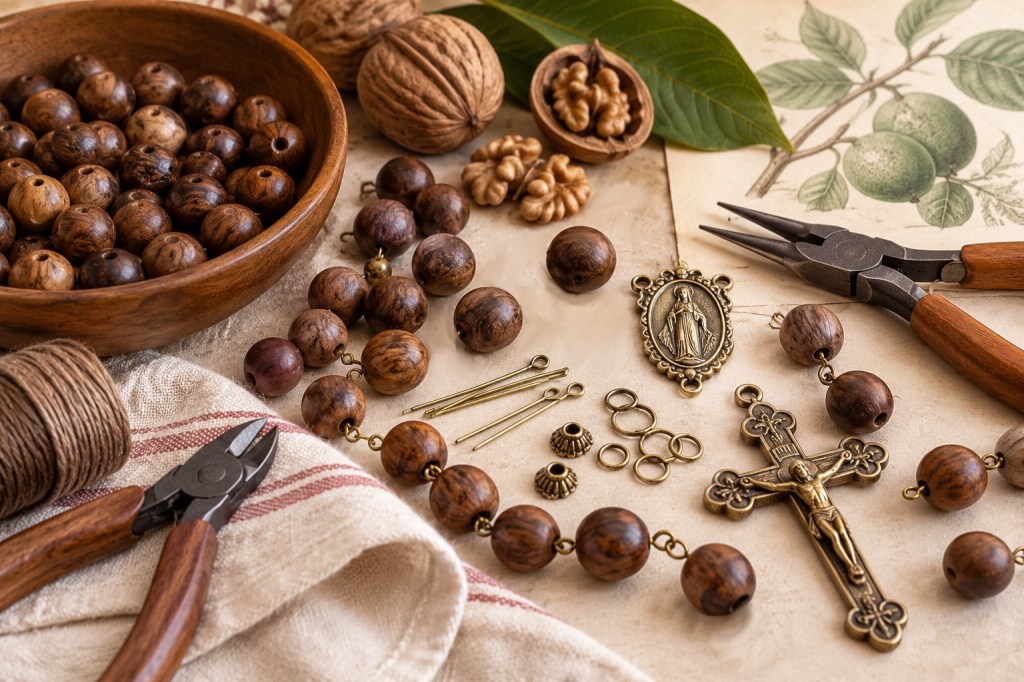
Some rosary materials seem to arrive carrying a story before the first prayer begins. Olive wood immediately calls to mind pilgrimage and the landscapes of the Holy Land. Ebony brings darkness, density, and the history of imported luxury. Rosewood catches the eye through streaks of color and grain. Boxwood can lead backward into the astonishing world of miniature devotional carving.
Walnut feels different.
It feels familiar.
That may be the first thing I notice about it. A walnut rosary does not necessarily look exotic, rare, or overtly devotional. The beads are usually some variation of warm brown: sometimes golden, sometimes chocolate, sometimes deep enough to approach black along the grain. One bead may show a long dark line while another remains comparatively quiet. Depending upon the piece of wood, the surface can be almost restrained or full of movement.
But nothing about it feels particularly foreign.
Walnut is the kind of wood many people have encountered somewhere else before they encounter it as prayer beads. Furniture. A table. A carved bowl. A cabinet. A box passed down through a family. A piece of wood in a workshop. Even someone who cannot identify walnut by sight may recognize the general language of it: warm, substantial, unmistakably wooden.
A walnut rosary can therefore feel less like an object made from an unusual devotional material and more like an ordinary material given a devotional purpose.
There is something I find compelling about that.
Not every rosary needs to arrive from a sacred landscape.
Sometimes prayer begins with what was already nearby.
What Is Walnut?
Like rosewood, walnut is not one single tree.
True walnuts belong to the genus Juglans, within the walnut family, Juglandaceae. The genus includes species native across parts of North and Central America, South America, Europe, and Asia. Among the most familiar are common or Persian walnut, Juglans regia, and North American black walnut, Juglans nigra. Kew currently recognizes more than twenty accepted species within the genus.
Even those two familiar species already demonstrate why the word walnut needs some care. Juglans regia originated across a broad region extending from the eastern Mediterranean and western Asia toward the Himalayas and was eventually introduced and cultivated throughout much of Europe and beyond. Black walnut, Juglans nigra, is native to eastern North America and produces the dark timber that became one of the most recognizable hardwoods in American furniture and woodworking traditions.
The woods can look different, and individual trees vary as well. Walnut heartwood commonly occupies the warmer and darker end of the wooden palette, although color can range considerably. Black walnut in particular is valued for dark brown heartwood, attractive grain, good machining qualities, and the smooth surface it can take when finished.
For the rosary collector, however, one caution should begin immediately.
A brown wooden rosary is not automatically walnut.
A rosary advertised as having a walnut-colored finish is not necessarily made from walnut.
And even a genuine walnut rosary does not necessarily tell us which species of Juglans supplied its beads.
Those questions belong more fully to Article Three. For now, it is enough to understand that walnut is not simply a color.
It is a material.
And material deserves more attention than appearance alone.
Why Walnut?
Walnut has spent centuries proving itself in objects intended to be used.
That matters for a rosary.
A prayer bead does not need the structural strength required of a table leg or cabinet frame, but it does need to survive small-scale shaping, drilling, polishing, friction, and repeated handling. The best rosary woods tend to occupy an interesting balance: hard enough to last, workable enough to shape, and pleasant enough beneath the fingers that the material does not become an obstacle to prayer.
Walnut fits comfortably into that space.
Black walnut, for example, is described by the U.S. Forest Service as strong, shock resistant, comparatively durable, easy to work with hand tools, excellent in machining, and capable of taking a smooth finish. Those characteristics help explain why walnut became so deeply embedded in furniture, cabinetry, decorative woodworking, and turned objects.
The same qualities scale downward beautifully.
A walnut bead can be smooth without feeling artificial. Dense without feeling ponderous. Dark enough to have visual depth while still revealing that it came from a tree.
That last point may be what distinguishes walnut most for me.
It still looks like wood.
Grain That Feels Familiar
Rosewood often invites scrutiny because its grain can be dramatic. Boxwood asks the eye to notice how little visible grain there may be. Walnut sits somewhere between them.
Its grain is often plainly visible without becoming theatrical.
A dark line may move through a bead. The surface may shift from medium brown to something richer and deeper. One section can appear almost straight-grained while another contains more movement. The effect is recognizably organic, but usually not so visually busy that the rosary becomes decorative first and devotional second.
There is a quiet familiarity to that appearance.
Perhaps this is because walnut has been used for so many domestic objects. We are accustomed to seeing it in things made to live with people. Tables meant to gather around. Cabinets opened every day. Boxes handled repeatedly. Furniture expected to acquire scratches rather than remain untouched behind glass.
Walnut has long been a working wood as well as a beautiful one.
Placed into a rosary, that history of usefulness seems appropriate.
A rosary is not meant merely to be seen.
It is an object expected to participate in a life.
A Rosary That Does Not Need to Be Precious
One of the strange things about devotional collecting is how easily rarity can begin masquerading as significance.
An unusual material attracts attention.
A precious metal seems important.
A rare stone acquires an elaborate description.
An exotic wood immediately generates questions about origin and trade.
Walnut does not require any of that.
There are beautifully made walnut objects and exceptionally figured pieces of timber, of course. Walnut can be expensive. Fine walnut furniture can be luxurious. None of that changes the basic familiarity of the material.
A plain walnut rosary can simply be a wooden rosary.
I like that.
There is something almost refreshing about a devotional object that does not need an extraordinary origin story in order to justify itself. The beads can be warm brown. The grain can be attractive. The crucifix can be simple. The whole thing can exist because walnut happened to be a good material for the job.
Prayer does not become more authentic because its beads are rare.
A rosary does not need to impress anyone.
Its function is almost stubbornly ordinary.
One prayer.
Then the next.
Then the next.
Walnut seems entirely comfortable with that ordinariness.
The Regional Question
Walnut also opens a different question from some of the woods we have already studied.
What happens when rosary makers work with the woods around them?
The answer will require more historical research before we reach Article Two, because we should not assume that every walnut rosary was locally made from a locally grown tree. Timber moves. Craftspeople purchase materials. Rosaries themselves travel enormous distances.
Still, walnut belongs to a broader category that deserves attention: woods that became familiar within particular regional craft traditions before they became rosary beads.
Common walnut became widely cultivated across Europe beyond its original native range. Black walnut became deeply important within North American woodworking. Other Juglans species developed within their own regions.
This creates a very different material story from one built primarily upon rarity.
Sometimes a craftsperson selects a material because it has arrived from somewhere extraordinary.
Sometimes they select it because generations of people nearby already know how to work it.
That possibility interests me enormously.
A rosary made from a familiar regional wood connects prayer not necessarily to pilgrimage, but to place in another sense.
Workshop.
Landscape.
Craft tradition.
Trees people recognize.
Wood people know how to shape.
Devotion built from the ordinary materials of home.
We will need to be careful not to romanticize that idea beyond the evidence. A modern walnut rosary manufactured in one country may contain timber grown in another. “Local” should never become a decorative label we apply merely because it sounds beautiful.
But the larger question remains worth asking.
Catholic devotional material culture has never been made entirely from inherently sacred substances.
It has also been made from whatever human beings knew how to use.
Walnut in the Hand
A walnut rosary feels different from a pale wood even when its weight is similar.
Color changes perception.
Dark beads can appear more substantial before they are ever touched. Yet walnut usually does not have the extraordinary density associated with ebony, nor does it need to. Its physical appeal tends to come from a combination of moderate substance, smooth finishing, and visible grain.
The beads can feel warm quickly in the hand. Their surface may become satin-like with handling, especially when the wood has been finely finished. A larger walnut bead can offer enough physical presence to register clearly beneath the fingers without making the rosary feel excessively heavy.
That balance matters in repetitive prayer.
A rosary needs to be noticed just enough.
The fingers must find the next bead.
The Pater bead must interrupt the sequence.
The crucifix must be recognizable by touch.
But the object should eventually become familiar enough that the mind does not need to devote much attention to operating it.
Walnut seems particularly suited to that gradual disappearance.
At first, the grain may attract attention.
After enough use, the hand simply knows the rosary.
Brown Is Not Boring
There are materials whose beauty depends upon brilliance.
Walnut does not.
Its palette is earthbound.
Brown.
Amber.
Chocolate.
Occasional gray or purple undertones.
Dark lines against warmer backgrounds.
None of these colors demands attention in the way faceted crystal or polished silver does. Yet the longer one looks, the more depth appears.
Perhaps brown suffers from being too familiar.
We associate it with soil, bark, furniture, old wood, leather, ordinary things. It rarely gets described with the reverence reserved for sapphire, ivory, gold, or ruby.
But familiarity can be its own form of beauty.
A walnut rosary may not sparkle in a church window.
It may look better beside a book.
On a wooden table.
Resting in an open palm.
The material belongs visually to everyday life.
And perhaps that is precisely where the Rosary itself so often lives.
Not only before altars.
In kitchens.
Cars.
Hospital rooms.
Bedrooms.
Waiting rooms.
Airports.
Living rooms.
Pockets.
Walnut looks as though it belongs there.
No Universal Walnut Symbolism Required
It would be easy to turn walnut into another symbolic system.
The shell protects the nut.
The tree produces food.
Dark wood suggests humility.
Strong timber suggests endurance.
Roots suggest faith.
Branches suggest spiritual growth.
Given enough determination, almost any natural material can be converted into an elaborate religious metaphor.
That does not mean Catholics historically chose it for those reasons.
At least not universally.
Walnut certainly has cultural, artistic, agricultural, and regional histories worth investigating. Particular religious communities may have attached specific associations to walnut trees or walnut objects. Those deserve attention wherever documentation supports them.
But we do not need to manufacture a general Catholic theology of walnut in order to make walnut rosaries interesting.
The material has another story.
People had walnut.
People knew how to work walnut.
Walnut made durable, attractive objects.
Some of those objects were rosaries.
Sometimes the historical explanation may genuinely be that ordinary.
I think there is something almost spiritually useful about allowing it to remain ordinary.
Not every material has to become a symbol before it can accompany prayer.
Evidence That Walnut Rosaries Are Real
One reason we hesitated before beginning this material was simple: walnut rosaries do not seem nearly as visually identifiable as olive wood or ebony rosaries. Many could easily disappear into the enormous category of online listings described only as “wood rosaries.”
Current Catholic suppliers, however, confirm that walnut is not merely a theoretical bead material. Our Lady of Clear Creek Abbey sells a St. Benedict rosary specifically described as made with 10 mm walnut-wood beads and identifies both the Hail Mary and Our Father beads as walnut. Other Catholic retailers sell rosaries explicitly described as genuine walnut, including Italian- and American-made examples.
That does not establish the age of the tradition.
It does not prove that every brown wooden rosary in an antique shop is walnut.
And it does not tell us which Juglans species produced every modern bead.
What it does establish is simpler and important:
Walnut is genuinely being used as a Catholic rosary material.
That is enough to justify asking what the material contributes to the object.
Knowing What You Are Holding
Even in an Encounter article, walnut introduces an identification problem that is difficult to ignore completely.
The word walnut is used both as a material and as a color.
A manufacturer can make something “walnut finish” without using walnut wood at all. Furniture does this constantly. Decorative objects do it. Rosaries can too.
Then there are names such as “Brazilian walnut,” which may refer commercially to woods that are not true walnuts of the genus Juglans. Common names belong to markets as much as they belong to botany.
This will become one of the governing ideas of Article Three:
Brown wood does not equal walnut.
Walnut-colored wood does not equal walnut.
A walnut finish does not equal walnut.
And a collector buying specifically because they want walnut should pay attention to how the seller describes the material.
“Wooden rosary, walnut color” is one claim.
“Genuine walnut beads” is another.
Neither is laboratory verification, but they are not equivalent descriptions.
Knowing what we want from an object begins with understanding what has actually been promised.
Why This and Not Something Else?
Walnut does not offer olive wood’s immediate connection with sacred geography. It lacks boxwood’s extraordinary history of Gothic microcarving. It does not possess the near-black visual gravity of ebony or the exotic naming complexity of rosewood.
Its distinction may be more modest.
Walnut is good wood.
Beautiful wood.
Useful wood.
A material humans have repeatedly chosen for objects expected to remain close, survive handling, and become part of domestic life.
That may be enough to explain much of its appeal as a rosary material.
It offers visible grain without excessive ornament.
Warm color without brightness.
Substance without unusual heaviness.
Refinement without necessarily becoming precious.
Most of all, it carries the unmistakable character of something made from a tree people might actually know.
There is nothing lesser about that.
The Beauty of the Ordinary
Perhaps walnut belongs in this series precisely because I almost considered skipping it.
It did not immediately announce itself as a distinctive rosary material.
I could picture ebony.
Olive wood.
Rosewood.
Boxwood.
Walnut seemed more difficult.
How many brown wooden rosaries have I seen without ever wondering what species they were?
How many would simply be cataloged as wood?
That uncertainty may turn out to be part of the story.
Ordinary materials are often poorly documented because people do not think to document them. A rare substance is named because rarity matters. A familiar piece of wood may simply be called wood.
The archive notices the extraordinary first.
Human life does not always work that way.
Some of the objects people use most are made from materials nobody bothered to describe because everyone already knew what they were.
Walnut may belong somewhere in that space.
Familiar enough not to require explanation.
Useful enough to remain.
Beautiful enough to choose.
Ordinary enough to disappear into a hand.
A walnut rosary does not need to tell us that its wood came from Bethlehem, crossed an empire, or belonged to a royal workshop.
Perhaps its story is quieter.
A tree grew somewhere.
Someone knew the wood.
Someone shaped it into beads.
Someone joined those beads into prayer.
Then another person picked them up.
Warm brown wood beneath the fingers.
A visible line of grain.
Nothing spectacular.
Nothing inadequate.
Just an ordinary material asked to do something ordinary and enormous at the same time:
help someone return to prayer.
⸻
Primary and Historical Sources
Royal Botanic Gardens, Kew — Plants of the World Online: Juglans
Used for accepted taxonomy, the diversity and geographic distribution of the true walnut genus, and the distinction between walnut as a botanical group and walnut as a loose commercial or color description. Kew recognizes Juglans as a geographically widespread genus containing more than twenty accepted species.
Royal Botanic Gardens, Kew — Juglans regia
Used for the botanical identity and native range of common or Persian walnut and its subsequent introduction across much of Europe and other regions.
Royal Botanic Gardens, Kew — Juglans nigra
Used for the botanical identity, North American native range, and historical timber importance of black walnut. Kew documents its valued dark timber and its long use in furniture and other durable wooden objects.
U.S. Forest Service — Juglans nigra, Black Walnut
Used for black walnut’s working properties, including strength, shock resistance, machining characteristics, grain, and ability to take a smooth finished surface.
Our Lady of Clear Creek Abbey — Walnut Wood St. Benedict Rosary
Used as direct contemporary evidence of Catholic rosaries explicitly manufactured with walnut-wood beads. The Abbey listing identifies both its Hail Mary and Our Father beads as walnut.
Church Supply Warehouse — Genuine Walnut Oval Bead Rosary
Used as contemporary evidence of an American-made Catholic rosary explicitly sold with genuine walnut beads rather than merely a walnut-colored finish.
Celtic Cove Catholic Bookstore — Genuine Walnut Wood Bead Rosary
Used as contemporary evidence of an Italian-made rosary sold specifically as genuine walnut wood.
CatholicShop — Oval Walnut Bead Rosary
Used as additional contemporary documentation of commercial Catholic rosaries identified specifically as using genuine walnut beads.


