The Invitations of Mary Series
©MS 2026
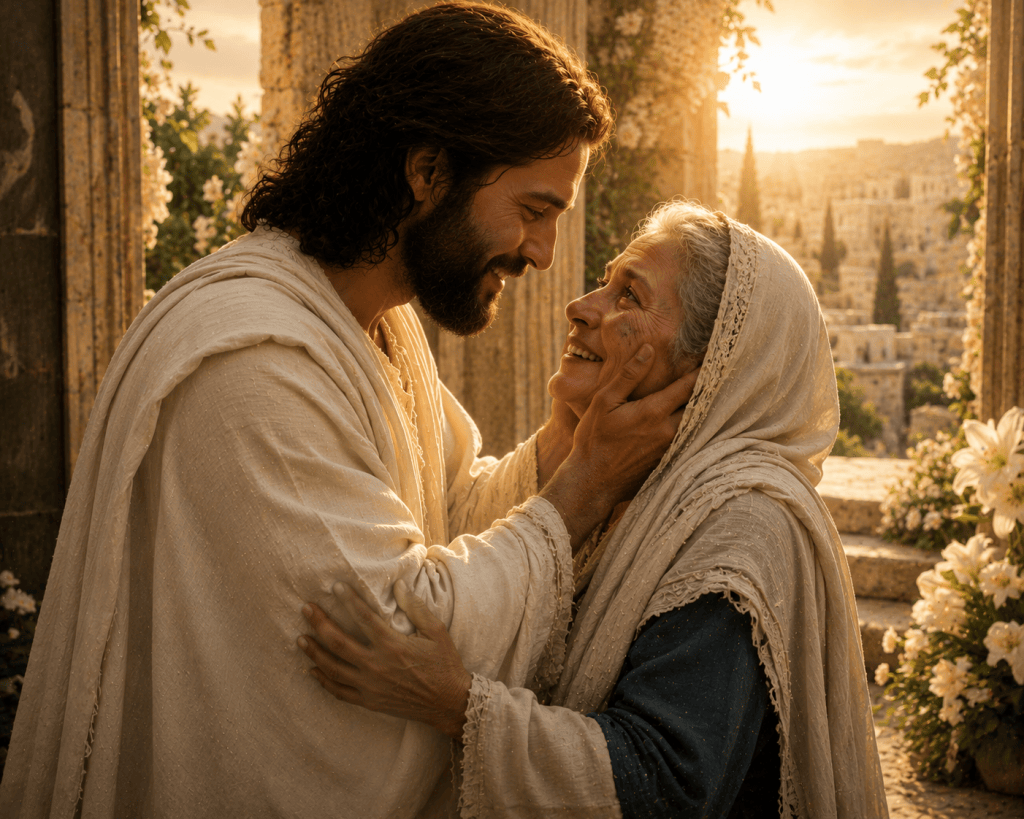
Before the Assumption became crowns, angels, titles, and generations calling her Queen of Heaven, perhaps there was simply an old woman realizing she was going to see her son.
We have spent fifty-four days making Mary human.
So let’s not stop now.
Not at the end.
Especially not at the end.
Catholic tradition teaches that at the end of Mary’s earthly life, she was assumed body and soul into heavenly glory.
The Church does not define whether Mary died before the Assumption.
Eastern Christianity preserves the ancient tradition of her Dormition—her “falling asleep.”
Western traditions have allowed both possibilities.
The dogma itself leaves the question open.
Pope Pius XII declared in 1950 that Mary, “having completed the course of her earthly life,” was assumed body and soul into heavenly glory.
Completed the course of her earthly life.
That’s all we are given.
No age.
No room.
No final conversation.
No description of her last morning.
No account of whether she knew what was about to happen.
And certainly no description of the moment Mary understood:
I’m going to see him.
But that’s the moment I want.
Not yet the Queen of Heaven.
Not yet crowned.
Not surrounded by angels.
Not standing on the moon.
Not clothed with the sun.
Mary.
Older now.
Finally.
We have been careful about her age throughout these reflections.
When Jesus was twelve, Mary was still startlingly young.
When he became a man, she was not elderly.
When he left Nazareth, she was a middle-aged mother watching her only son walk down the road.
At Calvary, she was not the ancient woman religious art sometimes makes her.
She was perhaps somewhere in her late forties.
But now—
let her be old.
Give her the wrinkles.
Give her the gray hair.
All of it.
Let the beautiful dark hair Joseph once knew be silver.
Let her hands be lined and spotted with age.
Let her fingers be a little stiff in the mornings.
Give her an aching knee.
Maybe both.
Let getting up from the floor require planning now.
Perhaps someone younger notices.
“Here.”
Mary looks at the offered hand.
“I can get up.”
“I know.”
Mary takes it anyway.
Maybe she has become one of those old women who complains about being treated like an old woman while simultaneously expecting everyone to listen because she is, in fact, the old woman in the room.
She has earned that privilege.
Perhaps the early Christians love her.
How could they not?
Not because she floats through their communities dispensing perfect wisdom.
I hope we haven’t spent fifty-four days with Mary only to turn her into stained glass at the end.
Maybe sometimes Mary is tired.
Sometimes impatient.
Sometimes funny.
Sometimes she wants everyone out of her house.
Maybe young Christians come asking questions.
“What was Jesus like as a child?”
Mary closes her eyes.
Again.
They always ask.
“Did he know who he was?”
“I don’t know.”
“What was his first miracle?”
“I’ve told you.”
“Tell us again.”
Mary sighs.
Then tells them again.
Cana.
She has told that story a hundred times.
Maybe the details have become polished through repetition.
The wine.
The servants.
Those enormous jars.
Jesus looking at her.
Someone laughs.
Mary smiles.
“He was annoyed with you?”
“I didn’t say that.”
“You made it sound like he was.”
Mary raises an eyebrow.
Perhaps everyone laughs.
There are other stories she tells easily.
Jesus learning Joseph’s trade.
Something ridiculous he did as a boy.
The time he tracked mud somewhere Mary had just cleaned.
Maybe Joseph teaching him something and getting it completely wrong himself.
Mary laughs when she tells those.
Then someone asks:
“What was it like at the Cross?”
Silence.
Mary looks down at her hands.
“No.”
The young person immediately understands.
Some stories belong to the Church.
Others still belong to Mary.
Maybe Calvary is one of them.
Or perhaps she speaks about it rarely.
Only when someone truly needs to know.
But she never tells everything.
There are things between a mother and her dead son that history doesn’t get to have.
Even sacred history.
Perhaps Mary lives among people who know Jesus primarily through resurrection.
That’s strange to think about.
They know:
Christ is risen.
Christ conquered death.
Christ will come again.
Mary knows all of that.
But she also knows how he sounded when he sneezed.
She knows what food he disliked.
Maybe there was something.
There had to be.
She knows how his handwriting looked.
Whether he snored.
How he behaved when he was exhausted.
The expression he made when Joseph told a terrible joke.
Everyone else knows the Gospel.
Mary remembers the person.
Maybe that’s what she gives the early Church.
Not secret doctrine.
Not hidden revelation.
Memory.
Jesus was real.
He ate.
He slept.
He laughed.
He became frustrated.
He worked.
He loved people.
He had a mother.
And Mary had spent years being that mother.
Now she is old.
Perhaps some evenings, after everyone leaves, she sits quietly.
And Nazareth comes back.
Not because she regrets anything.
Not because she wishes Jesus had never begun his ministry.
Not because she wants to undo the Cross or Resurrection.
She simply misses home.
The first home.
Joseph.
Oh, Joseph.
Maybe his face has become harder to remember.
That must happen.
Mary hates that.
She can remember pieces perfectly.
His hands.
His laugh.
The way he stood at the workbench.
A particular expression when he thought she was being unreasonable.
But sometimes she tries to assemble his whole face and something slips.
“No.”
She closes her eyes.
Tries again.
There.
For a second.
Joseph.
She misses him.
Not the Saint Joseph of statues.
Not patron of the Universal Church.
Not the righteous man of Matthew.
Her husband.
The man who shared her bed.
The man who knew when she was pretending not to be worried.
The man who raised a child that wasn’t biologically his and somehow made fatherhood look entirely his own.
The man whose absence changed the sound of the house.
Maybe Mary still talks to him sometimes.
“You would not believe what they’re saying about him now.”
Silence.
Mary smiles.
“Actually, you probably would.”
Then there is Jesus.
Not the risen Christ.
Not yet.
The boy.
She misses the boy.
Maybe that surprises her.
After everything—
after miracles and crowds and Jerusalem and Resurrection—
sometimes the Jesus Mary wants is seven.
Running through the house.
“Mama.”
“What?”
“Look.”
She had not looked once.
Maybe she remembers that.
She had been busy.
“Later.”
Now Mary would give anything to know what he wanted to show her.
Grief keeps ridiculous receipts.
Perhaps she misses seventeen-year-old Jesus sitting beside Joseph.
Twenty-year-old Jesus coming home dirty from work.
The grown Jesus who still knew where she kept everything.
Maybe she misses hearing:
“What’s for dinner?”
Imagine being the mother of the Messiah and discovering that one of the sentences you would someday ache to hear again was:
What’s for dinner?
Maybe Mary laughs aloud.
Alone.
Then cries.
That still happens.
Even after all these years.
Resurrection did not mean Mary stopped missing Jesus.
That’s important.
He rose.
She saw him again—perhaps, as we imagined yesterday.
Then he left again.
The Ascension was another goodbye.
Different.
Glorious.
Hopeful.
But still—
he went somewhere Mary could not follow.
Not yet.
Maybe that word sustained her.
Yet.
When Jesus left Nazareth:
When will he come back?
During the ministry:
Where is he now?
After the arrest:
Where have they taken him?
Holy Saturday:
Where are you?
Resurrection:
You’re here.
Ascension:
Gone again.
But now the absence is different.
Mary knows where he is.
Home.
Maybe that is how she thinks of it.
Not heaven as some distant theological geography.
Where Jesus is.
Where Joseph is.
Home.
And Mary is still here.
Years pass.
Her body changes.
Walking becomes slower.
Someone carries the water now.
Mary hates that at first.
Then realizes she does not miss carrying water at all.
Her eyesight perhaps weakens.
Her hearing too.
“What?”
Someone repeats themselves.
“I heard you.”
“You just said what.”
“I was thinking.”
The younger person knows better than to argue.
Mary has become old.
And maybe she is surprised by it.
Most people are.
Inside, perhaps she still feels like the young woman in Nazareth.
Fourteen.
Fifteen.
Sixteen.
Whatever her age had been when Gabriel came.
How can that girl and this old woman occupy the same life?
She looks at her hands.
These hands held him.
That’s always where memory returns.
Her hands.
They touched his newborn skin.
Changed him.
Fed him.
Washed him.
Caught him.
Worked beside him.
Held Joseph.
Buried Joseph.
Prepared meals for Jesus.
Touched his adult face.
Reached for him on the road to Calvary.
Maybe touched the wounds after Resurrection.
Now they tremble slightly.
Old hands.
Maybe Mary likes them.
They have done good work.
Then perhaps something changes.
Not dramatically.
I don’t want trumpets yet.
Maybe Mary becomes tired.
More tired than usual.
Someone notices.
“You should lie down.”
“I am fine.”
Of course.
Mary has apparently been fine for approximately seventy years.
But this time she lets them help her.
Maybe she knows.
Bodies know things.
Perhaps she lies down.
Someone brings water.
There it is again.
The cup.
From Holy Saturday to this.
Someone always making sure Mary drinks water.
She smiles.
“What?”
someone asks.
“Nothing.”
How could she explain?
Maybe people gather.
John, if he is still with her in the tradition we are imagining.
Other Christians.
Women who have become daughters to her.
Men who have heard Jesus’ stories from her own mouth.
People born after the Crucifixion.
People who never knew a world in which Jesus was an ordinary man walking through Galilee.
Mary looks around.
So many faces.
Her family became enormous.
Jesus did that.
Of course he did.
Maybe someone is crying.
Mary notices.
“Oh, don’t.”
That makes them cry harder.
Mary almost rolls her eyes.
Perhaps she is not afraid.
Or perhaps she is.
We shouldn’t take that humanity from her either.
Faith does not necessarily make dying easy.
The body has spent an entire lifetime keeping itself alive.
Breathing.
Eating.
Sleeping.
Healing.
Avoiding danger.
Then eventually we ask it to stop.
Maybe Mary is frightened.
Not of God.
Not even exactly of death.
Of the crossing.
What will it feel like?
Will it hurt?
Will I know what’s happening?
Human questions.
Mary is allowed human questions.
Maybe she sleeps.
Wakes.
The room is quieter.
Someone is holding her hand.
Mary looks toward the doorway.
That doorway.
How many doorways have we placed her in during these reflections?
Watching Jesus leave.
Waiting for Jesus to return.
Hearing news.
Looking toward footsteps that weren’t his.
Perhaps now there is another doorway.
Not literally.
Maybe.
But Mary senses something.
And suddenly—
she knows.
Not everything.
Just one thing.
I’m going to see him.
Maybe her breath catches.
Someone beside her leans closer.
“Mary?”
She doesn’t answer.
Her eyes fill.
But this isn’t fear.
Not entirely.
She has spent years believing this.
Of course.
She knows the promises.
She knows the Resurrection better than almost anyone alive.
But knowing something will happen someday is different from realizing:
Someday is now.
Now.
Jesus.
Maybe Mary becomes very still.
She can see him in memory.
Every version arriving at once.
Newborn.
The astonishing weight of him placed against her.
Toddler.
Boy.
Twelve-year-old making her absolutely furious in Jerusalem.
Young man at Joseph’s workbench.
Jesus at Cana giving her that look.
Teacher disappearing behind crowds.
Son walking away from Nazareth.
Prisoner.
No.
She doesn’t stay there.
Risen.
Warm.
Breathing.
Alive.
“Jesus.”
Maybe she says his name.
Someone beside her hears.
“What?”
Mary smiles.
Perhaps they think she’s confused.
She’s old.
She’s dying.
People assume things.
But Mary knows exactly what she means.
Jesus.
I’m coming.
And then another realization.
Joseph.
Oh.
Joseph too.
Maybe Mary laughs.
A tiny, astonished sound.
Now everyone in the room is confused.
Mary closes her eyes.
Her family.
The table.
For decades she has remembered that table.
Joseph in his place.
Jesus in his.
Mary in hers.
Then Joseph’s place empty.
Then Jesus’ place empty.
Then Mary alone.
Perhaps she has spent half a lifetime living at a table with missing people.
And suddenly—
no empty chairs.
That might be when she cries.
Not because she is leaving.
Because she has finally understood where she is going.
Everyone she has loved is not behind her.
They are ahead.
Maybe Mary squeezes the hand holding hers.
“It’s all right.”
The person shakes their head.
No.
It isn’t.
Not for them.
Mary understands.
She has been the person left behind.
She knows.
So perhaps she does for them what Jesus once did for her.
She stays calm.
Not because leaving doesn’t matter.
Because she knows the pain belongs mostly to those who remain.
Maybe she tells them:
“Eat.”
Someone laughs through tears.
What else would Mary say?
“Take care of each other.”
Perhaps.
“Don’t argue.”
That one is hopeless.
Maybe Mary smiles.
Then grows quiet again.
And perhaps this is where the Assumption begins.
Not with angels lifting her into a painted sky.
Not with apostles staring upward.
Not with crowns.
With recognition.
Mary realizes she is no longer waiting.
All her life has been waiting.
Waiting for Joseph to understand.
Waiting for a child to be born.
Waiting in Egypt.
Waiting for safety.
Waiting for twelve-year-old Jesus to be found.
Waiting for him to return from journeys.
Waiting for news.
Waiting through ministry.
Waiting outside places she could not enter.
Waiting beneath a Cross for suffering to end.
Waiting through Saturday.
Waiting for morning.
Waiting after Ascension.
Now—
no more waiting.
Maybe she whispers:
“Finally.”
Not impatiently.
Tenderly.
Finally.
Perhaps the room changes.
Maybe there is light.
Maybe there isn’t.
The Church gives us the mystery, not the mechanics.
Mary is assumed body and soul into heavenly glory.
What does that feel like from inside the person experiencing it?
We don’t know.
Maybe there is no sensation of rising.
No clouds beneath her feet.
No awareness of distance.
Maybe there is simply—
presence.
And Mary opens her eyes.
Jesus.
Not memory.
Not prayer.
Not the risen Jesus who appeared only to leave again.
Jesus.
And this time—
no goodbye waiting behind him.
Maybe Mary stares.
We’ve been here before.
That first imagined Resurrection meeting.
The impossible face.
The hesitation.
The need to touch.
But now Mary knows immediately.
Her son.
Perhaps Jesus smiles.
That smile.
Still.
After everything.
Mary laughs.
Maybe she becomes young again.
Maybe she doesn’t.
I don’t know that she would care.
She goes to him.
No hesitation now.
And Jesus opens his arms.
Mary walks into them.
Maybe that’s the entire Assumption from her perspective.
Not elevation.
Arrival.
Her face against her son’s shoulder.
His arms around her.
No soldiers.
No crowds.
No disciples calling him away.
No road waiting.
No ministry demanding him.
No Jerusalem.
No Cross.
No Ascension.
Nobody is leaving.
Maybe Mary holds him for a long time.
There is no reason not to.
Time has stopped being scarce.
Perhaps eventually she pulls back.
Looks at him.
“You took long enough.”
Jesus laughs.
Oh, that sound.
Mary closes her eyes.
Then perhaps someone else says her name.
A voice she has not heard in decades.
“Mary.”
She freezes.
No.
Slowly, she turns.
Joseph.
Maybe that’s where every ounce of dignity disappears.
Mary runs.
Old knee forgotten.
Joseph catches her.
And now she is laughing and crying again.
Because apparently this is how every great mystery ends for Mary:
with somebody she loves becoming touchable again.
Maybe Jesus watches.
Smiling.
Joseph looks over Mary’s shoulder at him.
Their son.
Their impossible, extraordinary, exhausting son.
Perhaps Joseph says:
“Look what he did.”
Mary laughs harder.
“Yes.”
Maybe that’s enough theology for the moment.
Look what he did.
The Church will give Mary titles.
Beautiful ones.
Mother of God.
Queen of Heaven.
Queen of Angels.
Queen of Apostles.
Seat of Wisdom.
Mystical Rose.
Ark of the Covenant.
Morning Star.
Generations will paint her in blue.
Gold.
Stars.
Crowns.
They will build cathedrals in her name.
Compose prayers.
Write hymns.
Carry her image through streets.
Put roses at her feet.
Hold beads and repeat words Gabriel once said directly to her.
Blessed are you among women.
All of that comes.
But before any title matters—
perhaps Mary looks around.
Jesus.
Joseph.
Home.
And maybe she thinks something almost embarrassingly simple.
We’re all here.
The family that once sat around a little table in Nazareth.
All here.
No empty places.
Maybe that’s why I want our fifty-four days to end here.
We began by asking questions about Mary that religious art cannot always answer.
Was she tired?
Did she laugh?
What did pregnancy feel like?
What did Joseph love about her?
What did their house sound like?
What did family dinner sound like?
What did she worry about?
What irritated her?
What did widowhood change?
What happened when Jesus left?
What did she do with an empty house?
What did she feel when strangers began claiming pieces of her son?
When did worry become fear?
Who told her he had been arrested?
What could she possibly have thought while watching him walk toward Calvary?
What did she do when he was gone?
What if she saw him alive again?
Again and again, we have tried to walk backward from icon to woman.
From Queen—
to mother.
From halo—
to hair falling loose after a long day.
From statue—
to aching feet.
From doctrine—
to dinner.
From sacred heart—
to human heartbeat.
And now we’ve reached the moment when the woman becomes the icon again.
Assumption.
Heaven.
Queen.
But maybe we understand the crown differently now.
Because underneath it is still Mary.
The girl from Nazareth.
Joseph’s wife.
Jesus’ mother.
The woman who carried water.
Made bread.
Lost sleep.
Buried her husband.
Watched her son leave.
Watched him die.
Saw him alive.
Then lived long enough to miss them both.
Maybe heaven does not erase any of that.
Maybe glory does not make the ordinary life insignificant.
Maybe the ordinary life is exactly what arrives there.
Every meal.
Every laugh.
Every argument.
Every worried night.
Every goodbye.
Every touch.
Every time Mary stood in a doorway and watched someone she loved disappear.
Nothing lost.
Perhaps Mary finally understands that.
She spent her life releasing people.
Joseph.
Jesus.
Again and again.
Now God releases her from the waiting.
And perhaps before angels call her Queen—
before heaven gives her anything—
Jesus simply says the word he has called her since he first learned to speak.
“Mama.”
Mary looks at him.
And maybe for one final instant she is every age she has ever been.
The frightened girl saying yes.
The exhausted young mother in Bethlehem.
The refugee carrying a baby toward Egypt.
The laughing wife at a table in Nazareth.
The mother searching Jerusalem.
The widow.
The woman in the doorway.
The mother beneath the Cross.
The grieving woman on Saturday.
The astonished mother touching a living face on Sunday.
The old woman waiting.
All of her.
She smiles.
And goes to her son.
Not for an afternoon.
Not until the next journey.
Not until someone needs him.
Not until another goodbye.
Forever.
Maybe that was the first thing Mary understood about heaven.
Not crowns.
Not angels.
Not glory.
Nobody she loves is leaving again.
And after a lifetime of watching people disappear down roads—
perhaps that was heaven enough.


