The Invitations of Mary Series
©MS 2026
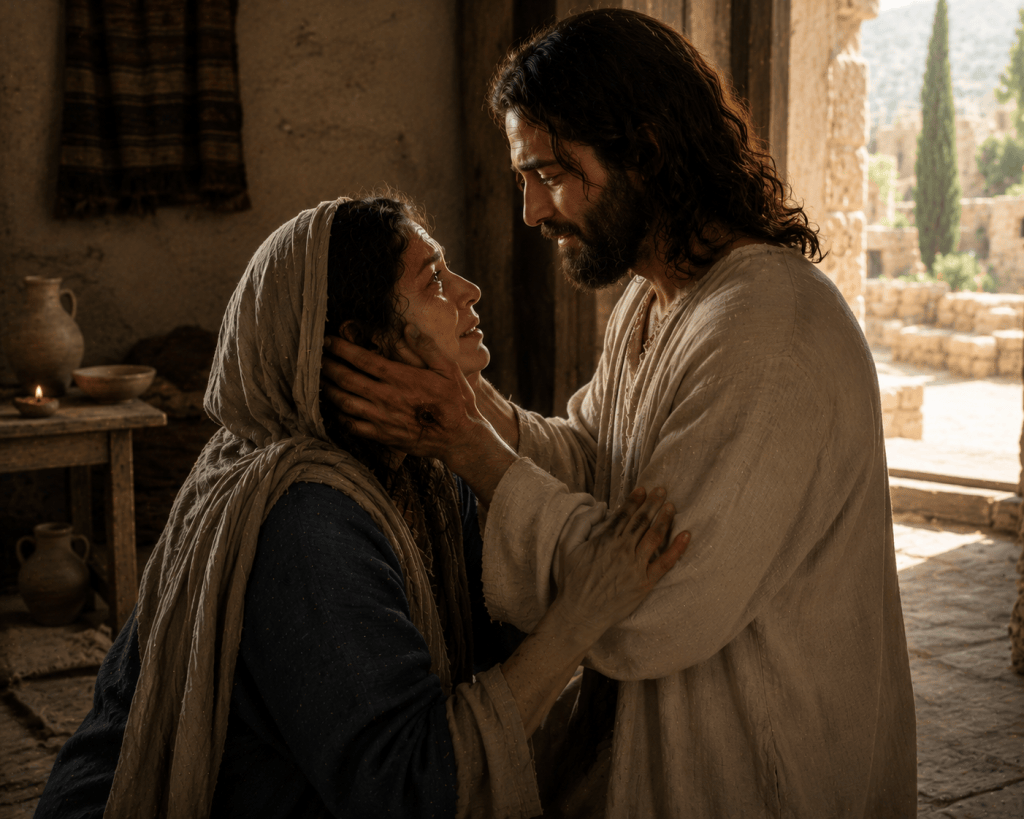
If Mary encountered the risen Jesus privately, what happened during the first few seconds before either of them spoke? No doctrine. Just mother and son.
We have to begin with what we do not know.
Scripture never tells us that the risen Jesus appeared privately to Mary, his mother.
Mary Magdalene sees him.
The disciples see him.
Thomas sees him.
The travelers on the road to Emmaus see him.
But nowhere are we given the scene that seems almost impossible not to wonder about:
Did Jesus go to his mother?
Christian tradition has wondered too.
For centuries, Christians have contemplated the possibility that Mary may have encountered her risen son even though the Gospel writers did not preserve such a meeting.
But it remains exactly that.
A possibility.
So we cannot say:
This happened.
We can only ask:
What if it did?
And if we’re going to imagine it—
I don’t want angels.
I don’t want choirs.
I don’t want brilliant light.
I don’t even want an Alleluia yet.
I want Mary.
The morning after the worst day of her life.
Maybe she had slept.
Barely.
Perhaps exhaustion had finally dragged her into something resembling sleep.
Then she woke.
And remembered.
Jesus was dead.
Again.
That terrible second death grief makes you experience after sleep.
Wake.
Forget.
Remember.
Oh.
Maybe Mary remained where she was.
Eyes open.
Not moving.
Yesterday she had survived the Sabbath.
Someone had gotten water into her.
Someone had convinced her to eat.
Maybe she had helped prepare spices.
Maybe she had cried until there was nothing left.
And now there was another morning.
Perhaps the women had already gone to the tomb.
The Gospels name Mary Magdalene among them.
Mary, Jesus’ mother, is not named in those accounts.
So perhaps she stayed behind.
Maybe she couldn’t go.
Maybe she had already seen enough.
Then—
footsteps.
Mary looked up.
Perhaps she barely reacted.
People had been coming and going.
John.
The women.
Followers.
People carrying information.
People crying.
Footsteps meant nothing anymore.
Then they stopped.
Someone was standing in the doorway.
And perhaps for the first few seconds—
Mary didn’t know him.
That sounds impossible.
Of course Mary would know Jesus.
She’s his mother.
But dead people do not stand in doorways.
The mind has rules.
And one of its most fundamental rules is:
The person you watched die cannot be standing across the room.
So perhaps Mary’s eyes saw Jesus—
and her mind refused the information.
No.
She blinked.
The figure remained.
Familiar height.
Familiar shoulders.
Familiar face.
No.
Mary stood slowly.
The chair scraped against the floor.
The man didn’t move.
She stared.
There are faces we know so well that recognition isn’t really thought.
The angle of a head.
The shape of a mouth.
The way someone stands.
The expression they make when they’re waiting for you to figure something out.
Mary had studied this face for thirty-three years.
Before anyone else knew it.
Baby.
Toddler.
Boy.
Adolescent.
Man.
She knew every version of this face.
And now—
impossibly—
there it was.
Jesus.
Maybe her hand went to the table.
Jesus took one step toward her.
Mary looked at his hands.
Perhaps she needed to.
She had seen what they did to them.
Jesus stopped.
Maybe he turned his palms slightly.
There.
The wounds.
Mary’s breath left her.
Her body had spent two days learning that Jesus was dead.
Now it was being asked to learn something else.
Alive.
No.
Alive.
Impossible.
Alive.
Maybe she stared at his chest.
Breathing.
His chest rose.
Fell.
Rose again.
And perhaps that was what convinced her.
Not the wounds.
Not even his face.
Breath.
Mary knew that rhythm.
She had listened for it beside him when he was an infant.
Wake in darkness.
Listen.
Breathing?
Yes.
Sleep.
When he was sick:
Breathing?
Yes.
When he slept after a long day:
Breathing.
And Friday—
nothing.
Now:
breath.
For the first few seconds, perhaps there was no theology at all.
No proclamation.
No triumph over death.
No understanding of what had happened to the world.
Maybe there was only:
You.
You are here.
You are standing.
You are breathing.
You are looking at me.
Mary crossed the room.
Slowly at first.
Perhaps she was afraid that if she moved too quickly, he would disappear.
Jesus stayed.
She stopped an arm’s length away.
Looked at him.
Really looked.
His forehead.
His face.
His shoulders.
His hands.
Alive.
Mary reached toward his face.
Then stopped.
What if there was nothing there?
What if grief had finally broken her mind?
Jesus waited.
Mary touched his cheek.
Warm.
Maybe that was it.
Maybe everything inside her collapsed at once.
Warm.
Not the terrible cooling skin of death.
Not memory.
Not a vision.
Her son was warm.
Mary’s face broke.
Her knees gave.
Jesus caught her.
And perhaps thirty-three years disappeared.
Mary grabbed him.
Not reverently.
Not as a disciple approaching the risen Lord.
As his mother.
Both arms around him.
Hard.
Maybe too hard.
Jesus held her.
Mary buried her face against him.
She could feel him.
His body.
His breath.
His arms around her.
Maybe one hand went to the back of his head.
That old gesture.
The one she had used when he was tiny.
When he was hurt.
When he was grieving.
Alive.
Maybe Mary couldn’t stop crying.
Not the crying of Calvary.
Something stranger.
Laughter trying to get inside sobbing.
Relief so enormous it hurt.
Perhaps she pulled away suddenly and touched his face with both hands, needing to verify him again.
Jesus smiled.
And maybe that smile nearly destroyed her.
Because she knew it.
Not the smile of religious art.
Not the solemn face of the risen Christ.
Her son’s smile.
The small one he gave her when he knew she was upset.
The one that said:
I know.
Maybe Mary hit him.
Not hard.
One hand against his chest.
“How could you?”
Jesus blinked.
“What did you do to me?”
Then she grabbed him again because she could.
Maybe Jesus laughed.
A tiny sound.
Mary pulled back.
“Do not laugh.”
And perhaps that made her laugh too.
Crying and laughing simultaneously.
“I watched you die.”
Jesus’ smile disappeared.
“I know.”
That might have hurt almost as much.
Because Resurrection did not erase Friday.
Jesus being alive did not mean Mary had not watched him suffer.
It did not remove the image of the Cross from her memory.
Joy does not retroactively make pain painless.
Maybe Jesus knew that.
So perhaps he let her be angry.
“You knew.”
Jesus was quiet.
“You knew this was going to happen.”
“Yes.”
“And you let me—”
Mary stopped.
Let me what?
Watch?
Follow?
Beg God?
Stand beneath you while you died?
There was no ending to the sentence.
Then Mary looked at his hands again.
She took one gently.
Turned it over.
The wound.
Her thumb moved near it.
“Does it hurt?”
There.
Motherhood returned immediately.
Jesus almost smiled again.
Perhaps thought better of it.
“Does it?”
Mary inspected him.
His other hand.
His face.
The wounds she had been unable to tend.
All the places where her hands had been useless on Friday.
The world would eventually venerate those wounds.
Artists would paint them.
Christians would contemplate them.
Mary might simply have looked at them and thought:
They did this to my child.
Maybe she touched one carefully.
Then looked at him.
“Why are they still there?”
Perhaps Jesus didn’t answer.
Maybe Mary wasn’t asking theology.
She simply wanted them gone.
Resurrection should mean gone.
Shouldn’t it?
Everything repaired.
Everything restored.
But Jesus still carried the evidence.
Perhaps Mary kissed his wounded hand.
Not worship.
A mother.
The same way she might once have kissed a scraped little palm.
And maybe Jesus began to cry.
Why wouldn’t he?
Jesus wept for Lazarus.
He wept over Jerusalem.
Resurrection does not require him to become less human.
Perhaps watching his mother touch the wounds she had seen inflicted hurt too.
Mary noticed.
Her anger disappeared.
She touched his face.
“My son.”
Maybe those were the first words that contained everything.
My son.
Jesus closed his eyes.
And perhaps he answered with whatever intimate word he had called her throughout his life.
“Mama.”
No doctrine.
Just mother and son.
Maybe Mary pulled him down beside her.
“Sit.”
Jesus obeyed.
Of course he did.
She reached automatically for the cup.
“Are you thirsty?”
Then perhaps she stopped.
What a strange question.
Did resurrected people need water?
Jesus smiled.
Mary almost laughed.
Maybe there would eventually be hundreds of questions.
What happened?
Where were you?
What does this mean?
Who else knows?
What happens now?
Are you staying?
But perhaps none of them mattered yet.
Mary had spent Friday watching every breath Jesus took because she knew eventually there would be a last one.
Now she watched him breathe because there wasn’t.
In.
Out.
Again.
Maybe she placed her palm against his chest.
Heartbeat.
There.
Mary closed her eyes.
She had known that heartbeat once before.
Before Bethlehem.
Before shepherds.
Before Egypt.
Before Nazareth.
For months, Jesus’ heartbeat had existed beneath Mary’s own.
Two rhythms inside one body.
Now her palm rested over it again.
Alive.
Jesus covered her hand with his.
Mary opened her eyes.
“Don’t go.”
Maybe she finally said it.
The sentence she had swallowed for years.
When he left Nazareth.
When his ministry took him farther away.
When people began threatening him.
When he went toward Jerusalem.
When he was arrested.
When he carried the Cross.
Don’t go.
And perhaps Jesus’ expression changed.
Mary saw it.
“No.”
“Mama.”
“No.”
“You just came back.”
“I know.”
How many times can one mother release the same son?
Maybe she knew even as she begged him.
Jesus had never belonged only to her.
She had spent his entire life learning that.
But surely she could have one morning.
One meal.
One hour.
Maybe he gave her that.
Scripture doesn’t tell us.
So imagination can be gentle.
Maybe for a little while Jesus simply sat with his mother.
No disciples.
No crowds.
No teaching.
No one needing anything from him.
Mary gave him bread.
“You’re eating.”
“Mama—”
“You were dead two days ago. You are not arguing with me today.”
Maybe Jesus actually laughed.
And perhaps hearing that sound was its own resurrection.
Jesus tearing bread.
Jesus reaching for a cup.
Jesus chewing.
His hands doing ordinary things.
Wounded hands.
Alive hands.
Perhaps Mary reached across the table and grabbed one again.
Jesus looked at her.
“Sorry.”
She didn’t let go.
Maybe he simply continued eating one-handed.
And perhaps that was when Mary realized something else.
Something she had prayed for through years of his ministry.
She looked at him.
Really looked.
Then said:
“They can’t hurt you anymore.”
Jesus held her gaze.
“No.”
Mary’s face crumpled.
Because for years her prayer had been:
Keep him safe.
Every road.
Every rumor.
Every angry crowd.
Every goodbye.
Keep him safe.
Friday had seemed like the final answer.
No.
But now—
something beyond safety.
No one could take his life again.
Maybe for the first time since his arrest, Mary’s body unclenched.
Her shoulders dropped.
Her jaw released.
Her hands stopped trembling.
Not completely.
Trauma does not disappear because something wonderful happens.
But something loosened.
Her son was alive.
Perhaps only then did the larger meaning begin creeping toward her.
Gabriel.
Simeon.
Jesus’ own strange words.
Three days.
Mary looked at him.
“Oh.”
Maybe that’s all.
Not complete understanding.
Just recognition that something far larger than her own grief had happened.
The world had changed.
But perhaps Mary did not need to understand the whole world yet.
She had spent enough of Jesus’ life sharing him.
Let her have these minutes.
Let Peter wait.
Let John wait.
Let history wait.
Let theology stand quietly outside the door.
Mary has her son back.
Maybe she touched his hair.
“You need a haircut.”
Jesus stared at her.
Mary smiled.
The first real smile since Friday.
And Jesus laughed.
Perhaps they sat together afterward without speaking.
Mary leaned against him.
Her head on his shoulder.
She listened.
Breathing.
Heartbeat.
Alive.
And maybe, for the first time in days, Mary rested.
Not because Friday had been erased.
Not because she understood everything.
Not because the Cross suddenly hurt less.
But because the person she believed she had lost forever was sitting beside her.
We do not know whether this meeting happened.
We should never turn a beautiful possibility into a Gospel claim.
Scripture leaves the question unanswered.
But perhaps that silence gives us room to wonder.
If Jesus did go to his mother, maybe there was no grand announcement.
Perhaps he simply appeared.
And waited for Mary to recognize him.
Maybe she touched his face.
Checked his hands.
Felt his breath.
Put her palm over his heartbeat.
Cried.
Got angry.
Held him.
Fed him.
Asked whether his wounds hurt.
Told him not to leave.
All the completely unreasonable things love does when the impossible person comes home.
And perhaps before Mary understood what Resurrection meant for humanity—
she understood what it meant in the oldest language she possessed.
On Friday, she had called:
“Jesus.”
And eventually there had been no answer.
Now:
“Jesus?”
He looked at her.
“Yes, Mama?”
And for a little while—
that was enough.


