The Invitations of Mary Series
©MS 2026
Holy Saturday may have been the first morning of Mary’s life when there was nothing left for her to do for her son.
Maybe she woke up.
That might have been the first cruelty.
She woke up.
For a few seconds, perhaps she did not remember.
The body can do that after catastrophe.
Sleep comes—if it comes at all—and consciousness loosens its grip on what happened.
Then morning.
A strange room.
Dim light.
Someone breathing nearby.
A blanket.
A wall.
And for one merciful fraction of a moment—
nothing.
Then memory returned.
Jesus was dead.
Maybe Mary closed her eyes again.
Not because she could sleep.
Because opening them meant accepting that the world had continued.
It was the Sabbath.
Somewhere outside, Jerusalem was waking.
Quietly.
Passover.
Families.
Prayers.
Meals.
Children.
The ordinary holiness of Sabbath continuing exactly as it had every other week of Mary’s life.
Except Jesus was dead.
How dare morning come?
Maybe that thought surprised her.
The sun should not rise.
People should not eat.
Someone should stop the city.
Someone should tell the birds.
Someone should tell the people walking past outside that Jesus died yesterday.
But Jerusalem knew.
At least some of it did.
And still—
morning.
Perhaps Mary lay perfectly still.
Her body hurt.
That might have surprised her too.
Why did her body hurt?
Nobody had scourged her.
Nobody had driven nails through her wrists.
Nobody had forced a cross onto her shoulders.
Yet perhaps every muscle ached.
Her head throbbed.
Her eyes burned.
Her jaw hurt from clenching it.
Her throat was raw.
Her feet were swollen from standing and walking.
Her back hurt.
Maybe there was dried blood somewhere on her clothing.
His?
Someone else’s?
She didn’t know.
Maybe she stared at it.
Blood.
And suddenly she was back there.
No.
Mary turned her face away.
Someone beside her stirred.
Maybe Mary Magdalene.
Maybe another woman.
Maybe John was somewhere nearby.
The Gospels do not tell us where Mary spent that Sabbath.
John tells us that before Jesus died, he looked down from the Cross, saw his mother and the disciple he loved, and said:
“Woman, here is your son.”
Then to the disciple:
“Here is your mother.”
And John tells us:
“From that hour the disciple took her into his home.”
Whether that means Mary went immediately into John’s care, whether she spent that first Sabbath with him, whether other women surrounded her—
we don’t know.
But I hope someone was there.
Not because Mary needed to speak.
Maybe she couldn’t.
Just because nobody should wake alone the morning after watching her child die.
Perhaps someone noticed her eyes were open.
“Mary?”
She didn’t answer.
“Do you need anything?”
What an impossible question.
Yes.
Her son.
“No.”
Maybe that was the first word she spoke on Holy Saturday.
No.
Someone brought water anyway.
Placed it near her.
Mary ignored it.
Eventually:
“You need to drink.”
Mary looked at the cup.
Need.
Such a ridiculous word.
Jesus had needed water yesterday.
“I thirst.”
Mary’s stomach turned.
“No.”
“Mary.”
She pushed the cup away.
Not violently.
Just enough.
“I can’t.”
Maybe Mary Magdalene sat beside her.
Didn’t argue.
Five minutes later, perhaps she offered it again.
Mary drank.
One swallow.
Then another.
Because apparently her body intended to remain alive.
That might have felt like betrayal.
Jesus’ body had stopped.
Hers had not.
Her heart was still beating.
Her lungs still drew breath.
Her stomach would eventually ask for food.
Her kidneys still required water.
Her muscles still moved.
Her skin was still warm.
How could the body continue participating in life when the person you loved was dead?
Maybe Mary hated being hungry.
If hunger came.
Perhaps someone set bread near her.
Mary stared at it.
Bread.
Of course.
How many times had she made bread for Jesus?
Thousands?
She couldn’t possibly know.
Flour on her hands.
Dough beneath her palms.
Jesus stealing something before a meal was ready.
Joseph pretending not to notice.
No.
Mary looked away.
“Eat something.”
“I can’t.”
“You haven’t eaten since yesterday.”
Yesterday.
That word was worse than bread.
Yesterday Jesus had been alive.
There was now a yesterday in which her son existed.
And a today in which he did not.
Maybe Mary began to cry.
Quietly.
Not the violent grief from the road.
Not the horror at the Cross.
This was different.
Yesterday.
There would be more of them.
Tomorrow:
Jesus died two days ago.
Then three.
A week.
A month.
A year.
Was that what life was going to become?
Counting distance from the last time she saw him breathe?
Maybe she ate the bread simply to make everyone stop asking.
One bite.
It became paste in her mouth.
She couldn’t swallow.
Water.
Another attempt.
Enough.
Nobody pushed.
What did Mary do on Holy Saturday?
Perhaps almost nothing.
And maybe that was unbearable because Mary had always done something.
When Gabriel came—
she answered.
When Elizabeth needed help—
Mary traveled.
When there was nowhere suitable to give birth—
she endured.
When Herod threatened Jesus—
they fled.
When twelve-year-old Jesus disappeared—
she searched.
When Joseph became ill—
perhaps she cared for him.
When Joseph died—
she buried him and kept living.
When Jesus left home—
she built a life around the absence.
When Cana ran out of wine—
she noticed.
When crowds needed Jesus—
she stepped aside.
When danger came—
she worried.
Watched.
Prayed.
Waited.
When Jesus was arrested—
she went looking for him.
When they led him to Calvary—
she followed.
When they crucified him—
she stayed.
Mary had always found something to do.
Holy Saturday offered her nothing.
Jesus was dead.
She could not feed him.
Could not cool his forehead.
Could not clean his wounds.
Could not tell him to rest.
Could not plead with authorities.
Could not follow him anywhere.
Could not stand where he could see her.
Could not hold his hand.
Could not even sit beside his body.
Joseph of Arimathea had taken care of that.
The Gospels tell us Joseph requested Jesus’ body from Pilate.
Nicodemus came with myrrh and aloes.
They wrapped Jesus in linen with spices according to Jewish burial custom and placed him in a new tomb.
The Synoptic accounts tell us women saw where he was laid.
John does not explicitly name Mary among those women.
Was she there?
We don’t know.
Maybe she couldn’t go.
Maybe someone gently took her away.
Maybe she had already seen enough.
Or perhaps Mary stood nearby and watched strangers perform the last acts she desperately wanted to perform herself.
That possibility hurts differently.
Someone else washed him.
Perhaps.
Someone else wrapped him.
Someone else carried him.
Someone else placed him down.
Her baby.
Maybe Mary wanted to say:
Careful.
The old word.
Careful with his head.
As though Jesus could still be hurt.
Maybe she almost reached to adjust the linen.
A mother noticing something wasn’t quite right.
Then stopped.
It didn’t matter anymore.
That realization might have broken something.
For thirty-three years, little things had mattered.
Is he warm enough?
Did he eat?
That scratch needs cleaning.
Your sandal is coming apart.
Take this with you.
Sleep.
Drink.
Be careful.
Now nothing she could do would make Jesus more comfortable.
Death is terrible partly because care has nowhere to go.
Love still generates the impulse:
Do something.
But the body is gone.
So where does all that care go?
Maybe that was Holy Saturday.
Mary with thirty-three years of maternal instinct still running through her body—
and nowhere to put it.
Perhaps she kept reaching for things.
Straightening something.
Folding a cloth.
Then realizing she didn’t need to.
Maybe she cleaned.
That would make sense.
Not because the room was dirty.
Because hands need work when the mind cannot survive stillness.
Fold.
Sweep.
Arrange.
Move something.
Put it back.
Someone finally said:
“Mary, sit down.”
“I am fine.”
She wasn’t.
Everyone knew.
Nobody argued.
Maybe she folded the same cloth three times.
Then noticed.
Her hands stopped.
She sat.
Silence.
Perhaps this was when Joseph came back to her.
Memory does strange things after loss.
One grief finds another.
Mary had known widowhood.
She knew the first morning after death.
The impossible stillness.
The empty place.
The habit of listening for a person who would never make another sound.
But when Joseph died, Jesus had still been there.
That mattered.
Maybe Mary suddenly remembered the first morning after Joseph’s death.
Jesus moving quietly around the house.
Perhaps making food neither wanted.
Sitting beside her.
Repairing something Joseph would once have repaired.
His presence filling part of the terrible absence.
She had lost Joseph—
but she still had Jesus.
Now she had lost Jesus.
And Joseph wasn’t there either.
Maybe Mary said his name.
“Joseph.”
Someone looked at her.
She shook her head.
Not speaking to them.
Perhaps she wished, irrationally, that Joseph were alive.
Then immediately thought:
No.
Maybe it was better he had not seen this.
Then:
No.
She wanted him anyway.
Grief doesn’t have to be consistent.
She wanted Joseph beside her.
She wanted Jesus alive.
She wanted Nazareth.
Not heaven.
Not resurrection.
Not prophecy.
Nazareth.
The table.
That damned little table.
Joseph sitting there.
Jesus beside him.
Bread.
Olives.
A cup.
Someone talking with their mouth full.
Mary telling them not to.
Joseph laughing.
Jesus laughing harder because Joseph was laughing.
Nothing miraculous.
Nothing important.
Nobody needing Jesus.
Nobody calling him Rabbi.
Nobody arguing about Sabbath law.
Nobody plotting.
Nobody following.
Nobody shouting:
Crucify him.
Just her family.
Maybe Mary would have given anything to go backward.
Not to Bethlehem.
Not to Gabriel.
Not to Cana.
Just one Tuesday.
An ordinary one.
Jesus perhaps seventeen.
Joseph alive.
Mary complaining about something completely forgettable.
She hadn’t known.
That’s what grief does.
It finds ordinary moments you failed to recognize as treasures and holds them up like evidence against you.
You didn’t know this was precious.
Of course she didn’t.
Nobody does.
Maybe Mary remembered being irritated with Joseph once.
Over what?
She couldn’t remember.
Imagine that.
She had wasted an evening annoyed with him and could no longer even remember why.
She would give anything for the argument now.
Maybe she remembered telling young Jesus:
“Not now.”
Not now.
How many times?
Mama.
Not now.
Mama, look.
In a minute.
Oh God.
Maybe she covered her face.
There is no mercy in grief’s accounting.
It takes every ordinary imperfection and asks:
Would you do it differently if you knew?
Yes.
Of course.
But that’s not how life works.
Maybe someone touched Mary’s shoulder.
“Don’t.”
The hand disappeared.
A moment later:
“I’m sorry.”
Mary reached blindly.
Found the hand.
Pulled it back.
“No. Stay.”
Perhaps that was Mary Magdalene.
Maybe John.
Maybe another woman.
We don’t know.
Stay.
That word.
Mary had stayed for Jesus.
Now someone stayed for her.
Perhaps they sat without speaking.
An hour.
Maybe less.
Grief destroys time.
Eventually someone prayed.
Mary listened.
Words she had said all her life.
Words about God’s faithfulness.
Mercy.
Israel.
Deliverance.
Maybe she couldn’t say them.
Perhaps that frightened her.
Mary had prayed through everything.
Now words felt impossible.
Maybe someone began a psalm.
Mary knew it.
Her lips didn’t move.
Was she angry with God?
Maybe.
I think we should allow the possibility.
Not unbelief.
Anger.
They are not the same thing.
God had asked for her yes.
She had given it.
She had carried Jesus.
Birthed him.
Protected him.
Raised him.
Released him.
Again and again.
And yesterday—
God had not stopped them.
Mary had watched.
Where were You?
Maybe she thought it.
Then immediately felt guilty.
Then angry about feeling guilty.
Where were You?
At Cana, she had brought Jesus a shortage of wine.
And something happened.
Yesterday she had surely wanted something infinitely more urgent.
Stop this.
Nothing.
Take him down.
Nothing.
Save him.
Nothing.
She had watched him die.
How was she supposed to understand that?
Maybe she didn’t.
Maybe Holy Saturday was the day Mary stopped trying.
Not forever.
Just for that day.
No pondering.
No keeping things in her heart.
No assembling mysteries.
There are experiences too large to interpret while you’re inside them.
So perhaps Mary gave herself permission—
or simply lacked the capacity—
to understand nothing.
Jesus was dead.
That was enough truth for one day.
Did she remember what he had said about rising?
Perhaps.
The disciples themselves struggled to understand those predictions before the Resurrection.
We should not casually give Mary perfect comprehension simply because she was Mary.
Maybe someone said:
“He said—”
Mary’s face changed.
“Don’t.”
“But he said after three days—”
“I know what he said.”
Silence.
Perhaps Mary immediately regretted the sharpness.
But she could not bear hope yet.
Hope can be cruel when grief is fresh.
If she let herself believe something impossible might happen—
what if nothing did?
Jesus was dead.
Mary had seen him.
Dead.
She knew death.
Joseph had taught her that.
Dead people did not walk back through doors.
Maybe she thought of Jairus’s daughter.
Lazarus.
Others Jesus had restored.
Then something even worse:
Jesus had raised other people’s loved ones.
Who would raise Mary’s?
Maybe she hated the thought the moment it appeared.
No.
She stood.
Walked somewhere else.
Someone let her.
Perhaps she found a corner where nobody could see her.
And finally—
she sobbed.
Not Mary of the Pietà.
Not Our Lady of Sorrows.
Not the immaculate face in a painted veil.
A mother.
Bent over.
Mouth open.
Unable to breathe correctly.
Snot.
Tears.
Pain so physical she pressed a hand against her chest because something there genuinely hurt.
“Jesus.”
Maybe she said his name again and again.
“Jesus.”
Not prayer.
Name.
“Jesus.”
As though enough repetition might make him answer.
Nothing.
“Jesus.”
Silence.
That might have been the worst thing she had ever heard.
For thirty-three years, Jesus had answered.
Not every time immediately.
Children ignore their mothers.
Teenagers certainly do.
Adult sons become distracted.
But eventually:
“Yes?”
Jesus?
“Yes, Mama?”
Jesus?
“What?”
Jesus.
Nothing.
Maybe Mary understood death through that silence more than she had beneath the Cross.
He would never answer her again.
At least—
that was what Saturday seemed to say.
Maybe she fell asleep eventually.
Not because she chose to.
Because the body shuts down.
Perhaps sitting upright.
Her head against a wall.
Someone placed a blanket over her.
She woke minutes later frightened.
“Jesus?”
Then remembered.
Oh.
Maybe that happened more than once.
Sleep.
Wake.
Remember.
Each awakening another tiny bereavement.
Did Mary eat?
Probably eventually.
Human beings generally do.
Did she drink?
Someone may very well have reminded her.
Did she speak?
Perhaps little.
Did she sleep?
Maybe in scraps.
But those details are speculation.
Scripture gives us no diary of Mary’s Holy Saturday.
What Scripture gives us is silence.
Jesus has been laid in the tomb.
The Sabbath begins.
The women will return after the Sabbath with spices.
And between those two events—
nothing.
Christian tradition calls this Holy Saturday.
We know what comes next.
Mary did not yet have our Sunday.
That’s important.
We rush through Saturday because we know the ending.
The tomb is temporary.
Death is defeated.
Christ is risen.
Alleluia.
But Saturday does not know that yet.
Saturday is the day after your child dies.
That’s all.
Maybe late in the day Mary went outside.
Just for air.
Jerusalem looked different.
Or exactly the same.
She couldn’t decide which was worse.
People were walking.
Children played.
Someone laughed somewhere.
Mary turned toward the sound.
Her whole body recoiled.
Then she felt ashamed.
Why shouldn’t someone laugh?
Jesus had laughed.
Oh.
Maybe she closed her eyes.
Could she still hear it?
His real laugh.
Not the polite one.
The ridiculous one.
The one that made him bend forward.
Yes.
For one second—
there he was.
Toddler.
Boy.
Young man.
Carpenter.
Not crucified.
Mary opened her eyes.
Gone.
Perhaps she realized memory was going to become both wound and shelter.
She could still go to Nazareth in her mind.
Joseph at the table.
Jesus working.
The sound of tools.
Dinner.
Footsteps.
But she could never stay there.
Eventually memory always returned her to Jerusalem.
Maybe sunset approached.
The Sabbath moving toward its end.
The women began discussing the tomb.
Spices.
When they could go.
What needed to be done.
Mary listened.
Perhaps they asked if she wanted to come.
Maybe she couldn’t answer.
Go to the tomb?
See where he was?
The place containing the body of her son.
Maybe yes.
Maybe absolutely not.
John does not tell us.
Neither should we.
Perhaps Mary only said:
“Take care of him.”
Then realized again.
He couldn’t feel care.
Still:
“Take care of him.”
The women understood.
Maybe Mary helped prepare the spices.
That possibility feels right, though we cannot claim it.
Her hands finally having something to do.
Measure.
Mix.
Fold cloth.
Prepare.
Something for Jesus.
Even if Jesus would never know.
That didn’t matter.
Love does things for the dead because love has not yet learned how to stop being active.
Perhaps Mary’s hands steadied.
For the first time all day.
Someone noticed.
Said nothing.
Mary worked.
And maybe that is where we leave her.
Not understanding.
Not anticipating angels.
Not serenely awaiting Resurrection.
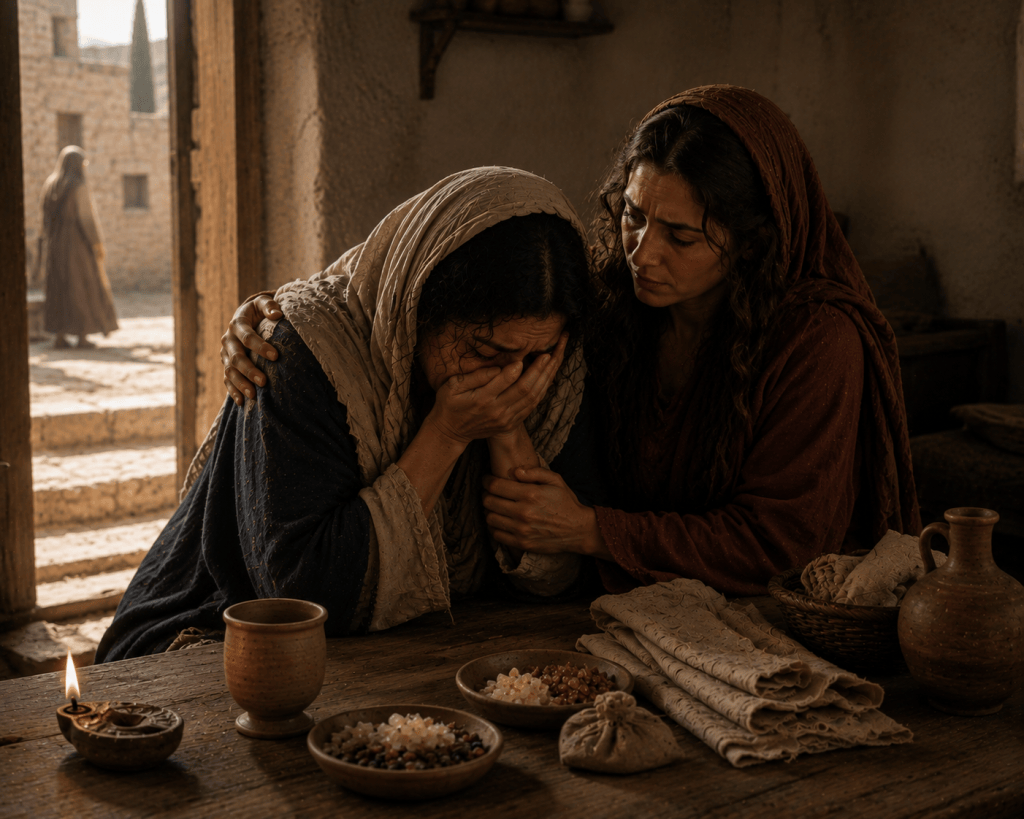
At a table.
Late on Holy Saturday.
Older than she had been yesterday.
Preparing something for a son she believed she could no longer help.
A lamp burning beside her.
Someone nearby.
Water within reach because someone had finally convinced her to drink.
A piece of bread mostly untouched.
Her eyes swollen.
Her body exhausted.
Her hands moving.
Then perhaps they stopped.
Mary looked toward the doorway.
For thirty-three years, some part of her had always known where Jesus was.
Cradle.
Workshop.
Road.
Capernaum.
Jerusalem.
Crowd.
Cross.
Now she knew where his body was.
That was not the same thing.
Where are you?
Maybe that was the question beneath Holy Saturday.
Not:
Why?
Not yet.
Where are you?
Because Mary had spent her whole life learning how to let Jesus leave.
But every other leaving had contained the possibility of return.
This one didn’t.
As far as she knew.
So what did Mary do when Jesus was gone?
Perhaps she did what grieving mothers have done in every century.
She breathed because her body kept breathing.
Drank because someone put water into her hands.
Ate because someone asked her to try.
Slept because exhaustion eventually overpowered grief.
Woke and remembered.
Cried.
Stopped crying.
Became angry.
Remembered ordinary things.
Wanted people near.
Wanted everyone to leave.
Reached instinctively toward a child who was no longer there.
And somehow—
hour by hour—
survived Saturday.
No miracle yet.
No angel.
No empty tomb.
Just Mary.
And the terrible work of remaining alive when the person you would have died for—
was gone.


