The Invitations of Mary Series
©MS 2026
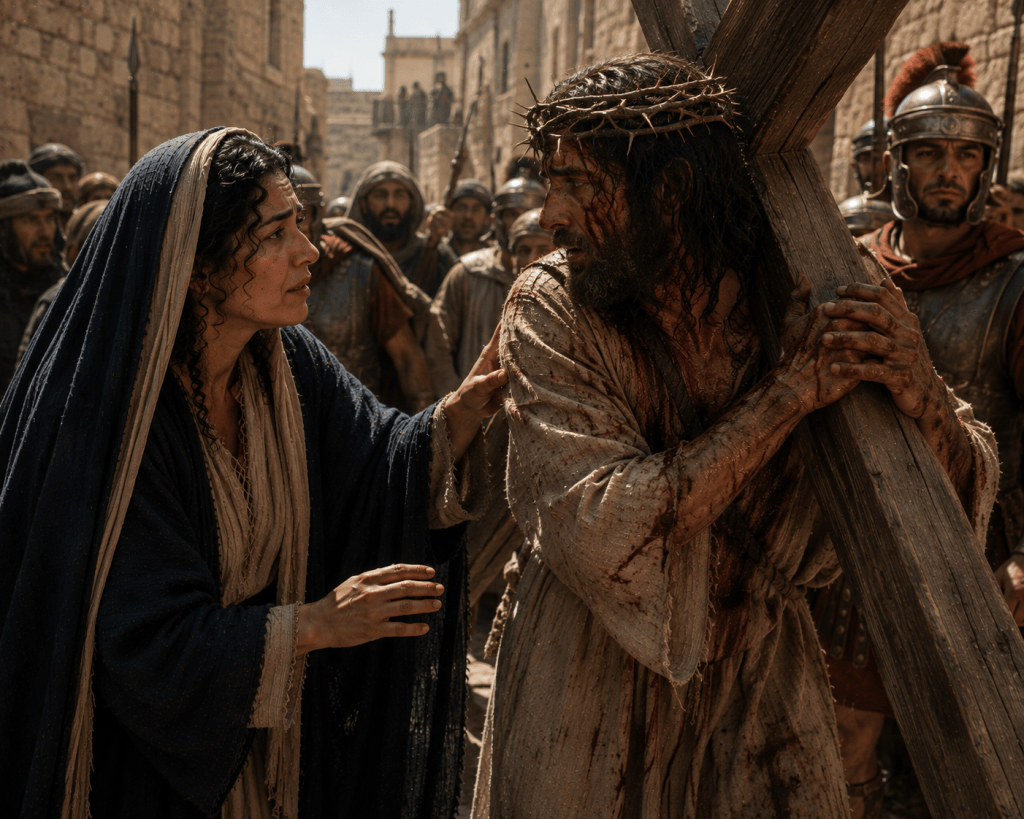
Perhaps theology came later. Perhaps when Mary saw him beneath the Cross, there was no Messiah, no prophecy, no salvation history. Perhaps there was only the unbearable recognition: That is my child.
Maybe she heard the crowd before she saw him.
Jerusalem was already awake.
Passover.
Pilgrims.
Soldiers.
Shouting.
Movement.
The city had no reason to become quiet simply because Mary’s world was ending.
That might have felt obscene.
Perhaps she had spent the night moving from place to place.
Waiting.
Asking.
Following whatever scraps of information reached her.
They had arrested him.
They had questioned him.
They had taken him to Pilate.
There had been accusations.
A crowd.
A sentence.
Then someone said the word.
Crucifixion.
Maybe Mary stopped understanding language for a moment.
She knew the word.
Everyone did.
Rome had made sure of that.
Crucifixion was designed to be understood.
Public.
Slow.
Humiliating.
A warning written in flesh.
But knowing what crucifixion was and hearing that your son had been sentenced to it were entirely different forms of knowledge.
Perhaps someone was explaining.
Mary heard none of it.
Where is he?
That was all.
Where is Jesus?
Maybe John was with her.
Maybe Mary Magdalene.
Maybe some of the other women who would later stand near the Cross.
The Gospels give us their presence at Golgotha.
They do not give us a detailed itinerary of how they reached it.
So we have to leave the spaces open.
But somehow—
Mary got there.
Perhaps someone told her which road the condemned would take.
And she went.
Maybe she pushed through people.
For once, she did not care whether she was rude.
“Please.”
Someone moved.
“Please.”
Another didn’t.
Mary went around him.
Then the crowd surged.
A shout.
Roman soldiers.
Mary looked.
And saw the Cross first.
Not Jesus.
The wood.
A heavy beam moving unevenly above shoulders and heads.
Then a man beneath it.
No.
Maybe her mind refused recognition.
That happens.
The eyes see.
The mind says:
No.
That isn’t him.
Too much blood.
Too swollen.
Too bent beneath the weight.
Too unlike the face she had spent thirty-three years knowing.
Then he moved.
Something familiar.
Perhaps the way he turned his head.
The shape of his shoulders beneath everything done to them.
The line of his face.
Jesus.
And perhaps every theological thought Mary had ever possessed simply disappeared.
No Gabriel.
No Messiah.
No throne of David.
No Son of the Most High.
No Simeon.
No Cana.
No Kingdom.
No Scripture.
No prophecy.
My child.
Maybe that was all.
There is a tendency, when imagining Mary at the Passion, to make her understand too much.
We place centuries of Christian theology inside her mind.
Redemption.
Atonement.
Paschal sacrifice.
The Lamb of God.
The fulfillment of Scripture.
The salvation of humanity.
Perhaps some of those meanings would eventually become part of how Mary understood what happened.
But on that road?
While looking at the body she had made room for inside her own?
I don’t know.
I think perhaps theology became very small.
Because Mary had a body too.
And bodies remember.
She saw blood on his forehead.
Her body remembered touching that forehead when it was hot with childhood fever.
She saw his hands.
Maybe bound.
Maybe scraped.
Eventually pierced.
But not yet.
Those hands.
Her body remembered them impossibly small.
Fingers curled around hers.
She saw his feet stumbling beneath him.
Her mind might have produced an image she had not summoned in decades:
Jesus learning to walk.
One step.
Another.
Fall.
Mary reaching.
Maybe she physically moved toward him.
Instinct.
Her hands came up.
Someone stopped her.
“No.”
Perhaps she said it.
Not to the soldier.
Not to anyone.
Just:
No.
Jesus stumbled.
Mary’s entire body went forward.
There are reflexes motherhood creates before language.
Catch.
Hold.
Protect.
She had caught him hundreds of times when he was little.
A toddler losing balance.
A child tripping while running.
A boy misjudging a step.
Now Jesus fell beneath Roman wood.
And Mary could not catch him.
Maybe that was the first unbearable thing.
Not the Cross itself.
Her hands had finally encountered a problem they could not solve.
She could not pick him up.
Someone else did.
Or soldiers forced movement.
The procession continued.
Mary stood frozen.
Then followed.
Perhaps people around her were shouting.
Some grieving.
Some jeering.
Some simply watching because executions attract spectators.
Maybe people had come because they had heard about Jesus.
Maybe some had shouted Hosanna only days before.
Maybe some had no idea who he was.
Mary hated all of them for looking.
For one second.
Maybe.
Stop looking at him.
What an impossible desire.
Crucifixion was intentionally public.
Humiliation was part of the punishment.
Jesus’ suffering belonged to everyone’s eyes now.
Mary wanted privacy for him.
A blanket.
A room.
A door.
Something.
Instead—
Jerusalem.
Perhaps someone beside her was crying loudly.
Mary wasn’t.
Not yet.
Sometimes grief becomes too large for tears.
The body goes quiet.
She followed.
And perhaps this is where memory became cruel.
Because every few steps something about the man in front of her belonged to another Jesus.
His hair.
She had washed it when he was little.
His shoulders.
Joseph had once placed a hand there while teaching him something at the workbench.
His voice.
She had heard it change from child to adolescent to man.
His back.
Maybe she remembered him asleep.
Safe.
His blood.
No.
Maybe Mary looked away.
Then immediately looked back.
Because looking hurt.
But not looking felt like abandoning him.
That might have been the choice of the whole road.
Look.
Don’t look.
Look.
She looked.
Perhaps someone said:
“Mary, you don’t have to see this.”
Yes.
She did.
Not because suffering is holy to witness.
Not because she needed to prove strength.
Because he was her son.
If Jesus had to walk this road—
she would not make him walk it without someone who loved him looking back.
Maybe that was all she could give him now.
Presence.
No rescue.
No protection.
No solution.
No miracle she could request at Cana.
Just:
I am here.
Perhaps that was when Jesus saw her.
Tradition has long imagined an encounter between Jesus and Mary on the road to Calvary, especially in the Fourth Station of the Cross:
Jesus meets his afflicted mother.
The canonical Gospels do not narrate such a meeting.
We should say that plainly.
But John does place Mary at the Crucifixion.
So whether their eyes met on the road, whether she reached him, whether there was any private exchange—
we do not know.
But imagine that they did.
Jesus looked up.
Saw her.
Maybe he stopped.
Or perhaps he couldn’t.
The procession was moving.
Soldiers would not have cared that his mother was there.
Mary pushed close enough.
“Jesus.”
His name.
That name again.
Not Rabbi.
Not Lord.
Not Son of David.
Jesus.
The name she had whispered beside a cradle.
Called from another room.
Said in irritation.
Laughed across a table.
Cried through Jerusalem when he was twelve.
Spoken softly after Joseph died.
Called after him when he left Nazareth.
Jesus.
Maybe he looked directly at her.
And Mary saw his face.
Really saw it.
Perhaps her mouth opened.
Nothing came out.
Because what could she possibly say?
Are you all right?
Absurd.
Be careful.
Too late.
Come home.
Oh.
Maybe that was the sentence that almost escaped.
Come home.
For years, Jesus had left and returned.
Mary had learned the rhythm.
Release.
Return.
He would disappear down a road.
Eventually—
footsteps.
A figure approaching.
Jesus came home.
Perhaps some irrational part of Mary still wanted to believe this was another departure.
That somehow this road would bend.
This crowd would disappear.
These soldiers would release him.
Jesus would appear at her doorway again.
Tired.
Hungry.
Alive.
She would feed him.
He would sleep.
Morning would come.
Come home.
Maybe she couldn’t say it.
Because his eyes told her something she didn’t want to know.
There would be no coming home from this road.
Perhaps that was when Mary began to cry.
Not beautifully.
No single tear sliding gracefully down a serene face.
Maybe her face folded.
Maybe she made a sound she had never made before.
Maybe she covered her mouth because she could not stop it.
Jesus saw.
And perhaps that hurt him.
That’s another thing we rarely allow.
Mary’s presence could have comforted Jesus.
It could also have wounded him.
Because he loved her.
He was not watching an icon suffer.
He was watching his mother watch him die.
Maybe for one second Jesus looked like he wanted to go to her.
The old instinct reversed.
Mary had always moved toward his pain.
Now perhaps Jesus wanted to move toward hers.
Neither could.
The soldiers pushed him forward.
Mary’s hand reached.
Maybe their fingers almost touched.
Maybe they did.
Tradition can imagine.
Scripture remains silent.
Then he was moving again.
Mary followed.
Was there room for theology?
Maybe theology came in fragments.
Not systematic thought.
Memory.
Gabriel.
He will be great.
Mary looked at him beneath the Cross.
Great?
The Lord God will give him the throne of his father David.
A condemned man.
He will reign over the house of Jacob forever.
Rome was marching him toward execution.
Perhaps the promises did not comfort her.
Perhaps they made no sense.
That matters.
Faith does not always make suffering intelligible while it is happening.
Mary had lived with unanswered words before.
At twelve, she had not understood Jesus.
She kept those things in her heart.
Pondered.
Waited.
But this?
How do you ponder while your child is bleeding?
Maybe she couldn’t.
Maybe the great contemplative work of Mary stopped.
For one day.
No pondering.
No understanding.
No assembling meaning.
Only:
Left foot.
Right foot.
Follow him.
Don’t lose him in the crowd.
Maybe that’s what grief reduced the world to.
Stay close.
Jesus disappeared behind people.
Mary panicked.
Moved.
There.
Stay close.
He stumbled.
Mary stopped breathing.
He rose.
Breathe.
Stay close.
Perhaps Simon of Cyrene was forced to carry the Cross.
The Synoptic Gospels tell us that happened.
Maybe Mary saw another man take the weight.
For one irrational second, perhaps she loved Simon.
Not because she knew him.
Because the wood was no longer crushing her son’s shoulders quite so completely.
Thank you.
Maybe she never said it.
Perhaps Simon looked at her.
Maybe he knew immediately who she was.
There are faces that require no introduction.
He carried the Cross.
Jesus walked.
Mary followed.
And maybe with the wood lifted from him, she could see Jesus more clearly.
That was worse.
His body.
What had they done to him?
Maybe Mary knew some of it now.
Scourging.
Beating.
Mockery.
The crown.
Perhaps someone had told her.
Perhaps she saw the evidence and didn’t need explanation.
This was the body she had once counted fingers and toes on.
That thought may sound sentimental until you remember what birth does to a mother.
Mary had known Jesus first as a body.
Before theology.
Before language.
Before he could say her name.
Weight.
Warmth.
Breath.
Skin.
Milk.
Sleep.
Christian theology will proclaim the Incarnation:
The Word became flesh.
Mary knew the flesh.
And now Rome was destroying it in front of her.
How could theology compete with that?
Perhaps it didn’t.
Perhaps theology was not something Mary thought about on the road.
Perhaps theology was what she did.
She stayed.
Maybe that was her theology.
Not understanding.
Presence.
Not:
I know why God is allowing this.
But:
I will not leave you.
There is faith in that too.
Perhaps a harder faith.
Because Mary could have fled.
Maybe someone encouraged her.
“You don’t need to go farther.”
She went farther.
“Mary, you know what happens there.”
She knew.
She went anyway.
Each step toward Golgotha meant consenting to see something no mother should see.
Not consenting to his death.
Not wanting it.
Not approving it.
Simply refusing to let fear decide that Jesus must face it without her.
Maybe she hated God on that road.
Would that frighten us?
Perhaps it shouldn’t.
The Psalms themselves contain accusation, bewilderment, abandonment, rage.
Faith has always had vocabulary for:
Where are You?
Maybe Mary prayed:
You said—
And couldn’t finish.
You said.
Gabriel.
Elizabeth.
Simeon.
All those promises.
You said.
Look at him.
Perhaps that was her prayer.
Look at him.
As though God might somehow have missed what was happening.
Look at my son.
And perhaps immediately another thought:
Your Son.
No.
Not today.
Mine.
Maybe that is too possessive for theology.
Perfect.
Let her have it.
For thirty-three years Mary had learned to release Jesus.
To Joseph’s fatherhood.
To adulthood.
To disciples.
To crowds.
To strangers.
To the sick.
To the poor.
To the work.
To God.
Again and again.
But on the road to Calvary, perhaps every part of her screamed:
No more.
You have had him.
All of you.
The crowds.
The disciples.
The people who needed healing.
The people who needed teaching.
The people who needed signs.
The people who needed salvation.
Give him back.
Give me my son.
Not Messiah.
Not Savior.
Not Lamb.
The man who sat at my table.
The boy Joseph taught to work wood.
The child who laughed when something ridiculous happened.
The toddler who became impossible when he was tired.
The baby whose fever terrified me.
Give him back.
Maybe Mary would have traded every miracle for one ordinary morning.
No crowds.
No Cana.
No healings.
No acclaim.
No disciples.
No ministry.
Jesus at the table.
Bread.
Sunlight.
A cup.
“Morning, Mama.”
That’s all.
Would that have been selfish?
Yes.
Human beings are allowed to become selfish when someone they love is being taken to die.
Maybe Mary knew intellectually that Jesus had chosen this road.
That didn’t mean she had to like it.
Maybe she was angry with him.
Why didn’t you leave?
Why didn’t you stop?
Why did you keep provoking them?
Why Jerusalem?
Why now?
Why didn’t you listen when I told you to be careful?
All the questions fear had been collecting for years.
Perhaps they arrived together.
And beneath every one:
Why didn’t you let me save you?
Because that had been Mary’s first job.
Protect the baby.
Herod comes?
Run.
Danger?
Take him somewhere safe.
Feed him.
Warm him.
Hold him.
God had entrusted Jesus to her care.
Hadn’t He?
So what was she supposed to do with a moment when protecting him was no longer possible?
Maybe Mary felt that she had failed.
Not rationally.
Grief is not rational.
A mother can know her adult child’s choices are not hers to control and still have some primitive part of herself whisper:
You were supposed to keep him safe.
Perhaps she carried that accusation alongside him.
Until Jesus looked at her.
Maybe his face said:
No.
Not your failure.
Again, we cannot know.
But perhaps after thirty-three years they could say things without language.
Mary had seen him across crowded rooms.
Across marketplaces.
Across gatherings.
Across years.
She knew his face.
Maybe she understood:
He is not asking me to save him.
What an unbearable realization.
What is he asking?
Nothing.
Perhaps.
Just stay.
So Mary stayed.
The road climbed.
The crowd continued.
The city began falling behind.
The place of execution drew closer.
Maybe Mary stopped trying to understand.
One step.
Another.
She watched Jesus.
Not Christology.
Not prophecy.
Not doctrine.
Jesus.
Her Jesus.
The son whose name strangers had once begun discussing in markets.
The man who had become increasingly unavailable because everyone needed him.
The son she had watched leave home.
The son she had waited to see return.
The man whose danger she had gradually learned to fear.
The prisoner someone had come to tell her about in the night.
Now there was no messenger.
No rumor.
No:
I heard.
No:
Someone said.
Mary could see.
And perhaps that was worse than every fear that came before it.
She had spent years imagining what might happen.
Reality was more brutal.
It usually is.
Maybe Jesus stumbled again.
Mary moved.
A soldier shouted.
Someone held her back.
“Jesus!”
He looked.
And perhaps for a fraction of a second—
there was no crowd.
No Rome.
No Cross.
No salvation history.
Just a mother and her son.
She wanted to reach him.
He wanted to reach her.
Neither could.
Maybe Mary placed her hand against her own chest.
The same body that had once contained his.
Her heart was beating violently.
His was too.
Still.
Alive.
For now.
That became enough.
One more step.
He’s alive.
Another.
Alive.
Another.
Alive.
Perhaps Mary counted without realizing she was counting.
Not steps.
Breaths.
Moments.
Because soon people would take even those.
But not yet.
So was there room for theology on the road to Calvary?
Maybe.
Mary had carried Scripture all her life.
She had carried Gabriel’s words for thirty-three years.
She had pondered mysteries longer than any disciple following behind Jesus.
Those things did not cease to exist because she was terrified.
But I don’t think theology necessarily stood between Mary and pain.
Perhaps faith did not explain the road.
Perhaps it simply kept her walking it.
There is a difference.
Later, Christians would call this redemption.
Salvation.
The Paschal Mystery.
The sacrifice of Christ.
The victory hidden inside apparent defeat.
All true within Christian faith.
But Mary did not have Easter yet.
That matters.
We look backward from an empty tomb.
Mary walked forward toward a Cross.
She did not know what Sunday morning felt like.
She only knew what Friday felt like.
And Friday looked like her child bleeding in a street.
So perhaps there was no triumphant understanding.
No serene recognition that everything was unfolding exactly according to divine plan.
Maybe there was only enough faith for the next step.
Stay with him.
Then another.
Stay.
Maybe that is more beautiful than imagining Mary understood everything.
She didn’t need to understand the Cross in order to refuse to leave the person carrying it.
Eventually the road ended.
Golgotha.
Mary looked up.
Saw where they had brought him.
Saw what waited there.
Perhaps her body finally understood before her mind allowed the words.
Crosses.
Tools.
Soldiers.
No.
Someone beside her reached for her.
Mary’s hand found theirs.
Held hard.
Jesus was taken forward.
Mary followed.
Because whatever else he was—
whatever God intended—
whatever salvation might somehow come from this—
whatever theologians would spend millennia saying about the man walking toward that hill—
Mary had one truth that required no interpretation.
That is my child.
And if the whole world insisted upon taking him from her—
then the whole world would have to do it while she stood there.
Watching.
Loving him.
Refusing to look away.


