The Invitations of Mary Series
©MS 2026
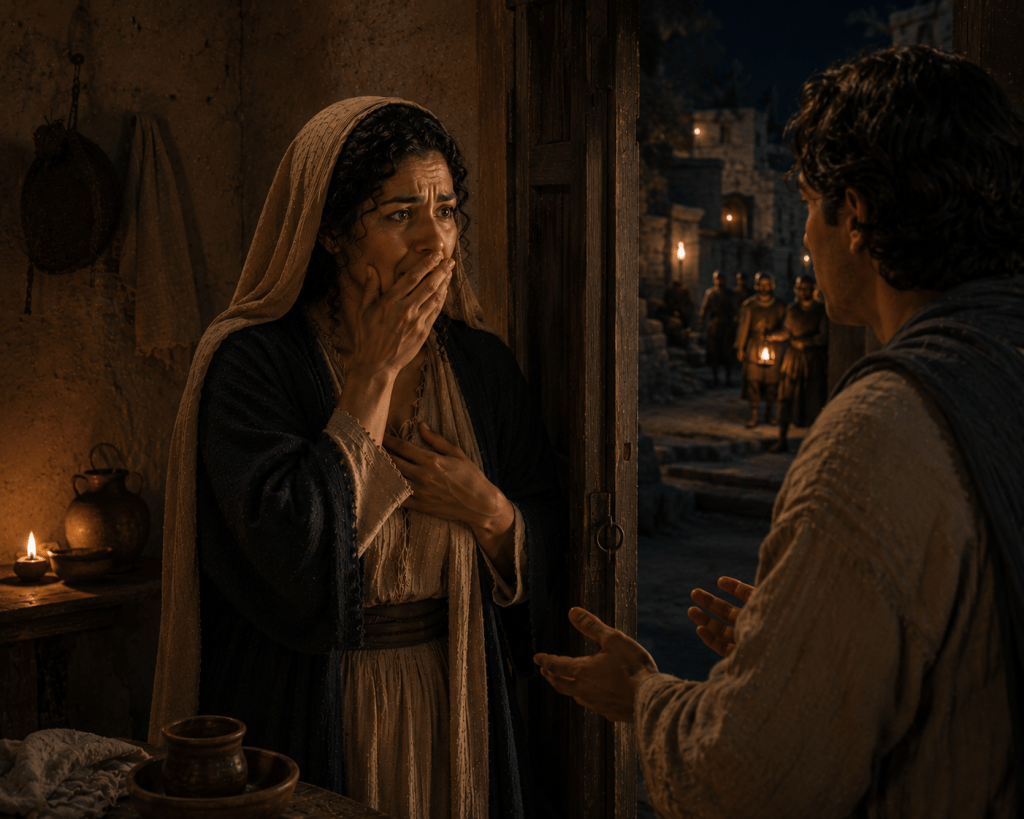
Perhaps the news came in the middle of the night. Perhaps someone reached her door out of breath and said the sentence she had spent years teaching herself not to imagine.
Maybe Mary was asleep.
That seems cruel.
Which means it was probably possible.
Jerusalem was swollen with pilgrims for Passover. The city and its surrounding villages were crowded, noisy, restless. Jesus had entered Jerusalem publicly. There had been confrontation in the Temple. Arguments. Questions designed to trap him. Tension had been gathering around him for days.
Mary may already have been there.
John will place her at the Cross.
So sometime between Galilee and Calvary, Mary had come to Jerusalem.
But the Gospels do not tell us where she stayed.
They do not tell us whether she saw Jesus during those final days.
They do not tell us whether she knew about the Last Supper.
And they do not tell us the moment she learned:
Jesus had been arrested.
That silence leaves us standing at a terrible doorway.
Because someone must have told her.
Or Mary saw enough commotion to discover it herself.
And once she knew—
everything changed.
Maybe she had gone to bed uneasy.
Not terrified.
Not yet.
But that old thread of fear was pulled tight again.
Jerusalem always made it worse now.
Too many people.
Too many authorities.
Too many people who knew Jesus’ name.
Too many people deciding what should be done about him.
Perhaps Mary had seen him earlier.
Maybe only briefly.
Jesus surrounded by disciples.
People everywhere.
He looked tired.
She noticed.
Of course she did.
“Are you all right?”
“Yes.”
Mary studied him.
He smiled.
She did not believe him completely.
Maybe she touched his face.
Or his arm.
Something small.
Then someone called for him.
Of course.
Always someone.
“Go,” Mary said.
Perhaps Jesus hesitated.
Then went.
Maybe those were the last ordinary words she said to him.
We don’t know.
That is the horror of last ordinary words.
Nobody marks them when they happen.
That night, perhaps Mary slept badly.
Then—
a knock.
Not the polite knock of someone visiting.
Hard.
Urgent.
Again.
Mary woke.
For half a second, she didn’t know where she was.
Then another knock.
Someone saying her name.
“Mary.”
Her body knew before she did.
That is one of the strange things about fear.
Sometimes the body receives the message first.
Heart.
Stomach.
Skin.
Breath.
The mind comes afterward.
Mary sat up.
Someone was already moving toward the door.
Perhaps another woman was staying with her.
Perhaps relatives.
Pilgrims often lodged within networks of family and acquaintances during festivals.
Maybe Mary heard footsteps.
The door opened.
Low voices.
Then silence.
That silence.
Mary stood.
“Who is it?”
Nobody answered quickly enough.
She stepped into the room.
Maybe it was John.
That possibility feels especially poignant.
We cannot know.
John’s Gospel eventually places the beloved disciple beside Mary at the Cross, and Jesus entrusts them to one another there. Whether John was the person who brought Mary news of the arrest is completely unrecorded.
But someone close to Jesus would make sense.
A disciple.
A follower.
Someone who knew where Mary was.
Someone who understood:
His mother has to be told.
Maybe John stood in the doorway.
Young.
Pale.
Breathing hard.
Mary looked behind him.
No Jesus.
“Where is he?”
John opened his mouth.
Nothing.
Mary’s heart began pounding.
“Where is Jesus?”
“They took him.”
Maybe that was all she heard at first.
Not arrested.
Not Gethsemane.
Not guards.
Not priests.
Just:
They took him.
The room changed.
Perhaps Mary’s hearing went strange.
People describe terrible news that way.
Sound becomes distant.
The edges of vision narrow.
Hands go cold.
The body floods with stress before the mind can assemble a coherent thought.
Mary stared at John.
“What?”
“They arrested him.”
No.
Maybe Mary didn’t say it.
Her body did.
A step backward.
A hand against the wall.
Breath gone.
No.
This was the sentence she had been waiting for without admitting she was waiting for it.
For years:
Be careful.
Send word.
Where is he?
Is he safe?
What happened?
Did you see it yourself?
When is he coming back?
Again and again, the answer had ultimately been:
He’s all right.
Not tonight.
“Where?”
“Gethsemane.”
“Is he hurt?”
“I don’t know.”
Wrong answer.
“Was he hurt?”
“I don’t know.”
“Who took him?”
“The Temple guard. There were others.”
“Where did they take him?”
Maybe John knew.
Maybe he didn’t.
The Gospel accounts describe Jesus being taken first into proceedings involving the high priestly authorities. John’s Gospel mentions Annas and then Caiaphas. Later he will be brought before Pilate.
But in the darkness and confusion immediately following the arrest, Mary may have known almost none of that.
Imagine that helplessness.
Your son has been taken.
By whom?
Several answers.
Where?
Not sure.
Why?
You know why.
What are they going to do?
Nobody knows.
Can you see him?
No.
Is he injured?
I don’t know.
Maybe Mary became very calm.
That happens too.
Not everyone collapses when terror arrives.
Sometimes the mind does something merciful.
It becomes practical.
“Where was Peter?”
“I don’t know.”
“Who was with Jesus?”
“We scattered.”
Mary looked at John.
Scattered.
Maybe he couldn’t meet her eyes.
There would be time for that later.
Not now.
“Take me to him.”
Maybe someone said:
“Mary—”
“Take me to him.”
“He’s been taken to—”
“Then take me there.”
She reached for her mantle.
Her hands wouldn’t cooperate.
That might have been the first physical betrayal.
A clasp she had fastened thousands of times.
Simple.
Her fingers missed it.
Again.
Mary stared at her hands.
They were shaking.
No.
Not now.
She tried again.
Couldn’t.
Someone stepped forward.
“I’ll do it.”
Mary almost snapped at them.
Then stopped.
Let them.
Her body was no longer interested in dignity.
Heart hammering.
Mouth dry.
Stomach turning.
A strange coldness despite the crowded room.
Perhaps her legs felt weak.
Perhaps she needed to urinate suddenly.
Perhaps she felt nauseated.
Perhaps every muscle seemed simultaneously ready to run and incapable of movement.
These are not failures of courage.
They are what a human nervous system can do when it receives the message:
Someone you love is in immediate danger.
Mary had a human body.
Let her have one.
Maybe she vomited.
We never imagine Mary vomiting.
Why not?
A woman receives news in the middle of the night that armed men have seized her son, whom authorities have been threatening.
Perhaps her stomach emptied.
Perhaps she leaned against a wall afterward, humiliated and shaking.
Someone brought water.
She waved it away.
“We have to go.”
Maybe another woman said:
“Sit for a moment.”
“No.”
“Mary—”
“No.”
Because sitting did nothing.
Jesus was somewhere else.
Perhaps she started walking before anyone was ready.
Jerusalem at night.
Passover.
Torches.
Pilgrims.
People still awake.
Doors closed.
Voices from courtyards.
Dogs perhaps barking somewhere.
And Mary moving quickly through streets she did not know as intimately as Nazareth.
“Which way?”
Someone pointed.
Mary walked faster.
Maybe she asked questions as they went.
“What happened?”
The story came in pieces.
Jesus had gone to pray.
The disciples were with him.
Judas arrived.
Mary stopped.
“Judas?”
There are names that become different forever after one sentence.
“Yes.”
Maybe Mary knew Judas.
Of course she likely had encountered him if she had spent time around Jesus and the disciples.
Perhaps he had eaten near her.
Spoken to her.
Accepted food from her.
Maybe she had laughed at something he said.
“Judas brought them?”
“Yes.”
Mary resumed walking.
She could process betrayal later.
“Then what?”
They seized Jesus.
There had been a sword.
Someone was injured.
Jesus stopped it.
Of course he did.
“Was Jesus injured?”
“I don’t know.”
Again.
Mary walked faster.
Maybe this was the first time she heard Peter had fled.
Not tonight.
She could feel whatever she felt about that later too.
Right now:
Where is my son?
Perhaps they reached a place where they could see activity.
Torches.
Men.
A courtyard.
Maybe someone stopped Mary.
“You can’t go in.”
Imagine saying that to her.
“My son is in there.”
“You can’t go in.”
For thirty years, Mary had been able to reach Jesus.
Then crowds came between them.
She learned to wait.
People needed him.
She learned to step aside.
Authorities became angry.
She learned to watch from a distance.
Now someone physically barred the way.
“My son is in there.”
Maybe her voice cracked.
First time.
The guard did not care.
Or perhaps he did care.
It changed nothing.
She couldn’t reach him.
That might have been when the panic finally broke through the practical calm.
Not when she heard the news.
Not while dressing.
Not while walking.
Here.
At the moment Mary realized:
I cannot get to him.
She looked past whoever blocked her.
Could she see anything?
A torch.
Movement.
Voices.
Maybe nothing.
“Jesus!”
Perhaps she called.
No answer.
Again:
“Jesus!”
Someone touched her arm.
Mary pulled away.
No.
This was not the twelve-year-old in Jerusalem.
That memory may have come anyway.
Three days.
She and Joseph searching.
Fear.
Then the Temple.
There he was.
Safe.
Annoyingly calm.
Mary had once found him in Jerusalem.
Joseph had been beside her then.
Oh.
Maybe that realization struck without warning.
Joseph.
She wanted him.
Not sentimentally.
Physically.
Immediately.
Joseph would know what to do.
Joseph would ask the right questions.
Joseph would stand beside her.
Joseph would keep his voice steady when hers couldn’t.
Joseph would find someone who knew someone.
Joseph would—
Joseph was dead.
And Mary was standing outside whatever place held their son.
Alone in the particular way only a widow can be alone.
Maybe she whispered:
“Joseph.”
Just once.
Then someone finally came with information.
Jesus had been questioned.
There were accusations.
Witnesses.
Arguments.
“What are they charging him with?”
The answer was complicated.
Religious accusation.
Political danger.
Claims about kingship.
Blasphemy.
Temple.
Messiah.
Mary did not need the legal theory.
“What are they going to do to him?”
Silence.
There it was again.
“What are they going to do?”
“We don’t know.”
But maybe someone did know.
Or suspected.
Mary saw it on a face.
“What?”
Nobody answered.
“What?”
“Mary…”
Her body went cold again.
Maybe she understood before they said the word.
Rome.
Crucifixion was not an abstract concept to people living under Roman rule.
Mary knew what crucifixion was.
People saw crosses.
They knew what Rome did to people classified as threats.
There was nothing symbolic about it yet.
A cross was not jewelry.
Not architecture.
Not a devotional object.
It was an execution.
Perhaps Mary’s mind refused the thought.
No.
They arrested him.
That did not mean execution.
There would be questioning.
He could be released.
Pilate could refuse.
Someone could intervene.
It was Passover.
Maybe authorities would not—
Her mind began building exits.
That is what frightened minds do.
Possible doors.
Possible reasons.
Possible people.
Possible delays.
Anything except the one conclusion waiting at the end.
Maybe she prayed.
Not elegantly.
Please.
That might have been all.
Please.
Thirty years earlier, an angel had told her:
Do not be afraid.
How impossible those words must sometimes have seemed.
Do not be afraid.
She had been afraid when Joseph learned she was pregnant.
Afraid giving birth far from home.
Afraid fleeing Herod.
Afraid when twelve-year-old Jesus disappeared.
Afraid when Joseph became sick.
Afraid when Jesus left Nazareth.
Afraid when people began threatening him.
And now?
Now fear had arrived with a body.
Guards.
Torches.
Closed doors.
Officials.
Maybe Mary thought of Simeon.
Not immediately.
I hope not immediately.
But perhaps eventually.
The old man in the Temple.
Jesus an infant in her arms.
Simeon blessing them.
Then turning toward her.
“And a sword will pierce your own soul.”
For decades, what could that possibly mean?
Perhaps Mary had wondered.
Then stopped wondering.
Then remembered.
Then forgotten again.
Tonight—
maybe the words returned.
No.
Not prophecy.
Not now.
That’s my son.
Perhaps Mary refused to turn suffering into meaning before it happened.
I like that version of her.
She did not stand outside in Jerusalem thinking:
Ah. The prophecy is being fulfilled.
She thought:
Get him out.
There would be time for theology later.
If there was a later.
Maybe dawn began appearing.
That gray-blue light before sunrise.
The longest night of Mary’s life ending without actually ending.
Because Jesus was still in custody.
She had not slept.
Had barely eaten.
Perhaps someone finally forced water into her hand.
She drank because her body needed something.
Her hands still trembled.
Then new information.
They’re taking him to Pilate.
Mary stood.
Immediately.
“Where?”
Again she moved.
Maybe by now people recognized her.
His mother.
Whispers.
Looks.
Some sympathetic.
Some curious.
Some hostile.
Mary ignored them.
Perhaps John stayed beside her.
Maybe Mary Magdalene was there.
The Gospels will eventually place several women near the Cross. At some point, the people who loved Jesus found one another.
I imagine that mattered.
Someone took Mary’s hand.
Perhaps she didn’t notice who.
She held on anyway.
And then—
maybe she saw him.
Not clearly.
Not close.
Across a courtyard.
Between people.
Guards around him.
Jesus.
Alive.
Mary’s body reacted before anything else.
Breath.
A sob she swallowed.
Her knees nearly giving.
Alive.
For one fraction of a second, relief.
The oldest maternal relief.
There you are.
Then she saw his face.
And relief disappeared.
Maybe he had already been struck.
Maybe there was blood.
Maybe his hands were bound.
Maybe he simply looked exhausted.
The exact chronology of what Mary personally witnessed is unknowable.
But eventually she would see what had been done to him.
Perhaps Jesus looked up.
Across the courtyard.
Found her.
Just as he had found her across crowds before.
Mary stopped moving.
For years, that look had meant:
I’m fine.
Go ahead.
I’ll come back.
Don’t worry.
Not this time.
Maybe Jesus tried to give her the same small reassuring expression.
Habit.
Love.
Mary’s face broke.
Because he could not reassure her anymore.
Not with this.
Perhaps she wanted to run to him.
Every instinct in her body screamed:
Go.
But guards were between them.
Authority.
Crowds.
The machinery had begun moving.
Mary could do nothing.
That may have been the true physical horror of the arrest.
Not simply fear that Jesus would be hurt.
Mary had spent his childhood acting whenever danger came.
Fever?
Cool him.
Hungry?
Feed him.
Missing?
Search.
Herod?
Run.
Injured?
Clean the wound.
Threatened?
Warn him.
Motherhood had trained Mary’s body for action.
Now her son was in danger—
and there was nothing her hands could do.
Perhaps she looked down at them.
Those hands.
Hands that had caught him when he stumbled.
Washed him.
Fed him.
Mended his clothing.
Held his fevered face.
Touched Joseph’s body after death.
Prepared thousands of meals.
Worked.
Prayed.
Reached.
Useless now.
Maybe she closed them into fists.
Not because Mary lacked faith.
Because she was furious.
At Judas.
At the men who arrested him.
At authorities.
At crowds.
Perhaps at Jesus.
Yes.
Maybe even Jesus.
You knew.
He had known.
He kept going.
She had asked him to be careful.
He had smiled.
And here they were.
Maybe anger kept Mary standing.
Sometimes it does.
Fear weakens the knees.
Anger locks them.
So she stood.
And perhaps that is how Friday began for Mary.
Not as the serene sorrowful mother of later art.
Not yet.
A woman who had been awakened in the night.
A woman who had not eaten.
A woman whose hands shook.
A woman trying to understand where her son had been taken.
A woman hearing legal and religious words when all she wanted to know was:
Are they going to kill him?
A woman looking for exits.
Someone who could intervene.
Something that could stop this.
And underneath every thought:
No.
No.
No.
No.
Until eventually—
perhaps there were no exits left.
But we’re not there yet.
This question ends earlier.
At the arrest.
At the moment fear stopped being hypothetical.
For years Mary had known people might hurt Jesus.
Tonight someone came to her door and told her:
They have him.
Maybe it was John.
Maybe another disciple.
Maybe one of the women.
Maybe Mary heard from frightened followers arriving from Gethsemane.
Scripture does not preserve the messenger.
So we should not pretend to know their name.
But someone carried that sentence to her.
And perhaps for the rest of Mary’s life she remembered everything about that person in that moment.
Their face.
Their breathing.
Where they stood.
The light in the room.
The exact sound before they spoke.
Because human memory does that with catastrophe.
It preserves useless things.
The cup on the table.
A lamp burning too low.
Someone’s sandal scraping stone.
The chill of the floor.
Then:
“Mary.”
And afterward there was the world before that sentence—
and the world after it.
Maybe years later Mary could still remember her first thought.
Not Messiah.
Not prophecy.
Not salvation.
Not Scripture.
Just the same instinct that had lived inside her since Bethlehem.
The instinct that once woke because an infant made the smallest sound beside her.
The instinct that checked a fever.
Counted breaths.
Searched Jerusalem.
Watched roads.
Listened to rumors.
Waited at doorways.
Where is my child?
Jesus was a grown man.
A teacher.
A healer.
A rabbi.
The one crowds followed.
The one people called Lord.
Mary knew all of that.
But somewhere in Jerusalem, armed men had taken him.
And inside Mary’s body—
for one terrible instant—
thirty-three years disappeared.
He was her little boy again.
And someone had him.


