The Invitations of Mary Series
©MS 2026
For nearly thirty years, much of Mary’s time had been organized around other people. Then one morning, there was nobody in the house who needed her.
Maybe the strangest thing was the time.
There was suddenly so much of it.
Not leisure, exactly.
Life in first-century Nazareth did not suddenly become a retirement holiday because Mary’s adult son left home. There was still water to obtain, food to prepare, grain to grind, clothing to wash and mend, floors to sweep, purchases to make, prayer, Sabbath, community obligations, family, neighbors.
Mary still had a body that needed feeding.
A house that needed tending.
A life that required work.
But the shape of the work had changed.
For almost her entire adult life, someone else’s needs had determined part of the rhythm of Mary’s day.
First Joseph.
Then Jesus.
Usually both.
Someone would be hungry.
Someone needed clean clothing.
Someone was coming home.
Someone was leaving early.
Someone needed something carried, found, repaired, remembered, prepared.
Even when Jesus became a grown man who could obviously feed and dress himself, another person living in a house creates gravity.
You think about them.
Is he eating here?
Will he be home tonight?
Should I save some?
Did he take that thing he said he needed?
Could he please move whatever he left directly in the middle of the floor?
Then Jesus left.
And Mary woke up to discover something almost unsettling:
Her time belonged to her.
Maybe she hated it at first.
Not all of it.
There may have been one morning when Mary realized she could sit for a few extra minutes.
Nobody was waiting for breakfast.
No workday needed coordinating.
Nothing urgent.
So she sat.
And sat.
And after perhaps five minutes thought:
This is terrible.
Because rest only feels restful when you have learned how to receive it.
Otherwise it can feel suspiciously like forgetting something.
Maybe Mary kept getting up.
Checking things.
Nothing.
Sitting again.
Getting up.
Surely there was something she should be doing.
The house was already reasonably clean.
Food was prepared.
The water was sufficient.
The mending could wait.
Nobody needed her.
That sentence might have hurt before it ever became freeing.
Nobody needs me.
Perhaps Mary thought that.
Then immediately corrected herself.
People needed her.
Of course they did.
But nobody needed her in the particular relentless way a child does.
There is a difference between being loved and being depended upon.
Mary had spent nearly thirty years experiencing both at once.
Now she had to discover who she was when they separated.
Maybe for a little while she invented work.
That seems plausible.
The shelf suddenly needed reorganizing.
Something hadn’t been properly cleaned in approximately seventeen years and apparently today was the day.
A garment could certainly be mended even though the tear was barely visible.
Perhaps Jesus came home for a visit sometime later and discovered that Mary had rearranged half the house.
He looked around.
“Where is everything?”
“Where it belongs.”
“It belonged somewhere before.”
“Incorrectly.”
Jesus opened a cupboard.
Stopped.
“Mama.”
“What?”
“Where are the cups?”
Mary pointed.
Jesus looked.
“Why?”
“Because that is where they go now.”
“They have never gone there.”
“They do now.”
Jesus stared at her.
Mary continued working.
Widowhood and an empty nest had apparently produced a dangerous woman with opinions about shelving.
But eventually, Mary would have stopped trying to fill every hour.
And perhaps something else happened.
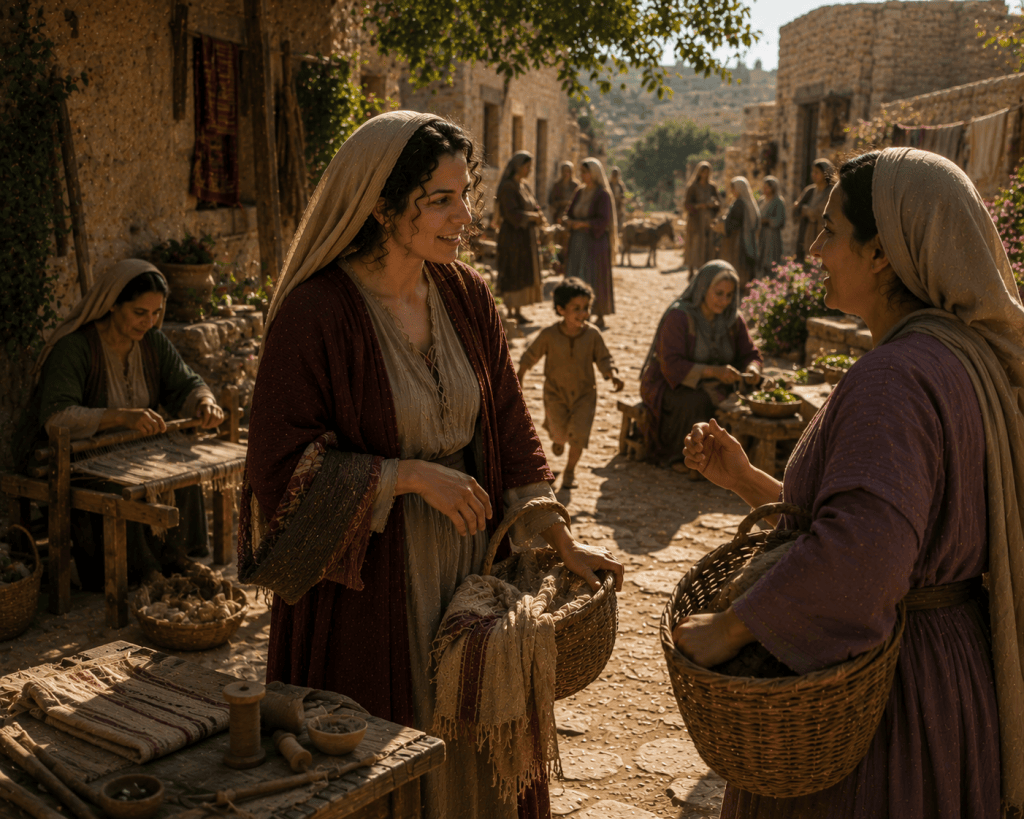
She started going out.
Not leaving Nazareth necessarily.
Just leaving the house.
Maybe Mary had always known everyone.
Nazareth was not a metropolis.
People knew families.
People knew who was sick.
Who had given birth.
Who had lost someone.
Who was struggling.
Who had a daughter about to marry.
Who had a roof that leaked.
Who had grain to spare.
Who needed help.
Mary had lived there for years.
She had relationships.
Perhaps now she had more time to participate in them.
Maybe someone had a baby.
Mary went.
Not because she was the Mother of God arriving with theological expertise.
Because she had raised a baby.
And babies are babies.
Someone handed Mary a screaming newborn.
“Please.”
Mary took the child.
Shifted the little body against her shoulder.
Rocked.
The baby quieted.
The exhausted mother stared.
“How did you do that?”
Mary smiled.
“Practice.”
Perhaps holding that newborn hurt unexpectedly.
The weight.
The warm little head against her.
That newborn smell.
The tiny hand closing around one finger.
For one second—
Bethlehem.
Not the angels.
Not shepherds.
Not prophecy.
Just Jesus.
Small enough to fit against her chest.
Mary swallowed.
Kept rocking.
Maybe the young mother asked:
“Does it ever get easier?”
Mary considered.
“No.”
The woman looked horrified.
Mary laughed.
“It changes.”
That was better.
Perhaps women began coming to Mary.
Not because she was famous.
Not yet.
Because she was older than some of them.
Experienced.
Widowed.
Had raised a son.
Had survived things.
That is enough to make someone useful.
A young wife might appear.
“Can I ask you something?”
Mary looked at her.
That tone.
Of course.
“Come in.”
Maybe it was marriage.
Her husband was irritating her.
Mary listened.
The woman expected holy advice.
Instead Mary said:
“Joseph used to do that.”
The woman blinked.
“Really?”
“Constantly.”
“What did you do?”
“Got annoyed.”
The woman laughed.
“No, after that.”
Mary thought.
“Usually told him.”
Perhaps Mary became good at removing unnecessary holiness from ordinary problems.
Not everything required a sign from God.
Sometimes your husband was simply being difficult.
Sometimes you were.
Apologize.
Eat something.
Try again tomorrow.
Maybe another woman came because she was frightened.
Pregnant for the first time.
Mary knew that fear.
Perhaps better than almost anyone.
Not because their circumstances were remotely the same.
But because Mary remembered being very young and carrying a child she did not entirely understand.
Maybe the woman asked:
“What if I’m terrible at this?”
Mary looked at her.
“You will be terrible at parts of it.”
Again, horrified.
Mary smiled.
“And you will learn.”
Maybe Mary was not the gentle dispenser of perfect reassurance we often make her.
Perhaps she had earned something better.
Perspective.
Babies survive imperfect mothers.
Marriages survive ordinary arguments.
Dinner burns.
Children become sick.
Parents panic.
People say the wrong thing.
People repair.
Love does not require flawless execution.
Mary knew.
Perhaps she helped with births.
We cannot know.
Women frequently supported other women around childbirth in ancient communities, and Mary certainly had personal experience.
Maybe she sat beside a laboring woman.
Held her hand.
Wiped her face.
Told her:
“Breathe.”
And when the woman said:
“I can’t do this,”
Mary answered:
“You are doing it.”
Maybe later, walking home beneath the evening sky, Mary remembered her own labor.
Joseph.
Jesus.
That first impossible night.
Thirty years.
How had thirty years happened?
Perhaps she visited widows.
I think she would.
Because now she knew.
Before Joseph died, Mary could sympathize with a widow.
After Joseph died—
she understood the cup.
The bed.
The meal.
The silence.
The first time you laugh and then feel guilty.
The thing he left unfinished.
The moment everyone else stops asking how you are because enough time has apparently passed.
Maybe when someone in Nazareth lost her husband, Mary did not arrive with advice.
She arrived with food.
Sat.
Said nothing.
The woman cried.
Mary stayed.
Eventually the woman apologized.
“I’m sorry.”
Mary frowned.
“For what?”
“This.”
Mary looked at her.
“This is what we’re doing today.”
And stayed.
Maybe that became one of Mary’s gifts.
She wasn’t frightened by grief anymore.
She knew grief could sit at a table without being fixed.
And perhaps people noticed.
Not:
Mary gives wonderful spiritual counsel.
More:
Go see Mary.
She’ll understand.
That is how reputations sometimes begin.
Children might have come too.
That feels almost inevitable.
Someone’s children running in and out.
A neighbor needed to finish something.
“Can they stay here?”
Mary looked at three small people already invading her house.
Apparently the question had been theoretical.
“Yes.”
Maybe one of them touched Joseph’s tools.
Mary’s voice crossed the room immediately.
“No.”
Tiny hand withdrew.
Some things remained sacred.
Another child found the crooked wooden thing.
Oh no.
Our immortal artifact has finally been discovered.
“What is this?”
Mary looked over.
“That?”
The child held it up.
“What does it do?”
Mary considered.
“Nothing.”
“Who made it?”
“Jesus.”
The child stared at the object.
Then at Mary.
“Jesus made this?”
“Yes.”
“It isn’t very good.”
Mary’s mouth twitched.
“No.”
The child examined it again.
“I could make a better one.”
“I imagine you could.”
Mary took it gently and put it back on the shelf.
Perhaps she smiled for the next hour.
And there was work.
Mary herself may have participated economically in ways the Gospels simply do not record.
Women in ancient Galilee did not spend their lives sitting decoratively inside houses. Household production was work.
Textiles.
Food processing.
Agricultural labor.
Trade within kinship and village networks.
Whatever Mary’s precise economic circumstances after Joseph’s death and Jesus’ departure, she still had to live.
Maybe she spun.
Wove.
Sewed.
Prepared goods.
Helped relatives.
Exchanged labor.
Perhaps Joseph and Jesus had left enough resources to provide some stability.
Perhaps family assisted.
Perhaps the community did.
We cannot know.
But Mary had hands.
And those hands had worked all her life.
They did not suddenly stop.
Maybe that was part of what kept her steady.
Hands occupied.
Mind free.
Thread moving.
Bread kneaded.
Cloth folded.
A task completed.
There is mercy in work sometimes.
And there was prayer.
Probably more now.
Not because Mary had suddenly become more devout.
Because there was space.
Perhaps she went to synagogue and stayed afterward.
Perhaps Scripture became different now.
For thirty years Mary had heard Israel’s story while raising the child she believed somehow stood inside its fulfillment.
Now that child was somewhere beyond Nazareth.
Teaching?
Walking?
With John?
She didn’t always know.
Imagine hearing Isaiah while your son is out there somewhere.
Imagine hearing the Psalms.
Imagine hearing promises about Israel.
Mary had kept words in her heart for decades.
Now perhaps she began turning them over differently.
Gabriel had said:
He will be great.
Mary had spent thirty years knowing Jesus as someone who occasionally left his sandals somewhere inconvenient.
Both were true.
Now the world was beginning to meet the first truth.
Mary had lived with the second.
Maybe she prayed for him.
That sounds obvious.
But what does the mother of Jesus pray for Jesus?
Safety?
Surely.
Let him find food.
Let people receive him kindly.
Let him sleep somewhere warm.
Protect him.
Then perhaps Mary caught herself.
Protect him from what?
She didn’t know.
That may have frightened her.
Maybe she prayed:
Let me trust what I cannot see.
She had needed that prayer before.
And perhaps Jesus returned.
That matters.
The public ministry was not necessarily one clean departure after which Mary never saw him until Jerusalem.
The Gospels place Mary within Jesus’ adult ministry at several points. Cana is the most obvious early example. Later, Mary and Jesus’ brothers appear seeking him while he teaches. Mary ultimately appears in Jerusalem at the Crucifixion.
Their relationship continued.
It simply changed.
Maybe Jesus came home occasionally.
We don’t know.
But imagine one such return.
Mary heard footsteps.
Ignored them.
She had finally trained herself not to turn at every sound.
Then:
“Mama?”
Mary froze.
She turned.
There he was.
Dusty.
Tired.
Thinner perhaps.
Alive.
Mary crossed the room.
Jesus smiled.
She hugged him.
Then immediately pulled back.
“You’re too thin.”
Jesus closed his eyes.
Home.
“I’m fine.”
“You’re not eating.”
“I eat.”
“Clearly not enough.”
“Mama.”
“Sit.”
Perhaps Jesus sat.
Mary began feeding him with the concentrated determination of a woman who had been deprived of the opportunity for weeks.
Jesus surrendered.
Then came questions.
Mary had hundreds.
She asked perhaps six.
Where have you been?
Who are you traveling with?
Where are you sleeping?
Are these people feeding you?
Who is this Simon you mentioned?
Why are there suddenly fishermen involved?
Maybe Jesus laughed.
Mary did not see what was funny about fishermen.
Then he told her things.
Not everything.
But stories.
People.
Roads.
John.
Crowds beginning.
Questions.
Mary listened.
This was different.
When Jesus was a child, she knew his world because she organized much of it.
Now he had experiences that belonged entirely to him.
People Mary had never met.
Places she had not been.
Conversations she had not heard.
Her son had a life she could no longer see from beginning to end.
That is another part of adult motherhood.
You become a listener to the life you once supervised.
Maybe Mary had to learn not to interrogate.
Difficult.
Very difficult.
“Then what happened?”
Jesus smiled.
“I’ll tell you tomorrow.”
Mary stared.
“That word has a terrible history in this family.”
Jesus laughed.
Maybe he slept beneath her roof that night.
And Mary lay awake listening.
There.
Breathing.
Another person in the house.
She smiled into the darkness.
Then morning came.
Jesus left again.
This time Mary did better.
Not easily.
Better.
Perhaps eventually his departures became part of her life.
Jesus came.
Jesus went.
News arrived.
Rumors arrived.
People arrived with increasingly strange stories.
“Mary.”
“Yes?”
“Your son healed someone.”
Mary stopped kneading bread.
“He what?”
Another day:
“They say he cast out a demon.”
Mary stared.
Another:
“There were hundreds of people.”
“Hundreds?”
“Maybe thousands.”
Mary’s hands stopped.
Thousands?
Imagine the cognitive dissonance.
The man who had eaten breakfast at her table.
Who had once screamed because he was overtired.
Who had made the world’s worst wooden object.
Thousands of people were following him.
Perhaps Mary sometimes felt proud.
Deeply.
Secretly.
Maybe someone said:
“You must have known.”
Mary thought of twelve-year-old Jesus in Jerusalem.
“No.”
Perhaps:
“I knew something.”
That was different.
And then came the criticism.
Because success rarely travels alone.
Some people loved him.
Some questioned him.
Some became angry.
Religious authorities began noticing.
Stories grew sharper.
Maybe someone came to Mary:
“Have you heard what they’re saying about Jesus?”
Mary’s stomach tightened.
“What?”
Suddenly her days contained something new.
Waiting for news.
That might have been the worst occupation.
When Jesus lived at home, Mary could see him.
If he was tired, she knew.
If he was sick, she knew.
If something troubled him, she could at least see the silence.
Now information arrived through other people.
Incomplete.
Exaggerated.
Late.
“He’s in Capernaum.”
“I heard he’s near the lake.”
“No, he went somewhere else.”
“They say there was trouble.”
“What trouble?”
“I don’t know.”
Wonderful.
Thank you.
Very helpful.
Maybe Mary became good at not panicking until she knew more.
Joseph would have been useful here.
He had always been steadier with uncertain information.
Perhaps Mary sometimes heard him in her head:
You don’t know that yet.
Fine.
She would wait.
And while she waited—
she lived.
That matters.
Mary did not spend Jesus’ ministry sitting beside a window anxiously staring down the road.
She had a life.
She worked.
She prayed.
She ate with people.
She helped.
She laughed.
She probably became irritated.
She attended synagogue.
She observed Sabbath.
She celebrated festivals.
She heard gossip.
She gave advice.
She received advice.
She missed Joseph.
She missed Jesus.
She enjoyed days when nobody required anything from her.
Then occasionally felt guilty for enjoying them.
Then hopefully stopped feeling guilty.
Maybe she discovered she liked mornings.
Her mornings.
No one else’s.
She could rise.
Pray.
Work.
Sit with a cup.
Listen to Nazareth wake.
No one asking:
“Where is—”
No one needing breakfast immediately.
No schedule except what the day required.
Perhaps eventually Mary stopped interpreting that as emptiness.
It became peace.
That would be beautiful.
The same silence that had once frightened her became something she could inhabit.
Maybe she sat outside in the evening.
Alone.
Not lonely.
Those are not the same.
She had learned the difference.
Joseph had taught her companionship.
His death had taught her grief.
Jesus had taught her motherhood.
His leaving taught her solitude.
And perhaps solitude taught Mary something nobody else could:
She existed even when nobody was asking her to be something for them.
Not wife.
Not actively mothering.
Not caretaker.
Not cook.
Not the person who remembered everything.
Just—
Mary.
Who was she?
Maybe she finally had time to find out.
Perhaps she liked certain things simply because she liked them.
A particular place to sit.
A walk at a certain hour.
A woman whose company always made her laugh.
A kind of work she preferred.
A food Joseph hadn’t liked, so she hadn’t made often.
Imagine that tiny revelation.
Mary preparing something.
Taking a bite.
Thinking:
Joseph hated this.
Pause.
Making it constantly thereafter.
Not spitefully.
Well.
Maybe slightly.
“You would complain.”
She smiled.
Ate another bite.
Maybe widowhood and an empty nest contained freedoms nobody was allowed to say aloud.
You can love someone profoundly and still discover that their absence removes compromises you had forgotten you were making.
That isn’t betrayal.
It’s adulthood.
Perhaps Mary moved something Joseph always insisted belonged somewhere stupid.
Finally.
She stared at the newly arranged space.
“Better.”
Thirty years of vindication.
And perhaps Jesus returned months later.
Looked around.
“Where is Father’s—”
“Don’t.”
Jesus stopped.
Mary pointed.
“It is better there.”
Jesus wisely reconsidered his sentence.
She had changed.
Jesus probably noticed.
Maybe he liked it.
Because Mary releasing Jesus did not mean Mary stopped growing.
Why would it?
She may have been only in her mid-forties.
That’s another thing our visual tradition sometimes hides.
If Mary bore Jesus very young and he began his ministry around thirty, then the woman watching his public life unfold may still have been somewhere around her mid-forties in the chronology we’re imagining.
Not ancient.
Not finished.
Potentially decades of life still inside her.
Mary’s story after active motherhood was not an epilogue.
She was not standing backstage waiting for the Crucifixion.
She was living.
Maybe that is the answer I like most.
What did Mary do with her days?
She lived them.
Some were full.
Some boring.
Some lonely.
Some peaceful.
Some spent worrying about Jesus.
Some spent not thinking about him for several hours and then realizing that with surprise.
Some with friends.
Some alone.
Some helping someone.
Some needing help herself.
Some remembering Joseph.
Some imagining what Jesus was doing.
Some laughing until she hurt.
Some praying.
Some working.
Some sitting quietly because she finally could.
And perhaps one morning Mary woke.
Light entered.
She lay there.
No Joseph.
No Jesus.
No one needing breakfast.
Months earlier, that silence had felt like a question.
What am I supposed to do now?
This time it didn’t.
Mary rose when she wanted.
Prepared food for one without accidentally making enough for three.
Opened the door.
Morning air entered.
Someone called to her from down the road.
“Mary!”
She looked.
A neighbor approaching.
Probably bringing a problem.
Mary smiled.
“What?”
“Can you help me with something?”
Of course.
Mary stepped outside.
Maybe that was her answer.
Motherhood had changed.
Marriage had ended.
The house had emptied.
But Mary had not become unnecessary.
She simply stopped being needed in only one way.
And perhaps the years after Jesus left Nazareth taught her something every woman deserves to know after spending much of her life caring for other people:
A life does not become empty when caregiving changes shape.
Sometimes—
for the first time—
it becomes wide.


