The Invitations of Mary Series
©MS 2026
Jesus had left home alive and well. Perhaps that was what made the emptiness so strange: nothing terrible had happened, and yet everything was different.
The following morning, Mary woke up.
And for perhaps three seconds—
nothing was wrong.
Not wrong, exactly.
That wasn’t the word.
Joseph had died.
That had been wrong in the terrible, irreversible way death is wrong.
Jesus had simply left.
He was alive.
He was healthy.
He had chosen to go.
Mary had watched him walk down the road herself.
She knew where he was going, at least generally.
There was no reason for panic.
No reason for grief.
No reason to lie awake listening for breathing that would never come again.
And still—
something was missing.
Maybe Mary woke before sunrise.
Habit.
For thirty years, motherhood had trained her body to wake according to other people’s needs.
Babies do not care whether mothers are tired.
Children wake early.
Men leave for work.
Bread needs time.
Water needs carrying.
Meals need preparing.
A household has rhythms.
Mary had lived inside them for most of her adult life.
Now she opened her eyes—
and nobody needed anything.
She lay there.
Perhaps that was the first strange thing.
There was no reason to get up yet.
No Joseph.
No Jesus.
No breakfast waiting on her hands.
No work beginning in the workshop.
No voice from another room.
Just Mary.
Maybe she stayed beneath the covering longer than usual.
Five minutes.
Ten.
And discovered she didn’t like it.
So she got up.
The house looked exactly as it had the night before.
That’s what always feels impossible after a major change.
Surely the room should know.
Surely walls should rearrange themselves.
Surely furniture should acknowledge what happened.
But the table remained the table.
The doorway remained the doorway.
The workshop remained the workshop.
Jesus’ cup was where Mary had put it after washing it.
His sleeping place remained.
His things remained.
Only Jesus had gone.
Maybe Mary went first to where he slept.
Not intentionally.
She was simply passing.
Then stopped.
The covering was folded.
Of course it was.
Perhaps Jesus had folded it himself before leaving.
That would irritate her slightly.
Too neat.
Too final.
If he’d left it rumpled, she could complain.
Instead—
folded.
Maybe his pillow still held the slightest indentation.
Or perhaps there wasn’t a pillow in the modern sense.
A folded textile.
Something simple.
Something his head had rested against the night before.
Mary touched it.
Then immediately felt foolish.
He wasn’t dead.
That distinction might have followed her everywhere that morning.
He isn’t dead.
Why does this hurt?
He’s coming back.
Probably.
He said he would.
This is good.
This is what he is meant to do.
Why does this hurt?
Maybe Mary straightened something that didn’t need straightening.
Then left.
The kitchen was next.
Or whatever space served for cooking and eating in their small home.
Mary reached for grain.
Then stopped.
How much?
That would be new.
For decades she had measured food according to other people.
Joseph.
Jesus.
Then after Joseph—
Jesus.
Jesus ate like a working man.
Mary had adapted.
More bread.
More lentils.
More everything.
Now—
one.
She stared at what she had taken.
Too much.
Again.
Mary put some back.
Still too much.
She sighed.
Put more back.
Perhaps she laughed once.
Not because it was funny.
Because apparently she had no idea how to feed a single person.
Maybe she muttered:
“Well, this is ridiculous.”
No one answered.
That was worse.
She made breakfast.
One portion.
One cup.
One place.
Maybe she sat where she always sat.
And then looked across the table.
Jesus’ place.
Empty.
This was different from Joseph’s empty chair.
Joseph’s emptiness had been absolute.
There had been no possibility of footsteps at the door.
No possibility of:
I forgot something.
No possibility of tomorrow.
Jesus’ place contained possibility.
He might sit there again.
Next week.
Next month.
Whenever.
Mary didn’t know.
Perhaps that uncertainty made it harder to know what to do with his place.
Joseph’s cup had eventually been put away.
But Jesus’?
Did she put it away?
Leave it?
Maybe she left it.
Not set out at breakfast.
Just on the shelf where it belonged.
Because he still lived somewhere in the category of:
coming home.
Mary ate.
The house made breakfast noises.
Her spoon.
The small fire.
Birds outside.
Someone walking along the road.
She heard footsteps.
Her head turned.
Immediately.
Then she remembered.
Too soon.
He could not possibly be back.
Mary looked down.
“Stop.”
Perhaps she actually said it aloud.
To herself.
To her body.
To thirty years of expectation.
She finished eating.
Then perhaps she did what she always did.
She began preparing for everyone else’s day.
And discovered there was no everyone else.
No work clothes of Jesus’ needing attention.
No meal to wrap for later.
No reminder.
No:
“Take this with you.”
No:
“You forgot—”
Nothing.
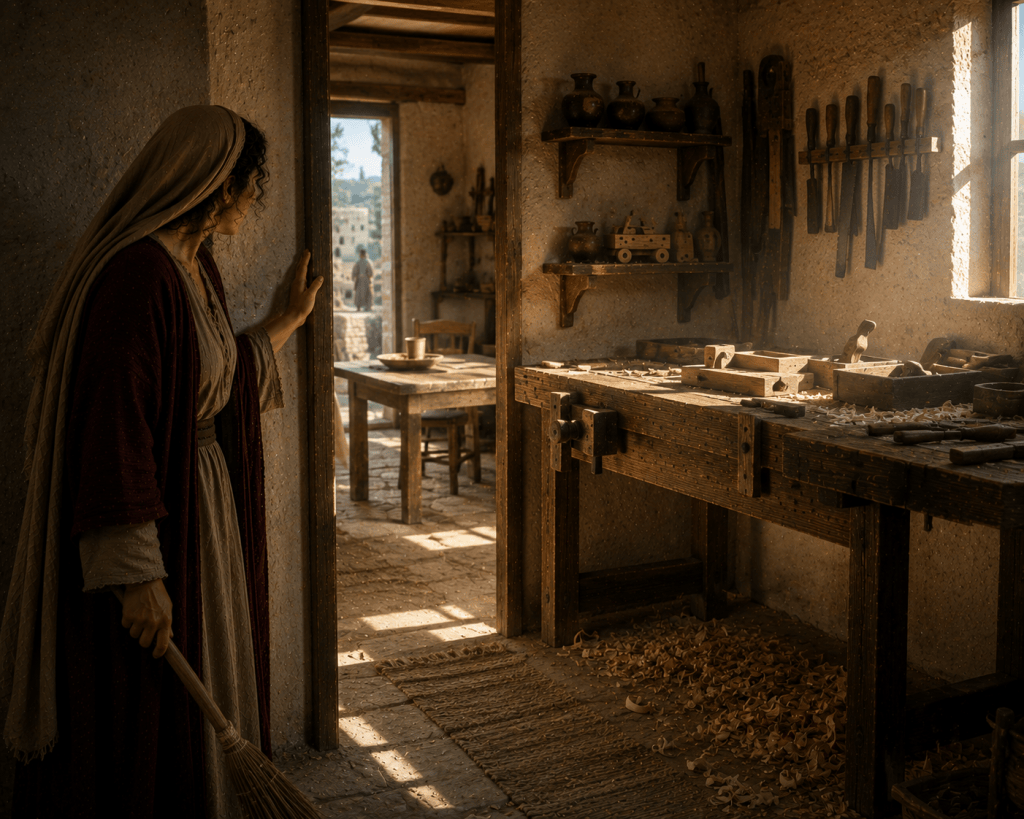
Maybe she went into the workshop.
That would be unavoidable eventually.
The workshop had already survived one transformation.
Joseph’s death.
For a while it had been silent.
Then Jesus had taken up the tools.
Gradually the house had learned a new rhythm.
Not Joseph’s.
Jesus’.
Different.
But alive.
Now the bench was silent again.
Mary stood in the doorway.
Perhaps that was when it really hit her.
Because for most of her life in Nazareth, that room had contained someone.
Joseph.
Then Joseph and Jesus.
Then Jesus.
Now—
wood.
Tools.
Dust.
Morning light.
Nothing moving.
Maybe there was something Jesus had been working on before he left.
But I think perhaps not.
I think Jesus had finished everything.
That’s what Mary noticed before he told her he was leaving.
He had been putting things in order.
No half-finished piece like Joseph had left behind.
No tomorrow waiting on the bench.
Everything completed.
Tools cleaned.
Work put away.
Mary hated that a little.
Joseph’s unfinished work had once hurt because he hadn’t known he was leaving.
Jesus’ finished work hurt because he had.
Perhaps she walked inside.
Ran her fingers along the bench.
There were marks everywhere.
Cuts.
Scratches.
Wear.
Years.
Which belonged to Joseph?
Which to Jesus?
Probably impossible to tell anymore.
Maybe she picked up a tool.
Put it back.
Then she noticed something.
Wood shavings.
A few beneath the bench.
Jesus had cleaned.
But not perfectly.
Mary smiled.
There.
At least something remained untidy.
She fetched the broom.
Then stopped.
Did she sweep them?
Maybe not.
Not that morning.
Perhaps she leaned the broom against the wall.
“They can stay.”
She heard herself say it.
Then looked around as though someone might judge her housekeeping.
Nobody.
That was becoming the problem.
Nobody.
Who was Mary supposed to talk to now?
Not existentially.
Literally.
Who heard the running commentary of an ordinary day?
“Do we have any more oil?”
No answer.
“I thought we did.”
Nothing.
“Did you move—”
She stopped.
Jesus wasn’t there.
Maybe Mary hadn’t realized how much she spoke to him.
Not conversations.
Fragments.
Things tossed into shared air.
“It’s going to rain.”
“That woman came by again.”
“Remind me tomorrow.”
“Did you eat?”
“Look at this.”
“Listen.”
All gone.
Every thought now ended inside her own head.
That would have made the house feel enormous.
Maybe she opened the door wider.
Street sounds entered.
Better.
People.
Life.
Someone arguing.
A child crying.
A donkey objecting to something.
Mary left the door open.
Perhaps that became a habit.
The house was too quiet with it closed.
Then someone passed.
“Morning, Mary.”
“Morning.”
“Jesus leave yesterday?”
“Yes.”
“Jordan?”
“Yes.”
The person nodded.
“Good boy.”
Mary nearly laughed.
Good boy.
If only they knew.
Or perhaps:
If only I knew.
The neighbor continued.
Mary watched.
For a moment she considered calling them back.
Not because she needed anything.
Just conversation.
She didn’t.
Maybe someone came later.
The woman with the bread.
I refuse to abandon her now.
At this point she has earned tenure in our imaginary Nazareth.
She appeared at the doorway.
No bread this time.
No excuse.
She simply looked inside.
“Have you eaten?”
Mary stared.
“Yes.”
“Good.”
The woman walked in anyway.
Maybe she sat at the table.
Looked toward Jesus’ empty place.
Then deliberately sat somewhere else.
Mary noticed.
Of course she did.
“How is it?”
Mary shrugged.
“Quiet.”
The woman nodded.
She knew about Joseph.
She knew quiet.
Maybe she didn’t say:
You’ll get used to it.
Thank God.
Some sentences should be forbidden.
Instead she began talking.
Something ordinary.
Someone’s daughter.
Someone’s roof.
The price of grain.
A neighbor who had once again done something spectacularly foolish.
Mary listened.
Then contributed.
Then disagreed.
Then laughed.
And for perhaps twenty minutes, the house had voices again.
When the woman left, silence returned.
But not as sharply.
Maybe that’s how Mary began building the next version of her life.
A person at a time.
Still, there were things she couldn’t outsource.
Jesus’ belongings.
What do you do with the room or corner of the house where your adult child slept after they leave?
Do you leave it untouched?
Fold everything?
Use the space?
Perhaps Mary did nothing.
That first day, certainly.
She wasn’t turning Jesus’ sleeping place into storage before he’d even reached the Jordan.
Maybe she passed it repeatedly.
Each time:
empty.
And perhaps, despite herself, she imagined where he was.
Had he eaten?
Was he walking?
Had he reached somewhere safe?
Was he cold?
Did he have enough water?
Then:
He’s thirty years old, Mary.
Maybe she told herself this repeatedly.
Thirty.
A grown man.
Capable of locating water.
Still.
Did he bring enough?
Perhaps Mary nearly laughed at herself.
Joseph would have.
That thought came more often now.
Joseph would have said—
Joseph would have thought—
Joseph would have—
And maybe Mary suddenly wished she could tell him.
Not about Jesus’ ministry.
Nothing theological.
Just:
He’s gone.
Our boy left yesterday.
The house is empty.
I don’t like it.
Perhaps she went to the workshop again.
Joseph’s tools.
Jesus’ tools.
Their tools.
“You should be here.”
Maybe she said it.
Not to Jesus.
To Joseph.
Because this was supposed to be something they experienced together.
The end of active parenthood.
Whatever came after.
They should have been sitting at breakfast saying:
Isn’t it quiet?
Joseph should have complained that Mary made too much food.
They should have wondered what Jesus was doing.
Joseph should have pretended not to worry.
Mary should have accused him of worrying.
Instead she had to do this part alone.
Maybe that was when she cried.
Not when Jesus left.
Not standing in the doorway.
Not watching him disappear.
The next morning.
Holding something stupid.
Perhaps one of his work shirts.
Or a bowl.
Or the broom.
Maybe she simply sat down on the workshop stool.
Joseph’s old stool.
Jesus had used it too.
And cried.
Quietly.
Not devastation.
Not Calvary.
Let’s not steal grief from the future.
This was smaller.
A transition.
An ending.
The ache of something good having completed itself.
Her son had grown up.
That was not a tragedy.
He had found his purpose.
Not a tragedy.
He was alive.
Not a tragedy.
Mary was proud.
Still not a tragedy.
And yet—
she missed him.
No theological explanation was required.
Maybe she cried for five minutes.
Then wiped her face.
Because bread still needed doing.
Or laundry.
Or something equally indifferent to major emotional transitions.
The day continued.
That’s what days do.
Perhaps around midday Mary forgot.
For just a second.
She was preparing something and thought:
Jesus will be hungry when he—
Stop.
She put down what she was holding.
Then laughed at herself.
“Apparently I’m going to do this all day.”
Maybe she did.
At sunset, another habit.
Mary looked toward the road.
Jesus often returned around then.
Her body expected a figure.
None came.
The light changed.
People went home.
Doors closed.
Families gathered.
Mary stood outside a little longer.
Maybe this was the loneliest moment.
Morning had tasks.
Day had visitors.
Evening had expectation.
Jesus did not appear.
Of course he didn’t.
Mary went inside.
Closed the door.
One plate.
One cup.
Maybe she considered eating alone.
Then remembered the invitation from the previous day.
Come eat with us.
Perhaps she almost didn’t go.
Staying home required less effort.
Loneliness often does.
Then she looked at the empty table.
“No.”
Maybe aloud.
Mary covered the food.
Put on her outer garment.
Opened the door again.
And left.
I like that.
I like imagining Mary choosing not to let the house swallow her.
Not every night.
There would be solitary evenings.
But perhaps on this first one—
she went where people were.
Someone’s children were loud.
Someone spilled something.
Someone argued.
Someone gave Mary too much food.
Someone asked about Jesus.
“Where is he?”
“On his way to the Jordan.”
“What for?”
Mary paused.
How exactly does one answer that?
“He needed to go.”
The person accepted this because apparently everyone in Nazareth was accustomed to Jesus occasionally being difficult to summarize.
Maybe someone said:
“He’ll be back.”
Mary looked down.
“Yes.”
And she believed that.
When Mary returned home later, the house was still empty.
But she had eaten.
She had laughed once.
Someone had walked part of the way with her.
She had survived the first full day.
Before bed, perhaps Mary checked the door.
Lowered the lamp.
Passed Jesus’ sleeping place.
Stopped.
Maybe she touched the folded covering.
This time she didn’t feel foolish.
“Goodnight.”
She said it.
To an empty room.
Perhaps to Jesus wherever he was.
Perhaps just because she had said goodnight to him for thirty years and habits deserve gentleness when they are dying.
Then Mary went to bed.
The next morning would be easier.
Not easy.
Just easier.
Eventually she would learn how much grain one person needed.
She would stop preparing food for Jesus automatically.
She would stop turning at every footstep.
The workshop would become simply quiet rather than shockingly quiet.
His sleeping place would eventually become space.
He would return sometimes.
Then leave again.
Mary’s life would grow outward.
But that first morning—
everything was still arranged around a person who had walked away less than twenty-four hours earlier.
His cup.
His covering.
His tools.
The dust beneath his bench.
The place where his sandals had been.
The stool where he sat.
The doorway through which he’d left.
Nothing had disappeared except him.
And perhaps that is what an empty nest really is.
Not an empty house.
A full house with one person missing from every object.
Mary stood inside thirty years of evidence.
Here he slept.
Here he ate.
Here Joseph taught him.
Here he worked.
Here he laughed.
Here he annoyed her.
Here he became a man.
Here he kissed her goodbye.
Then he walked out the door.
And the following morning, Mary discovered that raising a child leaves behind an extraordinary amount of space.
Perhaps she stood in the workshop once more before going to bed that first day.
Morning light had revealed the emptiness.
Now evening shadow softened it.
She looked at Joseph’s bench.
At Jesus’ tools.
At the ridiculous crooked little wooden thing still sitting on the shelf after all these years.
She picked it up.
Maybe for the first time in ages.
Jesus had made this.
Little Jesus.
Tiny hands.
Joseph guiding them.
Mary watching from the doorway.
Perhaps it really was terrible.
She turned it over.
Crooked.
Useless.
Perfect.
Mary smiled.
There he was.
Not thirty.
Maybe six.
Serious.
Proud.
Waiting for Joseph to tell him he’d done well.
She put it back.
The house was empty.
But Mary suddenly understood something.
It was not vacant.
There is a difference.
Vacant means nothing remains.
This house was almost unbearably full.
Joseph in the worn handles of the tools.
Jesus in the marks on the workbench.
Childhood in a ridiculous piece of wood.
Meals in the scratches on the table.
Years in the doorway.
Love everywhere.
Mary had spent so much of her life keeping things in her heart.
Now perhaps the house itself kept some of them for her.
She lowered the lamp.
Walked toward bed.
Stopped once.
Listened.
Silence.
Not death this time.
Just distance.
Her son was somewhere beneath the same night sky, walking toward whatever came next.
And Mary—
for the first time in nearly thirty years—
was learning how to wake up in a life that no longer required her to raise him.
Perhaps that was the real emptiness she encountered the following morning.
Not:
Jesus is gone.
But:
The work of raising Jesus is finished.
And beneath the loneliness, beneath the pride, beneath the worry and the strange freedom and the ache of his empty place—
perhaps there was one quiet truth Mary could finally allow herself to feel:
We did it, Joseph.
We raised him.
And now—
he has gone to become who he was always meant to be.


