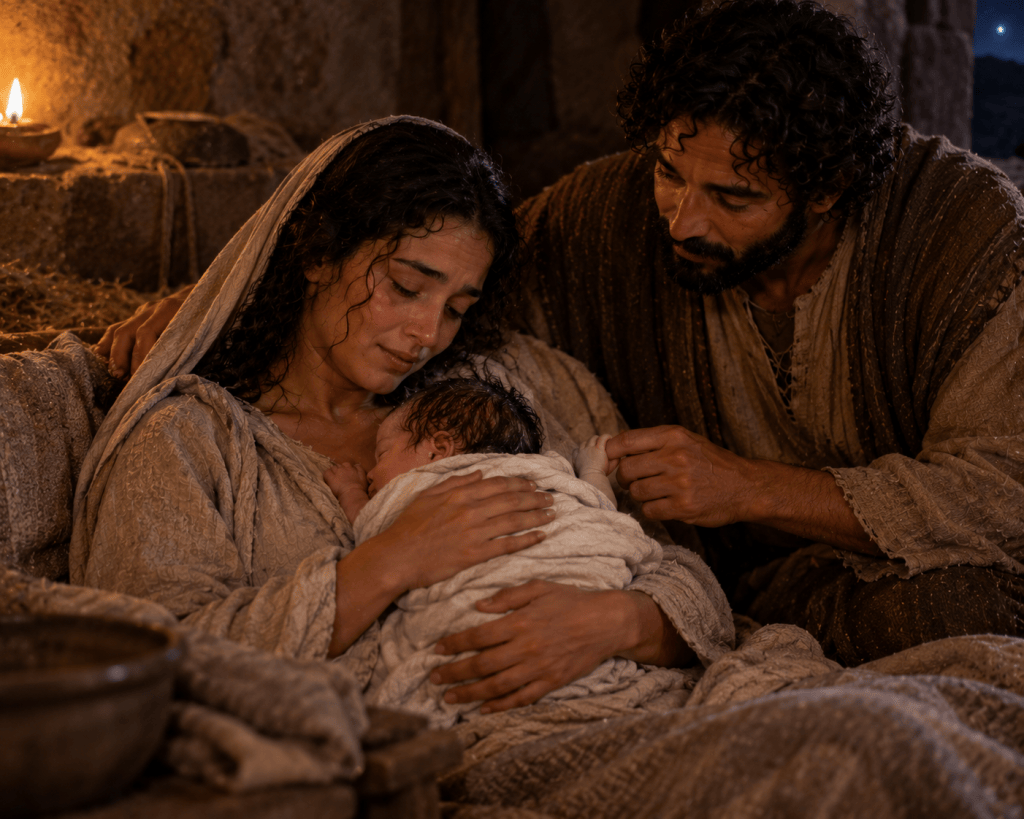
The Invitations of Mary Series
©MS 2026
Before the shepherds and angels and theology—there was a woman laboring to bring a child into the world.
Before anyone arrived to worship him, Mary had to give birth to him.
That sentence feels almost startling.
We are so accustomed to the Nativity already completed.
Mary kneels serenely.
Joseph watches.
Jesus lies clean and peaceful in the manger.
The animals are quiet.
The straw is somehow decorative rather than itchy.
Nobody is sweating.
Nobody is bleeding.
Nobody is frightened.
And Mary certainly doesn’t look like a woman who has just delivered her first baby.
Luke gives us only this:
“While they were there, the time came for her to give birth. Then she gave birth to her firstborn Son, and she wrapped him tightly in cloth and laid him in a manger.”
— Luke 2:6–7
Two verses.
Labor begins.
Jesus is born.
Mary wraps him.
The story continues.
But somewhere inside those verses is an entire human experience.
And there is an important theological complication here.
Catholic tradition has long reflected on whether Mary’s unique holiness and perpetual virginity meant that Jesus’ birth occurred without the ordinary pains or physical processes of childbirth. Some Fathers of the Church spoke of a miraculous, painless birth. Catholic doctrine affirms Mary’s perpetual virginity, including her virginity in giving birth, but the Church has not given us a medical description of exactly what Mary’s labor felt like.
So we cannot confidently say:
Mary experienced childbirth exactly as every other woman does.
Nor can we confidently reconstruct a painless miraculous delivery as though Luke described one.
Scripture simply doesn’t tell us.
Which leaves us with Mary.
A real woman.
A real body.
A real child.
And a mystery.
So perhaps the most honest thing we can do is stand at the edge of that silence and wonder.
Maybe it began with something small.
Mary had been uncomfortable for weeks.
By this point, discomfort was hardly noteworthy.
Her back hurt.
Her pelvis ached.
Jesus pressed downward.
Her abdomen tightened sometimes.
Sleep came in fragments.
Getting up required planning.
Sitting down required planning.
Rolling over probably felt like an engineering project.
So perhaps when the first contraction came, Mary didn’t immediately know.
She stopped.
Waited.
It passed.
Joseph noticed.
“What?”
“Nothing.”
He had learned by now that nothing frequently meant something.
But he also knew better than to interrogate her.
So he waited.
Another contraction.
Mary became still again.
This one was different.
Joseph watched her.
Mary looked at him.
Maybe neither spoke.
Then:
“Oh.”
Joseph’s face changed.
“What does ‘oh’ mean?”
Mary stared at him.
“I think…”
Another pause.
“I think it might be time.”
And suddenly Joseph, who had spent months preparing for precisely this event, forgot everything he had ever known.
Perhaps Mary was frightened immediately.
Or perhaps not.
Sometimes the thing we fear becomes strangely manageable once it actually begins.
There is no longer anything to anticipate.
Only the next thing to do.
Breathe.
Wait.
Move.
Rest.
Another contraction.
Breathe.
Maybe Mary thought of Elizabeth.
She had seen Elizabeth late in pregnancy. Depending on the timing of Mary’s departure, she may or may not have been present for John’s birth; Luke does not tell us that she was.
Perhaps Elizabeth had told her what she could.
What labor might feel like.
What to expect.
What not to fear.
But explanations have limits.
There is a difference between hearing:
It will hurt
and discovering what those words mean inside your own body.
Maybe the early contractions were manageable.
Mary walked.
Stopped.
Breathed.
Walked again.
Perhaps Joseph hovered.
That lasted approximately ten minutes.
“Do you need water?”
“No.”
“Do you want to sit?”
“No.”
“Should I—”
“Joseph.”
“Yes.”
“Please stop asking me questions.”
Ah.
The Look had evolved.
Joseph nodded.
He brought water anyway and placed it somewhere she could reach it.
Good man.
Then perhaps the contractions became stronger.
The world began shrinking.
That’s something I wonder about when we surround the Nativity with cosmic significance.
Angels were about to announce peace on earth.
Prophecy was being fulfilled.
The Messiah was entering the world.
The Word was becoming flesh.
All of that is true.
But what was Mary’s world at that exact moment?
Maybe it was very small.
Her body.
Her breath.
The ground beneath her.
Joseph’s voice.
The place where she gripped his hand.
The few minutes between one contraction and the next.
Sometimes pain makes philosophy impossible.
You are not contemplating salvation history.
You are thinking:
Not yet. Please give me another minute.
And then it comes anyway.
What did Mary sound like?
That’s another thing our Nativity scenes erase.
Birth is not necessarily quiet.
Maybe Mary moaned.
Maybe she cried out.
Maybe she prayed aloud.
Maybe she became completely silent.
Maybe she cursed the census.
Not God.
Not her child.
But I think Caesar Augustus was still fair game.
Perhaps Joseph heard:
“Caesar…”
and decided not to ask.
Wise.
Very wise.
Maybe Mary tried to pray.
Words she had known since childhood.
Psalms.
Fragments.
The prayers of Israel.
But perhaps eventually the words broke apart.
A sentence became a name.
A name became breath.
God.
Another contraction.
God.
Maybe that was enough.
Prayer doesn’t always remain eloquent when the body takes over.
Sometimes prayer becomes:
Help.
Stay.
Please.
Now.
Maybe Mary discovered that too.
And what was Joseph doing?
Poor Joseph.
There are circumstances in which being useful is enormously difficult.
He could bring water.
He could arrange cloth.
He could support Mary physically.
He could find whatever assistance was available.
Historically, childbirth was commonly women’s work, and if other women were available to assist Mary, their presence would be entirely plausible. Later Christian tradition imagines midwives around the Nativity, although the canonical Gospels don’t mention them.
Perhaps women helped her.
I hope they did.
Because the familiar image of Joseph acting as Mary’s sole birth attendant is possible, but it isn’t something Luke actually tells us.
Maybe there was an older woman.
A relative.
Someone associated with the household where they stayed.
Someone who had attended births before.
Someone who looked at terrified Mary and said:
You’re doing well.
And Mary desperately needed to hear that.
But perhaps Joseph remained nearby.
Mary reaches for him.
Not gently.
His hand disappears into hers.
A contraction comes.
Mary squeezes.
Joseph discovers astonishing things about the strength of a laboring woman.
When it passes, she releases him.
Joseph flexes his fingers.
Mary notices.
“Did I hurt you?”
“No.”
He is lying.
She knows.
She almost laughs.
Then another contraction begins and humor disappears again.
At some point Mary may have thought:
I cannot do this.
That thought is so common in descriptions of labor that I wonder whether she knew it too.
Not theological doubt.
Not regret about Gabriel.
Not rejection of Jesus.
Just the human mind reaching the edge of something enormous.
I can’t.
I can’t.
I can’t.
Maybe someone told her:
“You are.”
Not you can.
You are.
Your body is already doing it.
There is no test you must pass before continuing.
No courage you must manufacture.
The child is coming.
Stay here.
Breathe.
Again.
Perhaps Mary became angry.
At pain.
At her body.
At Joseph for existing nearby without experiencing any of this.
That’s deeply unfair.
Also deeply human.
Maybe he touched her at exactly the wrong moment.
“Don’t.”
His hand vanished.
Later:
“Joseph.”
“Yes?”
“Come here.”
He returned.
No complaint.
No:
You just told me not to touch you.
Because by now Joseph understood that instructions given during labor probably superseded all previous instructions.
Mary leaned against him.
Another contraction.
His arms held her weight.
Maybe for a moment she hated him.
Then loved him.
Then forgot he existed.
Then desperately needed him again.
Human bodies are strange places.
And perhaps there was blood.
We don’t put that in Christmas cards.
There were fluids.
Sweat.
Mess.
Straw or cloth that needed changing.
A young woman exhausted beyond anything she had previously known.
Whether Mary’s birth was physiologically ordinary or miraculously preserved from the usual pains and injuries associated with childbirth is something Christian tradition has debated and contemplated for centuries.
But the Incarnation itself insists on something we should not sanitize:
Jesus really entered human flesh.
Mary really bore him.
He was not placed into her arms from somewhere outside humanity.
He grew within her.
Her body nourished his.
Her body carried his increasing weight.
And somehow, mysteriously, her body became the threshold through which he entered the world.
That is not an embarrassment around the edges of Christmas.
It is part of its astonishing claim.
Maybe Mary thought about Gabriel.
Months earlier:
“You will conceive and give birth to a son, and you will name him Jesus.”
At the time, give birth had probably felt like the least mysterious part of that sentence.
Women gave birth.
She knew that.
She had seen pregnant women.
Heard birth stories.
Perhaps heard labor through the walls of neighboring homes.
But now those two simple words—
give birth
—had become an entire universe.
Maybe somewhere between contractions she thought:
Gabriel could have elaborated.
Just slightly.
Perhaps she would have appreciated a warning.
Then came the point when everything changed.
The baby was coming.
Really coming.
Fear might have become instinct.
Mary’s body knew something her conscious mind didn’t have to explain.
Perhaps someone told her what to do.
Perhaps she already knew.
Perhaps she bore down.
Rested.
Again.
Again.
And maybe she cried out.
I think we should allow her that sound.
Not because suffering makes the birth more holy.
But because Mary does not become less sacred when we allow her body to be powerful, physical, strained, sweating, working.
We have made femininity in sacred art so clean.
But birth is ancient.
Animal.
Human.
Blood and breath and muscle and terror and astonishing strength.
If Mary’s birth involved those realities, they were not beneath her dignity.
God chose a woman’s body as the place where the Incarnation happened.
That tells us something.
And then—
release.
A sudden absence where enormous pressure had been.
A sound.
Maybe for one terrifying fraction of a second, silence.
Mary waiting.
Joseph waiting.
Everyone waiting.
Then—
a cry.
Not angels.
Not shepherds.
A baby.
Jesus’ first human announcement of himself may have been exactly what every newborn announces:
I am here.
Imagine Mary’s face.
Not the serene Madonna yet.
Exhausted.
Sweat along her hairline.
Curls stuck against her skin.
Perhaps tears.
Perhaps disbelief.
“Is he—?”
Someone answers.
“He’s here.”
He’s here.
And then they gave him to her.
That is the moment I keep returning to.
Because for nine months Mary had known Jesus in a way no one else ever could.
Movement.
Pressure.
Hiccups, perhaps.
Kicks.
Weight.
Her body had been his entire world.
Then suddenly—
he was outside her.
There was his face.
His hair.
His hands.
His mouth opening in outrage at the entire experience.
Maybe Mary stared.
This?
This was him?
The child Gabriel had announced?
The Son of the Most High?
This red, slippery, furious little person?
Perhaps she laughed.
Perhaps she sobbed.
Maybe both.
She would have checked him.
Mothers do.
Fingers.
Face.
Breathing.
Everything there?
Everything right?
Perhaps she touched his cheek.
Jesus turned toward the warmth.
Maybe instinct took over again.
He knew her.
Not intellectually.
Bodily.
Her smell.
Her voice.
Her heartbeat—the sound that had surrounded him for his entire existence.
Imagine that.
The first familiar thing God encountered after entering the world was Mary.
Her voice was already home.
Maybe Joseph came closer.
And perhaps for once he had absolutely nothing to say.
Scripture never records Joseph speaking anyway.
This feels like an appropriate moment for that silence.
Mary looked up at him.
Joseph looked at Jesus.
Then Mary watched something happen to his face.
This man had believed her.
Stayed.
Traveled.
Protected.
Prepared.
Worried.
But until this moment, Jesus had been mostly promise.
Now there was a baby.
Joseph reached toward him.
Stopped.
Perhaps asked without words.
Mary nodded.
Maybe Joseph touched one tiny hand.
Jesus’ fingers closed around one of his.
And Joseph was finished.
Absolutely finished.
But Mary wasn’t.
That’s another thing Nativity scenes skip.
After birth, the mother’s body does not simply announce:
Completed.
There is still work.
Still contractions.
Still bleeding.
Still exhaustion.
Still the physical aftermath of birth.
Mary may have trembled.
She may have been cold.
She may have needed washing.
Rest.
Food.
Water.
Help.
She had just done something enormous.
And then she immediately had a newborn who needed her.
Motherhood does not provide much ceremonial transition.
Congratulations.
Here is the baby.
He is hungry.
Luke tells us Mary wrapped Jesus in cloths herself.
That detail suddenly feels different when we imagine what preceded it.
She had just given birth.
And yet somehow:
she wrapped him.
Perhaps slowly.
Maybe her hands shook.
Perhaps someone had prepared the cloths beforehand.
Mary unfolded them.
Jesus protested.
“I’m sorry.”
He continued protesting.
“I know.”
She wrapped one side.
Then the other.
Maybe Joseph tried to help.
“No, like this.”
“How?”
“Hold him.”
Joseph held Jesus as though entrusted with a live coal.
“Not like that.”
“I don’t know how.”
“Neither do I.”
Maybe they both looked at each other.
Oh.
Right.
Neither of them had done this before.
Perhaps Mary laughed.
Exhausted, incredulous laughter.
Their first parenting crisis:
How exactly do you wrap God?
Then the manger.
We hear that word and immediately see Christmas.
Mary may have seen:
the safest available place to put the baby down.
Maybe Joseph cleaned it.
Maybe they lined it.
Maybe Mary looked at it skeptically.
“This?”
Joseph perhaps gave her the expression of a man who had exhausted all alternatives.
Mary was too tired to argue.
Fine.
The Messiah would sleep in the feeding trough.
Apparently this was happening.
She lowered Jesus into it.
Maybe he immediately woke up.
Of course he did.
Mary closed her eyes.
Joseph looked at her.
“Don’t.”
Joseph said nothing.
Again:
growth.
And only then, perhaps, came quiet.
Not heavenly quiet.
The strange quiet after something enormous has happened.
Mary lying back.
Body aching.
Jesus making tiny newborn sounds nearby.
Joseph sitting close.
Maybe other helpers cleaning the evidence of birth.
Mary looked around.
This was not Nazareth.
Not her home.
Not where she had imagined giving birth.
Nothing looked the way she would have planned.
But Jesus was here.
She turned her head toward him.
Maybe she whispered his name for the first time as his mother looking at him outside her body.
Jesus.
Yeshua.
The name Gabriel had given her.
Before conception.
Before morning sickness.
Before Elizabeth.
Before Joseph’s heartbreak and dream.
Before her body changed.
Before Caesar sent them toward Bethlehem.
Before the endless road.
Before labor.
Now the name belonged to a face.
Soon there would be shepherds.
Soon there would be stories about angels filling the night.
Soon people would kneel.
Soon theology would spend centuries trying to find language large enough for what had happened.
Incarnation.
Theotokos.
Mother of God.
Word made flesh.
Emmanuel.
Salvation.
All true.
But perhaps for one little while none of those words mattered.
There was only Mary.
Exhausted.
Sore—or, if the ancient tradition of a miraculous birth is right, perhaps astonished by an experience unlike ordinary childbirth.
Either way, she had crossed from pregnancy into motherhood.
And there was Jesus.
Breathing.
Moving.
Needing warmth.
Needing food.
Needing her.
Before anyone worshiped him, Mary probably did something much more ordinary.
She checked whether he was warm enough.
Before anyone proclaimed him Messiah, she may have counted his fingers.
Before anyone called her Mother of God, perhaps she wondered whether she was holding him correctly.
Before the shepherds and angels and theology—
there was a woman and her newborn child.
And maybe that’s where we should linger.
Not because the theology is unimportant.
Because this is the theology.
God did not merely appear human.
He became human.
Small enough to fit against Mary’s chest.
Dependent enough to need her warmth.
Fragile enough to be wrapped.
Human enough to cry.
And Mary did not merely provide a picturesque background for the Incarnation.
She bore him.
Whatever the mysterious physical circumstances of that birth were, Christianity makes the astonishing claim that salvation entered history through the embodied yes of a woman.
Maybe Mary looked down at Jesus sometime before the shepherds arrived.
His cheek against her.
Her body utterly spent from the events of the night.
Joseph nearby.
The world outside unaware that anything had changed.
And perhaps she remembered Gabriel saying:
“You will conceive and give birth to a son.”
Mary touched one tiny hand.
Nine months of wondering.
Nine months of becoming.
And now—
here he was.
Maybe she whispered, with the exhausted disbelief known by mothers long before and long after her:
“We did it.”
And for a little while,
before anyone came looking for a Savior,
Mary simply held her baby.

 The Living Rosary Archives