The Invitations of Mary Series
©MS 2026
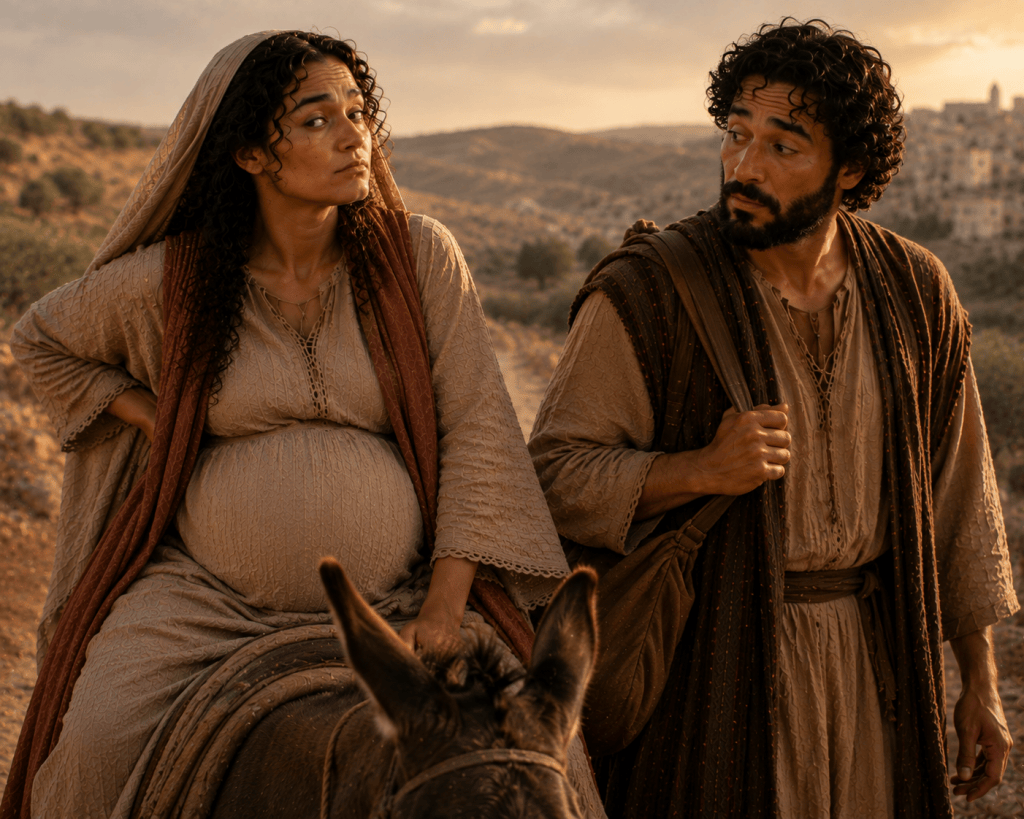
There are moments in every loving relationship when the holiest thing you can possibly do is recognize the look and become very, very quiet.
I think Joseph learned the look.
Not immediately.
There was probably a learning curve.
But by the time Mary was heavily pregnant and they were making their way toward Bethlehem, surely this man had developed at least some ability to distinguish between:
Mary is quiet.
and
Mary is quiet, and I should under no circumstances interfere with whatever is happening over there.
These are very different conditions.
And perhaps somewhere on that road, Joseph made the mistake of confusing them.
Once.
Scripture tells us very little about the journey itself.
Luke tells us that Joseph traveled from Nazareth to Bethlehem for the registration ordered under Caesar Augustus, and that Mary went with him while pregnant.
It does not tell us their route.
It does not tell us how many days they traveled.
It does not tell us whether Mary rode a donkey, though that image became deeply rooted in later Christian tradition.
And it certainly does not tell us whether Mary became profoundly irritated with Joseph somewhere south of Nazareth.
So this is imagination.
But Mary was human.
Joseph was human.
She was late in pregnancy.
They were traveling a considerable distance.
Therefore, I am willing to entertain the possibility that at some point Joseph opened his mouth—
and Mary looked at him.
And Joseph closed it again.
Maybe it happened late in the afternoon.
They had been traveling for hours.
Mary’s back hurt.
Her hips hurt.
Her feet hurt.
If she was riding, riding hurt.
If she had gotten down to walk for a while, walking hurt.
There was apparently no position available to the human body that Jesus did not currently make uncomfortable.
She was hot.
Dusty.
Hungry, but nothing sounded good.
Thirsty, but irritated by how frequently drinking water created another logistical problem.
Her clothing felt wrong.
Her hair felt wrong.
Everything felt wrong.
And Jesus had apparently lodged one small foot directly beneath her ribs.
Mary pressed a hand against the spot.
“Please.”
Joseph looked over.
“What?”
Mary didn’t answer.
Joseph waited.
Then made his first mistake.
“Are you all right?”
Mary turned her head.
Looked at him.
Joseph reconsidered his participation in the conversation.
Maybe it wasn’t even an angry look.
That’s important.
Mary didn’t need to glare.
She didn’t need to snap.
She didn’t need to say anything.
Perhaps it was simply the exhausted face of a woman who had reached the absolute outer boundary of her ability to interact pleasantly with another human being.
Eyes tired.
Mouth set.
One eyebrow perhaps slightly raised.
A very clear message:
Joseph.
I love you.
I know you mean well.
If you ask me one more question, I may walk into the wilderness and never return.
Joseph understood.
Eventually.
“Never mind.”
Mary turned forward again.
Good man.
Maybe he lasted ten minutes.
That’s respectable.
Then the road became rougher.
Joseph looked back.
Mary shifted uncomfortably.
He slowed.
“Do you want to—”
The look.
Joseph stopped.
“No.”
Mary continued looking at him.
“I mean, no, I do not have a question.”
Silence.
Excellent recovery.
Perhaps Joseph found this confusing.
Because normally Mary wanted him to notice things.
If she was struggling with something at home and Joseph somehow failed to notice:
Joseph.
If he offered help when she had decided she didn’t need it:
Joseph.
If he did not offer help when she secretly did need it:
also somehow,
Joseph.
There was apparently no reliable system.
Joseph had spent months learning that Mary sometimes insisted she was fine when she was clearly not fine.
He had developed The Sigh.
She had developed The Look.
Their marriage now possessed an entire language consisting primarily of breathing and eyebrows.
And on the road to Bethlehem, Joseph may have discovered an advanced form:
The Look That Means Do Not Attempt Assistance Unless There Is Active Fire.
Maybe Mary knew she was being unreasonable.
That’s possible too.
Sometimes you know.
You are aware that the person beside you has done absolutely nothing wrong.
Unfortunately, this knowledge does not magically produce the energy required to tolerate them.
Joseph walks.
Mary looks at him.
Why is he walking like that?
He’s walking normally.
Still.
Why is he breathing so loudly?
He is breathing at the ordinary volume required to remain alive.
Annoying.
He adjusts the travel bundle.
The strap squeaks.
Once.
Mary hears it.
Then again.
Squeak.
She closes her eyes.
Squeak.
Joseph notices.
“What?”
“Nothing.”
Squeak.
Mary opens her eyes.
“Can you make that stop?”
Joseph looks at the strap.
“The bag?”
“Yes.”
He adjusts it.
They continue.
Squeak.
Mary inhales.
Joseph immediately removes the bag from his shoulder and carries it in his hand.
Problem solved.
No discussion required.
Marriage.
Perhaps Mary felt guilty afterward.
Joseph was trying.
He had been trying the entire journey.
He carried what he could.
Watched the road.
Found water.
Helped her when she allowed it.
Probably worried about her constantly while attempting not to make that worry another burden she had to carry.
And Mary knew that.
She loved him for it.
She was also, at that exact moment, profoundly sick of looking at him.
Both things can be true.
Maybe after an hour of silence, Mary glanced over.
Joseph was still walking beside her.
Quietly.
Very quietly.
Suspiciously quietly.
She realized what he was doing.
“Joseph.”
He looked at her cautiously.
“Yes?”
“You can talk.”
He considered this invitation carefully.
“Are you certain?”
Mary almost smiled.
“Yes.”
“How certain?”
“Joseph.”
“Right.”
Maybe she laughed then.
Just a little.
Not because anything was particularly funny.
Because he looked genuinely wary.
This man had faced an angel in a dream.
He had accepted an impossible pregnancy.
He would soon flee a murderous king.
But at that moment his greatest concern was determining whether his wife had officially rescinded the prohibition on conversation.
Mary shook her head.
“I’m sorry.”
Joseph shrugged.
“You’re tired.”
“I am.”
“Your back hurts.”
“Yes.”
“Your feet hurt.”
“Yes.”
“The baby is kicking you.”
“Yes.”
“And you’re tired of traveling.”
Mary looked at him.
“Very.”
Joseph nodded.
“Then I think you’re allowed to be tired of me too.”
That might have softened her completely.
Maybe she reached for his hand.
If she was walking, perhaps she simply took it.
If she was riding, perhaps she rested her hand briefly on his shoulder as he walked alongside.
Not a grand romantic gesture.
Just:
Thank you for understanding me when I’m not particularly pleasant.
Joseph might have squeezed her fingers.
Then, because he was apparently incapable of leaving a successful moment alone:
“How much longer do you think you can travel today?”
Mary’s hand withdrew.
Joseph sighed.
“Too soon?”
“Much.”
“I see.”
“You were doing so well.”
“I know.”
Perhaps the real problem wasn’t Joseph at all.
Maybe Mary was simply done being needed.
That’s something we don’t often allow her.
For months her body had belonged partly to someone else.
Jesus needed her blood.
Her breath.
Her food.
Her strength.
Her sleep had changed.
Her movement had changed.
Her appetite had changed.
Her body had expanded around another person.
And now Rome needed her to travel.
Joseph needed to know whether she was all right.
People along the road needed answers.
Everyone needed something.
Perhaps for twenty minutes Mary wanted absolutely nobody to need anything from her.
Not even conversation.
That isn’t selfish.
Sometimes the nervous system simply says:
Enough.
No more questions.
No more decisions.
No more touching.
No more noise.
No more explaining how I feel.
Let me exist quietly until I have enough of myself back to share again.
Maybe Mary knew that feeling.
We often imagine her availability as limitless.
Mary is always receptive.
Always gentle.
Always listening.
Always ready.
But human beings have limits.
Jesus himself withdrew from crowds.
He sought solitude.
He slept.
He became tired.
The Incarnation does not treat human limitation as moral failure.
So perhaps Mary’s need for quiet didn’t require an apology at all.
Maybe Joseph understood that better than she did.
“I’m sorry.”
“For what?”
“I’ve been…”
She gestures vaguely.
Joseph waits.
“Unpleasant.”
Maybe he smiles.
“A little.”
Mary looks at him.
Joseph immediately adds:
“Understandably.”
Good recovery.
“But you haven’t done anything.”
“I know.”
“That almost makes it worse.”
Joseph laughs.
Mary groans.
“I mean it.”
“I know.”
“I don’t want to be angry with you.”
“Then don’t be.”
“I am.”
“All right.”
Mary stares.
That’s it?
Joseph shrugs.
“You’ll stop eventually.”
She hates how reasonable that is.
Maybe Joseph had learned something important during their marriage:
Not every emotion needs to be fixed.
Mary didn’t always need him to make her comfortable.
Sometimes he couldn’t.
He couldn’t shorten the road.
He couldn’t remove the weight of pregnancy.
He couldn’t make Caesar’s decree disappear.
He couldn’t guarantee exactly when they would arrive.
He couldn’t climb inside Mary’s body and move Jesus’ foot away from her ribs.
There was no solution.
So perhaps he stopped offering one.
He simply walked beside her.
That may have been exactly what she needed.
I imagine them traveling for a long stretch without speaking.
Footsteps.
The animal, if they had one.
Wind.
Occasional voices from other travelers.
Mary breathing.
Joseph nearby.
Nothing demanded from her.
Gradually her shoulders loosen.
The irritation fades.
The road is still terrible.
Her body still hurts.
But the feeling of being overwhelmed begins to recede.
Maybe she watches Joseph for a moment.
He isn’t sulking.
He isn’t punishing her with silence.
That’s important.
There is a difference between:
I am giving you the quiet you asked for
and
I am withholding myself because you hurt my feelings.
Joseph simply walks.
Present.
Available.
Quiet.
Maybe Mary loves him enormously in that moment.
Eventually she breaks the silence.
“How far?”
Joseph looks at her.
Dangerous question.
He has learned the rules.
He looks toward the horizon before answering.
“I don’t know.”
Correct.
Mary nods.
A few steps.
Then Joseph adds:
“But I think we’re getting closer.”
Mary looks at him.
“I think?”
“I cannot see Bethlehem.”
“Then you are not permitted to say ‘not far.’”
“I remember.”
“Good.”
Another few steps.
Then Mary smiles.
Barely.
Joseph notices.
Doesn’t comment.
Also good.
He’s learning.
Maybe later that evening they stopped.
Mary sat down with enormous relief.
Joseph brought her water.
She took it.
No questions.
Food.
She ate.
No questions.
He arranged something behind her back so she could lean more comfortably.
Mary looked at him.
“Thank you.”
Joseph nodded.
Then sat nearby.
After a while Mary said:
“You can ask now.”
“Ask what?”
“How I am.”
Joseph looked at her carefully.
“How are you?”
Mary considered.
“Awful.”
Joseph laughed.
Mary smiled.
“But better.”
I love imagining that kind of marriage for them.
Not one where Mary was endlessly pleasant.
Not one where Joseph always knew exactly what she needed.
But one where they learned.
Where Joseph eventually recognized:
This is not the moment.
Where Mary could communicate:
I need quiet
without that meaning:
I don’t love you.
Where temporary irritation wasn’t frightening.
Nobody had to panic because someone needed space.
Nobody had to chase the other person demanding reassurance.
Sometimes Mary could simply be done.
And Joseph could let her be done.
Then she came back.
Maybe this was one of the quiet gifts of their ordinary years together.
Joseph knew her face.
Not the face painted on icons.
Not Our Lady of Sorrows.
Not Queen of Heaven.
Not the serene Madonna.
Mary’s face.
He knew the tiny crease between her eyebrows that meant she was worried.
The look that meant she was trying not to laugh.
The look that meant she had discovered one of his tools somewhere it absolutely did not belong.
The look that meant:
Help me.
The look that meant:
Do not help me.
And this one.
The one that required no interpretation after several years together:
Do. Not. Speak.
Perhaps Joseph respected it.
Mostly.
He was human too.
Maybe once, after nearly an hour of silence, he forgot.
“Mary?”
She slowly turned her head.
Joseph remembered.
“Nothing.”
She turned back.
A few seconds later, despite herself—
she smiled.
Joseph saw it.
He wisely pretended he didn’t.
Because perhaps that is another kind of intimacy.
To know someone well enough to recognize when your presence is wanted—
and when your presence is wanted quietly.
Joseph didn’t have to disappear.
Mary didn’t want him gone.
She just needed him to stop asking whether she was all right when she was extremely, obviously, profoundly not all right.
So he walked beside her.
The road stretched ahead.
Bethlehem waited somewhere beyond the hills.
Mary shifted again, trying to find one position that didn’t hurt.
Joseph glanced over.
Their eyes met.
For one dangerous second, he looked as though he might ask.
Mary raised one eyebrow.
Joseph faced forward immediately.
Good man.
Maybe Mary rested a hand over the child inside her.
Then looked toward the horizon.
Still tired.
Still uncomfortable.
Still very possibly sick of Caesar Augustus, traveling, pregnancy, dust, and perhaps the entire male sex for the next half hour.
But Joseph was beside her.
Quiet.
Exactly where she wanted him.
And for now—
that was enough.


