The Invitations of Mary Series
©MS 2026
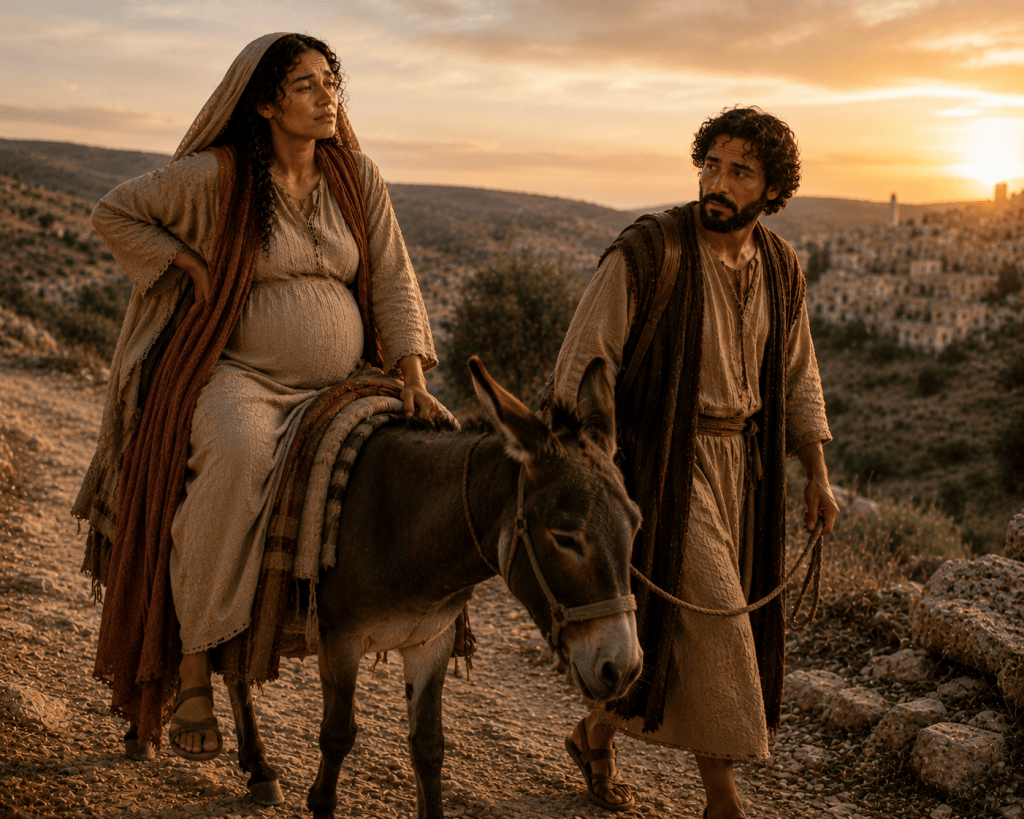
At some point, perhaps even the Mother of God was simply very, very tired of being on the road.
By the time Mary traveled to Bethlehem, the pregnancy was no longer subtle.
There was no wondering whether someone might notice.
No small curve beneath her clothing.
No private knowledge held between herself, Joseph, and God.
She was pregnant.
Very pregnant.
Luke tells us that Caesar Augustus issued a decree for registration and that Joseph traveled from Nazareth to Bethlehem because he belonged to the house and family of David.
And then Luke adds Mary:
“He went to be registered with Mary, to whom he was engaged and who was pregnant.”
— Luke 2:5
We know what happens next.
They reach Bethlehem.
Jesus is born.
Mary wraps him in swaddling clothes and lays him in a manger.
The story moves so quickly that the journey itself almost disappears.
But Mary had to actually make it.
Pregnant.
Near enough to delivery that Jesus would be born after they arrived.
And I cannot imagine that every mile of that journey felt spiritually profound.
At some point, surely Mary thought:
I am so tired of this.
We should be careful with the details we imagine.
The Gospel does not tell us that Mary rode a donkey.
Our Nativity scenes nearly always give her one, and some later traditions do too, but Luke simply tells us that Mary and Joseph traveled.
We don’t know their exact route.
We don’t know precisely how long the journey took.
We don’t know whether they traveled alone or with others.
We don’t know whether Mary walked, rode an animal for portions of the journey, or alternated between the two.
So perhaps we should leave the donkey where it belongs:
possible, but not certain.
What is certain is that Nazareth and Bethlehem were not neighboring villages.
Mary had to travel a substantial distance while heavily pregnant.
And pregnancy does not become more comfortable simply because the child you’re carrying is Jesus.
Maybe the first day wasn’t terrible.
Mary had prepared.
Joseph had prepared.
Food.
Water.
Clothing.
Whatever they needed for sleeping.
Perhaps provisions for the baby, because surely by this point Mary understood that birth was approaching.
Maybe she was even glad to begin.
Waiting for an unpleasant journey can sometimes be worse than finally doing it.
They left Nazareth.
Mary looked back.
Then forward.
Bethlehem.
All right.
Let’s go.
Perhaps she prayed.
Perhaps she and Joseph talked.
Perhaps the landscape was beautiful.
And then several hours passed.
Now her back hurt.
Pregnancy has a remarkable ability to turn ordinary bodily functions into logistical problems.
Mary needed to sit.
Then she had been sitting too long.
She needed to stand.
Standing hurt.
Walking helped.
Then walking hurt.
She was hungry.
Then food sounded terrible.
She was thirsty.
Then drinking meant she would eventually need to stop again.
Perhaps Jesus had discovered a particularly uncomfortable position beneath her ribs.
Mary pressed a hand against the place.
“Please move.”
Joseph looked over.
“What?”
“Not you.”
He understood.
Maybe he smiled.
Mary did not.
“Don’t encourage him.”
“I didn’t say anything.”
“You smiled.”
Apparently Joseph had now learned that smiling could also be dangerous.
Maybe Jesus moved constantly on the road.
Every jolt.
Every change in Mary’s position.
Every time she finally became comfortable—
kick.
Mary stops.
Joseph looks concerned.
“What?”
“Your son.”
Joseph waits.
“What did he do?”
“He has a foot.”
Joseph blinks.
“I assumed he would.”
Mary looks at him.
Wrong answer.
Joseph realizes this.
“I mean—where?”
“Here.”
She presses beneath her ribs.
Joseph wisely says:
“That looks uncomfortable.”
“Thank you.”
A minute later:
“Did he move?”
“No.”
Another mile.
Perhaps there were days Mary did not want conversation.
That’s something I rarely see in depictions of the journey to Bethlehem.
Joseph walking solemnly.
Mary serene.
Both contemplating divine mysteries.
Maybe.
Sometimes.
But if they were on the road for days, there were probably stretches when Mary simply did not want Joseph to speak.
Not because she was angry with him.
Because she was tired.
Her hips hurt.
Her back hurt.
She had slept badly.
She had been wearing the same travel clothing too long.
Dust had worked its way into places dust had no business being.
And Joseph, attempting kindness, asks:
“How are you feeling?”
Mary looks at him.
How does she look?
Joseph immediately regrets the question.
“Never mind.”
“No. Ask.”
“I don’t think I should.”
“You already did.”
Joseph waits.
Mary sighs.
“Everything hurts.”
“What can I do?”
“Make Bethlehem closer.”
“I cannot do that.”
“Then nothing.”
At least he asked.
Maybe she was angry at Caesar.
I hope she was.
The traditional imagery of Mary traveling toward Bethlehem is so peaceful that it’s easy to forget why she was traveling at all.
An emperor had issued a decree.
Somewhere very far away, a powerful man made an administrative decision.
And ordinary people moved.
Joseph moved.
Mary moved.
A heavily pregnant woman traveled because imperial government had reached into the rhythms of their household.
Perhaps Mary thought:
Does Caesar Augustus know how pregnant I am?
Obviously not.
Does Caesar care that her back hurts?
No.
Does Rome care that this is an extraordinarily inconvenient time for Joseph’s household to travel?
Also no.
Maybe Mary occasionally muttered something about the emperor.
Joseph heard.
Said nothing.
Righteousness includes knowing when not to defend Caesar Augustus to your heavily pregnant wife.
And perhaps Mary was afraid.
Not constantly.
Fear is exhausting too.
But every unfamiliar tightening in her abdomen might have made her wonder.
Is this it?
Not here.
Please.
Not on the road.
Maybe Elizabeth had told her what she could about late pregnancy.
But Elizabeth had been a first-time mother too.
There were limits to everyone’s expertise.
Mary knew birth was coming.
She could not know exactly when.
Perhaps she woke one morning and thought:
Something feels different.
Joseph noticed her expression.
“What?”
“I don’t know.”
Those are not words a man traveling with a heavily pregnant woman wants to hear.
“What do you mean, you don’t know?”
“I mean I don’t know.”
“Should we stop?”
“I don’t know.”
“Mary.”
“Joseph, if I knew, I would tell you.”
He stops asking.
Excellent.
Growth.
Maybe sometimes she walked with one hand supporting the underside of her belly.
Not gracefully.
Not symbolically.
Just because it helped.
Perhaps by evening her ankles were swollen.
Her feet hurt.
She lowered herself carefully onto whatever passed for a place to rest and decided that she would simply remain there for the rest of her natural life.
Joseph unpacked something.
“We should eat.”
Mary didn’t move.
“Mary?”
“I live here now.”
Joseph looked around.
Perhaps they were beside a road.
“You live here?”
“Yes.”
“All right.”
He handed her food.
Maybe she looked at him.
“You’re not going to argue?”
“I’ve learned.”
She smiled despite herself.
Perhaps that’s how they survived the journey.
Not through constant spiritual ecstasy.
Humor.
Tiny accommodations.
Joseph learning when to help and when not to ask.
Mary learning when stubbornness was no longer useful.
They had already practiced this.
Remember the basket.
“I can carry it.”
Joseph’s sigh.
Now, heavily pregnant on the road to Bethlehem, perhaps Mary finally surrendered more easily.
Joseph holds out his hand when she needs to stand.
She takes it.
No argument.
He rearranges something to make her more comfortable.
She lets him.
He carries what he can.
She doesn’t remind him that she could carry some of it herself.
Maybe late pregnancy accomplished what months of Joseph’s sighing could not.
Mary had discovered:
Fine. Sometimes help is useful.
Joseph, wisely, never said:
“I told you so.”
Because Joseph wanted to reach Bethlehem alive.
And what did Mary think about God?
That question interests me more.
Because surely there must have been moments when the circumstances seemed almost absurd.
Gabriel had told her:
Her child would be great.
Son of the Most High.
He would receive David’s throne.
His kingdom would have no end.
Wonderful.
Could the Son of the Most High perhaps have arranged to be born closer to home?
Maybe Mary felt guilty for thinking it.
Then maybe she stopped feeling guilty.
Because discomfort isn’t disbelief.
You can trust God and still hate the road.
You can believe something has purpose and still wish it were easier.
You can say yes to God and, months later, exhausted and aching, ask:
Did it really have to happen like this?
Perhaps Mary did.
Maybe she remembered Gabriel.
Do not be afraid.
That had sounded different in Nazareth.
Then she had been standing in a familiar place.
Now she was somewhere between home and Bethlehem, very pregnant, dependent upon Joseph, uncertain where they would stay, and increasingly aware that labor might not wait for convenient arrangements.
“Do not be afraid.”
Fine.
She was trying.
But perhaps faith wasn’t a feeling of calm.
Perhaps faith looked like continuing down the road while afraid.
One foot.
Then another.
Rest.
Drink.
Eat.
Stand again.
Keep going.
There is something deeply Marian about that too.
Not the dramatic yes.
The thousands of tiny yeses required afterward.
Maybe Mary talked to Jesus.
I hope she did.
By now he would have been impossible to ignore.
His movements.
His weight.
The way her entire body had reorganized itself around him.
Perhaps when Joseph walked a little ahead, Mary whispered:
“We are going to Bethlehem.”
A movement.
“Yes, I know.”
Another.
“I don’t know why either.”
Maybe she smiled.
“You could wait until we get there.”
A stronger movement.
“Please?”
No agreement.
Already a child.
And perhaps there were moments of wonder too.
We shouldn’t make the journey only miserable.
Maybe they stopped somewhere at dusk.
The heat faded.
Mary finally found a position that didn’t hurt.
Joseph sat nearby.
The road became quiet.
Stars emerged.
Maybe Mary rested her hands over Jesus and felt him moving beneath them.
For a few minutes, there was no Caesar.
No aching feet.
No distance left to travel.
Just her.
Joseph.
The child.
Perhaps Joseph put his hand beside hers.
A movement.
His eyes widened.
Mary smiled.
“He does that all day.”
Joseph kept his hand there.
Another kick.
Maybe he laughed quietly.
And Mary watched his face.
Perhaps those were the moments that made the rest bearable.
Then morning came.
And they had to move again.
Mary opened her eyes.
Her entire body objected.
Joseph was already preparing.
She watched him.
“No.”
He turned.
“What?”
“I have changed my mind.”
“About?”
“Bethlehem.”
Joseph tried not to smile.
Mary saw it.
“I am serious.”
“I know.”
“We can register here.”
“I don’t think we can.”
“Have you asked?”
Joseph paused.
“No.”
“Then we don’t know.”
Eventually she stood.
Because Bethlehem remained where it was.
And so did Rome’s decree.
And apparently neither cared about Mary’s opinion.
Perhaps near the end of the journey, every indication that they were getting closer became precious.
Someone tells them:
“Bethlehem isn’t far.”
Mary immediately asks:
“How far?”
The answer is vague.
She hates vague answers now.
“A little way.”
“What does that mean?”
Joseph tries:
“Not far.”
Mary turns toward him.
“You are not permitted to say ‘not far’ unless you can see Bethlehem.”
Joseph nods.
Fair.
Later he sees something ahead.
“Mary.”
“What?”
“I can see it.”
She doesn’t believe him at first.
“Actually?”
“Yes.”
“Don’t lie to me.”
“I would never lie about Bethlehem.”
She looks.
There.
Maybe only distant buildings against the hills.
But there.
Bethlehem.
Relief.
Almost enough to make her cry.
And then perhaps another thought arrived.
They had made it.
Which meant the journey was ending.
Which meant something else was getting very close.
The birth.
Mary looked down at her enormous abdomen.
Suddenly the road didn’t seem like the biggest problem anymore.
Maybe Joseph saw her expression.
“What?”
Mary shook her head.
“Nothing.”
Joseph knew better by now.
“Mary.”
She looked toward Bethlehem.
Then at him.
“I think I’m frightened.”
Perhaps Joseph was too.
He didn’t tell her not to be.
Maybe he simply reached for her hand.
She took it.
And they continued.
We know what waits for them in our telling of the story.
No comfortable family room prepared in Nazareth.
No familiar women nearby.
No Elizabeth.
No bed Mary had arranged for herself.
Soon she would labor.
Soon she would hold Jesus.
Soon shepherds would arrive talking about angels.
But Mary walking toward Bethlehem didn’t know exactly how the next days would unfold.
She only knew she was tired.
Uncomfortable.
Probably filthy.
Possibly frightened.
Almost certainly ready to stop traveling.
And still moving.
I think that matters.
Because we sometimes turn faithfulness into serenity.
Mary said yes, therefore Mary serenely endured everything that followed.
But perhaps faithfulness sometimes looked like a heavily pregnant young woman muttering because her back hurt.
Perhaps she complained.
Perhaps she needed to stop again.
Perhaps Joseph annoyed her.
Perhaps she wondered why God couldn’t have arranged this differently.
Perhaps she was utterly sick of the road.
None of that would make her less faithful.
It would make her human.
I imagine one of the final stretches.
Mary is exhausted.
Joseph offers his hand.
She takes it without argument now.
They walk.
Maybe slowly.
Bethlehem ahead.
Jesus heavy inside her.
Joseph glances over.
“All right?”
Mary gives him a look.
He corrects himself.
“Terrible question.”
“Very.”
“Sorry.”
A few more steps.
Mary asks:
“How much farther?”
Joseph looks ahead.
“Not far.”
Mary stops.
Joseph remembers the rule.
“I can see it.”
She follows his gaze.
There it is.
Mary exhales.
Then perhaps she puts one hand beneath the weight of her belly and says quietly:
“Good.”
Not profound.
Not prophetic.
Just exhausted.
“Because I am done.”
And somewhere inside her, the child who would change the world moved beneath her ribs.
Mary closed her eyes.
“Not you too.”
Joseph laughed.
Mary looked at him.
Then, despite aching feet and a body that had reached the absolute limit of its patience—
she laughed too.
And they kept walking toward Bethlehem.

 The Living Rosary Archives