The Invitations of Mary Series
©MS 2026
Perhaps holiness did not mean they never disagreed. Perhaps it meant neither of them needed to win forever.
Maybe it was something stupid.
Not Gabriel.
Not the pregnancy.
Not Egypt.
Not Jesus.
Nothing worthy of stained glass.
Maybe Joseph said he would do something and forgot.
Maybe Mary changed a plan without telling him.
Maybe one of them misunderstood what the other had said.
Maybe they were tired.
Maybe there wasn’t enough money.
Maybe dinner was late.
Maybe Joseph came home already irritated about something that had nothing to do with Mary, and Mary happened to say exactly the wrong thing.
Maybe Mary had spent the entire day solving everyone else’s problems and had absolutely no patience left when Joseph asked one innocent question.
Because sometimes disagreements aren’t really about the thing people are arguing about.
Sometimes they’re about being hungry at the wrong time.
We don’t know whether Mary and Joseph argued.
Scripture doesn’t tell us.
And Catholic teaching about Mary’s sinlessness does not require us to imagine a marriage without differences of opinion, frustration, misunderstanding, or hurt feelings.
Disagreement is not necessarily sin.
Neither is irritation.
Neither is telling someone:
“That hurt me.”
The question is what people do with those things.
And if Mary and Joseph lived together as husband and wife for years, I imagine there were moments when one looked at the other and thought:
I cannot talk to you right now.
Perhaps holiness occasionally looked like recognizing that fact.
Maybe this particular disagreement began with Joseph being late.
He had said he would be home.
Mary had planned around it.
There was something they needed to do together.
The light began changing.
Still no Joseph.
Mary waited.
She finished one task.
Then another.
She reheated food.
Then stopped reheating it.
Eventually Joseph appeared.
Dusty.
Tired.
Completely unaware that he was walking into a situation.
“I’m sorry. It took longer than I thought.”
Mary looked at him.
“You could have sent word.”
“I couldn’t.”
“You knew I was waiting.”
“I was working.”
“So was I.”
There it is.
The first little spark.
Joseph heard it.
Mary heard it.
Neither stopped.
“I said I’m sorry.”
“You said it took longer.”
“I just said I was sorry.”
“After I said something.”
Joseph frowned.
Mary turned back to whatever she was doing.
He put something down slightly harder than necessary.
Not thrown.
Just…
placed with meaning.
Every married person in human history recognizes this maneuver.
Mary heard it.
She turned.
“Do not put things down like that.”
Joseph stared at her.
“Like what?”
“Like that.”
“I put it on the table.”
“You know exactly what you did.”
“I put it down.”
“You put it down angrily.”
Joseph’s face says he has made several poor decisions and is considering another.
Maybe he chooses it.
“You’re telling me how I put something down?”
Wrong.
Very wrong.
Mary’s eyebrows rise.
And somewhere in heaven, perhaps an angel who has dealt with this family before quietly decides not to intervene.
Maybe the argument grows.
Not enormous.
Just enough.
Joseph thinks Mary is being unfair.
Mary thinks Joseph isn’t listening.
Joseph explains why he was late.
Mary explains that being late isn’t actually the point.
Joseph asks what the point is.
Mary cannot believe she has to explain the point.
Now Joseph is irritated because apparently he is supposed to know the point without being told.
Mary is irritated because she believes she has already told him.
This is how civilizations collapse.
Eventually one of them says something sharper than intended.
Not cruel.
Just sharp.
The room goes quiet.
There it is.
The moment after.
The one where you immediately know:
I shouldn’t have said it like that.
Maybe Mary looks away first.
Maybe Joseph does.
Neither is ready to apologize yet.
That’s another thing we sometimes deny holy people.
We imagine perfect reconciliation as instantaneous.
“I am sorry.”
“I forgive you.”
Peace restored.
But human emotions often need a little time to catch up with human intentions.
You can know you were wrong while still being annoyed.
You can love someone while not currently wanting to look at them.
Maybe Mary needed to finish what she was doing.
Maybe Joseph went outside.
Not storming away.
Just creating enough space that they didn’t turn a small disagreement into a larger one.
Perhaps that itself was something they had learned.
Stop before you start trying to hurt each other.
Not every thought needs to become a sentence.
Not every sentence needs an answer.
Sometimes love knows when to be quiet.
Maybe Joseph went to his work area.
He picked up something.
Put it down.
Picked up something else.
He wasn’t actually working.
Mary knew he wasn’t.
She could hear the suspicious absence of work.
Perhaps she continued preparing food.
Also more loudly than necessary.
A bowl meets the table.
Joseph hears it.
He thinks:
Apparently I am not the only person capable of putting something down angrily.
He wisely keeps this observation to himself.
Progress.
Then time passes.
Ten minutes.
Twenty.
Maybe an hour.
The anger begins burning off.
And underneath it, other things become visible.
Mary remembers Joseph’s face when he came through the door.
He had looked exhausted.
She hadn’t noticed.
Joseph remembers that Mary really had been waiting.
She wasn’t angry merely because he was late.
She had worried.
Perhaps plans depended on him.
Perhaps she had felt forgotten.
Neither person’s experience cancels the other’s.
That’s one of the hardest things about disagreements.
Sometimes both people have a point.
Which is terribly inconvenient when you would prefer to be entirely correct.
Perhaps Mary realizes first.
Not that she was wrong about everything.
That isn’t reconciliation.
She still thinks Joseph should have found some way to let her know.
But she knows the way she spoke to him was unfair.
So she finds him.
Maybe he’s sitting outside.
The sun has nearly gone.
He’s holding some piece of wood he has made absolutely no progress on.
Mary stands in the doorway.
Joseph knows she’s there.
He doesn’t turn immediately.
Maybe she says:
“Are you actually working?”
Joseph looks at the untouched wood.
“No.”
Mary almost smiles.
Good.
A tiny opening.
She sits beside him.
Not touching.
Not yet.
For a while neither speaks.
Then Mary says:
“I was worried.”
Not:
You were inconsiderate.
Not:
You always do this.
Not:
You made me angry.
Just:
“I was worried.”
And suddenly Joseph understands something he didn’t understand while they were arguing.
“Oh.”
Mary looks at her hands.
“You said you would be back.”
“I know.”
“When you weren’t…”
She doesn’t finish.
Maybe she doesn’t need to.
Life in their world contained plenty of reasons for someone not to come home when expected.
Accidents.
Animals.
Violence.
Illness.
Work.
Travel.
Perhaps Mary’s anger had grown over fear.
Joseph exhales.
This time not The Sigh.
Something softer.
“I should have found a way to tell you.”
Mary nods.
“Yes.”
Then perhaps Joseph says:
“But I didn’t like the way you spoke to me.”
There it is.
The dangerous second half.
Mary’s first instinct may be to defend herself.
Because you—
She stops.
That’s difficult.
Maybe that’s holiness.
Not never feeling defensive.
Catching the defense before it becomes another weapon.
She thinks.
Then:
“I know.”
Joseph looks at her.
“I shouldn’t have.”
Another pause.
“I’m sorry.”
Maybe Joseph nods.
“I’m sorry too.”
And that’s it.
No orchestral music.
No angels.
No dramatic embrace.
Two apologies sitting between them in the evening air.
But maybe Mary isn’t ready to let him off quite that easily.
“You still need to tell me if you’re going to be late.”
“I know.”
“Joseph.”
“I know.”
“Because this isn’t going to happen again.”
Joseph considers that.
Mary sees him considering it.
“Joseph.”
“I will try very hard not to let this happen again.”
Mary narrows her eyes.
That is not the same promise.
It is, however, probably the more truthful one.
“Fine.”
Joseph smiles slightly.
Mary notices.
“Don’t.”
“I’m not doing anything.”
“You’re smiling.”
“I am allowed to smile.”
“Not yet.”
Joseph looks away.
The smile gets worse.
Mary fights hers.
Reconciliation has begun.
Perhaps touch came afterward.
Maybe Joseph’s hand was resting on the ground between them.
Mary placed hers beside it.
Not on top.
Just close.
Then Joseph moved one finger.
Touched hers.
A tiny question.
Mary didn’t move away.
Their hands settled together.
That might have been enough.
There are apologies spoken with words.
There are others spoken with the body.
I’m still here.
Come closer.
We’re all right.
Maybe eventually Mary leaned against him.
Joseph kissed the top of her head.
Neither mentioned the argument for a few minutes.
Then Joseph said:
“Is there any food left?”
Mary sat upright.
“You’re hungry?”
“I didn’t eat.”
“You came home late and you didn’t eat?”
Joseph immediately realizes he has somehow entered another problem.
Mary stands.
“Come inside.”
“I can get it.”
“I know.”
“I was only—”
“Joseph.”
He follows.
Perhaps this is how many reconciliations actually end.
Not with profound declarations.
With:
Eat something.
And maybe they talked again later.
Because an apology isn’t always the same thing as resolving the problem.
This matters.
“I am sorry” can repair the wound.
But if the same disagreement keeps happening, love may also require:
What do we do differently next time?
Perhaps Mary and Joseph learned that too.
“If you’re delayed, send someone if you can.”
“I will.”
“And if you can’t…”
Mary pauses.
Maybe this is her part.
“I’ll try not to assume the worst.”
Joseph nods.
“And I’ll tell you when I come home instead of immediately defending myself.”
Mary looks at him.
“That would help.”
Maybe Joseph adds:
“And perhaps we don’t discuss important things before I’ve eaten.”
Mary laughs softly.
“That may be the wisest thing you’ve said.”
“Thank you.”
“It wasn’t entirely a compliment.”
“I’ll take it.”
There were probably disagreements where Mary needed to apologize first.
And others where Joseph did.
Perhaps sometimes one of them was plainly wrong.
Other times neither was.
Maybe occasionally the reconciliation took longer.
A night.
A morning.
Maybe they went to sleep still irritated.
Not hating each other.
Not threatening the marriage.
Just not finished yet.
Then morning arrived.
Joseph woke.
Mary was already awake.
One of them looked at the other.
And perhaps the absurdity of continuing yesterday’s argument into a brand-new sunrise became apparent.
“Are you still angry?”
“A little.”
“Me too.”
A pause.
“Do you want breakfast?”
“Yes.”
Sometimes that’s enough to begin.
And surely there were moments when one apologized for something the other had already forgotten.
“I’m sorry about yesterday.”
Joseph looks confused.
“What?”
“When I said—”
“Oh.”
“You weren’t thinking about it?”
“No.”
Mary stares at him.
She has spent half the night constructing an elaborate internal reconciliation.
Joseph has apparently slept peacefully.
This creates an entirely new reason to be annoyed.
Maybe he sees it happen.
“Mary.”
“What?”
“Don’t become angry because I’m no longer angry.”
“I am not.”
The sigh.
The look.
They are back on familiar ground.
But I think the most beautiful possibility is that they learned each other’s ways of returning.
Maybe Mary needed words.
Joseph learned not to assume that simply behaving normally meant the disagreement was over.
Maybe Joseph needed a little quiet before he could talk.
Mary learned not to follow him immediately demanding resolution.
Maybe Mary apologized by bringing food before she could find the words.
Maybe Joseph repaired things.
A hinge.
A stool.
Something Mary had mentioned weeks earlier.
Not as payment.
Just:
I was thinking about you while my hands were working.
Maybe eventually they could recognize the peace offering before it was named.
Mary sets a cup beside Joseph.
He looks at it.
Then at her.
“Are we still arguing?”
“Do you want to?”
“No.”
“Then drink.”
Peace treaty accepted.
I don’t imagine Mary and Joseph’s marriage as peaceful because they never disagreed.
That kind of peace is fragile.
It only exists as long as nobody says the wrong thing.
I like imagining something sturdier.
A marriage where disagreement was survivable.
Where irritation wasn’t catastrophe.
Where neither person interpreted conflict as proof that love had disappeared.
Where someone could say:
I’m angry with you.
And the answer underneath everything remained:
I’m still here.
That kind of security takes time to build.
Maybe they built it slowly.
Argument by argument.
Apology by apology.
Meal by meal.
And perhaps Jesus grew up watching that too.
That’s an extraordinary thought.
Before Jesus taught:
“Blessed are the peacemakers,”
he lived in a human household.
Before he spoke about forgiveness, he watched human relationships.
We cannot know what Mary and Joseph’s disagreements looked like, and we certainly cannot claim particular incidents as history.
But Jesus knew family life.
He knew what human frustration sounded like.
He knew what reconciliation looked like in ordinary homes.
Perhaps sometimes he saw Joseph apologize to Mary.
Perhaps he saw Mary apologize to Joseph.
Perhaps he learned, in the ordinary human way children learn, that love can survive:
misunderstanding,
irritation,
hurt,
and return.
Not because Jesus needed moral instruction in the way we do.
But because the Incarnation means he truly entered human life.
Including its relationships.
Maybe that is what reconciliation looked like in Nazareth.
Not perfection.
Not one person surrendering every time.
Not pretending nothing hurt.
Not spiritualizing the disagreement until nobody was allowed to be angry.
Perhaps it was much simpler.
Time enough to cool down.
The courage to return.
The humility to listen.
The willingness to say:
I was wrong about that.
The honesty to say:
But this still hurt me.
The patience to hear both.
And eventually—
a hand finding another hand.
Dinner reheated.
A cup placed beside someone.
A joke attempted carefully.
A smile finally allowed.
Tomorrow still assumed.
Maybe years later Mary couldn’t remember what most of their arguments were about.
That’s probably true of many marriages.
The crisis that consumed an entire evening eventually becomes:
“What were we even fighting about?”
But perhaps she remembered the pattern.
Joseph would go quiet.
She would give him space.
Eventually one of them returned.
Someone sat down.
Someone spoke first.
Someone apologized.
And neither kept a ledger.
Perhaps that’s what made reconciliation holy.
Not that Mary and Joseph never wounded one another accidentally.
But that neither treated the wound as an opportunity to wound back.
They returned.
Again and again.
Because marriage is full of tiny departures.
Moments when irritation sends two people emotionally to opposite sides of a room.
And love asks:
Who will cross the distance first?
Perhaps sometimes it was Joseph.
Sometimes Mary.
Maybe that evening it was her.
She found him outside holding a piece of wood he hadn’t touched for twenty minutes.
She sat beside him.
Neither spoke.
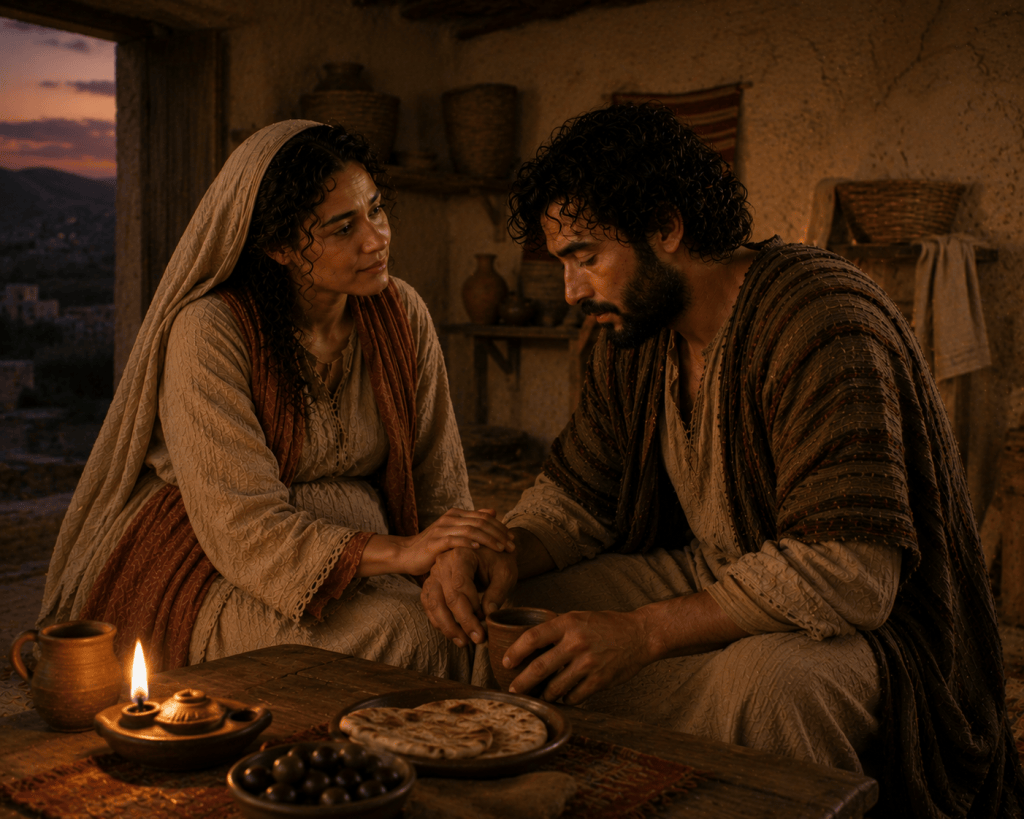
Then Mary quietly placed her hand on the ground between them.
Joseph looked at it.
A moment later, his hand covered hers.
Mary leaned against his shoulder.
Joseph rested his cheek against her hair.
The problem hadn’t vanished.
They would still need to talk.
But the battle was over.
They were on the same side again.
And perhaps, in an ordinary little home in Nazareth, reconciliation sounded less like angels singing—
and more like Mary finally asking:
“Are you hungry?”
Joseph looked at her.
“Very.”
Mary sighed.
“Of course you are.”
And together,
they went inside.

 The Living Rosary Archives