The Invitations of Mary Series
©MS 2026
There are some faces you are afraid to look at when you know you have hurt someone—even when you have done nothing wrong.
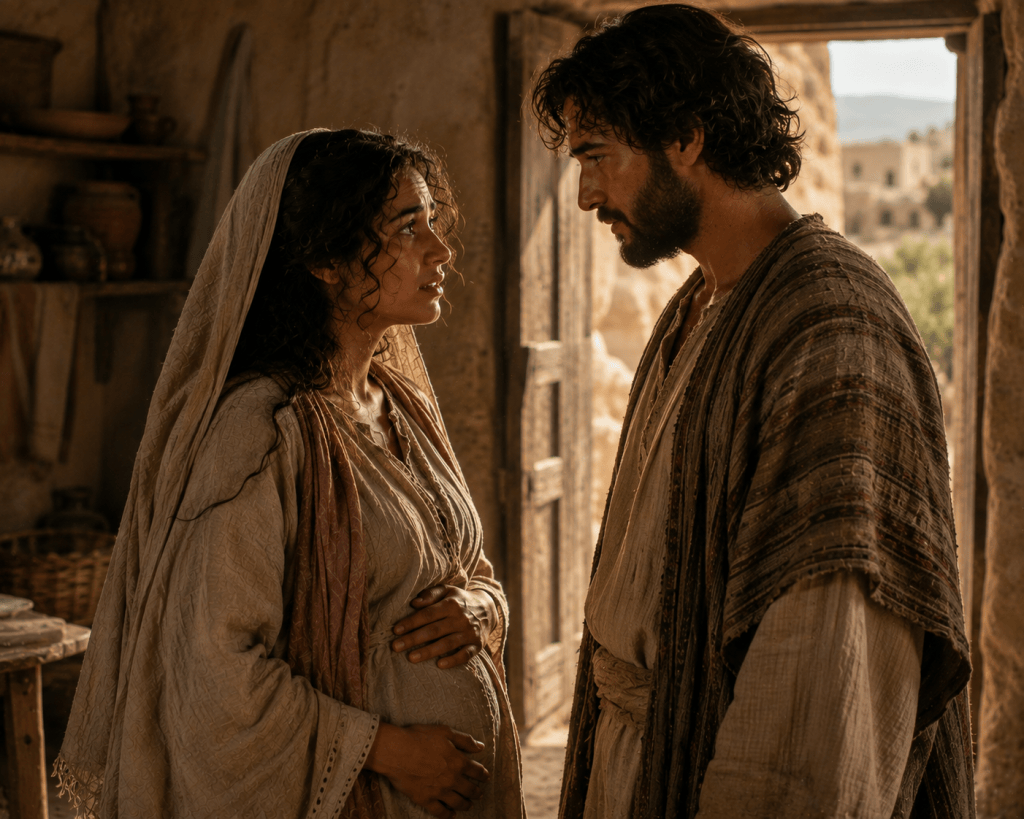
There must have been a moment when Mary saw Joseph again.
Not Joseph before the Annunciation.
Not Joseph before Elizabeth.
Not the man who knew the life they expected to have together.
Joseph after he knew.
Matthew tells us:
“When his mother Mary was betrothed to Joseph, but before they lived together, she was found with child through the Holy Spirit.”
— Matthew 1:18
Then Matthew tells us something painful.
Joseph intended to divorce her.
Quietly.
He was unwilling to expose her publicly, but he apparently did not initially understand what had happened.
Then, in a dream, an angel told him:
“Joseph, son of David, do not be afraid to take Mary your wife into your home. For it is through the Holy Spirit that this child has been conceived in her.”
We know what Joseph did afterward.
He obeyed.
What we don’t know is what happened when Mary next looked at him.
And I cannot stop thinking about that moment.
Because Joseph had received his answer from God.
But Mary wouldn’t necessarily have known that yet.
Perhaps she saw him coming.
Maybe someone told her:
“Joseph is here.”
And everything inside her tightened.
Because Mary had spent months learning to live inside the consequences of Gabriel’s announcement.
She had traveled to Elizabeth.
She had watched her body change.
She had returned home.
Somewhere in all of that, Joseph discovered that she was pregnant.
And however the discovery happened, Mary must have understood what it looked like.
There were very few explanations available.
She had been unfaithful.
That was the obvious one.
The reasonable one.
The human one.
The truth was considerably less believable:
An angel appeared to me and told me I would conceive through the Holy Spirit and that my child is the Son of God.
Imagine saying that to someone you love.
Now imagine watching their face afterward.
We don’t know whether Mary herself told Joseph or whether he learned another way.
Matthew simply says she “was found with child.”
That silence matters.
So we shouldn’t manufacture a conversation Scripture never records and present it as history.
But however Joseph learned, there must eventually have been a moment when Mary understood:
He knows.
And perhaps there had been distance between them afterward.
Maybe hours.
Maybe days.
We don’t know.
But Matthew tells us Joseph had enough time to consider what he should do.
He decided on quiet divorce.
Then he slept.
Then the angel came.
Which means Joseph experienced some period of believing that Mary had betrayed him.
And Mary may have experienced some period of knowing—or fearing—that he believed exactly that.
That thought hurts.
Maybe she had never seen Joseph look at her that way before.
Confused.
Wounded.
Perhaps angry.
Perhaps simply devastated.
We often make Joseph almost superhumanly calm because we know the end of the story.
Joseph is righteous.
Joseph obeys.
Joseph protects Mary.
Joseph raises Jesus.
All true.
But righteousness does not make betrayal painless.
From Joseph’s perspective, before the angel explained anything, the woman he was betrothed to was pregnant with a child he knew was not his.
He may have been heartbroken.
And Mary may have seen it.
She knew she hadn’t betrayed him.
But she couldn’t erase what the situation looked like.
Sometimes innocence doesn’t protect you from watching someone you love hurt because of you.
That may have been its own kind of suffering.
So imagine Mary waiting to see him again.
Maybe she rehearses another explanation.
Maybe she has stopped rehearsing.
There are only so many ways to tell an impossible truth.
Perhaps she has already cried.
Perhaps she is angry.
Perhaps she is tired of explaining herself.
Perhaps she has reached that terrible place where all she can think is:
God, I did what you asked me to do.
Now what?
Then footsteps.
Joseph.
Mary looks up.
And immediately—
something is different.
Maybe Joseph’s face isn’t what she expected.
There is no accusation.
No coldness.
No careful distance.
Instead, he walks toward her.
Perhaps quickly.
Mary doesn’t understand.
She braces herself anyway.
“Joseph—”
And he says:
“I know.”
Two words.
That’s how I imagine it.
Not because Scripture tells us he said them.
It doesn’t.
But because I wonder what two words could have meant more to Mary at that moment.
I know.
Not:
I know you’re pregnant.
He already knew that.
I know what happened.
I know you told me the truth.
I know this child is not evidence of your betrayal.
I know you have not made a fool of me.
I know God is doing something neither of us understands.
I believe you.
What would Mary’s body have done with that relief?
Maybe her knees nearly gave way.
Maybe she started crying before she could stop herself.
Not delicate tears.
Not the beautiful single tear sliding down the cheek of a statue.
Maybe the horrible, breathless crying that comes when you’ve been holding yourself together for too long and suddenly discover you don’t have to anymore.
Perhaps Joseph wasn’t expecting that.
Maybe he reached for her.
Maybe Mary hesitated.
Because what had happened between them couldn’t simply disappear.
Even though neither had done anything wrong, something had been wounded.
Joseph had believed she betrayed him.
Mary had known he might.
An angel had fixed the misunderstanding.
But angels do not erase the emotional experience that preceded them.
Maybe Mary looked at Joseph and asked the question she desperately needed answered:
“You believe me?”
Joseph nodded.
“Yes.”
Perhaps she asked again.
“You believe me?”
Because sometimes relief is too enormous to trust the first time.
“Yes.”
And maybe then she cried.
Or perhaps she was angry first.
I think we should allow her that possibility too.
Joseph approaches differently.
He tells her about the dream.
The angel.
The words.
Do not be afraid to take Mary your wife into your home.
And Mary listens.
Then perhaps there is a long silence.
Joseph expects relief.
Instead Mary says:
“You needed an angel?”
Oh.
Maybe not the response Joseph expected.
Mary stares at him.
“I told you.”
“I know.”
“You didn’t believe me.”
“Mary—”
“You thought I—”
She can’t even finish.
Because now that the danger has passed, maybe she finally has enough room to feel how badly it hurt.
And Joseph doesn’t defend himself.
What could he say?
Your explanation was difficult to believe?
It was.
They both know that.
Maybe he says:
“I am sorry.”
And Mary knows he has nothing to apologize for logically.
But emotionally?
Perhaps she needs to hear it anyway.
Maybe she laughs through tears because the absurdity finally becomes too much.
“Apparently angels have to explain everything in this family.”
Joseph almost smiles.
“That seems to be becoming a problem.”
And perhaps the tension breaks just enough for both of them to breathe.
There is something else I wonder about.
Did Joseph tell Mary that he had planned to divorce her?
Matthew tells us.
Did Mary know?
Perhaps she did.
If so, imagine hearing that the man you expected to marry had decided to leave you.
Quietly.
Kindly, by the standards available to him.
But still—
leave.
Maybe Mary understood.
That doesn’t mean it didn’t hurt.
Perhaps when Joseph explained the dream, he also had to explain the decision that came before it.
“I was going to end the betrothal.”
Mary looks down.
“I thought you might.”
“I didn’t want to expose you.”
“I know.”
That might have made it worse somehow.
Because even when Joseph thought Mary had betrayed him, he had tried to protect her.
That tells us something about him.
Maybe it told Mary something too.
This was the man who would raise Jesus.
A man who, while heartbroken, chose mercy.
A man who believed himself wronged and still refused to use Mary’s vulnerability to punish her.
Mary may have looked at Joseph differently after that.
Not because he had doubted her.
Because of what he did with his doubt.
And then there was the child.
Until now, the pregnancy had been Mary’s bodily reality.
Joseph knew about it.
But after the dream, perhaps something changed.
Jesus became their responsibility.
Not biologically.
Not in the same way.
But Joseph had been given a choice.
The angel said:
Do not be afraid to take Mary your wife into your home.
Joseph could now step forward knowingly.
He knew the child wasn’t his.
He knew the circumstances were extraordinary.
And he stayed.
I wonder if Mary understood immediately what that meant.
Joseph wasn’t merely choosing her.
He was choosing Jesus too.
Her hand might have moved instinctively toward her abdomen.
Perhaps Joseph’s eyes followed.
For the first time, there was no suspicion in his face when he looked there.
Only uncertainty.
Wonder.
Maybe fear.
Maybe Mary noticed.
She might have taken his hand.
Then stopped.
Because this was new.
“Do you want to?”
Joseph looks at her.
She guides his hand toward the small curve beneath her clothing.
Maybe there was nothing to feel yet.
Maybe Jesus wasn’t moving.
It didn’t matter.
Joseph’s hand rested there.
And perhaps Mary watched his face.
The man who had spent the previous day believing this child represented the destruction of their future was now touching the place where that child grew.
What do you say?
Perhaps nothing.
Maybe some moments are too large for speech.
Joseph must have been afraid too.
The angel’s first words to him were:
“Do not be afraid.”
Gabriel had told Mary the same thing.
That almost makes me smile.
Apparently the first stage of the Incarnation involved God repeatedly telling terrified human beings:
Please stop panicking.
Mary had been afraid.
Joseph had been afraid.
They had different fears.
Mary feared what was happening to her.
Joseph feared what he believed had happened between them.
Now they stood together with a future neither had planned.
Maybe Mary finally realized:
I’m not carrying this alone anymore.
Not Jesus.
She alone carried him physically.
But the consequences?
The questions?
The practical problems?
The whispers?
The future?
Joseph had stepped into them with her.
That must have changed something.
Perhaps they sat down.
And for the first time, actually talked.
Not Mary trying desperately to convince him.
Not Joseph trying to understand something impossible.
Just two people who now possessed the same unbelievable information.
“What did the angel say?”
Mary asks.
Joseph tells her.
She listens closely.
Maybe she interrupts.
“He said that?”
“Yes.”
“What else?”
Joseph tells her that the child will save his people from their sins.
Mary goes quiet.
Gabriel had told her Jesus would be great.
Son of the Most High.
King.
Joseph had been told something else.
Savior.
Maybe they began assembling the pieces together.
Her angel.
His dream.
Elizabeth.
Zechariah.
John.
Jesus.
Two ordinary people sitting in an ordinary room realizing that God had apparently entrusted them with something enormous and provided remarkably few practical instructions.
Perhaps Mary finally asked:
“What do we do now?”
Joseph looked at her.
Maybe he almost laughed.
Because surely one of the angels could have included that part.
“I don’t know.”
And perhaps that was the first honest foundation of their life together.
Neither knew.
They would figure it out.
I think we sometimes imagine Joseph’s dream as the moment all the difficulty disappeared.
Angel appears.
Joseph understands.
Problem solved.
But relationships don’t work like theological equations.
Joseph’s knowledge changed instantly.
His emotions may not have.
Mary’s fear didn’t necessarily vanish because Joseph believed her.
Trust had been strained by circumstances neither of them created.
There may have been awkwardness.
Silences.
Questions.
Perhaps Joseph occasionally looked at Mary and still struggled to comprehend what he had accepted.
Perhaps Mary occasionally remembered that he had once believed the worst.
And then they kept choosing one another anyway.
Maybe that matters.
Holy relationships don’t have to be relationships in which nothing difficult ever happens.
Sometimes holiness is what people do after the difficult thing.
Joseph listened.
Mary stayed.
They talked.
They trusted.
They built something from an impossible beginning.
But I keep returning to Mary’s first look at his face.
Because she would have been searching it.
Before he said anything.
Humans do that.
We look for the answer before the person gives it.
Anger?
Disgust?
Distance?
Pity?
And perhaps Mary found none of them.
Maybe she found the Joseph she knew.
Tired.
Shaken.
Still confused.
But there.
Still there.
I wonder whether that was the moment she finally exhaled.
Not when Gabriel said do not be afraid.
Not when Elizabeth called her blessed.
Not even when she reached home safely.
When Joseph looked at her—
and stayed.
Maybe Mary had spent weeks preparing herself to lose him.
Instead, he stepped closer.
Perhaps he didn’t say anything profound.
Joseph isn’t recorded saying a single word anywhere in the Gospels.
So maybe we should let him remain beautifully consistent.
Perhaps he simply reached for Mary’s hand.
She looked down at their hands.
Then back at him.
And understood.
He knew.
He believed her.
He was staying.
The future was still terrifying.
People might still talk.
They still had no idea how to raise the Son of God.
Rome still occupied their country.
Mary was still unexpectedly pregnant.
Nothing about the situation had become simple.
But something had changed.
She wasn’t standing in it alone anymore.
Perhaps she squeezed Joseph’s hand.
Perhaps he squeezed back.
And for the first time since Gabriel entered her life, Mary looked at the man she had expected to build an ordinary future with and understood:
There would be no ordinary future.
Not now.
Maybe there never had been.
But there could still be a future.
Together.
And perhaps, after everything she had feared on that long road home, that was enough.


