The Invitations of Mary Series
©MS 2026
Eventually, after the angels and impossible explanations, somebody still had to decide what to eat.
Perhaps normality returned so quietly they almost missed it.
Not all at once.
There was no moment when Mary and Joseph looked at one another and declared:
Well. That’s settled. Back to normal.
There was no normal to go back to.
Mary was pregnant.
Joseph knew the child wasn’t his.
Mary knew Joseph had considered ending their betrothal.
Joseph had received an angelic dream telling him that Mary’s impossible explanation was true.
The child she carried had been conceived through the Holy Spirit.
He would save his people from their sins.
Everything had changed.
Their marriage.
Their future.
Their expectations.
Their understanding of God.
Perhaps even the way they looked at one another.
And yet—
human beings cannot remain forever inside enormous moments.
Eventually someone gets hungry.
Maybe that was how it happened.
They had been talking for what felt like hours.
Or perhaps they had been sitting in uncomfortable silence.
Mary had told Joseph what Gabriel said.
Joseph had told Mary about his dream.
They had probably gone over details more than once.
“What exactly did he say?”
“What did he look like?”
“Were you awake?”
“No.”
“You’re certain it wasn’t just a dream?”
Joseph gives her a look.
Mary realizes what she has just asked.
“Oh.”
“Yes.”
“Sorry.”
“Thank you.”
Perhaps that almost made them laugh.
Almost.
But not yet.
There was still too much between them.
Then Mary’s stomach growled.
Loudly.
Not a delicate little sound.
A full, undeniable bodily interruption.
Joseph looked at her.
Mary closed her eyes.
“No.”
Joseph’s mouth twitched.
“Don’t.”
“I didn’t say anything.”
“You were going to.”
“I wasn’t.”
“You absolutely were.”
And perhaps for the first time since everything went wrong—
Mary smiled.
Just a little.
Joseph smiled too.
Then he asked:
“Have you eaten?”
And somehow that question was easier than everything else.
Maybe Mary hadn’t.
Anxiety has a way of rearranging appetite.
Perhaps she had been too nervous to eat properly before seeing him.
Now that Joseph believed her, her body apparently decided the crisis had ended and resumed making demands.
“Not since this morning.”
Joseph frowned.
Mary recognized the expression.
There.
That was familiar.
Not Joseph trying to understand divine conception.
Not Joseph deciding whether he could marry her.
Just Joseph being annoyed because Mary hadn’t eaten.
“You need to eat.”
“I know.”
“You said that last time.”
“I did eat eventually.”
“That isn’t the point.”
And suddenly—
there they were.
For thirty seconds, they were themselves again.
Maybe Mary felt such relief that it almost hurt.
What did normal conversation look like between Mary and Joseph before the Annunciation?
We have no idea.
Scripture doesn’t preserve a single conversation between them.
In fact, Scripture doesn’t record a single spoken word from Joseph at all.
So everything here is imagination.
But they were real people.
Whatever their betrothal looked like within their first-century Jewish culture, they had surely spoken about ordinary things.
Family.
Work.
Food.
Neighbors.
Plans.
Things that needed repairing.
Things that cost too much.
Who said what to whom.
Weather.
Maybe Joseph talked about wood.
Probably more than Mary actually wanted to hear about wood.
Maybe Mary occasionally regretted asking how his day went because Joseph would begin explaining something involving a joint, a tool, and why someone had done something incorrectly.
She would listen.
For a while.
Then:
“Joseph.”
“Yes?”
“I don’t know what any of those words mean.”
Perhaps he laughed.
Maybe that was normal.
And after angels entered their relationship, I wonder how desperately they both wanted something ordinary again.
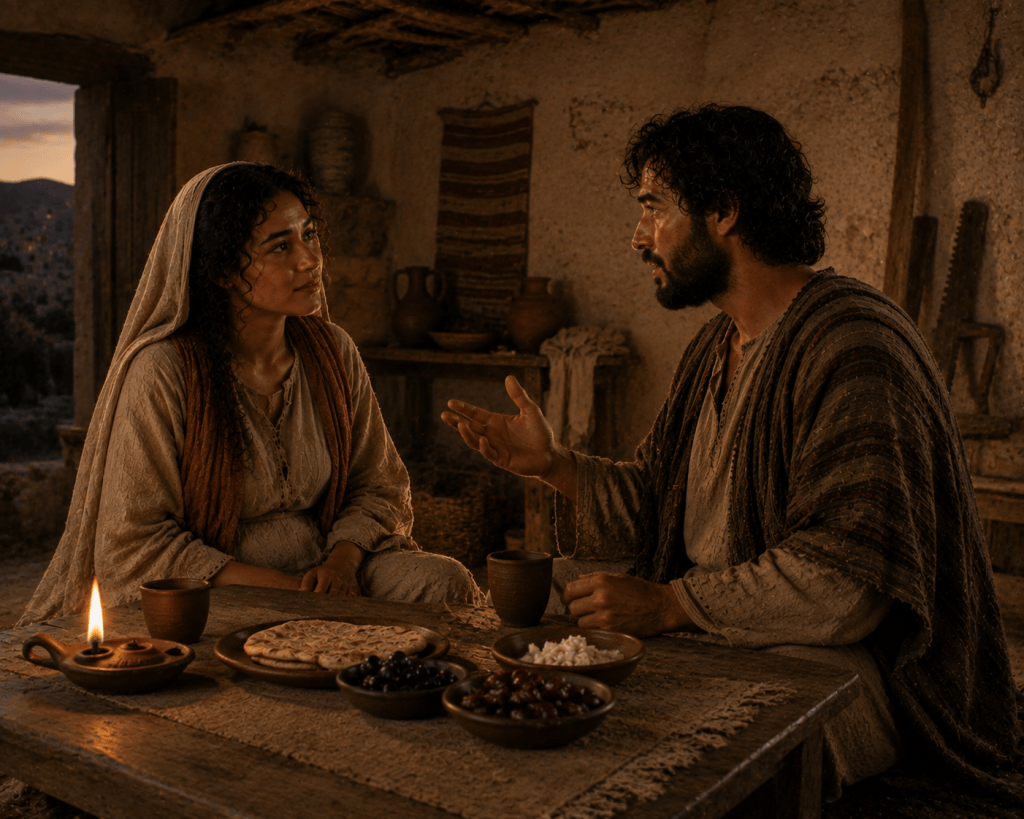
Maybe Joseph found food.
Bread.
Olives.
Cheese.
Dates.
Whatever was available.
Nothing ceremonial.
Nothing symbolic.
Just dinner.
Mary sat.
Joseph sat across from her.
And suddenly there was another problem.
They had run out of extraordinary things to discuss.
There is a particular awkwardness that comes after a serious conversation finally ends.
Everything important has been said.
Nobody knows what should come next.
Perhaps Joseph tore a piece of bread.
Mary did the same.
Silence.
They ate.
More silence.
Then Joseph said:
“The roof still leaks.”
Mary looked up.
“What?”
“The roof.”
She stared at him.
“It still leaks.”
“Yes.”
A pause.
“You’re telling me about the roof?”
Joseph looked uncertain.
“I suppose.”
Mary began laughing.
Not because the roof was funny.
Because yesterday their relationship was potentially ending.
Today they were discussing the Messiah.
And now Joseph was complaining about a roof.
He looked slightly offended.
“It does leak.”
“I believe you.”
“You’re laughing.”
“I know.”
“It needs fixing.”
That made it worse.
Mary covered her mouth.
Joseph tried to remain serious.
He failed.
And maybe that was the first real crack in the tension.
Perhaps Joseph laughed too.
Quietly at first.
Then they looked at each other and realized how absurd their lives had become.
An angel had appeared to Mary.
An angel had appeared to Joseph in a dream.
Mary’s elderly relative was miraculously pregnant.
Her husband had temporarily lost his ability to speak.
Mary was carrying the Son of God.
And the roof leaked.
Of course it did.
Because apparently God could rearrange salvation history without repairing anyone’s roof.
Mary finally caught her breath.
“You’d think Gabriel could have mentioned it.”
Joseph stared at her.
“The roof?”
“He was already there.”
That did it.
Maybe Joseph laughed harder than she had heard him laugh in weeks.
And suddenly the room felt different.
I think Mary might have needed that.
Not merely Joseph believing her.
She needed Joseph back.
The familiar person.
The man whose expressions she knew.
The man she could tease.
The man who irritated her in predictable ways.
The man she expected to share meals with and complain about chores to.
Because Joseph’s acceptance of Jesus didn’t magically return their relationship to what it had been.
They had crossed something together.
Before, they had been two people preparing for marriage.
Now there was a child between them.
Not metaphorically.
Literally.
And that child had already transformed their lives before either of them had held him.
Perhaps normal conversation was the first evidence that Mary and Joseph could still find one another inside all of that.
Maybe they started talking about Elizabeth.
That was safe.
“How is she?”
“Very pregnant.”
Joseph smiled.
“That bad?”
Mary thought about it.
“She dropped something once and just stared at it.”
Joseph looked confused.
“She couldn’t pick it up?”
“She could.”
“Then why—”
“She decided it wasn’t worth having anymore.”
Joseph laughed.
Mary smiled.
“You’ll understand eventually.”
“Why will I understand?”
Mary gave him a look.
Because eventually she would be that pregnant.
Joseph’s expression changed as the realization arrived.
“Oh.”
Mary nodded.
“Oh.”
There was another silence.
But this one wasn’t uncomfortable.
Joseph glanced at Mary’s abdomen.
Only subtly changed.
Then back at her.
Perhaps they both thought the same thing.
We’re really doing this.
Maybe Joseph asked the practical question neither angel had bothered answering.
“When?”
Mary frowned.
“When what?”
“The baby.”
“Oh.”
She calculated.
Maybe Elizabeth had helped her estimate.
She told him.
Joseph immediately began thinking.
Mary could see it happening.
Work.
Money.
Space.
What needed building.
What needed preparing.
Maybe she recognized that expression too.
“Don’t.”
Joseph looked at her.
“Don’t what?”
“You’re planning.”
“We need a plan.”
“We have time.”
“How much?”
Mary told him again.
Joseph clearly did not consider this sufficient time.
Maybe Mary smiled.
This was familiar too.
Joseph worrying through logistics.
Mary telling him they would manage.
Perhaps before Gabriel, they had discussed where they would live.
What their household might need.
Maybe they had imagined children someday.
Now someday had arrived with alarming efficiency.
“What do babies need?”
Joseph might have asked.
Mary stared at him.
“You’re asking me?”
“You’ve been with Elizabeth.”
“She hasn’t had hers yet.”
“Oh.”
“She is approximately six months more qualified than we are.”
Joseph considered that.
“So she knows?”
“No.”
“Ah.”
Maybe they both sat with that for a moment.
Two first-time parents.
No manual.
No experienced Elizabeth secretly holding all the answers.
Just families, community, observation, tradition, and whatever people had been doing with babies since people began having them.
Joseph looked worried.
Mary reached across the table.
“We’ll learn.”
Maybe he looked at her hand over his.
Then nodded.
“We’ll learn.”
And perhaps that was enough.
Maybe their conversation became progressively more ordinary as the evening continued.
Someone in the village had gotten married.
Someone else had been arguing with a neighbor.
A customer still owed Joseph money.
Mary remembered something ridiculous Elizabeth had said.
Joseph told her something that happened while she was gone.
Mary complained about the journey home.
Joseph asked whether her feet hurt.
“Yes.”
“Why didn’t you say something?”
“To whom, Joseph? You weren’t there.”
“Right.”
Another awkward moment.
Then Mary smiled.
“I’m saying it now.”
Joseph nodded solemnly.
“Your feet hurt.”
“Terribly.”
“I’m sorry.”
“Thank you.”
Maybe that was what healing looked like.
Not one dramatic reconciliation.
Hundreds of tiny returns.
At some point, perhaps Mary forgot to be careful.
That’s how I imagine she knew things were beginning to mend.
For days—or however long the misunderstanding lasted—she may have monitored every word.
Every expression.
Every movement.
Does Joseph believe me?
Is he angry?
Is he leaving?
What is he thinking?
But eventually she said something without considering how it might sound.
Then something else.
She interrupted him.
He interrupted her.
She rolled her eyes.
He sighed.
And suddenly Mary realized:
I haven’t been afraid for the last ten minutes.
What an extraordinary relief that must have been.
Normality isn’t always boring.
Sometimes normality is the thing you desperately want back after you’ve nearly lost it.
Perhaps there was one moment when they both remembered again.
Mary laughed.
Joseph looked at her.
And his eyes drifted toward her abdomen.
The laughter softened.
There he was.
Jesus.
Still invisible except for the smallest change in Mary’s body.
Still months from birth.
And yet already present in every conversation.
Mary followed Joseph’s gaze.
Maybe she placed a hand there.
Joseph asked:
“Do you feel different?”
Mary thought.
“Yes.”
“How?”
She tried to explain.
Tired.
Sometimes nauseous.
Her body felt strange.
Her clothes fit differently.
Sometimes she simply felt pregnant in a way she couldn’t describe.
Joseph listened.
Then perhaps he asked:
“Are you afraid?”
Mary looked at him.
“Yes.”
He nodded.
“So am I.”
No angelic reassurance followed.
No voice from Heaven.
Just two frightened people sitting at a table.
Maybe Mary smiled.
“Good.”
Joseph blinked.
“Good?”
“I’d be concerned if I were the only one.”
He laughed.
And perhaps they understood something then.
They did not have to become fearless to do this.
They only had to keep going.
Together.
Eventually the food was gone.
The light was fading.
Joseph would have to leave, depending upon where they were in their betrothal and living arrangements.
Perhaps neither wanted to end the conversation.
Not because it had been profound.
Because it hadn’t.
That was the gift.
For the first time since Mary returned, they had spoken without defending, explaining, deciding, or surviving.
They had talked about food.
Elizabeth.
Work.
A leaking roof.
Mary’s aching feet.
The baby.
Tomorrow.
Tomorrow.
Maybe that was the most important word of all.
Because people only discuss tomorrow when they expect there to be one together.
Joseph stood.
Mary walked him toward the doorway.
Perhaps there was still a trace of awkwardness.
Their relationship wasn’t magically repaired.
Trust, even when damaged by circumstances rather than wrongdoing, sometimes needs time to settle back into place.
But before Joseph left, maybe he turned.
“The roof.”
Mary stared at him.
“What about it?”
“I’ll fix it.”
She smiled.
“I’m relieved.”
“It was bothering you.”
“It wasn’t.”
“You laughed.”
“I laughed because you started discussing roof repairs after telling me an angel appeared to you.”
Joseph considered this.
“Fair.”
Then maybe Mary added:
“Joseph?”
He turned.
“I’m glad you’re here.”
That one wasn’t ordinary.
Not entirely.
Joseph’s expression softened.
“So am I.”
And he left.
Mary stood in the doorway for another moment.
Then perhaps she looked around the little room.
Nothing had returned to normal.
It never would.
The future she had expected before Gabriel was gone.
She and Joseph would never again be the two people they had been before all of this happened.
But perhaps that evening Mary discovered something better than returning to normal.
They could make a new one.
One where angels occasionally destroyed their plans.
One where impossible children arrived before expected.
One where they were frightened and confused and sometimes hurt one another without meaning to.
One where the roof still leaked.
One where dinner still needed eating.
One where Joseph could make Mary laugh.
One where tomorrow still belonged to both of them.
Perhaps holiness didn’t mean living forever inside extraordinary moments.
Maybe holiness also looked like sitting across from someone after everything had changed and asking:
“Have you eaten?”
And beginning again.


