The Invitations of Mary Series
©MS 2026
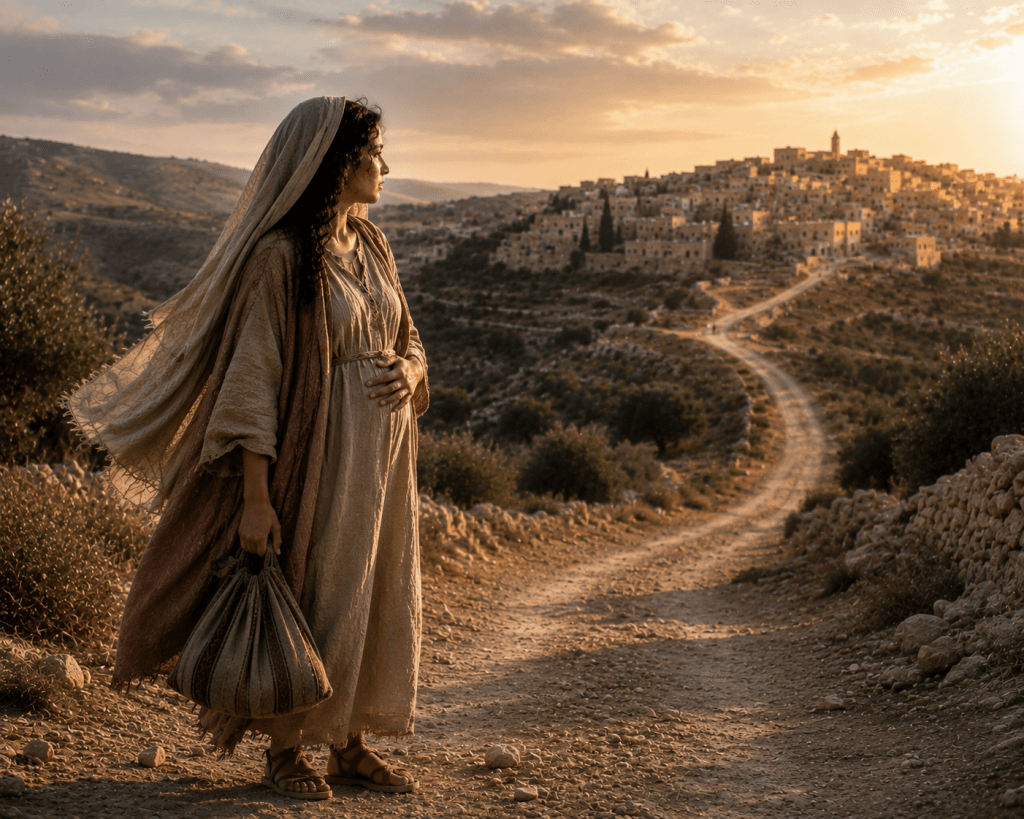
She had arrived carrying a secret. She may have returned carrying evidence.
Mary stayed with Elizabeth for about three months.
Luke gives the departure exactly one sentence:
“And Mary remained with her about three months and then returned to her home.”
— Luke 1:56
That’s it.
Mary went home.
Four words in English that conceal an enormous moment.
Because the Mary who traveled into the Judean hill country was not necessarily the Mary who traveled back.
When she arrived at Elizabeth’s house, she was newly pregnant.
Perhaps nobody looking at her would have known.
She could move through the world carrying this astonishing truth completely inside herself.
Gabriel knew.
Elizabeth knew.
Zechariah knew something extraordinary was happening.
Mary knew.
But her body had not necessarily begun telling anyone else.
Three months later?
That may have changed.
We don’t know exactly how far along Mary was when she reached Elizabeth, nor how visibly pregnant she was when she left. Pregnancy develops differently from woman to woman.
But if she conceived around the Annunciation and remained with Elizabeth approximately three months, it is entirely plausible that by the time she returned to Nazareth, Mary was beginning to show.
Perhaps only a little.
Perhaps enough.
And I wonder what it felt like when Mary realized:
I have to go home now.
Maybe she delayed leaving by a day.
Not because she didn’t want to return.
Because Elizabeth’s house had become safe.
For three months, Mary had lived somewhere she didn’t have to explain herself.
Elizabeth believed her before Mary had even explained.
The moment Mary entered the house, Elizabeth cried:
“And how does this happen to me, that the mother of my Lord should come to me?”
No interrogation.
No suspicion.
No demand for proof.
Elizabeth simply knew.
Imagine what that must have felt like.
Mary had received perhaps the most unbelievable announcement ever given to a human being—
and then walked into a house where someone believed her.
For three months she could breathe.
She could ask questions.
She could be frightened.
She could laugh.
She could complain about pregnancy.
She could watch Elizabeth’s body preparing for birth while her own slowly began to change.
And perhaps every morning, when Mary dressed, the evidence became slightly more difficult to ignore.
The fabric fell differently.
The ties needed adjusting.
The curve beneath her clothing became less ambiguous.
At Elizabeth’s house, that was beautiful.
On the road home?
It meant something else.
Because Nazareth was waiting.
I wonder whether Elizabeth noticed Mary’s fear before Mary said anything.
Maybe they were preparing for her departure.
Food for the journey.
Clothing folded.
Whatever Mary had brought gathered together.
Elizabeth was enormous by then, nearing the end of her own pregnancy.
Mary adjusted her garment.
Then adjusted it again.
Elizabeth watched.
Mary caught her looking.
“What?”
Elizabeth didn’t answer immediately.
Mary looked down.
Her hands moved instinctively across her abdomen.
And perhaps there it was.
Not enormous.
Not the dramatically rounded belly of Nativity paintings.
Just enough.
Enough that someone who knew Mary might look twice.
Mary whispered:
“They’re going to know.”
And Elizabeth had no comforting lie to offer.
“Yes.”
That’s a frightening word sometimes.
Yes.
The same word Mary had given Gabriel.
Now she had to live inside everything that yes had created.
We often celebrate Mary’s fiat at the Annunciation as though saying yes were the difficult part.
Maybe it was.
But sometimes saying yes is easier than walking home afterward.
The angel has gone.
The revelation is over.
The sacred moment has passed.
And now you have to return to ordinary people who didn’t hear what you heard.
You have to explain the consequences of something they didn’t witness.
You have to live publicly with a decision you made privately with God.
Mary could tell them Gabriel appeared.
Would they believe her?
She could tell them the Holy Spirit came upon her.
Would that explanation help?
She could tell them her child was the Son of the Most High.
How would that sound?
Perhaps even Mary understood how impossible her story was.
Especially now that her body was beginning to require an explanation.
We don’t know precisely when Joseph learned Mary was pregnant.
Matthew tells us that Mary was found to be with child through the Holy Spirit before she and Joseph lived together.
Joseph, believing she had been unfaithful, intended to divorce her quietly until an angel appeared to him in a dream.
Luke doesn’t tell us how that discovery unfolded.
So we should be careful not to fill the silence with certainty.
But somewhere in this period, Mary had to face Joseph.
And I cannot imagine that journey home without wondering whether she rehearsed what she would say.
Maybe for miles.
Joseph, I need to tell you something.
No.
Something happened before I left.
Worse.
An angel came to me.
How does anyone continue after that?
Perhaps Mary practiced the entire explanation in her head.
Gabriel.
The greeting.
Her fear.
The promise.
Her question.
The Holy Spirit.
Her yes.
Elizabeth.
All of it.
Then imagined Joseph’s face.
And stopped.
Maybe she tried again later.
There are conversations we rehearse a hundred times because every possible beginning feels inadequate.
Mary may have known that no arrangement of words could make this sound reasonable.
She could only tell the truth.
And hope the person she loved believed her.
Perhaps that frightened her more than gossip.
We tend to talk about Mary’s social risk broadly.
What would the village think?
What would people say?
Those questions mattered.
But villages are abstractions.
Joseph was not.
He had a face.
A voice.
A history with her.
Whatever their betrothal looked like, Mary knew this man.
Perhaps she knew exactly how his expression changed when he was confused.
Maybe she knew what he looked like when something hurt him.
And perhaps, walking home, she imagined being the cause of that expression.
Not because she had betrayed him.
Because he might believe she had.
That is a different kind of pain.
To tell the truth and know it sounds exactly like a lie.
Maybe Mary was angry about that.
We rarely allow her anger.
But perhaps somewhere on that road she thought:
Couldn’t Gabriel have appeared to Joseph too?
Immediately?
Would that really have been so difficult?
One angel.
One additional stop.
“Hello, Joseph. Before Mary gets home, there is something you should know.”
Problem solved.
Instead, according to Matthew, Joseph received his angelic explanation only after he was already considering ending the marriage.
Why?
We don’t know.
Perhaps Mary wondered too.
She had said yes.
She was doing what God asked.
And still she might have to endure being misunderstood.
That’s something faith doesn’t always advertise very well.
Obedience does not guarantee that other people will understand you.
Sometimes you can be exactly where you believe God called you to be—
and still look completely wrong from the outside.
Mary may have learned that very early.
The journey itself would have taken days.
Nazareth and the Judean hill country were separated by considerable distance. The exact route and circumstances of Mary’s travel aren’t recorded, and we don’t know who accompanied her.
So imagine the road without pretending we know the itinerary.
Dust.
Heat.
Hills.
Villages.
Other travelers.
Nights spent somewhere along the way.
And Mary walking north.
Home getting closer.
Maybe the first days were easier.
Nazareth still felt distant.
Then familiar landscapes began appearing.
Places she recognized.
Roads she had traveled before.
The distance between herself and the conversation she dreaded shrinking with every mile.
There is a particular anxiety in returning somewhere when you know your life there is about to change.
The place hasn’t changed.
You have.
Perhaps Mary passed people traveling in the opposite direction.
Nobody noticed her.
Or maybe someone did.
A stranger’s eyes lingered for half a second on her abdomen.
Mary instinctively pulled her outer garment closer.
Not yet.
Please.
Not yet.
And then perhaps she felt Jesus move.
Depending on the chronology and Mary’s stage of pregnancy, it may have been too early for unmistakable movement; we simply don’t know.
But if she could feel him by then, imagine the timing.
Mary is walking, frightened about what awaits her.
Her mind racing.
Joseph.
Family.
Neighbors.
Explanations.
Consequences.
And then—
a flutter.
A small movement beneath her ribs or low in her abdomen.
Mary stops.
Her hand finds the place automatically.
Everything else becomes quiet for a moment.
You.
That’s why she’s going home.
Not because she has an argument to win.
Not because she needs to convince Nazareth of anything.
Because she is carrying Jesus.
Perhaps the movement reminded her of something she’d temporarily lost beneath all the fear:
This wasn’t merely a scandal she had to survive.
This was her child.
Maybe she smiled.
“Your timing could be better.”
Another tiny movement.
Perhaps Mary laughed despite herself.
Then kept walking.
I wonder whether she missed Elizabeth almost immediately.
There are people who become safe places during strange seasons of our lives.
Leaving them feels like losing shelter.
Perhaps the first night away, Mary instinctively thought of something she wanted to tell Elizabeth.
Then remembered she couldn’t.
Maybe she had become accustomed to Elizabeth’s voice.
Her advice.
Her laughter.
The ridiculous domestic pantomime of Zechariah trying to communicate.
The comfort of another pregnant body nearby.
Now Mary was alone with her thoughts again.
Maybe she cried.
Not dramatically.
Just quietly.
Because sometimes courage looks remarkably similar to homesickness.
And perhaps Elizabeth had given her something before she left.
Not necessarily an object.
Maybe words.
At their goodbye, perhaps Mary admitted:
“I’m afraid.”
Elizabeth didn’t tell her not to be.
Gabriel had already done that.
Maybe Elizabeth simply said:
“I know.”
There is enormous mercy in that answer.
Not don’t worry.
Not everything will be fine.
Not God has a plan.
Just:
I know.
Maybe she took Mary’s hands.
“Tell the truth.”
“What if they don’t believe me?”
Elizabeth couldn’t promise they would.
So perhaps she said:
“Then the truth is still the truth.”
Mary may not have found that particularly comforting either.
But she might have carried it home.
Eventually, Nazareth appeared.
Maybe from a rise in the road.
The familiar cluster of homes.
Smoke.
Fields.
People.
Home.
Mary stopped.
Perhaps whoever traveled with her kept moving for several steps before realizing she had fallen behind.
There it was.
Everything she knew.
And suddenly the road she had spent days wanting to finish became a road she wasn’t quite ready to leave.
Because once she entered the village, the waiting ended.
Someone would see her.
Someone would ask.
Eventually Joseph would know.
Perhaps Mary stood there with one hand resting against the small curve of her abdomen.
She could turn around.
Not realistically.
But emotionally.
For one second, maybe every frightened part of her wanted to walk straight back to Elizabeth’s house.
Where she was believed.
Where she was safe.
Where nobody looked at her body and wondered whose child she carried.
Instead, she looked at Nazareth.
And kept walking.
I think about that more than Gabriel sometimes.
We celebrate the courage required for Mary’s yes.
But there was courage in this too.
Going home.
Gabriel wasn’t beside her now.
Elizabeth wasn’t beside her.
There was no heavenly light around her.
No choir.
No one announcing:
Make way. This woman is carrying the Messiah.
She probably looked like what she was:
a very young Jewish woman coming home visibly—or nearly visibly—pregnant.
And perhaps frightened.
She had no control over what anyone would think.
She had no ability to make Joseph believe her.
She could not manage every whisper.
She could not protect herself from every judgment.
She could only walk into the village carrying the truth inside her.
Literally.
Maybe that’s another kind of fiat.
Not the beautiful one we paint.
The second yes.
The third.
The hundredth.
Yes, I will go home.
Yes, I will tell him.
Yes, I will let myself be seen.
Yes, I will live with what follows.
Perhaps faith is rarely one enormous yes.
Maybe it’s the same yes repeated after the angel leaves.
On dusty roads.
In difficult conversations.
When people misunderstand.
When the evidence becomes visible.
When turning around would be easier.
I imagine Mary reaching the edge of Nazareth.
Someone sees her.
Maybe a familiar voice calls:
“Mary!”
Her stomach drops.
She turns.
Smiles.
Answers.
For a few more seconds, everything is ordinary.
Perhaps the person asks about Elizabeth.
“How is she?”
“Well.”
“And the baby?”
“Strong.”
Mary smiles because that part is easy.
Then the person’s eyes move downward.
Maybe they don’t react.
Maybe they haven’t noticed.
Maybe Mary’s clothing still conceals enough.
Not today.
Relief.
Or perhaps there is the smallest pause.
A glance.
Then back to Mary’s face.
And Mary knows.
It has begun.
She adjusts the bundle she’s carrying.
Her hand brushes her abdomen.
Then she walks on.
Toward home.
Toward Joseph.
Toward whatever comes next.
Three months earlier, Mary had traveled away carrying a secret nobody could see.
Now she returned carrying a truth that was slowly becoming impossible to hide.
And perhaps somewhere during those final steps, frightened and exhausted and wishing Elizabeth were still beside her, Mary remembered the words that had begun all of this:
Do not be afraid.
Maybe she wasn’t suddenly unafraid.
Maybe courage never required that.
Perhaps she simply whispered:
“I know.”
And walked the rest of the way home.


