The Invitations of Mary
©MS 2026
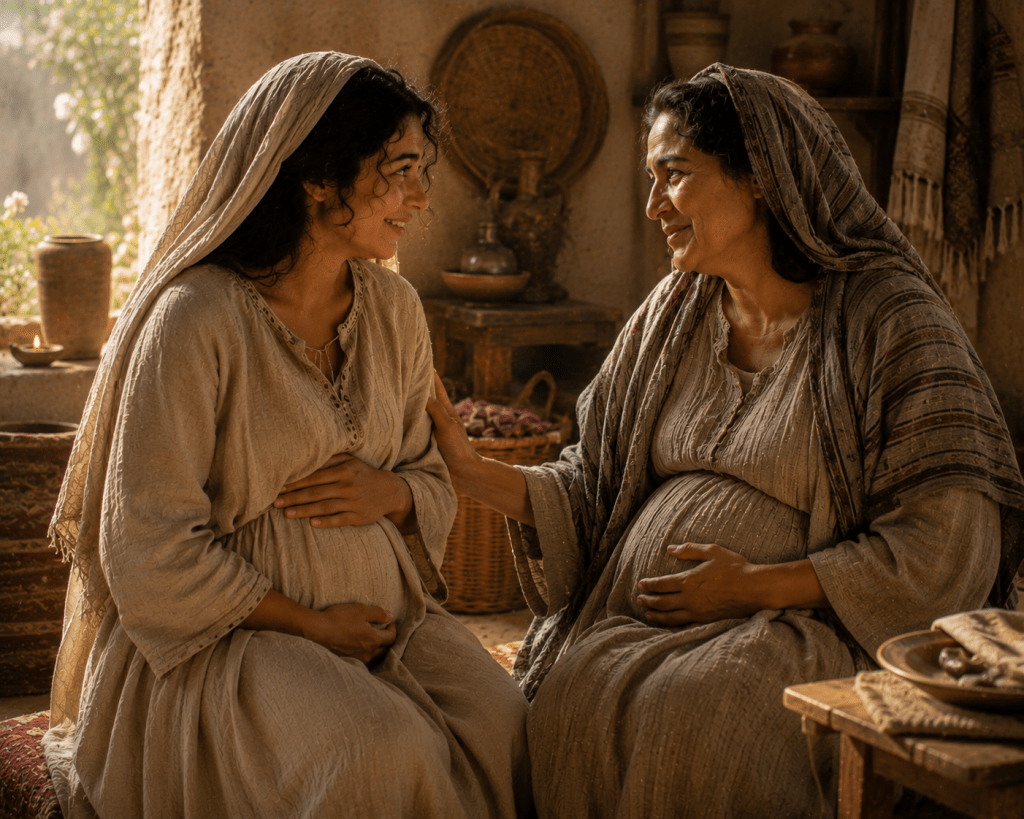
*I am aware that before concerning John, Elizabeth had no children. She was however 6 months further in her pregnancy and also, having seen other births of family and friend’s children, Elizabeth may have a few tips*
Gabriel could tell Mary who her child would be. Elizabeth could tell her what it might mean to become his mother.
Gabriel gave Mary extraordinary information.
Her son would be great.
He would be called the Son of the Most High.
He would receive the throne of David.
His kingdom would have no end.
The Holy Spirit would come upon her.
The power of the Most High would overshadow her.
It is difficult to imagine a more astonishing introduction to motherhood.
But Gabriel apparently did not tell Mary what to do when her back hurt.
He didn’t explain how pregnancy would change her body.
He didn’t tell her what labor felt like.
He didn’t explain how frightening it could be to love someone she hadn’t even met yet.
He didn’t tell her how much motherhood would involve waiting, worrying, feeding, cleaning, watching, guessing, and occasionally having absolutely no idea what she was doing.
Angels, apparently, deliver announcements.
They do not give parenting classes.
But Elizabeth might have.
When Mary arrived at Elizabeth’s house, Elizabeth was already six months pregnant.
And that matters.
Mary was at the beginning.
Elizabeth was well into it.
Mary’s pregnancy may still have been largely invisible.
Elizabeth’s body had already been transformed by hers.
She had lived through months of symptoms, changes, fears, and surprises.
And perhaps for the first time since Gabriel appeared, Mary could look at another woman and see something of what was coming.
Not theologically.
Physically.
Practically.
Humanly.
Maybe Elizabeth noticed Mary watching her one morning as she struggled to stand.
“What?”
“Nothing.”
“You’re staring.”
Mary smiled.
“I wasn’t.”
Elizabeth finally got upright and put a hand against her lower back.
“You were.”
Perhaps Mary hesitated.
“Does it hurt?”
Elizabeth laughed.
“Oh, Mary.”
That answer alone probably taught her something.
I wonder whether Mary arrived with questions she hadn’t even known how to formulate.
Gabriel had told her how she would conceive.
But what happened next?
Maybe Elizabeth became the person Mary could ask the embarrassing questions.
Does this always happen?
Is this normal?
Did you feel this?
When did you start showing?
How do you sleep when your stomach gets bigger?
How do you know the baby is all right?
What does movement feel like?
And eventually, perhaps quietly:
Does giving birth hurt as much as people say?
Elizabeth might have paused at that one.
Because there are some questions older women know cannot be answered reassuringly without lying.
Maybe she said:
“Yes.”
Mary’s eyes widened.
Elizabeth quickly added:
“But women do it.”
“That isn’t particularly comforting.”
“I know.”
Maybe they laughed.
But Mary remembered.
There is something beautiful about the fact that Gabriel pointed Mary toward Elizabeth.
He could have given Mary another sign.
Something celestial.
Something unmistakably supernatural.
Instead he told her about another pregnant woman.
“Your relative Elizabeth in her old age has also conceived a son.”
And Mary went to her.
Perhaps that was itself a kind of provision.
God gave Mary a miracle.
Then he gave her someone who might understand what it was like to live inside one.
Because miracles still have laundry.
Miracles still need meals.
Miracles can leave you exhausted.
Miracles can kick you in the ribs.
And perhaps Elizabeth taught Mary that holiness would not remove the ordinary parts.
Maybe one of the first things Mary learned was that pregnancy required accepting help.
That might have been difficult.
We don’t know Mary’s temperament.
But if she was accustomed to being capable, useful, and physically active, perhaps she assumed she would simply continue doing everything normally.
Elizabeth knew better.
Maybe Mary watched her sit down in the middle of the day.
“You’re resting?”
“Yes.”
“Is something wrong?”
“No.”
Mary waited.
Elizabeth looked at her.
“I’m tired.”
That was it.
No apology.
No justification.
Perhaps Mary filed that away.
Later, when her own body demanded rest, maybe she remembered.
Pregnancy wasn’t laziness.
Rest wasn’t failure.
Her body was doing work even when her hands weren’t.
Maybe Elizabeth taught her that without ever intending to.
And perhaps Mary learned something else from watching Elizabeth:
Motherhood begins before the baby arrives.
Elizabeth already knew John’s rhythms.
She knew when he tended to move.
What seemed to wake him.
Where he liked to wedge himself uncomfortably.
Maybe Mary watched Elizabeth absentmindedly rub her abdomen while talking.
Watched her stop suddenly when John moved.
Watched her speak to him.
Perhaps Elizabeth complained to him.
“Would you please move your foot?”
Mary laughed.
“He can’t hear you.”
Elizabeth looked offended.
“He certainly can.”
Maybe Mary smiled.
But weeks later, when she first felt Jesus move, perhaps she immediately spoke to him too.
Because she’d seen Elizabeth do it.
There are things women learn from watching other women that nobody formally teaches.
How to hold a baby.
How to support its head.
How to recognize a cry.
How to wrap cloth around a newborn.
How to continue a conversation while doing three things with one hand.
Maybe Mary’s education in motherhood began simply by paying attention.
But Elizabeth’s motherhood was unusual too.
She had waited for John for years.
Luke tells us that Elizabeth had been unable to conceive and that both she and Zechariah were advanced in years.
That history must have shaped how she carried him.
Perhaps she worried.
Perhaps she treasured every movement.
Perhaps she sometimes woke during the night and placed a hand against her abdomen just to feel whether he would move.
Mary may have noticed.
One evening:
“Are you all right?”
Elizabeth nodded.
“He was quiet.”
A pause.
Then movement.
Elizabeth exhaled.
Mary understood.
That may have been another lesson.
Love makes you vulnerable before you ever meet the person you love.
Gabriel could tell Mary not to be afraid.
Elizabeth could show her what it meant to be afraid because you love someone.
Those are different things.
Perhaps Elizabeth also taught Mary that you could be grateful and uncomfortable at the same time.
That feels important.
Elizabeth had waited years for this child.
If anyone had reason to be relentlessly grateful for pregnancy, it was her.
And yet I sincerely doubt gratitude made her back stop hurting.
Maybe one afternoon Mary found her muttering while trying to get comfortable.
“You prayed for this baby.”
Elizabeth stared at her.
“I did.”
“You’re complaining.”
“I am.”
Mary grinned.
Elizabeth pointed at her.
“You’ll learn.”
And Mary did.
You can desperately want something and still find parts of it miserable.
You can call something a blessing while wishing it would stop sitting on your bladder.
You can thank God for a child and still desperately want to sleep.
Gratitude does not require pretending discomfort is pleasant.
Maybe Mary learned that from Elizabeth before she needed the lesson herself.
And then there was Zechariah.
Whatever else Mary learned about motherhood in that house, she was also watching a marriage become a family.
Elizabeth and Zechariah had spent years together without children.
Now everything was changing.
Maybe Mary watched how they prepared.
Cloth folded.
Space rearranged.
Plans made.
Perhaps Zechariah built or repaired something.
Maybe Elizabeth disagreed with how he was doing it.
He couldn’t speak, which probably made the disagreement unusually one-sided.
Mary may have watched two people make room in an established life for someone who wasn’t there yet.
That mattered.
Because Mary would eventually return to Joseph.
They would have to do the same thing.
Motherhood was not only something happening inside her body.
A household would have to bend around this child.
Schedules.
Work.
Sleep.
Money.
Travel.
Food.
Everything.
Children arrive small.
They do not arrive insignificantly.
Maybe Elizabeth’s home taught Mary that.
But perhaps the greatest thing Elizabeth taught her had nothing to do with pregnancy at all.
Maybe she taught Mary that mothers cannot control the lives of their children.
Elizabeth knew astonishing things about John.
Zechariah’s encounter in the Temple had revealed that their son would be great before the Lord.
He would be filled with the Holy Spirit.
He would prepare a people for God.
That sounds glorious.
It also means John never entirely belonged to Elizabeth’s plans for him.
Mary understood that problem better than anyone.
Her child came with a calling before he came with a heartbeat she could feel.
Gabriel had already told her who Jesus would be.
Mary would raise him.
Feed him.
Teach him.
Comfort him.
Protect him.
But she would not determine his purpose.
Perhaps watching Elizabeth prepare for John helped Mary begin to understand something every mother eventually confronts:
You carry them.
You raise them.
You love them.
And then they become themselves.
Maybe Elizabeth said something like that one evening.
Not prophetically.
Just as an older woman.
Mary asks:
“Do you ever wonder what he’ll be like?”
“All the time.”
“Are you afraid?”
Elizabeth considers it.
“Yes.”
Mary looks surprised.
“Even after everything Zechariah was told?”
“Especially after everything Zechariah was told.”
That answer stays between them.
Then Elizabeth places a hand over John.
“We can raise them, Mary.”
She looks at her younger relative.
“We cannot live their lives for them.”
Mary could not possibly have understood how much those words might someday hurt.
Not yet.
Years later, Jesus would stay behind in Jerusalem and Mary would search anxiously for him.
He would grow.
Leave Nazareth.
Gather disciples.
Walk into places she couldn’t follow.
People would threaten him.
And eventually Mary would stand beneath a Cross unable to rescue the child she had once carried inside her own body.
No angel could teach her how to survive that.
Perhaps Elizabeth couldn’t either.
But maybe Elizabeth could begin teaching her the first terrible truth of motherhood:
Love does not give you control.
And still—
motherhood was not only fear.
Elizabeth may also have taught Mary anticipation.
The pleasure of preparing tiny things.
The absurdity of imagining fingers small enough to fit into little clothing.
Wondering whose eyes the baby would have.
Wondering what his cry would sound like.
Maybe they prepared cloth together.
Mary held up something impossibly small.
“A baby fits in this?”
Elizabeth laughed.
“Apparently.”
Mary looked doubtful.
Then perhaps her hand drifted toward her own abdomen.
Jesus would be that small.
The Son of the Most High.
Small enough to wrap in cloth.
Small enough to lose a sock.
Small enough to need his mother to support his head.
How could Gabriel possibly have explained that?
He could announce the Incarnation.
Elizabeth could help Mary imagine a newborn.
Maybe Mary learned that motherhood was made mostly of ordinary things.
Not announcements.
Not prophecy.
Not magnificats.
Repetition.
Feed.
Wash.
Rest.
Carry.
Wait.
Comfort.
Do it again.
Perhaps Elizabeth told her:
“You’ll spend half your life wondering whether you’re doing it correctly.”
Mary frowned.
“How do you know if you are?”
Elizabeth smiled.
“You don’t.”
That may have been terrifying.
Mary had been chosen by God.
Surely God would provide detailed instructions.
Apparently not.
Perhaps motherhood, like faith, would involve doing the next loving thing without always knowing what came afterward.
Mary already knew something about that.
She had said yes before she knew the whole story.
Maybe motherhood would simply ask her to keep saying it.
Yes, I’ll get up.
Yes, I’ll feed you.
Yes, I’ll carry you.
Yes, I’ll stay.
Yes, I’ll let you go.
Again.
Again.
Again.
Mary stayed with Elizabeth about three months.
Then Luke tells us she returned home.
I wonder what that goodbye felt like.
Mary had arrived newly pregnant, carrying questions and perhaps fear.
She left farther along.
Maybe beginning to show.
Maybe already accustomed to the strange reality of sharing her body with another person.
And perhaps she left with knowledge Gabriel had never given her.
Not heavenly knowledge.
Women’s knowledge.
Eat when you can.
Rest when your body tells you.
This pain is normal.
That one might not be.
Here’s how you wrap the cloth.
Babies move strangely.
Sometimes fear comes with love.
You will not always know what you’re doing.
Ask for help.
Laugh when you can.
And perhaps:
You can do this.
I like imagining Elizabeth saying that before Mary left.
Maybe Mary suddenly looked very young.
Because she was.
Whatever age she actually was, she was entering motherhood for the first time.
And Elizabeth knew she would soon have to continue without her.
Perhaps she held Mary’s face between her hands.
Or simply embraced her.
“You can do this.”
Mary might have answered:
“I don’t know if I can.”
And Elizabeth, who had lived long enough to know that confidence often arrives after necessity, not before it, might have smiled.
“You don’t have to know yet.”
Maybe that was the lesson.
Gabriel had told Mary:
Nothing will be impossible with God.
Elizabeth may have taught her what that looked like on an ordinary Tuesday.
Not certainty.
Not fearlessness.
Not supernatural competence.
Just a woman doing what needed to be done because someone she loved needed her.
Mary would eventually become the mother Christians have contemplated for two thousand years.
But first she had to learn how to be someone’s mother.
Perhaps some of that learning happened in a house in the Judean hill country beside an older pregnant woman who could answer questions angels never thought to address.
Gabriel told Mary who Jesus was.
Elizabeth may have helped her understand something equally important:
what it meant that he would call her Mother.


