
©MS 2026
The Brown Scapular of Our Lady of Mount Carmel
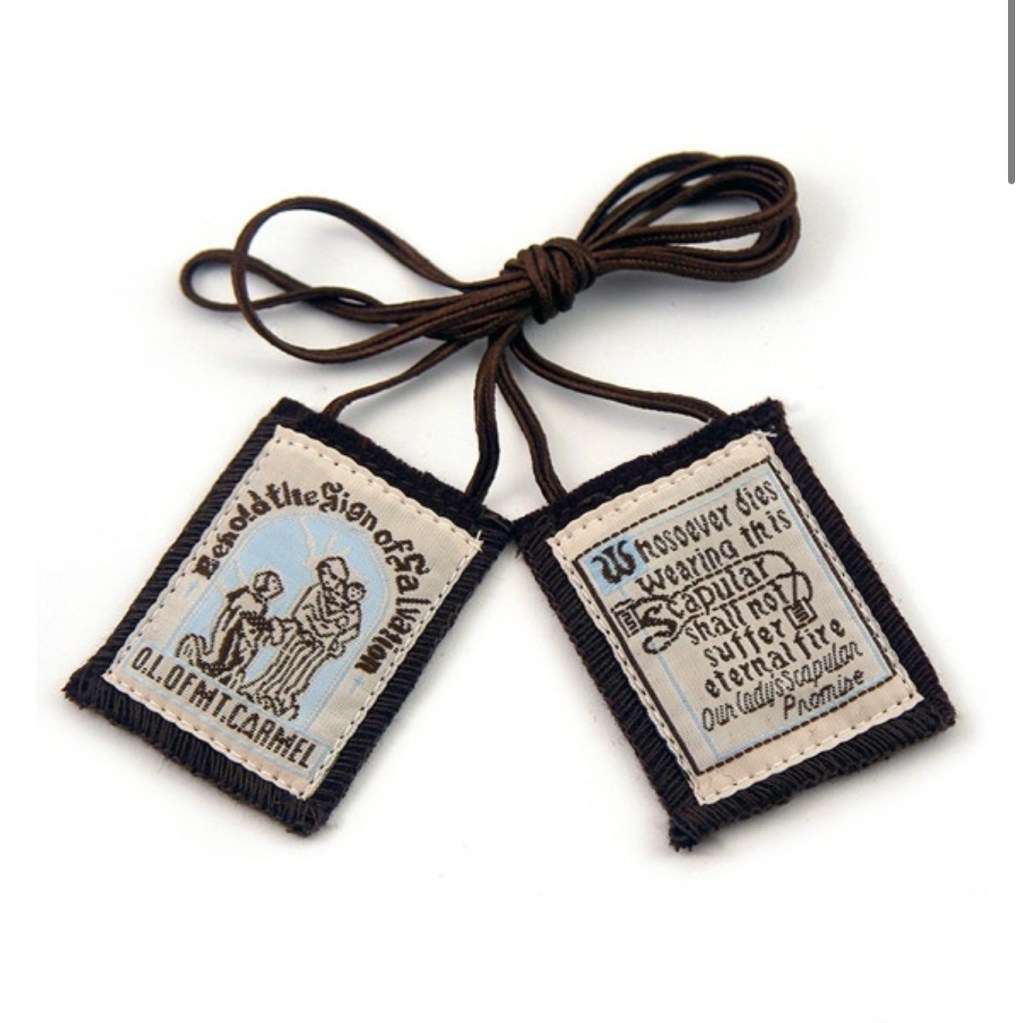
A Carmelite Habit Made Small
Few sacramentals are more well-known to Catholics than the Brown Scapular. Two small pieces of brown cloth connected by cords and placed over one’s shoulders, with one panel hanging in front and one panel hanging in back. The sacramental itself is simple in design. The history behind it is not. To some Catholics, the Brown Scapular is synonymous with a certain promise of protection from eternal fire said to have been granted by the Blessed Virgin Mary to those who die wearing the brown garment. To others it is a sign that we place ourselves under Mary’s protection. To still others it is merely an expression of devotion to Carmelite spirituality. At various times and places these three meanings have not always been carefully distinguished. Nor is the Brown Scapular best understood in terms of the first meaning mentioned above. The Brown Scapular is the Carmelite religious habit made available in a form that lay Catholics can wear. It is a sign of our belonging, our entrustment to Mary, our prayer, our conversion, and our desire to live in intimate adherence to Jesus Christ with Mary as our mother, sister, patroness, and model. Its deepest meaning is found not so much in what we hope to receive by wearing the scapular as it is found in the life we are invited to live by wearing it.
⸻
At a Glance
| Full Name | Brown Scapular of Our Lady of Mount Carmel |
| Traditional Color | Brown or dark cloth |
| Associated Tradition | Carmelite Order |
| Religious Family | Carmelites of the Ancient Observance, Discalced Carmelites, and the wider Carmelite family |
| Devotional Focus | Marian entrustment, prayer, conversion, and conformity to Christ |
| Original Form | The full-length scapular worn as part of the Carmelite religious habit |
| Lay Form | Two small pieces of cloth joined by cords and worn over the shoulders |
| Traditional Association | St. Simon Stock and a Marian vision traditionally dated to 1251 |
| Historical Certainty of the Vision | The tradition is ancient and accepted devotionally, but the surviving historical evidence does not verify the reported event |
| Formal Rite Available? | Yes. An approved rite of blessing and enrollment was confirmed by the Holy See in 1996 |
| Enrollment Required to Wear It? | No. A Catholic may wear it devotionally; formal enrollment concerns entry into the scapular confraternity or a more explicit association with Carmel |
| Feast | Our Lady of Mount Carmel, July 16 |
| Does the Cloth Guarantee Salvation? | No |
| Central Meaning | To be clothed in Christ and to live the Carmelite spirit under Mary’s maternal care |
⸻
Before the Scapular: The Beginnings of Carmel
The Carmelite Order originated with a group of hermits living on Mount Carmel in the Holy Land during the early part of the thirteenth century. Around 1206-12 14, the community received a written rule of life from Albert, the Latin Patriarch of Jerusalem. The main tenet of the rule required that each individual live “in allegiance to Jesus Christ”. The Rule also highlighted prayer, Scripture, silence, community, work and spiritual watchfulness. The hermits constructed a chapel where they worshipped, dedicated to Mary, whom they identified as the Lady of the Place. They referred to themselves as the Brothers of the Blessed Virgin Mary of Mount Carmel. In Carmelite spirituality Mary would eventually be seen as not only mother and patroness, but also sister, companion and the perfect disciple who heard God’s Word and acted on it. Conflict in the Holy Land caused the migration of many of the hermits to Europe during the thirteenth century. There they slowly transitioned from being an eremitical order to one of the mendicant orders of friars who lived and ministered in burgeoning towns and cities. The scapular was part of the Carmelite habit that they brought with them.
⸻
What Was the Original Carmelite Scapular?
The original scapular was not small like a necklace. It was a large piece of clothing. It featured long panels of cloth that fell down the front and back of the wearer. It rested on the shoulders and overlaid the tunic as part of the Carmelite habit. The official Carmelite catechesis writes, The scapular is the basic common habit of the Carmelite family. The religious Carmelite wear it in full length. The devotion uses a smaller form of the same object. Both forms maintain the same essential structure: Two large pieces of cloth joined on the shoulders with one falling toward the front and the other toward the back. The term scapular refers to shoulders. Scapular comes from the Latin word scapulae meaning shoulders. This matters. The Brown Scapular is not just a medic slapped onto some fabric. It is a small piece of clothing. It represents being clothed, covered, and identified with a particular family.
⸻
Why Is It Brown?
The color need not be interpreted according to some universal Catholic code where brown always means X. Rather, the color ultimately comes from the color of the Carmelite habit. Brown, therefore, marks the scapular as belonging to Carmel itself: its religious life, its spirituality, and its history. Even the Carmelite crest features brown and white, reflecting the colors traditionally associated with the Carmelite habit. While brown may conjure up later spiritual associations of humility, simplicity, earthiness, poverty or hiddenness, these meanings are retrospective and are not why the scapular is brown historically. The scapular is brown because it is Carmelite.
⸻
The Tradition of St. Simon Stock
The best-known account is related to St. Simon Stock, who is often referred to as a Carmelite prior general. Tradition relates that Simon Stock was praying for aid for the Order which had been in great persecution after it came into Europe. It is related that the Blessed Virgin appeared to him with the Carmelite scapular in her hand. Presenting him with the habit, she promised that she would shield all who wore that habit, saying “Whoever dies wearing this shall not suffer eternal fire.” She said this while holding up the brown scapular. This tradition is celebrated as occurring on July 16, 12 51. The popularity of the Brown Scapular accounts is one of the most repeated stories in all of Catholic devotion. Pope John Paul II honored what he referred to as the Order’s “venerable tradition” about the scapular’s bestowal, describing the devotion as “this treasure, once entrusted to Carmel, but now spread throughout the entire Church”. Devotion and history are not synonymous, however.
⸻
What Does the Historical Evidence Show?
The earliest surviving accounts that reference a 13th century Carmelite named Simon make no mention of a scapular vision. References to Simon in written association with the vision do not appear until near the end of the 14th century – about 150 years after the vision was supposed to have occurred. Given these facts Carmelite historians must conclude that the historical evidence does not support the vision as a verified 13th century event. This does not mean Catholics should jeer. But it does mean we shouldn’t lie about it.
We can certainly:
- Affirm the Simon Stock tradition is venerable and deeply embedded in Carmelite spirituality.
- Note that the Church has allowed and encouraged the devotional tradition.
- Point out that Popes have spoken favorably of it.
What we cannot do is claim historical research can verify the specifics of the reported vision. Private revelation is not the foundation for the Christian faith. Private revelations are not the source of sacramental grace. Nor does the spiritual significance of the scapular evaporate if we can’t reduce its origins to one historical apparition. The scapular is still the habit of Carmel. It’s still a symbol of the Order’s great confidence in Mary’s protection.
⸻
What Does the Brown Scapular Symbolize?
Being Clothed in Christ
The approved rite of enrollment interprets the scapular in light of Baptism.
The Vatican’s Directory on Popular Piety and the Liturgy explains that the scapular reminds the wearer that, through Baptism, Christians have been clothed in Christ. With Mary’s assistance, the wearer seeks greater conformity to Christ and hopes to reach the heavenly home still dressed in the spiritual garment received through grace.
The scapular therefore points beyond itself.
It does not say:
I am saved because I possess this cloth.
It says:
I have been clothed in Christ, and I am trying to live accordingly.
⸻
Belonging to the Carmelite Family
John Paul II wrote that the scapular is essentially a habit. Those who receive it are associated, in varying degrees, with the Carmelite Order and dedicate themselves to the service of Christ under Mary’s patronage.
That association can take several forms.
Some wearers are Carmelite friars, nuns, sisters, or members of secular Carmel.
Others formally join a scapular confraternity.
Still others wear the scapular devotionally and attempt to live according to Carmelite spirituality without formal membership in an organized association.
The degree of affiliation differs.
The spiritual direction remains the same: toward prayer, communion with Christ, and a life shaped by the Carmelite charism.
⸻
Marian Entrustment
The Vatican describes the scapular as an outward sign of a filial relationship between Mary and those who entrust themselves to her maternal protection and seek her intercession.
In Carmelite spirituality, Mary is not treated as an alternative to Christ.
She is honored as the disciple who points toward him.
John Paul II explained that authentic scapular devotion should produce a lasting Christian “habit”—a pattern of prayer, sacramental life, mercy, and faithful conduct.
The cloth symbolizes maternal care.
The life of the wearer should reveal where that care is leading.
⸻
Prayer and Interior Life
Carmelite spirituality is deeply contemplative.
It emphasizes:
- Allegiance to Jesus Christ
- Meditation upon Scripture
- Prayer and silence
- Participation in the Eucharist
- Awareness of God’s presence
- Community and service
- Devotion to Mary as the woman who hears and obeys the Word
- Growth in charity, chastity according to one’s state of life, and obedience to God’s will
The Brown Scapular is meant to recall this spirituality.
If the object becomes entirely separated from prayer, conversion, and the Carmelite way of life, its meaning has been reduced.
⸻
What Are the “Graces” of the Brown Scapular?
The Brown Scapular is a sacramental.
According to Catholic teaching, sacramentals do not confer sanctifying grace in the same manner as the sacraments. Through the prayer of the Church, they dispose believers to receive grace and help them cooperate with it.
The graces associated with the scapular should therefore be understood through:
- The saving work of Christ
- The prayer of the Church
- Mary’s intercession
- The wearer’s openness to conversion
- Participation in the sacramental life
- Perseverance in faith
- Growth in Carmelite spirituality
The object is not mechanically effective.
It does not compel God.
It does not make repentance unnecessary.
It does not permit someone to live deliberately against the Gospel while relying upon a piece of cloth for salvation.
⸻
The Promise of Salvation
The traditional scapular promise has often been stated in the strongest possible language:
Whoever dies wearing this scapular will not suffer eternal fire.
Taken literally and without context, this can sound as though the scapular guarantees salvation regardless of how the wearer lives.
That interpretation is incompatible with Catholic teaching.
Christ alone saves. The graces of salvation come through his death and Resurrection. The sacraments communicate saving grace, while sacramentals prepare believers to receive and cooperate with grace.
The Carmelite catechesis interprets the traditional promise through the biblical call to perseverance:
The one who remains faithful to the end will be saved.
The scapular represents trust that Mary will assist those who sincerely seek to live the Christian and Carmelite vocation—not that she excuses a refusal to do so.
The promise is therefore best understood as a promise of maternal assistance and intercession within a life directed toward Christ.
It is not a contractual loophole around conversion.
⸻
What Is the Sabbatine Privilege?
The so-called Sabbatine Privilege is a later tradition claiming that Mary appeared to Pope John XXII and promised to free faithful scapular wearers from purgatory on the first Saturday after their death, provided they fulfilled certain devotional conditions.
Historical investigation found that the papal bull associated with this claim was not authentic. In the early seventeenth century, Church authorities prohibited the Carmelite Order from preaching the privilege in that form.
The Church did permit a more general belief:
Mary, through her continuing intercession, may assist deceased members of the Carmelite family and scapular confraternity—particularly in a tradition that honors Saturday as a day associated with her.
That is significantly different from guaranteeing release from purgatory according to a fixed calendar deadline.
Evidence Check
Claim: Mary promised to release every qualified scapular wearer from purgatory on the first Saturday after death.
Assessment: Not historically supported.
Evidence Category: Later devotional tradition based upon an inauthentic papal document.
Supported Belief: Catholics may trust in Mary’s intercession for the dead, including those spiritually associated with Carmel, without claiming a guaranteed Saturday release.
⸻
What Does the Traditional Scapular Look Like?
The simplest and most historically faithful form consists of:
- Two small pieces of brown or dark cloth
- Joined by cords or ribbons
- Worn with one panel in front and one behind
Images are not required.
The Carmelite catechesis notes that the most authentic lay form is plain cloth, possibly with a small cross. Elaborate printed or embroidered images became common much later and can sometimes obscure the fact that the cloth itself—representing the habit—is the scapular.
Many modern scapulars display:
- Our Lady of Mount Carmel
- The Christ Child
- The Sacred Heart
- St. Simon Stock
- Carmelite heraldry
- Short devotional phrases
These decorations may support devotion, but they are not what makes the item a scapular.
⸻
Must It Be Made of Wool?
Older instructions frequently required wool.
Contemporary Carmelite catechesis states that pure wool is no longer necessary. Even the habits of many Carmelite religious are now made from other practical fabrics.
The important feature is that it remains recognizably a small cloth form of the Carmelite habit.
⸻
Blessing, Investiture, and Enrollment
The Church has an approved Rite of Blessing of and Enrollment in the Scapular of the Blessed Virgin Mary of Mount Carmel, confirmed by the Congregation for Divine Worship and the Discipline of the Sacraments in 1996.
The Vatican cautions that the imposition should not be improvised. It should follow preparation in which the person understands the meaning of the devotion, the association being entered, and the responsibilities being accepted.
Blessing
The scapular is blessed as a sacramental.
The approved rite is ordinarily celebrated by a priest or deacon.
Investiture or Imposition
The scapular is placed upon the person through the rite.
This publicly marks the person’s reception of the scapular and its spiritual meaning.
Enrollment
Enrollment refers more specifically to association with the Scapular Confraternity or Carmelite family according to the Order’s norms.
A person does not have to be formally enrolled simply to wear the Brown Scapular as a devotion. Carmelite guidance acknowledges that those who wear it sincerely and practice Carmelite spirituality may possess a genuine, though less formal, spiritual affiliation with Carmel.
⸻
What Commitments Does the Wearer Make?
The exact obligations associated with a confraternity should be determined from its current statutes and formation.
More broadly, Carmelite sources present scapular spirituality as including:
- Wearing the scapular faithfully
- Developing daily devotion to Mary
- Living in allegiance to Jesus Christ
- Participating in Mass and the Eucharist
- Reading and meditating upon Scripture
- Cultivating regular prayer
- Practicing charity
- Living chastity according to one’s state of life
- Seeking obedience to God’s will
- Growing in familiarity with Carmelite spirituality and its saints
These should not be treated as arbitrary tasks performed to activate a promise.
They describe the life the garment represents.
⸻
Must It Be Worn Constantly?
The Brown Scapular is traditionally worn as a garment, not merely stored among devotional possessions.
The ideal is continued use because its purpose is to become a persistent reminder of the wearer’s Christian and Carmelite commitment.
Practical interruptions—bathing, medical procedures, skin irritation, damage, or safety concerns—should not be interpreted superstitiously. Removing the cloth temporarily does not cause Mary to withdraw her care.
The devotion concerns the person’s relationship with Christ and Mary.
It is not broken by a cord snapping in the laundry.
⸻
What Happens When the Scapular Wears Out?
Because the scapular is cloth, it will eventually fray, tear, or become stained.
It may be replaced.
The initial reception and commitment belong to the person, not exclusively to one particular physical set of cloth panels. Replacement scapulars may be worn without repeating the complete enrollment rite, although they may still be blessed.
A worn blessed scapular should ordinarily be disposed of respectfully, such as by burial or burning, rather than being treated as ordinary trash.
⸻
What About the Scapular Medal?
Pope St. Pius X permitted the use of a scapular medal in certain circumstances as a substitute for several cloth scapulars after proper investiture.
Nevertheless, the cloth remains the more complete symbol because the Brown Scapular is fundamentally a habit. Replacing the cloth with metal can weaken the visible connection between the lay scapular and the Carmelite garment from which it came.
For someone able to wear the cloth comfortably, the cloth form most clearly preserves the devotion’s meaning.
⸻
Common Misunderstandings
“The scapular guarantees heaven.”
It does not.
Salvation comes from Christ. The scapular expresses trust, conversion, perseverance, and openness to grace.
“The Brown Scapular is a magical protection charm.”
It is a sacramental, not an amulet.
“The Simon Stock vision is a proven historical event.”
It is a venerable devotional tradition, but the surviving documentation appears much later than the event it describes.
“The Sabbatine Privilege guarantees release from purgatory on Saturday.”
That specific claim rests upon an inauthentic document and should not be taught as an established privilege.
“The picture is the scapular.”
The cloth is the scapular. Images are optional decorations.
“Only formally enrolled confraternity members may wear one.”
A Catholic may wear the scapular devotionally. Formal enrollment creates a more explicit association and should involve formation rather than indiscriminate registration.
“Wearing it means I am a Third Order Carmelite.”
It does not. Secular or Third Order membership involves its own formation, promises, rule, and community structure.
“If I remove it briefly, the protection ends.”
That interpretation turns devotion into superstition.
⸻
The Brown Scapular Today
The Brown Scapular remains one of the most widespread Marian devotional practices in Catholicism.
The Vatican describes its use as truly universal and as one of the Marian devotions repeatedly recommended by the Church’s teaching authority. At the same time, it warns that the scapular is sometimes worn apart from Carmelite spirituality and insists upon proper preparation for its imposition.
Both principal branches of the Carmelite Order continue to promote the scapular as a sign of:
- Carmelite identity
- Marian entrustment
- Baptismal commitment
- Prayer and interior life
- Participation in the Church
- Conformity to Jesus Christ
The devotion is alive.
Its challenge is not survival.
Its challenge is recovering its meaning from centuries of simplification, exaggeration, and superstition.
⸻
A Student’s Reflection
Before researching the Brown Scapular, I knew the promise.
I did not know the garment.
I had heard that the scapular offered protection and that a person who died wearing it would not suffer eternal fire. Without context, that claim made the scapular sound almost transactional:
Wear this.
Receive that.
What I found was much richer—and more demanding.
The Brown Scapular is the Carmelite habit made small.
It is not primarily a promise that I may claim.
It is a life I am being invited to remember.
The cloth rests upon the shoulders because it represents something carried: allegiance to Christ, trust in Mary, prayer, conversion, charity, and the slow formation of an interior life.
The uncertain history of the Simon Stock vision does not destroy that meaning.
For me, it clarifies it.
The devotion does not have to stand or fall upon whether a thirteenth-century event can now be proven from surviving documents. Its meaning is supported by the living spirituality of Carmel, by the Church’s understanding of sacramentals, and by centuries of Christians who have worn the habit as a reminder to become what it represents.
Perhaps the most honest way to understand the Brown Scapular is this:
It is not a guarantee that the wearer will escape the demands of the Christian life.
It is a quiet garment reminding the wearer to live them.
⸻
Primary and Historical Sources
Carmelite Order resources on the origins, Rule, history, spirituality, and wider Carmelite family.
Congregation for Divine Worship and the Discipline of the Sacraments, Directory on Popular Piety and the Liturgy, paragraph 205.
Pope John Paul II, Message to the Carmelite Family, March 25, 2001.
Carmelite Orders, Catechesis and Ritual for the Scapular of Our Lady of Mount Carmel, prepared under the direction of the North American Carmelite provincials and incorporating the approved 1996 rite.
Carmelite catechesis by Fr. Sam Anthony Morello, O.C.D., and Fr. Patrick McMahon, O.Carm., concerning the scapular’s history, spirituality, enrollment, Simon Stock tradition, and Sabbatine Privilege.


