The Invitations of Mary
©MS 2026
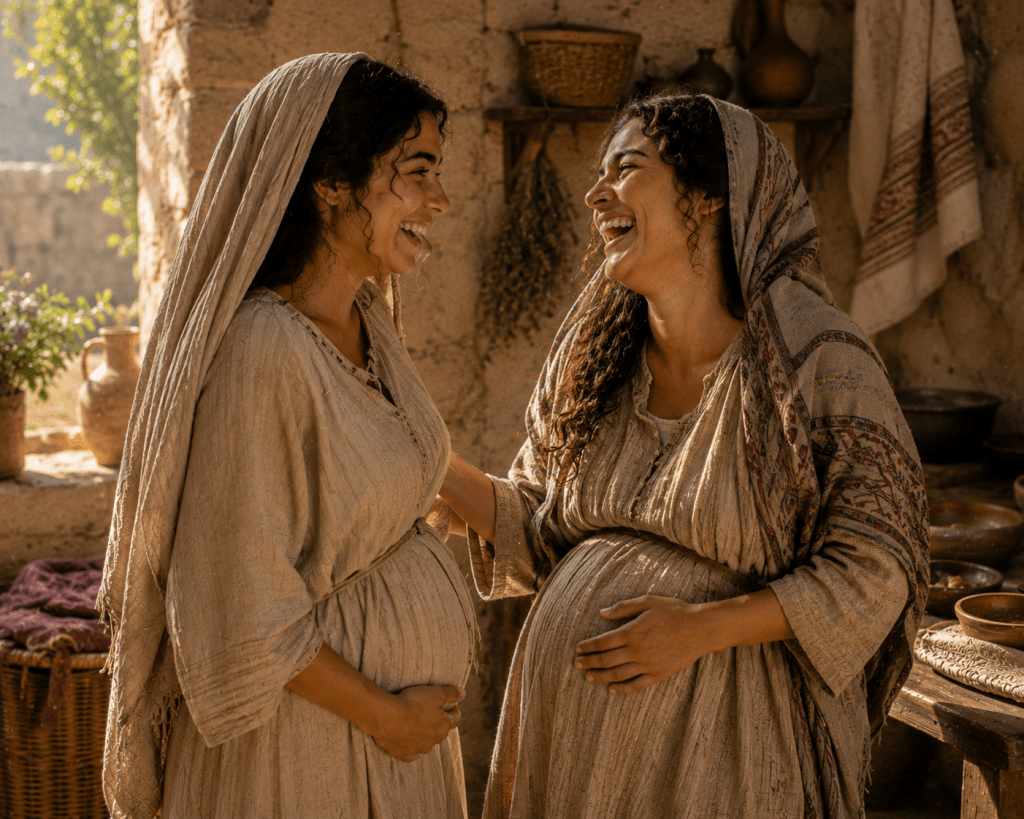
Before they became figures in stained glass, they were two pregnant women sharing a house.
I hope they laughed.
Really laughed.
Not the serene little smile religious paintings permit holy women.
I mean the kind of laughter that starts over something stupid, gets worse because the other person is laughing, and eventually leaves both of you unable to explain what was funny in the first place.
Because when Mary arrived at Elizabeth’s house, something extraordinary happened.
Elizabeth heard Mary’s greeting.
John leapt within her.
Elizabeth was filled with the Holy Spirit.
She cried out:
“Blessed are you among women, and blessed is the fruit of your womb.”
Mary answered with the Magnificat.
It is magnificent.
Sacred.
Theological.
Prophetic.
And then…
Mary stayed for about three months.
Three months.
Luke gives us a few verses about the Visitation and then moves on.
But Mary didn’t.
She lived there.
Which means that somewhere between “My soul magnifies the Lord” and Mary eventually returning home, there were breakfasts.
There were chores.
There were evenings when nobody had anything profound left to say.
There were two pregnant women living under the same roof.
And surely—
surely something made them laugh.
Maybe it was Zechariah.
I feel slightly guilty beginning there.
Slightly.
Because poor Zechariah had been struck unable to speak after questioning Gabriel’s announcement that Elizabeth would conceive.
This was undoubtedly a serious spiritual experience.
It was also, from a purely domestic standpoint, an extremely unusual situation.
Elizabeth’s husband could not talk.
For months.
And I have to believe there was at least one moment when Elizabeth discovered a tiny advantage to this arrangement.
Perhaps Zechariah was gesturing emphatically about something.
Elizabeth understood perfectly well what he wanted.
She simply continued what she was doing.
Mary watched.
Zechariah gestured again.
Elizabeth looked at him.
“Oh, I’m sorry. I don’t understand.”
Zechariah stared at her.
Mary immediately looked down because she knew if she made eye contact with Elizabeth, it was over.
Zechariah gestured more vigorously.
Elizabeth maintained an expression of saintly confusion.
Mary’s shoulders began shaking.
Finally Zechariah realized exactly what was happening.
He pointed accusingly at his wife.
Elizabeth smiled sweetly.
Mary lost it.
Maybe Zechariah rolled his eyes and walked away.
And perhaps Elizabeth waited until he was gone before whispering:
“God forgive me.”
Mary, still laughing:
“He probably will.”
“Zechariah may not.”
That does not diminish Zechariah.
It makes me hope their marriage had enough affection in it to survive a little teasing.
Because three months is a long time to communicate with gestures and writing tablets.
There were going to be misunderstandings.
And misunderstandings are occasionally hilarious.
Maybe pregnancy itself provided most of the material.
Elizabeth was much further along than Mary.
By the time Mary arrived, Elizabeth was in her sixth month.
Which means Mary was living with someone who had already traveled considerably farther down the road her own body had just begun.
Perhaps Elizabeth was enormous.
Not elegantly pregnant.
Just—
pregnant.
She drops something.
Looks at the floor.
Looks at Mary.
Mary looks at the object.
Then at Elizabeth.
“No.”
“No.”
Neither moves.
Eventually Mary sighs and picks it up.
Elizabeth says:
“You’ll understand soon.”
“I can bend over.”
“For now.”
Maybe Mary rolled her eyes.
A few months later, she remembered that sentence.
Perhaps Elizabeth was the first person Mary could complain to.
Really complain.
Not about being chosen.
Not about Jesus.
Just about pregnancy.
“My breasts hurt.”
Elizabeth nods.
“I know.”
“I am tired all the time.”
“I know.”
“I was hungry, and then I made food, and now the smell of it makes me sick.”
“I know.”
“Why?”
Elizabeth shrugs.
“I don’t know.”
This may have been enormously comforting.
Gabriel had explained the overshadowing of the Holy Spirit.
He had not explained why Mary’s body might suddenly develop an irrational vendetta against breakfast.
Elizabeth could.
Or at least she could say:
Mine does that too.
There are moments when theological explanation is less useful than another woman saying:
“Yes. That happens. It’s awful.”
Maybe Mary needed that.
And perhaps Elizabeth teased her.
Mary was younger.
Elizabeth had waited years for this pregnancy.
She may have possessed the confidence of an older woman who had long since stopped worrying about appearing perfectly composed.
Mary wakes one morning looking miserable.
Elizabeth takes one look at her.
“Nauseous?”
Mary nods.
“Good.”
Mary stares at her.
“Good?”
“Means you’re pregnant.”
“I was already aware of that.”
“Apparently your stomach wanted confirmation.”
Mary does not laugh.
Elizabeth does.
Mary throws a cloth at her.
Now they’re both laughing.
Maybe.
We don’t know.
But I desperately hope something like it happened.
Because Mary had arrived carrying an extraordinary burden.
Elizabeth was the first person Scripture shows recognizing what had happened to her without Mary having to defend herself.
Think about the safety of that.
Mary didn’t have to persuade Elizabeth that Gabriel had really appeared.
She didn’t have to explain how she was pregnant.
She didn’t have to prepare herself for disbelief.
Elizabeth saw her and knew.
That kind of safety creates room for laughter.
Mary could exhale there.
Maybe that’s why she stayed.
We don’t actually know precisely why Mary remained about three months.
Perhaps she stayed to help Elizabeth through the later part of pregnancy.
Perhaps family obligation played a role.
Perhaps she simply needed somewhere to be.
But imagine what those months offered her.
A house where her pregnancy was not a scandal.
A house where impossible conception was practically becoming a family theme.
A house where another woman could look at her changing body without suspicion.
A house where she could say:
I’m scared.
And perhaps also:
This is ridiculous.
Sometimes those sentences belong very close together.
I wonder if they ever laughed about Gabriel.
They had both been affected by visits from the same angel.
Gabriel appeared directly to Mary.
Gabriel appeared to Zechariah regarding Elizabeth.
Eventually, perhaps the stories were compared.
Mary tells Elizabeth exactly what happened.
“He told me not to be afraid.”
Elizabeth nods.
“He frightened Zechariah so badly that he argued with him.”
Mary tries not to smile.
“He asked for a sign.”
“He got one.”
Mary loses the battle.
Elizabeth starts laughing.
From across the room, Zechariah notices.
He looks suspicious.
The women immediately become very interested in whatever they are doing.
Zechariah narrows his eyes.
Maybe he knew.
Poor man.
He couldn’t even defend himself.
But perhaps some of their laughter was gentler.
Maybe they talked late at night.
The house quiet.
Zechariah asleep.
Two women sitting together with a lamp burning low.
Mary’s pregnancy still barely visible.
Elizabeth’s impossible to miss.
Maybe they talked about their babies.
What would they look like?
Would John’s hair be like Elizabeth’s?
Would Jesus resemble Mary?
Would they know one another?
That question almost hurts knowing what we know.
They would.
John would prepare the way for Jesus.
He would stand in the Jordan calling Israel to repentance.
He would recognize the one coming after him as greater than himself.
And eventually both sons would die violently because of the lives God had called them to live.
But their mothers didn’t know all of that yet.
Not fully.
Perhaps one evening they simply imagined two little boys.
Maybe Elizabeth said:
“They’ll be trouble together.”
Mary laughed.
“Why?”
“Look at their mothers.”
“Elizabeth!”
“What?”
And there it was again.
Laughter.
Before prophecy became fulfillment.
Before anyone lost anyone.
Just two women wondering what their sons would be like.
Perhaps they laughed about names.
Elizabeth already knew her son would be called John.
Mary knew hers would be Jesus.
Neither woman had gotten to choose.
Maybe that struck them as funny.
“Did you have names you liked?”
Mary asks.
Elizabeth gives her a look.
“Apparently that was not our decision.”
Mary laughs.
“Neither was mine.”
“Efficient, though.”
“What?”
“God sends the child and the name together.”
Mary nearly chokes on her drink.
Elizabeth shrugs.
“One less thing to argue about.”
Somewhere Zechariah taps something sharply against the table.
Elizabeth calls toward him:
“I said one less thing.”
Maybe Mary laughed at Elizabeth’s baby moving.
Luke tells us John leapt in Elizabeth’s womb at Mary’s greeting.
Elizabeth knew exactly what had happened.
But John presumably moved plenty of other times too.
Perhaps Mary eventually felt it.
Elizabeth takes Mary’s hand.
“Here.”
Mary waits.
Nothing.
“Wait.”
Still nothing.
Then—
a kick.
Mary’s eyes widen.
Again.
She laughs.
“He’s strong.”
Elizabeth sighs.
“You should feel him at night.”
Maybe John kicks again when Mary speaks.
They both notice.
Mary says something else.
Another movement.
Elizabeth looks at her.
“Oh, wonderful.”
“What?”
“He likes you.”
Mary smiles.
“That seems good.”
“You say that because he isn’t kicking your ribs.”
Later Jesus begins moving inside Mary.
Now there are two babies making their opinions known.
Maybe the women compared notes.
“John kept me awake.”
“Jesus won’t stop moving.”
Elizabeth smiles.
“Perhaps they’re talking.”
Mary laughs.
“About what?”
“Us.”
And maybe that became the joke.
Whenever both babies started moving:
They’re talking again.
I wonder whether Mary ever laughed so hard she had to stop because her stomach hurt.
Maybe Elizabeth made her.
Maybe Mary was funnier than we imagine.
We don’t know anything about Mary’s sense of humor.
And I think that’s a shame.
Because surely she had one.
Jesus certainly demonstrated wit, exaggeration, irony, wordplay, and wonderfully memorable absurd images in his teaching.
A camel squeezing through the eye of a needle.
Someone carefully removing a speck from another person’s eye while walking around with a plank sticking out of their own.
A blind person leading another blind person directly into a ditch.
These are funny images.
We sterilize them because they’re Scripture.
But Jesus knew how to make a point by making people picture something ridiculous.
Did some of that humor sound familiar to Mary?
Maybe.
Maybe not.
But I like wondering.
Perhaps Mary could tell a story so well that Elizabeth knew exactly when the punchline was coming.
Maybe Elizabeth had a laugh that made Mary laugh harder.
Maybe one of them snorted.
There.
I said it.
Perhaps the Mother of God once laughed because Elizabeth snorted.
And then Elizabeth laughed because Mary was laughing.
And eventually neither of them remembered what started it.
Why shouldn’t holiness sound like that?
We have a strange tendency to imagine sacred people as permanently solemn.
As though holiness gradually removes all the ridiculous parts of being human.
The saints never spill things.
Mary never trips.
Joseph never tells a bad joke.
Elizabeth never teases her husband.
Jesus apparently progresses directly from silent infant to teaching in the Temple.
But joy is not an interruption of holiness.
It belongs inside it.
Mary herself says:
“My spirit rejoices in God my Savior.”
Rejoices.
Not merely obeys.
Not merely endures.
Rejoices.
And perhaps some of that joy sounded like laughter echoing through Elizabeth’s house.
I think Mary may have needed laughter especially then.
Her future was uncertain.
Joseph’s reaction either remained ahead of her or had only recently been resolved, depending on how we understand the chronology.
Her reputation was vulnerable.
Her body was changing.
She was carrying a child whose identity she could barely comprehend.
Elizabeth was carrying her own impossible child after years of barrenness.
Both women were standing inside events far larger than themselves.
There must have been serious conversations.
There must have been prayer.
There may have been tears.
But human beings cannot remain emotionally suspended at maximum theological intensity for three months.
Eventually someone burns the bread.
Someone can’t reach something.
Someone says something stupid.
Someone’s husband is waving his arms because nobody understands what he wants.
And you laugh.
Maybe that’s one of the gifts Elizabeth gave Mary.
Not answers.
Not theology.
Not instruction.
Normalcy.
For a few months, Mary could simply be a pregnant young woman living with another pregnant woman.
Someone understood.
Someone believed her.
Someone knew that miraculous pregnancies could still include sore backs and terrible sleep.
Someone could listen when Mary was afraid.
And someone could make her laugh.
I like imagining one particular evening.
They’ve finished whatever work needed doing.
Zechariah has gone to sleep.
The lamp is low.
Elizabeth is tired enough that getting up feels unreasonable.
Mary is tired enough that she has stopped pretending she isn’t.
They’re talking about something completely unimportant.
We will never know what.
Maybe a neighbor.
Maybe something Zechariah did.
Maybe something Mary said earlier.
Maybe one of the babies moved at exactly the wrong moment.
Elizabeth says something.
Mary laughs.
Elizabeth adds one more sentence.
Mary laughs harder.
“Stop.”
Elizabeth absolutely does not stop.
“Elizabeth—”
Now Mary cannot breathe properly.
Elizabeth is laughing too.
One of them tries to become serious.
That makes it worse.
Eventually they are wiping tears from their faces.
Their stomachs hurt.
Mary whispers:
“I hate you.”
Elizabeth answers:
“No, you don’t.”
And Mary starts laughing again.
No angels.
No prophecy.
No Magnificat.
No one writing it down.
Just two women in a little house in the Judean hill country laughing loudly enough that perhaps Zechariah woke, stared at the ceiling, and decided he didn’t even want to know.
History forgot that moment.
If it ever happened, it wasn’t important enough for Luke.
And yet I hope there were hundreds like it.
Because eventually Mary would know grief beyond anything she could imagine sitting in Elizabeth’s house.
Eventually she would stand beneath her son’s Cross.
Eventually Elizabeth would lose John.
There would be enough sorrow.
But not yet.
For now, their sons were alive inside them.
They were together.
They were safe.
And perhaps somewhere during those three months, before anyone called them saints, before their sons changed the world, before Christians built churches and painted icons and wrote hymns about their meeting—
Mary and Elizabeth laughed until they couldn’t stop.
I hope they did.
I really, really hope they did.


