The Rosarium Series | ©MS 2026
Introduction
The story of ebony does not begin with rosaries.
Nor does it begin in Europe.
Unlike olive wood, which grew within the landscapes that shaped Christianity’s earliest history, ebony entered Catholic devotional life from much farther away.
Its journey was longer.
More complicated.
And in many ways, more surprising.
For centuries, ebony was valued not as a devotional material, but as a luxury one.
It traveled through trade networks that connected distant forests to workshops, ports, markets, churches, and households thousands of miles away.
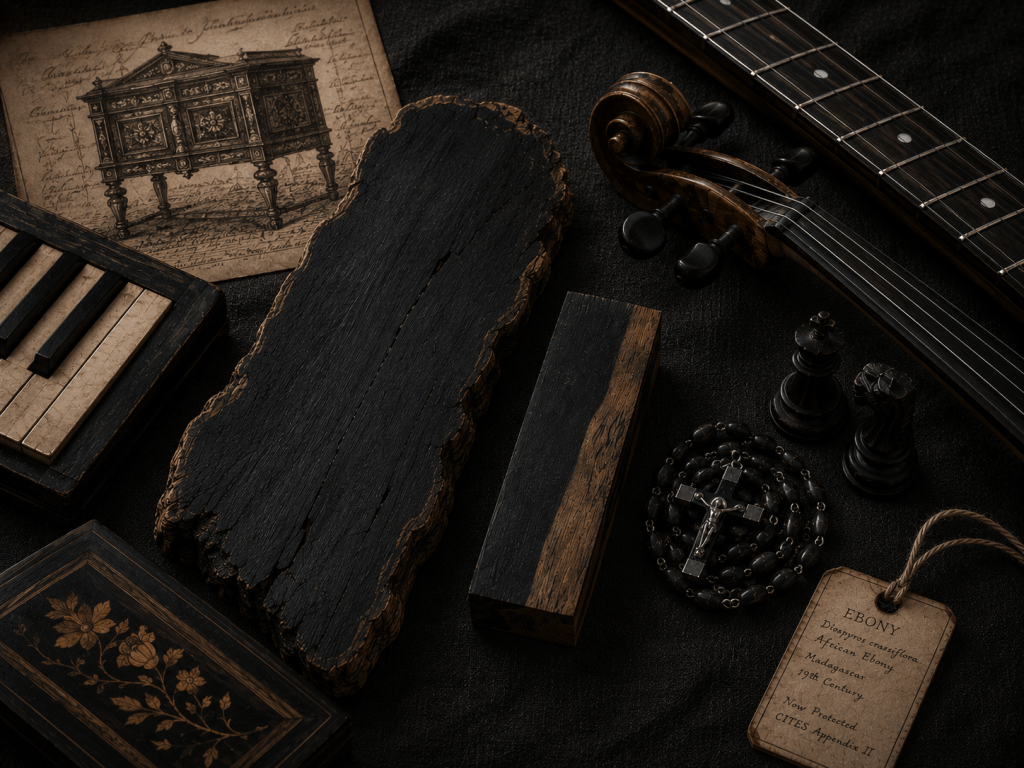
It appeared in furniture before it appeared in rosaries.
In cabinets before crucifixes.
In decorative arts before private prayer.
Yet history has a curious way of reshaping materials.
What begins as one thing often becomes another.
A wood admired for rarity becomes a wood valued for durability.
A material associated with craftsmanship becomes a companion in prayer.
An imported luxury becomes an intimate object held quietly in the hand.
Understanding ebony rosaries therefore requires looking beyond the rosary itself.
We must look at the routes the wood traveled.
The craftspeople who worked with it.
The changing devotional cultures that eventually embraced it.
And the centuries of history that transformed a tropical hardwood into one of Catholicism’s most recognizable prayer materials.
Because ebony did not arrive in devotional life all at once.
It arrived gradually.
Through trade.
Through craftsmanship.
Through changing tastes.
And through generations of people who found new purposes for an old material.
To understand ebony rosaries, we must begin long before the first bead was ever strung.
Imported Luxury: Ebony in Seventeenth-Century Europe
To understand ebony rosaries, we must first step into a world where ebony was not yet a devotional material at all.
At least not primarily.
In seventeenth-century Europe, ebony arrived first as something extraordinary.
Imported.
Rare.
Expensive.
A material shaped by distance.
Long before it became small enough to pass quietly between fingers in prayer, ebony belonged to another category of objects entirely:
luxury.
The seventeenth century was an age of expanding trade and changing material worlds. European merchants, kingdoms, and trading companies increasingly connected distant regions through maritime routes that carried goods, raw materials, ideas, and wealth across oceans.
Among these imports were exotic hardwoods.
Dense woods.
Fragrant woods.
Visually striking woods.
And ebony stood apart almost immediately.
Its darkness distinguished it from familiar European timbers. While local woods often displayed warm browns, pale tones, or visible grain patterns, ebony appeared dramatically different.
Deeply dark.
Dense.
Smooth.
Capable of taking a remarkable polish.
Resistant to wear.
It possessed a visual authority unlike anything most Europeans encountered in their native forests.
Its rarity added to its appeal.
Obtaining ebony required long trade routes, skilled merchants, and access to distant markets. The wood traveled great distances before ever reaching a workshop, making it both costly and desirable.
To own ebony was often to possess something uncommon.
Something difficult to acquire.
Something that signaled access to craftsmanship, trade, and refinement.
As a result, ebony became closely associated with elite material culture.
Throughout seventeenth-century Europe, it appeared in:
- luxury furniture
- cabinets and decorative veneer work
- carved ornamental objects
- ecclesiastical furnishings
- aristocratic interiors
- fine woodworking commissions
Its value was not simply practical.
It was cultural.
Ebony represented craftsmanship elevated through rarity.
A material that invited skilled work and rewarded careful attention.
Indeed, the wood became so influential in French furniture-making that it helped give rise to the term ébéniste—a cabinetmaker specializing in fine furniture and decorative woodwork, particularly involving imported and exotic woods.
This detail is worth pausing over.
Because it reminds us that ebony entered European imagination first not through prayer, but through craftsmanship.
Not through devotion, but through admiration.
People desired ebony because it was beautiful.
Difficult to obtain.
Distinctive.
And capable of being transformed into objects of remarkable quality.
Yet materials rarely remain confined to a single world.
The same characteristics that made ebony desirable for furniture would eventually make it attractive for smaller objects as well.
Its durability.
Its smoothness.
Its density.
Its ability to withstand handling.
The story of ebony rosaries had not yet begun.
But the conditions that would make them possible were already taking shape.
A prized material.
A culture fascinated by craftsmanship.
And a Europe increasingly comfortable surrounding itself with meaningful objects shaped by skilled hands.
For the moment, ebony remained a wood of cabinets, parlors, and workshops.
But history was already preparing a different future for it.
One measured not in rooms—
but in beads.
The Ébéniste and the World of Cabinetmaking
Before ebony became associated with prayer, it became associated with craftsmanship.
And few crafts embraced it more enthusiastically than cabinetmaking.
As imported woods became increasingly available through expanding trade networks, European artisans discovered that ebony possessed qualities unlike those of most local timbers.
It was dense.
Stable.
Capable of taking a remarkable finish.
Its deep color provided dramatic contrast when paired with lighter woods.
And when shaped by skilled hands, it transformed ordinary furniture into something extraordinary.
Nowhere was this appreciation more visible than in France.
By the seventeenth century, ebony had become so closely associated with fine furniture that a new professional title emerged:
ébéniste.
The term referred to a highly skilled cabinetmaker specializing in veneered furniture and decorative woodworking, particularly involving imported and exotic woods.
An ébéniste was not simply a carpenter.
Nor merely a furniture builder.
He was an artisan working at the intersection of design, material knowledge, engineering, and decorative art.
His work often involved rare woods, intricate veneers, inlays, metal fittings, and highly refined finishing techniques.
The existence of the word itself reveals something important.
Ebony had become more than a material.
It had become a cultural ideal.
A symbol of craftsmanship, refinement, and technical skill.
This mattered because materials acquire meaning through the ways people encounter them.
For many Europeans, their first experience of ebony was not through a rosary or crucifix.
It was through an object crafted with exceptional care.
A cabinet.
A writing desk.
A decorative box.
An ecclesiastical furnishing.
A piece of furniture designed to endure.
Over time, ebony became associated with qualities that extended beyond appearance.
Durability.
Precision.
Permanence.
Careful workmanship.
The wood earned a reputation as a material worthy of skilled hands.
And that reputation would eventually travel with it into other forms of craftsmanship.
Including devotional work.
This transition was not immediate.
Nor was it inevitable.
Yet it was logical.
The same characteristics that made ebony desirable for fine furniture also made it appealing for smaller objects.
Objects meant to be handled repeatedly.
Objects expected to last.
Objects shaped by touch.
A rosary bead asks many of the same things from a material that a cabinetmaker asks of a fine piece of furniture:
strength
stability
workability
endurance
The scale may differ.
The purpose may differ.
But the relationship between artisan and material remains surprisingly similar.
In both cases, the goal is not merely to shape the wood.
It is to reveal what the wood can become.
This is one reason ebony’s journey into devotional life feels less like a sudden change and more like a gradual expansion.
The wood did not leave craftsmanship behind when it entered prayer.
It carried craftsmanship with it.
Every ebony rosary owes something, however indirectly, to generations of artisans who first taught Europe how to admire the material.
Before ebony became a companion in prayer, it was already a companion in craft.
And that history remains visible every time a polished bead catches the light and reveals the skill required to shape it.
Catholic Revival and the Rosary Boom
If the seventeenth century made ebony desirable and craftsmanship made it admired, the nineteenth century created conditions that made devotional use increasingly likely.
To understand ebony rosaries, we must first understand something larger:
the nineteenth century witnessed an extraordinary revival of Catholic devotional life.
And much of that revival emerged after disruption.
The French Revolution had dramatically altered the religious landscape of France and much of Europe.
Churches were closed.
Religious communities were suppressed.
Monasteries dissolved.
Sacred objects destroyed, dispersed, or hidden.
The Church entered the nineteenth century carrying the memory of both loss and upheaval.
Yet history rarely moves in a straight line.
What followed was not the disappearance of devotional culture, but its renewal.
Pilgrimages returned.
Religious communities reformed.
Marian devotion expanded.
Confraternities grew.
And increasingly, faith once again became visible through material culture.
Rosaries.
Medals.
Prayer books.
Holy cards.
Crucifixes.
Small devotional objects carried in pockets, tucked beside beds, placed in household shrines, and held during daily prayer.
The nineteenth century became, in many ways, an age of devotional objects.
France and the Expanding Devotional World
France occupied a particularly important place in this revival.
Several developments helped shape Catholic devotional culture during the century:
- renewed Marian devotion
- the spread of the Miraculous Medal after 1830
- pilgrimage culture surrounding Lourdes after 1858
- expanding religious publishing
- growing devotional markets
- increased accessibility through rail travel
Together, these movements helped place devotional objects into the hands of ordinary Catholics on an unprecedented scale.
The rosary became increasingly personal.
Portable.
Domestic.
Something intended for daily use rather than occasional ceremony.
And as demand increased, so did the variety of materials used in rosary making.
Glass.
Metal.
Seed beads.
Bone.
Wood.
Imported hardwoods.
Materials that might once have appeared primarily in decorative arts now found new life in devotional practice.
When Ebony Became Plausible
This is where ebony’s story begins to change.
By the nineteenth century, ebony was still valued.
Still imported.
Still associated with craftsmanship and refinement.
Yet expanding trade networks and changing markets made it more accessible than it had been in earlier centuries.
Not common.
Not inexpensive.
But increasingly available.
And rosaries required only small amounts of material.
A single block of ebony that might once have been reserved for furniture or decorative work could now produce dozens—or even hundreds—of beads.
Scale changed the equation.
So did devotional demand.
Rosaries needed materials capable of enduring repeated handling.
Materials that could be drilled, polished, shaped, and carried for years.
Ebony proved exceptionally well suited to these requirements.
Dense enough to endure.
Smooth enough to handle comfortably.
Refined without requiring ornament.
Durable without sacrificing beauty.
Most importantly, it fit comfortably within the devotional aesthetics of the period.
Nineteenth-century Catholicism often valued objects that felt personal rather than ostentatious.
Objects capable of accompanying daily prayer rather than merely displaying wealth.
Ebony occupied a fascinating middle ground.
It retained associations with craftsmanship and quality while remaining visually restrained.
An ebony rosary could feel dignified without feeling extravagant.
Elegant without being showy.
A Material Finds a New Intimacy
There is something quietly moving about this transition.
Furniture is seen.
Displayed.
Admired.
A rosary is touched.
Counted.
Carried.
Worn smooth through repetition.
Somewhere within the devotional culture of nineteenth-century Catholic Europe, ebony became smaller.
Closer.
More personal.
The material did not abandon its earlier history.
It carried that history forward.
The craftsmanship remained.
The durability remained.
The beauty remained.
But the purpose changed.
A wood once associated with parlors, studies, and fine furnishings gradually entered the private world of prayer.
And in doing so, acquired a new identity.
Not merely a material to be admired.
But a companion to devotion.
A wood that had traveled across oceans, passed through workshops, and found its way into the hands of ordinary believers.
The story of ebony rosaries had truly begun.
Ebony in Devotional Use
Why This Material Endured
By the nineteenth century, ebony had become a plausible material for rosaries.
Trade made it available.
Craftsmanship made it workable.
Catholic revival created demand.
Yet historical possibility alone does not explain continued use.
Many materials entered devotional life.
Not all remained.
For a rosary material to endure across generations, it must do more than look attractive.
It must function.
Rosaries are not merely decorative objects.
They are repetitive objects.
Handled daily.
Carried quietly.
Wrapped around fingers.
Tucked into pockets.
Prayed in hospitals.
Prayed beside beds.
Prayed during travel.
Prayed through ordinary routines and extraordinary circumstances alike.
A rosary material must be capable of accompanying a life.
Ebony proved unusually well suited to this role.
Built for Repetition
One of ebony’s greatest strengths is that it tolerates use remarkably well.
Repeated handling rarely diminishes the material quickly.
Its density helps resist wear.
Its smooth surface remains pleasant under the fingers.
Its structure allows beads to retain their shape even after years of prayer.
This may seem like a small thing.
Yet devotional life is built from small things.
A rosary that feels comfortable in the hand is more likely to be used.
A rosary that survives years of use is more likely to become familiar.
And familiarity often becomes attachment.
Many devotional objects survive because they were treasured.
Rosaries often survive because they were needed.
Ebony’s durability allowed it to become both.
Refinement Without Display
Another reason ebony appears repeatedly in devotional contexts may be found in its appearance.
Many nineteenth-century devotional objects occupied a delicate balance.
They were expected to be beautiful.
But not necessarily extravagant.
Personal.
But not ostentatious.
Meaningful.
But still practical.
Ebony fit comfortably within that world.
Its beauty was undeniable.
Yet it expressed itself through restraint rather than spectacle.
Unlike crystal, polished silver, or elaborate metalwork, ebony did not draw attention through brilliance or ornament.
Its appeal was quieter.
A rosary made from ebony could feel dignified without feeling luxurious.
Refined without feeling decorative.
For many Catholics, particularly those drawn toward private devotion, this balance likely held considerable appeal.
Meaning Through Use
One of the challenges in studying devotional materials is the temptation to assign fixed symbolic meanings.
We often want to know:
What did ebony represent?
The historical answer is often less certain than we might wish.
Evidence suggests that ebony’s popularity was likely driven more by material qualities than by any universal devotional symbolism.
It was durable.
Beautiful.
Refined.
Available through established trade networks.
Well suited to craftsmanship.
And practical for repeated handling.
Yet objects acquire meaning through use.
A rosary carried during illness acquires associations different from one carried during pilgrimage.
A family rosary acquires meanings different from one purchased yesterday.
Over time, the material becomes intertwined with memory.
Not because the wood itself changed.
But because people’s relationships with it did.
Perhaps this is why ebony often feels emotionally significant today.
Not because history assigned it one singular meaning.
But because generations of believers quietly attached their own meanings to it.
A Companion to Devotion
In the end, ebony’s success as a devotional material may be surprisingly simple.
It worked.
It endured.
It felt good in the hand.
It rewarded craftsmanship.
It survived repetition.
And because it survived repetition, it became part of people’s lives.
That may be the most important quality any rosary material can possess.
Not rarity.
Not symbolism.
Not prestige.
Companionship.
The ability to remain present through years of prayer.
To grow familiar without becoming invisible.
To accompany devotion quietly and faithfully.
Ebony seems to have done exactly that.
And perhaps that is why it remains with us still.
Ebony Through Time
Scarcity, Stewardship, and Ethical Questions
If olive wood tells a story of cultivation, continuity, and long agricultural life, ebony tells a different story.
A story shaped by rarity.
By distance.
And increasingly, by questions of stewardship.
The qualities that made ebony desirable in seventeenth-century Europe remain largely the same qualities that attract admiration today.
Its density.
Its durability.
Its dark coloration.
Its ability to withstand generations of handling.
Its beauty.
Yet these qualities come with a complication.
Many ebony species grow slowly.
Far more slowly than many commonly used woods.
A tree may require decades—and in some cases much longer—to reach a size suitable for harvest.
What took nature generations to produce could be consumed relatively quickly by human demand.
A Material of Increasing Scarcity
Historically, most people purchasing ebony furniture, carvings, musical instruments, or devotional objects rarely considered the long-term availability of the material.
The wood arrived in workshops.
Craftsmen shaped it.
Consumers admired it.
The forests themselves remained largely invisible.
Today, that invisibility has become more difficult to maintain.
Modern forestry research, conservation efforts, and international trade regulations have brought increased attention to the pressures facing certain ebony species.
Importantly, the word ebony does not describe a single tree.
It encompasses numerous species within the Diospyros genus, each with its own geographic range, conservation status, and management challenges.
Some species remain relatively available through managed forestry and legal trade.
Others have experienced significant pressure from overharvesting, habitat loss, illegal logging, or unsustainable demand.
As a result, modern conversations about ebony increasingly involve not only craftsmanship—
but stewardship.
Trade, Transparency, and Responsibility
For contemporary collectors and buyers, the question is no longer simply:
What is this made from?
It is also:
Where did it come from?
Responsible sourcing has become an increasingly important part of the material’s story.
Today, ethical makers, woodworkers, and devotional artisans often pay closer attention to:
- species identification
- legal harvesting practices
- supply-chain transparency
- sustainable forestry management
- responsible international trade
These considerations would have been unfamiliar to many nineteenth-century rosary makers.
They have become difficult to ignore in the twenty-first.
This does not mean every ebony rosary should be viewed with suspicion.
Nor does it mean collectors should feel guilty for appreciating historical objects.
Rather, it invites a deeper awareness of the material itself.
To know something about the wood.
Its history.
Its challenges.
And the responsibilities that accompany its continued use.
The Value of Existing Objects
One of the more interesting developments in modern collecting is the growing appreciation for objects already in existence.
Antique rosaries.
Family heirlooms.
Estate-sale finds.
Vintage devotional objects preserved through care and use.
Such objects occupy a unique position.
The material has already been harvested.
The object already exists.
Its history is already unfolding.
In these cases, stewardship often means preservation rather than consumption.
Repair rather than replacement.
Care rather than acquisition.
The rosary becomes not merely an object to own, but an object entrusted to another generation.
A Different Kind of Rarity
There is an interesting contrast here.
In seventeenth-century Europe, rarity often increased desirability.
An uncommon material signaled prestige.
Access.
Refinement.
Today, rarity can provoke different questions.
Responsibility.
Conservation.
Continuity.
How should a slow-growing material be treated?
What obligations accompany its use?
How can craftsmanship and stewardship coexist?
These are not questions with simple answers.
Yet they are worth asking.
Because every material carries a history.
And histories continue.
Stewardship and Attention
Perhaps the most meaningful response is not anxiety, but attentiveness.
To learn where a material comes from.
To support makers who value transparency.
To preserve historical objects thoughtfully.
To understand that beauty and responsibility need not be opposites.
An ebony rosary carries many stories.
The story of forests.
The story of trade.
The story of craftsmanship.
The story of devotion.
And now, increasingly, the story of stewardship.
To hold such an object well is not merely to admire it.
It is to recognize that we have become part of its history too.
Stewardship as Devotion
There is something quietly humbling about ebony.
Not because it is rare.
Not because it is valuable.
But because it is slow.
Long before it becomes a rosary bead, ebony spends years becoming a tree.
Years becoming heartwood.
Years acquiring the density, color, and character that people eventually admire.
The material asks for patience before a craftsperson ever touches it.
And perhaps that is part of what makes ebony worth reflecting upon.
Modern life often values speed.
Immediate results.
Immediate access.
Immediate replacement.
Ebony tells a different story.
Its existence reminds us that some things cannot be hurried.
Growth requires time.
Maturity requires time.
Endurance requires time.
The same is often true of prayer.
Most people do not become patient in a day.
Or faithful in a day.
Or wise in a day.
The virtues most people hope to cultivate tend to emerge through repetition.
Through return.
Through years of small acts that rarely appear dramatic while they are happening.
A rosary embodies this rhythm beautifully.
One bead.
Then another.
One prayer.
Then another.
One day.
Then another.
What appears simple becomes transformative through repetition.
The relationship between stewardship and devotion may begin here.
Both ask us to value continuity over immediacy.
To care for something rather than consume it.
To preserve rather than discard.
To recognize that not everything valuable can be replaced quickly.
This does not apply only to forests or materials.
It applies to traditions.
Relationships.
Communities.
Even faith itself.
An ebony rosary carries the work of many hands.
Foresters.
Woodworkers.
Artisans.
Merchants.
Collectors.
Families.
People separated by geography, language, and centuries, yet connected through a single object.
Stewardship begins when we recognize those connections.
When we understand that what we hold did not arrive here alone.
And perhaps that is one of ebony’s quiet lessons.
Not merely that beautiful things are worth preserving.
But that preservation itself can become an act of gratitude.
A repaired rosary.
A carefully documented history.
A family heirloom passed forward rather than forgotten.
A collector who learns before acquiring.
A craftsperson who works thoughtfully with the material entrusted to them.
These actions may seem small.
Yet devotion often lives in small actions.
The rosary itself teaches this.
Prayer repeated.
Attention returned.
Care offered again and again.
Perhaps this is why stewardship feels so at home beside devotion.
Both are ultimately acts of faith in continuity.
A belief that what is worth preserving today may still matter tomorrow.
And that our responsibility is not simply to possess beautiful things—
but to care for them well enough that they may continue their journey long after our own hands have let them go.


