The Invitations of Mary Series
©MS 2026
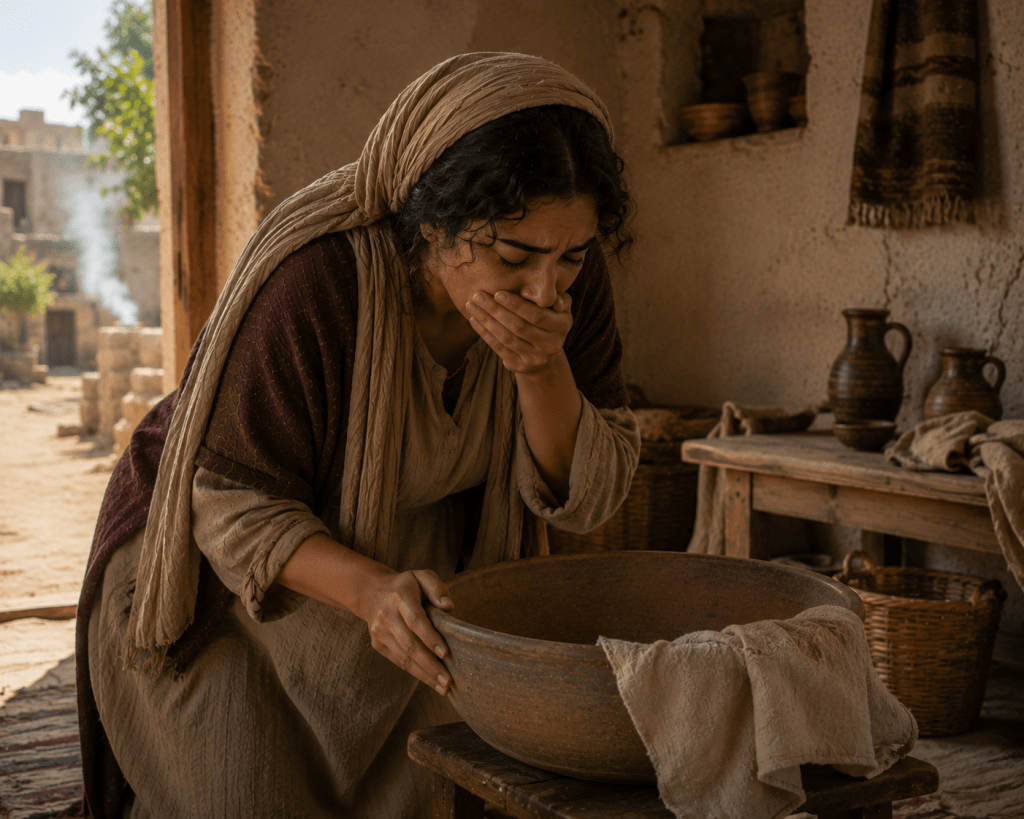
Imagine the Mother of God leaning over a basin thinking, “This is miserable.”
There are some images of Mary we are very comfortable with.
Mary kneeling before Gabriel.
Mary traveling toward Bethlehem.
Mary holding the newborn Jesus.
Mary standing beneath the Cross.
Mary assumed into Heaven.
We have painted these moments for centuries.
We have covered them in gold.
But I have never seen:
The Blessed Virgin Mary trying desperately not to throw up before breakfast.
And yet—
why not?
We don’t know whether Mary experienced morning sickness.
The Gospels tell us nothing about the physical details of her pregnancy. They don’t tell us whether she was nauseated, whether her back hurt, whether her ankles swelled, whether certain smells suddenly became unbearable, or whether Jesus spent his final weeks before birth enthusiastically kicking her in the ribs.
So this isn’t biography.
It is imagination grounded in something Christianity insists upon:
Mary was actually pregnant.
Not symbolically.
Not decoratively.
Not in the strange, sanitized way pregnancy sometimes appears in religious art, where Mary’s abdomen becomes beautifully rounded but nothing else about her body seems inconvenienced by the fact that there is an entire human being growing inside it.
She carried Jesus.
And pregnancy is profoundly physical.
Which makes me wonder whether there was ever a morning in Nazareth when Mary woke, sat up—
and immediately thought:
Oh no.
Maybe she had just enough warning to reach a basin.
Maybe not.
Perhaps she knelt there afterward with one hand gripping the edge, dark hair falling loose around her face, breathing slowly and waiting for her stomach to decide whether it was finished tormenting her.
And maybe her first coherent thought wasn’t theological at all.
Maybe it was:
This is miserable.
I hope we’re allowed to give her that.
Morning sickness is badly named.
For many pregnant women, nausea does not politely confine itself to mornings.
It can happen when waking.
Or at noon.
Or in the evening.
Or because someone cooked something.
Or because someone mentioned something.
Or because apparently the human body occasionally decides that the smell of a perfectly ordinary food is now an existential threat.
Mary’s pregnancy may have been miraculous in conception.
That does not necessarily mean it was miraculous in comfort.
And that distinction matters.
Christianity teaches that Jesus truly took human flesh from Mary.
Mary’s body wasn’t merely a sacred container that carried him around until Bethlehem.
Her body grew his body.
Her body changed to sustain him.
Her blood supplied what his developing body needed.
Her uterus expanded.
Her organs shifted.
Her hormones changed.
Her breasts prepared to feed him.
Her muscles and joints adapted to increasing weight.
Eventually, she would labor.
Eventually, she would give birth.
Whatever particular symptoms Mary did or didn’t experience, the Incarnation happened inside human biology.
And human biology is not always dignified.
Sometimes human biology is kneeling over a basin wondering whether you are finished vomiting.
That does not make the Incarnation less sacred.
It might make it more astonishing.
Imagine Mary during those first weeks.
At first, nobody can see anything.
She looks exactly the same.
Maybe she even feels mostly the same.
And then one morning something smells wrong.
Perhaps someone is baking bread.
Bread.
A smell she has known her entire life.
And suddenly her stomach turns.
Mary stops.
No.
Surely not.
She tries breathing through her mouth.
That makes it worse.
She moves away from the hearth.
Maybe she manages:
“Could someone—”
And then she’s gone.
If Joseph was already aware of the pregnancy by then, perhaps this became one of his earliest lessons in fatherhood.
Mary is somewhere being violently ill.
Joseph stands several feet away holding whatever food caused the problem.
“What do I do with this?”
Mary, without lifting her head:
“Get it away from me.”
“How far?”
“Joseph.”
Right.
Far.
Immediately.
Perhaps he learns very quickly that foods Mary loved yesterday are unacceptable today.
Something she couldn’t stand last week is suddenly the only thing she wants.
Maybe he brings her something she specifically requested.
She looks at it.
“No.”
“You asked for this.”
“I know.”
“You said you wanted—”
“I know what I said.”
Joseph looks at the food.
Looks at Mary.
Makes the profoundly wise decision not to continue this conversation.
Saint Joseph, patron of husbands learning when a situation cannot be solved by logic.
But maybe the nausea came before Joseph knew.
That possibility feels different.
Mary wakes sick.
Again.
And again.
She knows why.
Nobody else does.
Maybe someone notices.
“Are you feeling all right?”
Mary straightens too quickly.
“Yes.”
“You look pale.”
“I’m fine.”
And perhaps she isn’t lying exactly.
She’s not ill.
She’s pregnant.
But she isn’t ready—or able—to explain that yet.
That must have been strange.
Her body beginning to reveal a secret before she had figured out how to speak it aloud.
Perhaps nausea was the first physical evidence Mary received that Gabriel’s words were becoming real.
Until then, she had only the angel’s promise.
Nothing looked different.
Nothing felt different.
Then suddenly—
something did.
Maybe after the first miserable morning, once the nausea passed, Mary sat very still.
Because beneath the discomfort there may have been another realization.
Jesus.
This is because of Jesus.
Maybe her hand moved toward her abdomen.
Not with serene devotional wonder this time.
More like:
You are making your mother extremely sick.
And then perhaps she smiled despite herself.
There is something wonderfully intimate about imagining Mary’s relationship with Jesus beginning this way.
Long before she could hold him.
Long before she could hear him cry.
Long before he could wrap his tiny hand around her finger.
Her son was already changing her life.
And her body.
I wonder whether Mary ever felt guilty for hating parts of pregnancy.
Women are still made to feel strange about this.
You can desperately want a child and hate being pregnant.
You can love the baby and hate nausea.
You can be grateful and uncomfortable.
You can believe something is a gift while also thinking:
I would very much like this particular part of the gift to stop.
Those things do not contradict one another.
Did Mary know that instinctively?
Maybe.
Or maybe she had to discover it too.
Perhaps there was a morning when she’d been sick several times.
She was exhausted.
Her stomach hurt.
She hadn’t been able to keep much food down.
Someone nearby was cooking something that smelled absolutely unbearable.
And maybe Mary thought:
I hate this.
Then immediately:
Should I hate this?
This child is from God.
This is a blessing.
Gabriel called me favored.
Shouldn’t I be grateful?
But gratitude doesn’t settle an upset stomach.
Holiness does not require pretending suffering feels pleasant.
Mary could love Jesus completely and still dislike vomiting.
She could be grateful for pregnancy and still want the nausea to end.
She could say yes to God and still discover that some parts of yes were miserable.
That may be one of the most important things about imagining Mary’s pregnancy honestly.
Her fiat was not a promise to enjoy everything that followed.
It was a willingness to receive what came.
Those are not the same thing.
And perhaps other women helped her.
I hope they did.
Pregnancy is one of those places where women’s knowledge has traveled through generations largely through conversation.
Try this.
Eat something before you stand up.
Drink slowly.
Lie down.
That smell bothered me too.
Here—take this.
We don’t know who surrounded Mary during those months.
But I like imagining an older woman recognizing the look on her face before Mary says anything.
“You’re nauseated.”
Mary sighs.
“Yes.”
“Have you eaten?”
“I don’t want to eat.”
“That wasn’t my question.”
There is something wonderfully ordinary about Mary receiving advice.
The Mother of God being mothered.
Perhaps that is part of what Elizabeth offered her.
When Mary reached Elizabeth’s home, Elizabeth was already months into her own pregnancy.
Two pregnant women under one roof.
Imagine the conversations Scripture doesn’t record.
Sleep.
Food.
Bodies.
Fear.
Babies moving.
The indignities nobody puts into hymns.
Maybe Elizabeth knew exactly what Mary meant when she walked into a room, smelled something and immediately walked back out.
Maybe she laughed.
Maybe Mary didn’t find it funny.
Yet.
There is another reason I like allowing Mary an uncomfortable pregnancy.
Because religious art has a habit of making holy bodies strangely untouched by being bodies.
Saints suffer dramatically.
Martyrdom is permitted.
Wounds are permitted.
Tears are permitted.
But ordinary physical indignity?
We tidy that away.
Yet the central claim of Christianity is astonishingly physical:
The Word became flesh.
Not an idea.
Not an apparition.
Flesh.
And that flesh began within Mary’s body.
So perhaps there were headaches.
Constipation.
Heartburn.
Fatigue.
Food aversions.
Tenderness.
Insomnia.
Backaches.
A bladder that increasingly had its own opinions.
Maybe none of those.
Maybe several.
We cannot know.
But none of them would diminish Mary.
None would make Jesus’ conception less miraculous.
None would make the pregnancy less holy.
They would simply mean the Incarnation happened where Christianity says it happened:
inside human flesh.
And if Mary did experience morning sickness, I wonder whether there was ever a moment when Jesus later learned about it.
Maybe years afterward.
Perhaps Mary mentioned something about the pregnancy.
Jesus is old enough now to understand.
“You made me terribly sick.”
Jesus looks surprised.
“I did?”
“For weeks.”
Joseph, somewhere nearby:
“We couldn’t cook lentils.”
Mary points immediately.
“The smell.”
Joseph nods gravely.
“The smell.”
Jesus laughs.
Maybe Mary does too.
Perhaps every family has stories children eventually hear about themselves.
You wouldn’t sleep unless someone walked with you.
You screamed whenever we bathed you.
You kicked constantly.
You made me crave something ridiculous.
You were born during a storm.
Maybe Jesus had those stories too.
Not because he needed them.
Because families tell stories.
And before he belonged to the crowds—
he belonged to a household that remembered him when he was small.
Mary remembered him before he was even visible.
Maybe there really was a morning when Mary found herself leaning over a basin.
Eyes watering.
Hair falling into her face.
One hand gripping the rim.
Absolutely finished with the entire experience.
Perhaps when it finally passed, she stayed there for another moment.
Breathing.
Annoyed.
Exhausted.
Not remotely resembling a Renaissance Madonna.
Then perhaps she sat back.
Wiped her mouth.
Rested a hand against an abdomen that still barely looked different.
And muttered:
“You had better be worth this.”
Maybe she immediately laughed at herself.
Because, of all mothers in history—
she already knew the answer.
But knowing something is worth it doesn’t mean it isn’t hard.
That’s the Mary I want to remember.
Not a woman floating untouched through a miraculous pregnancy.
A woman whose yes became physical.
Whose faith lived inside a changing body.
Who could be blessed and nauseated.
Chosen and exhausted.
Grateful and miserable.
Holy and desperately wishing the room would stop smelling like breakfast.
Perhaps she leaned over that basin and discovered something every mother eventually learns:
You can love someone more than your own life—
and still be profoundly inconvenienced by them.
Even when the person inconveniencing you
is God.


