The Invitations of Mary Series
©MS 2026
Everything had changed. Nothing looked different.
I wonder how long it took Mary to remember.
That strange space between sleeping and waking, when you haven’t quite returned to yourself yet.
Maybe morning light was beginning to enter the room.
Maybe she heard someone moving outside.
An animal.
Footsteps.
The first sounds of Nazareth beginning another day.
Perhaps for three or four seconds, Mary simply woke.
And then…
Oh.
Yesterday.
Gabriel.
The words.
The promise.
Her yes.
Maybe she opened her eyes completely.
Maybe she lay perfectly still.
Because everything had changed.
And absolutely nothing looked different.
The same ceiling.
The same walls.
The same blanket.
The same clothes waiting for her.
The same water jar.
The same work.
Outside, the same village was waking to the same morning it would have expected yesterday.
But Mary wasn’t the same.
She was carrying Jesus.
At least, she believed she was.
And I wonder what that felt like when there was no evidence yet that she could see.
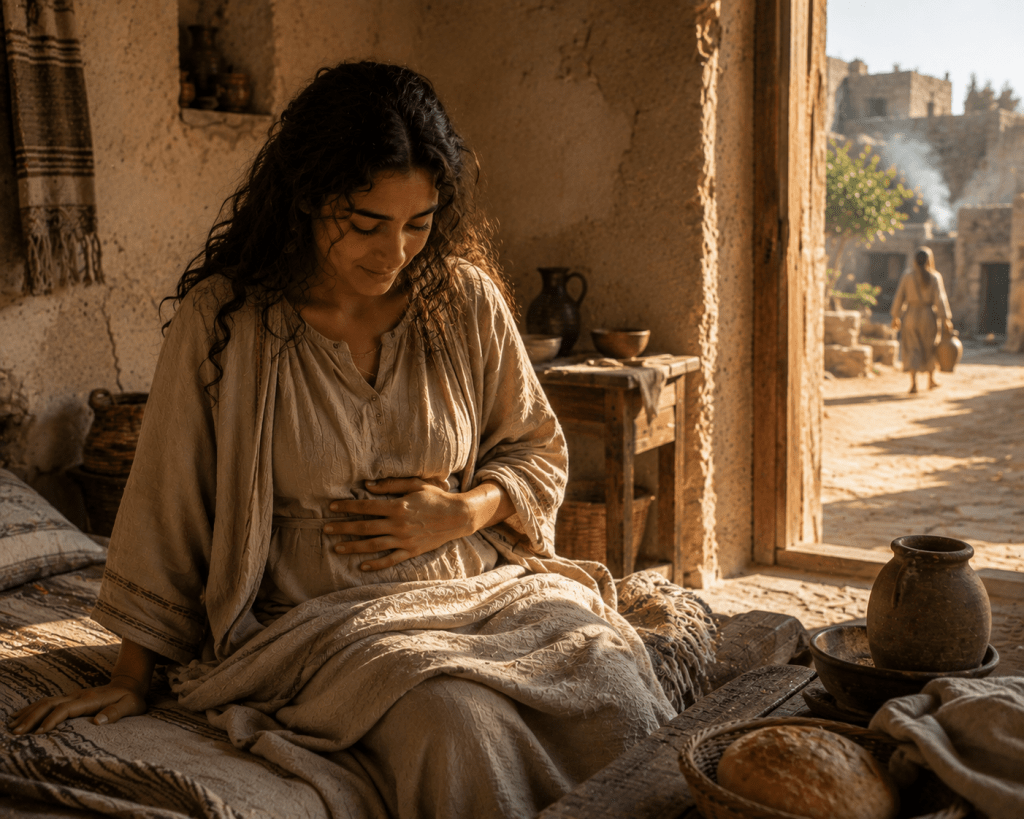
Did Mary immediately touch her abdomen?
I think about that.
Not the rounded belly we see in paintings of the Visitation.
There would have been nothing to see yet.
No movement.
No kicking.
No unmistakable physical reassurance that a child was growing within her.
Her body may have felt exactly as it had the morning before.
Maybe she placed her hand there anyway.
Tentatively.
Almost experimentally.
Are you there?
There is something achingly tender about imagining that first gesture.
Before anyone could see Jesus.
Before anyone could touch him.
Before Mary herself could feel him move.
There was simply faith.
Gabriel had said:
“You will conceive in your womb and bear a son.”
Mary had answered:
“Let it be with me according to your word.”
Then she went to sleep.
And woke up in a body that looked completely unchanged.
Did she wonder whether it had happened already?
Did she expect to feel different?
Surely something this enormous should feel like something.
Perhaps she lay there searching herself for evidence.
A warmth?
A sensation?
Anything?
Maybe there was nothing.
And perhaps that was unsettling.
Because Gabriel was gone now.
There was no angel standing beside the bed the following morning saying:
Yes, Mary. It happened.
No heavenly confirmation waiting at breakfast.
No visible sign.
Just memory.
And trust.
I wonder whether Mary questioned herself.
We sometimes become uncomfortable imagining that.
Mary believed.
Mary trusted.
Mary said yes.
Therefore, we may feel as though she must have awakened the next morning with perfect supernatural certainty, glowing peacefully beneath her linen covering while celestial music played somewhere outside.
But faith and questions are not enemies.
Mary herself had already asked Gabriel:
“How can this be?”
She was willing to ask.
Maybe the next morning brought new questions.
Was it real?
Not necessarily Did I imagine the angel?
Although, frankly, if an angel appeared in my house and disappeared again, I suspect the following morning would contain at least one moment of:
Did that actually happen?
Perhaps Mary replayed every detail.
Where she had been standing.
What Gabriel said.
What she said.
The way the room felt.
The moment he left.
Maybe she looked at the exact place where he had stood.
Nothing.
Just a room.
Maybe yesterday suddenly felt dreamlike.
Extraordinary experiences sometimes do after sleep.
You wake and the ordinary world rushes back in so convincingly that yesterday’s impossible thing feels almost unreal.
Perhaps Mary needed to remember the words carefully.
Do not be afraid.
You have found favor with God.
You will conceive.
The Holy Spirit will come upon you.
Nothing will be impossible with God.
Maybe she repeated them to herself.
Not because she had forgotten.
Because she needed them again.
And then, eventually, she had to get out of bed.
That’s the part of Mary’s story I keep loving.
She had to get up.
The Incarnation did not excuse her from morning.
Perhaps she washed her face.
Perhaps she dressed.
Perhaps she tied back her dark hair and covered it.
Perhaps she ate something.
Perhaps there was water to fetch or food to prepare.
Maybe someone spoke to her before she was ready.
“Good morning.”
“Good morning.”
That’s all.
Imagine how strange that must have been.
Someone who had known Mary yesterday sees her today.
They notice nothing.
Why would they?
She looks like Mary.
Maybe a little distracted.
Maybe quieter.
Maybe she slept badly.
But otherwise…
Mary.
And she is standing there thinking:
You have no idea.
There is something almost funny about it.
Perhaps someone complained about something trivial.
The bread wasn’t right.
An animal had gotten into something.
A neighbor was irritating.
Someone needed help with a task.
Mary listened.
Nodded.
Answered.
Meanwhile:
The Son of the Most High is inside me.
How do you participate in small talk after that?
Maybe badly.
Perhaps someone asked:
“Mary, are you listening?”
“What?”
“I asked whether—”
“Oh. Sorry.”
Because she had disappeared into her thoughts again.
I would have.
How could she not?
And what about food?
Did breakfast suddenly feel different?
Maybe Mary reached for bread and stopped.
For the first time in her life, eating wasn’t only feeding herself.
That realization comes to pregnant women eventually.
What I eat nourishes someone else now.
My body is doing something even when I am doing nothing.
Perhaps Mary didn’t understand pregnancy in our modern biological detail, but women understood the basic embodied reality of carrying a child.
Maybe she ate and thought:
This is for you too.
There is something extraordinary about the first meal Mary ate after the Annunciation.
Nothing miraculous happened to the food.
Ordinary bread.
Ordinary water.
Perhaps olives.
Fruit.
Whatever was available.
And Mary’s body took those ordinary things and began using them to build the body of Jesus.
That thought stops me.
Christians spend enormous theological energy contemplating the Incarnation—and rightly so.
The Word became flesh.
But flesh has to come from somewhere.
Jesus received his human body from Mary.
Her body nourished his.
Her blood sustained his developing life.
Eventually her milk would feed him.
The God Christians believe created wheat entered humanity through a body nourished by bread.
And maybe the morning after Gabriel, Mary simply ate breakfast.
No one painted it.
But the Incarnation was already happening.
Perhaps that morning was also when the practical fear became sharper.
Yesterday had been revelation.
Today was consequence.
Because if Gabriel’s words were true—and Mary believed they were—then eventually her body would look different.
Maybe not today.
Maybe not tomorrow.
But eventually.
And then everyone would know something had happened.
Joseph.
Family.
Neighbors.
People who would not have received angelic explanations.
Mary may have looked at herself that morning and realized:
I can still hide this.
Not necessarily because she intended deception.
Simply because there was nothing yet to reveal.
For a little while, the secret was invisible.
How long would that last?
When would she tell Joseph?
When would she leave for Elizabeth?
What would she say?
Would people believe her?
Yesterday, those questions may have felt theoretical beneath the overwhelming presence of Gabriel.
Morning has a way of making things practical.
There are things you agree to at night that look considerably more complicated in daylight.
Maybe Mary discovered that.
Her yes remained yes.
But now she had to live inside it.
I wonder if she felt joy.
Not the Magnificat yet.
Not the triumphant joy of generations calling her blessed.
Something quieter.
Private.
Maybe she caught herself smiling.
Perhaps while doing something completely ordinary.
Her hand returned unconsciously to her abdomen.
And suddenly:
Jesus.
Her son.
Gabriel hadn’t only given Mary a theological announcement.
He told her she would have a baby.
A child.
Her child.
Maybe that reality began arriving in pieces.
She would hold him.
Feed him.
Name him.
Jesus.
Gabriel had already given her his name.
Did Mary whisper it that morning?
Perhaps very quietly.
Just to hear it.
Jesus.
No one else around her knew that name belonged to someone yet.
But Mary did.
Maybe she said it again.
Jesus.
The first private conversation between mother and child may have happened before Mary could feel him at all.
“Good morning.”
I love imagining that.
Maybe it sounds too modern.
But women have spoken to babies they carry for as long as women have carried babies.
Why wouldn’t Mary?
Perhaps she felt silly.
There was nothing to see.
Nothing to hear.
Nothing to feel.
Still:
Good morning.
And somewhere beyond Mary’s perception, human life had begun.
Maybe that is what made this morning different from the one before Gabriel.
Yesterday, Mary woke into a world she could see.
Today, she woke carrying something she couldn’t.
That feels like faith in its most intimate form.
Not believing an abstract doctrine.
Trusting that something is happening when there is no visible evidence yet.
Mary had Gabriel’s promise.
For now, that had to be enough.
Soon Elizabeth would greet her.
Eventually her body would change.
Eventually she would feel Jesus move.
Eventually Joseph would know.
Eventually shepherds would kneel beside him.
Eventually Simeon would hold him.
Eventually crowds would follow him.
Eventually Mary would watch him die.
Eventually she would see him risen.
But none of that existed yet.
There was only morning.
Mary.
And a secret.
Perhaps she stepped outside.
The sun rose over Galilee exactly as it had the day before.
Neighbors began their work.
Smoke rose from cooking fires.
Water jars were carried.
Children made noise.
Joseph was somewhere living a morning whose future had also changed without his knowledge.
Rome still ruled.
Herod still sat on his throne.
The Temple still stood in Jerusalem.
The world had no idea that anything significant had happened.
No proclamation had gone out.
No star hung over Bethlehem.
No shepherds had heard angels.
No Magi had begun following anything.
History looked exactly the same.
And somewhere in Nazareth, a young Jewish woman walked into the morning carrying God within her.
Nobody noticed.
Maybe that’s what I find most beautiful.
We expect transformation to announce itself.
We want the dramatic moment.
The visible proof.
The clear dividing line.
We want to feel different when something important begins.
But perhaps some of the most important beginnings are almost invisible.
A seed beneath soil.
A decision nobody else knows you’ve made.
Healing that has barely begun.
A prayer you aren’t sure has been heard.
A tiny life no one can see.
A yes whose consequences haven’t arrived yet.
Sometimes the world looks exactly the same the morning after everything changes.
Mary knew that.
She woke.
Opened her eyes.
Saw the same room.
Touched the same floor.
Put on the same clothes.
Probably did many of the same things she had done the morning before.
Except perhaps, every so often, her hand drifted toward her abdomen.
And she remembered.
You’re here.
Nothing around her looked different.
But Mary knew.
And for a little while,
that was enough.


