The Rosarium Series | © MS 2026
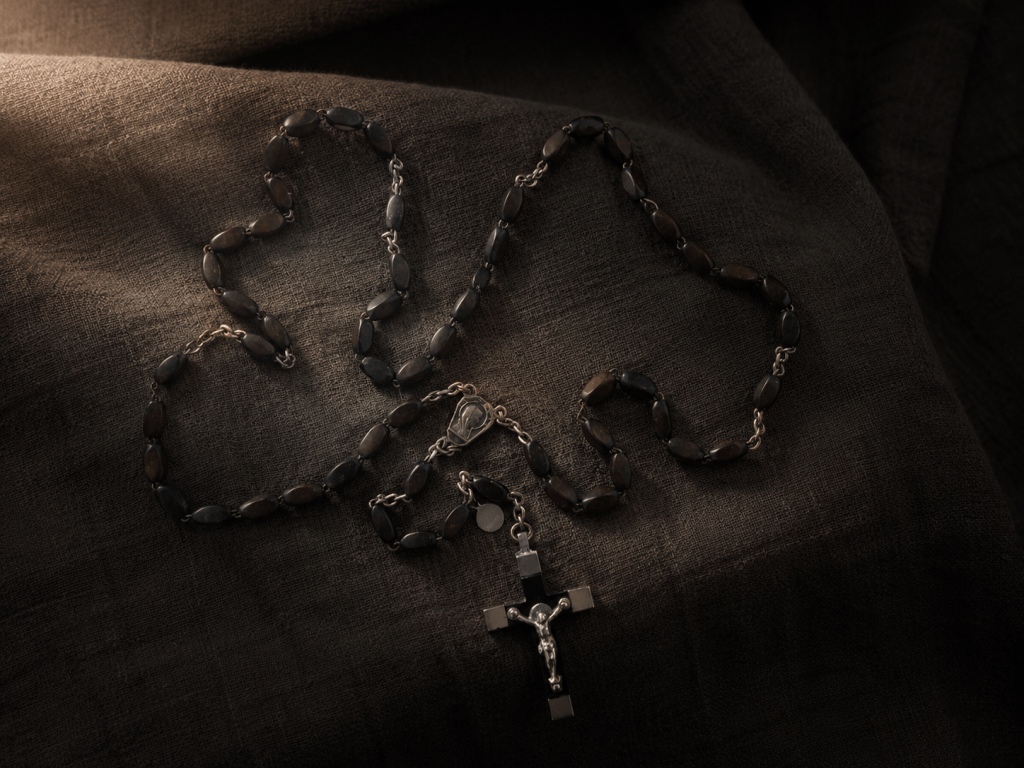
Dark wood, devotional history, and the quiet gravity of ebony
Some rosaries feel immediately familiar.
Olive wood feels warm.
Glass catches light.
Metal reflects.
Ebony feels different.
Before prayer even begins, an ebony rosary often announces itself through weight.
Darkness.
Density.
Smoothness.
A quiet visual seriousness.
Held in the hand, ebony rarely feels ornamental.
It feels deliberate.
Restrained.
Steady.
Its deep color absorbs light rather than reflecting it. Its polished surface often feels cool at first touch, gradually warming through use. Even simple ebony rosaries carry a kind of presence that is difficult to mistake.
For many people, an ebony rosary feels companionable in silence.
A material suited to repetition.
To stillness.
To attention.
And yet ebony raises questions quite different from those surrounding olive wood.
Olive wood speaks readily of pilgrimage and sacred geography.
Ebony tells another story.
A story that begins not in familiar groves or biblical landscapes, but in distant forests and long journeys.
A story of craftsmanship.
Durability.
Trade.
Devotion.
And the surprising ways materials acquire meaning through use.
Why ebony?
Why did generations of Catholics choose such a dark and unusually dense material for prayer?
And what story might an ebony rosary quietly carry in the hand?
What Is Ebony?
Unlike olive wood, ebony is not a single tree.
The word ebony is generally used for several species of dense hardwoods belonging to the Diospyros genus, found primarily in tropical regions of Africa and Asia.
For centuries, these woods have been prized for qualities that make them immediately recognizable.
Ebony is often:
- exceptionally dense
- dark in color, ranging from deep brown to near-black
- fine-grained and smooth
- capable of taking a remarkable polish
- resistant to wear under repeated handling
Compared to many other woods used in devotional objects, ebony feels substantial.
A bead of ebony may weigh noticeably more than a similarly sized bead made from olive wood or many common hardwoods.
The difference is often felt before it is seen.
The rosary settles into the hand differently.
Its presence is more pronounced.
Its movement more deliberate.
Visually, ebony can appear almost uninterrupted in color. Yet close inspection often reveals subtle variation—brown undertones, faint grain patterns, and small shifts in texture that become visible under changing light.
No two examples are entirely identical.
And importantly:
not every dark rosary is ebony.
Dark-stained woods, bog oak, horn, rosewood, vulcanite, composites, and modern synthetic materials may all resemble ebony at first glance.
Part of learning to appreciate devotional materials is learning patience.
To look closely.
To notice weight.
Texture.
Grain.
Construction.
Because materials, like prayer, often reveal themselves slowly.
Why Ebony?
Part of the answer begins with the hand.
Ebony feels different.
Dense.
Smooth.
Substantial.
Its physical presence quietly alters the experience of prayer.
Where lighter woods may move almost unnoticed between fingers, ebony often feels deliberate.
Present.
A rosary that asks to be held rather than merely carried.
This mattered.
Because rosaries are repetitive objects.
They are handled again and again.
Through habit.
Through waiting.
Through uncertainty.
Through grief.
Through ordinary mornings and sleepless nights.
A devotional material needed to endure touch.
Ebony endured remarkably well.
Its density helped resist wear.
Its hardness tolerated repeated handling.
Its polished surface softened gently through years of use.
And even after decades of prayer, ebony often retained a feeling of steadiness.
Not fragile.
Not decorative.
Companionable.
Durable, Practical, and Beautiful in Restraint
For artisans and devotional makers, ebony offered unusual advantages.
It could be shaped into smooth beads.
Drilled with precision.
Polished to a soft luster.
Made elegant without becoming ornate.
This distinction matters.
Ebony communicates beauty differently than crystal, silver, or cut glass.
Its appeal is quieter.
More restrained.
Its beauty comes less from sparkle and more from presence.
Luxury without glitter.
Refinement without spectacle.
For clergy, religious communities, devotional households, and ordinary Catholics drawn toward simplicity, ebony offered something compelling:
a rosary capable of feeling serious without feeling extravagant.
Its darkness carried dignity.
Its simplicity carried weight.
Sometimes devotion asks not for ornament—
but steadiness.
A Material of Stillness
It is tempting to assign symbolic meaning to every material.
Collectors and devotional writers alike often do this.
Yet history requires caution.
There is little evidence that ebony possessed one universal meaning across Catholic devotional life.
It was not officially designated as a wood of mourning.
Nor was it uniquely associated with any single form of prayer.
And yet materials are experienced emotionally.
People respond to them.
Live with them.
Develop preferences for them.
Modern collectors and rosary users often describe ebony in remarkably similar ways:
quiet
serious
restrained
contemplative
grounding
Not because the wood itself carries those meanings inherently.
But because its physical qualities seem to support those impressions.
Its darkness softens visual distraction.
Its weight anchors movement.
Its polished surface invites touch.
An ebony rosary does not determine how someone prays.
Yet it often seems well suited to the slower, quieter forms of devotion that accompany reflection, endurance, and attention.
Perhaps meaning accumulated not through symbolism alone—
but through experience.
Through years of being held.
Through repetition.
Through prayer.
Why This and Not Something Else?
Perhaps the answer is ultimately simple.
Ebony offered something unusual:
durability and gravity at the same time.
Strong enough for repeated use.
Beautiful without ornament.
Smooth enough to become familiar.
And substantial enough to feel present.
Prayer after prayer.
Year after year.
Rosaries have always occupied a curious space between object and companion.
They are tools.
But they are also witnesses.
They travel beside people through seasons of faith, uncertainty, gratitude, illness, joy, and grief.
The materials chosen for them matter because those materials shape how the rosary is experienced.
Ebony’s gift may simply be this:
it remains.
Steady.
Quiet.
Unhurried.
A wood capable of disappearing into the rhythm of prayer while somehow making its presence known at the same time.
And perhaps that is why ebony endured.
Not because it demanded attention.
But because it accompanied it so well.


