The Invitations of Mary Series
©MS 2026
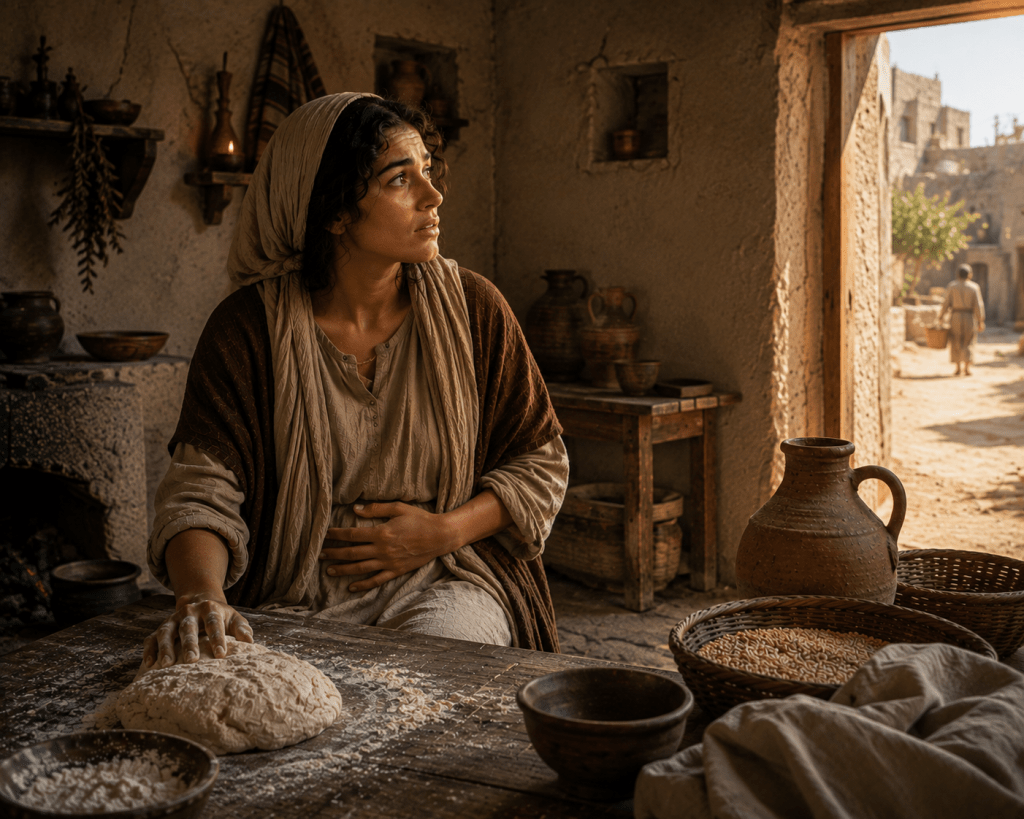
The angel was gone. The room remained.
And then Gabriel left.
That part gets almost no attention.
We spend centuries painting the arrival.
The angel.
The lilies.
Mary’s startled face.
The raised hand.
The impossible announcement.
You will conceive in your womb and bear a son.
Mary’s question.
Gabriel’s answer.
Elizabeth.
The Holy Spirit.
The power of the Most High.
Nothing will be impossible with God.
And finally:
“Let it be with me according to your word.”
Then Luke gives us five quiet words:
“Then the angel departed from her.”
And that’s it.
Gabriel leaves.
No music swells.
No narrator explains what Mary does next.
The Gospel simply moves on.
But Mary couldn’t.
Not immediately.
Because there must have been a moment when the angel was there—
and then he wasn’t.
And suddenly Mary was alone.
I wonder what the room felt like.
Maybe the first thing she noticed was the silence.
Not peaceful silence.
Not yet.
The strange silence that follows something enormous.
The kind where your ears almost seem to strain against the absence of what had just filled the room.
Perhaps Mary didn’t move.
Maybe she stood exactly where Gabriel had left her.
Her heart still pounding.
Her breath shallow.
Her hands trembling slightly.
Was she afraid to move?
Sometimes after something shocking happens, the body seems to lag behind reality.
Your mind understands that the conversation is over.
Your body hasn’t received the message.
So you stand there.
You stare.
You replay.
Maybe Mary looked at the place where Gabriel had been.
Was there anything left?
Light?
Warmth?
A smell?
Anything?
Or did the room return instantly to exactly what it had been before?
I almost think that would have been stranger.
The same walls.
The same table.
The same clay vessels.
The same unfinished work.
Sunlight entering from the same doorway.
Dust moving lazily through the air.
Outside, someone walked past.
An animal called somewhere nearby.
A neighbor continued whatever conversation she had been having.
Nazareth had not stopped.
How dare it?
Mary had just been told that she would conceive the Son of the Most High.
And someone outside was probably arguing about grain.
There is something almost offensive about the ordinary world after life-changing news.
It doesn’t know.
The sun doesn’t pause.
People don’t suddenly become quiet.
Water still needs carrying.
Bread still needs making.
Someone laughs nearby.
Someone complains.
Someone asks what you’re making for dinner.
And you stand there thinking:
Do you understand what just happened?
No.
They don’t.
They couldn’t.
Mary may have been the only person on earth who knew.
For one extraordinary stretch of time, perhaps this enormous secret existed entirely between Mary and God.
Not Joseph.
Not her parents, if they were living.
Not Elizabeth yet.
Not the neighbors.
Not the religious authorities.
Not Rome.
Just Mary.
And God.
What do you do with that?
Perhaps she sat down.
I think I would have.
Not gracefully.
Just whatever surface was closest.
Maybe her knees felt unreliable.
Maybe she pressed both hands against her face.
Maybe she stared at the floor.
Maybe she laughed once—not because anything was funny, but because sometimes the body doesn’t know what else to do with something impossible.
Maybe she cried.
Maybe she did neither.
Perhaps Mary simply whispered:
“What just happened?”
I love allowing her that question.
Because Mary’s yes does not mean Mary understood everything.
Luke explicitly gives us a Mary who asks questions.
“How can this be?”
Later, when twelve-year-old Jesus remains behind in Jerusalem, Mary tells him plainly that she and Joseph have been searching for him anxiously. Luke then tells us they did not understand what Jesus said to them.
Mary is faithful.
Mary is not omniscient.
Those are very different things.
So after Gabriel left, she still had questions.
Probably hundreds of them.
Maybe the first was:
When?
Gabriel had said she would conceive.
Had it already happened?
Would something happen later?
Would she feel it?
Would she know?
Did Mary place a hand against her abdomen?
Not because there was anything to feel.
Simply because that’s where Gabriel had told her the impossible would happen.
Her body looked exactly the same.
She felt exactly the same.
Perhaps that frightened her more.
Nothing looked different.
And yet everything was.
Then maybe another thought came.
Joseph.
Oh.
Joseph.
That may have been the moment when the theological enormity of Gabriel’s announcement collided with Mary’s actual life.
Because Gabriel could say:
The Holy Spirit will come upon you.
But Mary would eventually have to explain that sentence to her betrothed.
Imagine realizing that.
She knew what pregnancy meant socially.
She knew how babies normally came into existence.
So did everyone else.
How exactly does a young woman begin that conversation?
Joseph, something happened today.
An angel came.
No, really.
He said—
No, Joseph, please listen.
The Holy Spirit—
Even imagining it makes my stomach tighten.
Matthew tells us what Joseph eventually thought.
He planned to divorce her quietly.
Which means there was pain between Gabriel’s visit to Mary and the angel’s visit to Joseph.
Mary’s yes did not prevent that pain.
Perhaps she knew immediately that it wouldn’t.
Maybe she sat in that room and realized:
He may not believe me.
Would anyone?
Elizabeth might.
Gabriel had given Mary Elizabeth almost like a lifeline.
Your relative Elizabeth in her old age has also conceived a son.
Perhaps Mary’s thoughts kept returning to her.
Elizabeth.
Elizabeth would understand impossible pregnancies.
Elizabeth had experienced her own divine interruption.
Elizabeth was somewhere Mary could go.
But not yet.
For a little while, Mary was still in the room.
Alone.
And I wonder whether she replayed Gabriel’s first words.
“Greetings, favored one! The Lord is with you.”
The Lord is with you.
Did those words feel different now?
Because God’s presence is comforting until you realize it may completely dismantle the life you expected to have.
We sometimes talk about being “favored” by God as though favor should make life easier.
Mary’s favor had just complicated everything.
Her engagement.
Her reputation.
Her body.
Her future.
Perhaps even her safety.
The Lord was with her.
And nothing was simple anymore.
Maybe she felt afraid.
Maybe that embarrassed her.
She had just said yes.
Wasn’t she supposed to feel courageous now?
But courage doesn’t necessarily arrive after the decision.
Sometimes you make the courageous decision first.
Then you sit alone afterward thinking:
Oh God. What have I done?
I think there is room for Mary there.
Her fiat was not invalidated if fear followed it.
Her trust was not false if uncertainty remained.
Faith does not mean the nervous system receives advance notice that everything will eventually be all right.
Maybe she shook.
Maybe she prayed again.
Perhaps not magnificently.
The Magnificat would come later.
Elizabeth would greet her.
John would leap.
Mary’s certainty would find words:
My soul magnifies the Lord.
But perhaps there was no song yet.
Maybe there was only:
Stay with me.
That’s a prayer too.
And then, eventually, Mary must have gotten up.
This is the detail I can’t stop thinking about.
At some point after the angel departed, ordinary life resumed.
Maybe the dough from before Gabriel’s arrival was still sitting on the table.
Maybe the grain remained where she’d left it.
Maybe there was water to put away.
Maybe a piece of cloth waited beside her.
Whatever she had been doing before Gabriel came had not magically completed itself during the Annunciation.
The room still contained a life that had begun under entirely different assumptions.
Perhaps Mary looked at those things strangely.
They belonged to an hour ago.
They belonged to the girl who woke that morning thinking she knew approximately what her future contained.
Marriage to Joseph.
A household.
Children, perhaps.
Ordinary joys.
Ordinary sorrows.
A life in Nazareth.
That Mary had set something down.
This Mary was picking it back up.
And no one looking through the doorway would have known the difference.
That’s astonishing to me.
There may have been no visible evidence whatsoever that the Incarnation had begun.
No halo appeared over Mary’s head.
No celestial music followed her through Nazareth.
People who saw her later that day may have simply seen Mary.
Maybe someone greeted her.
Maybe she answered normally.
Maybe someone asked her a completely mundane question.
“Did you finish that?”
“Are you coming tomorrow?”
“Have you seen my—?”
And Mary had to participate in ordinary conversation while thinking:
An angel was in my house.
I wonder how long she kept the secret.
Minutes?
Hours?
Did she tell someone immediately?
Did she need time first?
Luke doesn’t say.
But eventually she would travel to Elizabeth.
Eventually Joseph would know.
Eventually her body would begin telling the story whether Mary wanted it told or not.
But there was a brief threshold before all of that.
The quiet after Gabriel.
I think it may have been one of the most private moments of Mary’s life.
Before Christianity.
Before Marian theology.
Before paintings.
Before titles.
Before Theotokos.
Before churches named for her.
Before millions of people repeated Gabriel’s greeting back to her in prayer.
There was simply a young Jewish woman sitting in a room in Galilee trying to understand what had just happened.
And perhaps that’s why I keep coming back to those five words:
Then the angel departed from her.
Gabriel didn’t stay.
That’s important.
He didn’t accompany Mary to Joseph and explain everything for her.
He didn’t walk beside her to Elizabeth.
He didn’t remain visible throughout the pregnancy reassuring everyone who questioned her.
He delivered the message.
Mary said yes.
And then she had to live the yes.
That feels very different.
Sometimes the moment of clarity is brief.
The retreat ends.
The church empties.
The conversation is over.
The certainty fades.
The extraordinary experience passes.
And you are left standing inside your ordinary life with whatever you agreed to while God felt very close.
Then comes the harder part.
Living it when the angel is gone.
Maybe that’s what the room felt like.
Not empty.
But enormous.
Quiet enough for Mary to hear her own breathing.
Familiar objects suddenly unfamiliar.
A future she could no longer picture.
Fear.
Wonder.
Questions.
Perhaps joy beginning somewhere beneath all of it.
And an absence where Gabriel had been.
Mary looked around.
Nothing had changed.
Everything had changed.
Then perhaps she rested her hand against her abdomen.
Took one long breath.
And whispered into the ordinary room:
“All right.”
Because the angel had left.
And now Mary’s part began.


