The Invitations of Mary Series
©MS 2026
The most famous interruption in history had to interrupt something.
Gabriel arrives in the middle of a sentence.
At least, that is how Luke makes it feel.
The angel enters.
“Greetings, favored one! The Lord is with you.”
Mary is perplexed.
Gabriel tells her not to be afraid.
Then, within a handful of verses, everything changes.
She will conceive.
She will have a son.
His name will be Jesus.
He will be called Son of the Most High.
His kingdom will have no end.
Mary asks how.
Gabriel answers.
Mary says yes.
And Christianity has spent two thousand years contemplating what happened next.
But I keep wondering about something much smaller.
What happened immediately before?
What was Mary doing five minutes before Gabriel arrived?
Because she must have been doing something.
Luke doesn’t tell us.
Christian art has certainly tried to fill in the blank.
Artists frequently place Mary at prayer or reading Scripture when Gabriel appears. It is a beautiful theological image: the young woman contemplating the Word of God at precisely the moment the Word is about to become flesh within her.
I understand why artists loved it.
But we don’t actually know.
Maybe Mary was praying.
Or maybe she was sorting lentils.
I find myself increasingly delighted by that possibility.
Perhaps she was doing something so completely ordinary that nobody would ever think to preserve it.
She could have been preparing food.
Mending something.
Grinding grain.
Spinning thread.
Sweeping.
Carrying water.
Putting something away.
Looking for something she’d misplaced.
Maybe she was kneeling on the floor trying to retrieve something that had rolled beneath a piece of furniture.
Imagine that.
The moment before the Annunciation:
Mary, future Mother of God, muttering,
“Where did that go?”
And then Gabriel appears.
There is something almost startling about realizing that one of the most consequential moments in Christian history probably interrupted an ordinary day.
Mary did not receive an appointment.
There was no warning the previous evening:
Tomorrow, please make yourself available. An archangel will arrive sometime between noon and four.
She didn’t wake knowing this was The Annunciation.
It wasn’t called that yet.
It was just today.
Perhaps she had plans.
That’s the part that fascinates me.
Mary had a future before Gabriel arrived.
Not the future she would actually live.
The future she reasonably expected.
She was betrothed to Joseph.
There were probably practical things to think about.
Marriage.
Household.
Family.
Where and how they would live.
What needed preparing.
Maybe she was excited.
Maybe she was nervous.
Maybe she had questions she hadn’t asked Joseph yet.
Maybe she had opinions about something he wanted for their future.
Maybe there were ordinary conversations happening around their betrothal that nobody recorded because, until Gabriel arrived, they were simply two people preparing for marriage.
Mary had plans.
And then heaven walked into the room.
I wonder whether Gabriel interrupted one of those thoughts.
Maybe she was thinking about Joseph.
Maybe she was thinking about what needed to be done before evening.
Maybe she was mentally arranging tomorrow.
Maybe she was hungry.
Maybe she was irritated.
Maybe she had just burned something.
Given our previous considerations, I refuse to rule it out.
Perhaps Gabriel arrived approximately three minutes after Mary scraped an overcooked loaf and thought:
Well, this day is going beautifully.
Then:
Greetings, favored one.
Excuse me?
There is humor in imagining it, but there is something deeper too.
Because I think we often imagine encounters with God happening when people are appropriately prepared for them.
There should be silence.
Candles.
Prayer.
A clean room.
A receptive heart.
Maybe some incense.
Preferably Gregorian chant happening inexplicably in the background.
We create environments in which we expect God.
And those environments can be beautiful.
But Scripture is filled with a God who seems remarkably comfortable interrupting people.
Moses is tending sheep.
Gideon is threshing wheat.
Samuel is trying to sleep.
David is out with the flock.
Peter and Andrew are fishing.
Matthew is at work.
Paul is traveling.
God has never seemed particularly concerned with waiting until humans finish what they’re doing.
Why should Mary be different?
Perhaps Gabriel arrived while her hands were busy.
I like imagining that especially.
Mary holding something.
A piece of cloth.
A bowl.
A spindle.
A handful of grain.
And then—
someone is there.
Whatever she was holding suddenly becomes irrelevant.
Did she put it down?
Did she drop it?
Did she freeze?
Luke tells us Mary was troubled by Gabriel’s greeting and considered what it could mean.
Artists often portray her reaction beautifully.
One hand raised.
Eyes wide.
Body leaning slightly backward.
But imagine the physical reality of surprise.
Perhaps her heart began pounding.
Perhaps her breath caught.
Perhaps she instinctively stepped away.
Maybe she looked toward the doorway.
Maybe she wondered whether she should call someone.
Maybe she thought, for one bewildering second:
Who are you?
Then Gabriel says the words angels apparently need to say remarkably often when interacting with human beings:
Do not be afraid.
Which suggests there was, in fact, something to be afraid of.
We have made Gabriel beautiful.
Soft wings.
Golden hair.
Gentle expression.
But biblical encounters with angels do not generally produce the reaction:
Oh, how lovely.
People are frightened.
Whatever Mary experienced, it disrupted the room.
And perhaps whatever she had been doing simply stopped.
That’s the image I keep seeing.
Not Gabriel first.
The unfinished thing.
A spindle lying where Mary set it down.
Grain waiting to be ground.
A half-folded cloth.
A bowl with something still inside it.
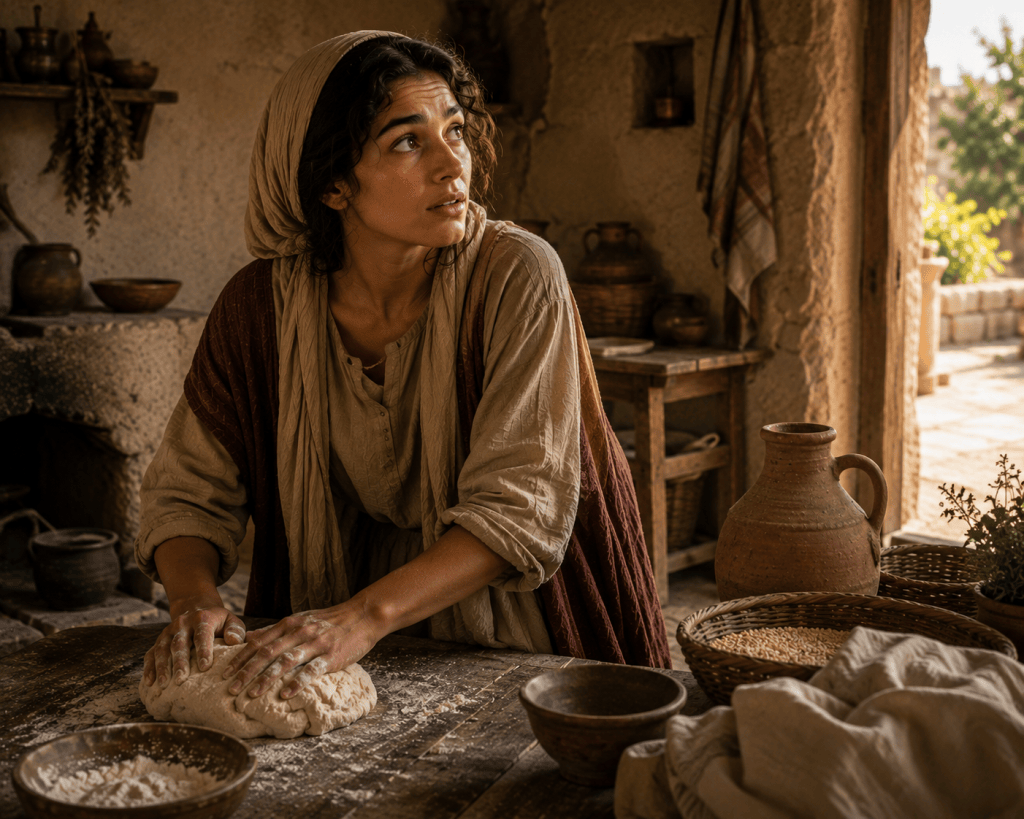
Bread dough beneath her hands.
Water she had just carried.
Evidence that Mary had expected her life to continue normally for at least the next several minutes.
Then it didn’t.
There must have been a moment after Gabriel left when Mary saw that thing again.
Imagine that.
The room becomes ordinary once more.
The angel is gone.
Silence returns.
Mary is standing there.
She has just agreed to something she cannot possibly understand completely.
She has been told that the Holy Spirit will come upon her.
That she will conceive.
That her child will be holy.
That he will be called the Son of God.
That Elizabeth, impossibly, is pregnant too.
And then—
Mary looks down.
There’s the dough.
It still needs kneading.
There is something wonderfully absurd about that.
The world has changed.
Dinner has not.
Maybe Mary stood there for a while.
How long?
Ten seconds?
Five minutes?
An hour?
Did she sit down?
Did she cry?
Did she laugh?
Did she touch her abdomen even though there was nothing yet to feel?
Did she replay Gabriel’s words?
The Lord is with you.
Do not be afraid.
You will conceive.
Nothing will be impossible with God.
Did she wonder whether it had actually happened?
Maybe she looked around the room for evidence.
Nothing.
The walls were still walls.
The floor was still dirty in whichever places it had been dirty before.
The water jar was still where she left it.
The bread still needed attention.
Outside, Nazareth continued being Nazareth.
Someone walked past.
A neighbor called to another neighbor.
An animal made noise.
Somebody somewhere was complaining about something entirely unimportant.
Nobody knew.
Mary knew something had happened that would change the world, and the world had not noticed yet.
That might be one of the strangest moments of her entire life.
Before Gabriel, she belonged completely to the ordinary rhythm of that day.
After Gabriel, she carried a secret larger than history.
And yet there was no visible dividing line.
Just an unfinished chore.
I think about how often life works that way.
We imagine the moments that change us should look different from the moments surrounding them.
Usually they don’t.
The phone rings while you’re doing dishes.
The test result arrives while you’re eating lunch.
Someone says I love you in a completely ordinary room.
Someone says I’m leaving in one too.
A job offer arrives while you’re wearing pajamas.
A death is announced while groceries are sitting on the counter.
The ordinary world has an almost offensive habit of continuing when our lives have just split into before and after.
Mary may have discovered that before almost anyone.
There was the thing she was doing before Gabriel.
Then there was Gabriel.
Then there was the same thing waiting afterward.
Except Mary was no longer the same woman who had begun it.
Perhaps she eventually returned to the task.
That’s the part I love most.
Maybe she picked the cloth back up.
Maybe she resumed grinding.
Maybe she returned to the bread.
Maybe she took the water where it needed to go.
Her hands continued doing what they had learned to do while her mind tried to comprehend the incomprehensible.
And perhaps that is where Mary’s yes really began.
Not only in the magnificent words:
“Let it be with me according to your word.”
But afterward.
When the angel was gone.
When nobody was watching.
When there was no heavenly messenger left to reassure her.
When she had to decide what to do next.
Maybe she looked around.
Took a breath.
And finished making dinner.
Tomorrow there would be Joseph.
There would be questions.
There would be consequences she could not yet see.
Soon there would be a journey to Elizabeth.
Eventually Bethlehem.
Egypt.
Nazareth again.
A child.
A cross.
A tomb.
Everything was coming.
But not yet.
Right now, perhaps there was flour on her hands.
Something unfinished on the table.
And an ordinary afternoon that had just become the dividing line of her life.
We don’t know what Mary was doing immediately before Gabriel arrived.
Maybe she was praying.
Maybe she was working.
Maybe she was laughing.
Maybe she was thinking about Joseph.
Maybe she was having a perfectly mediocre day.
I almost hope it was something mundane.
Because then the Annunciation becomes even more astonishing.
God did not wait for Mary to step outside ordinary life before coming to her.
He entered it.
Right into the middle.
Right between one task and the next.
Right into whatever she thought she was doing that day.
And somewhere in Nazareth, there may have been a bowl, a broom, a spindle, a loaf, or a piece of cloth that could have told us exactly when everything changed.
Mary put it down as one woman.
And when she picked it up again,
she was the Mother of God.


