Part 3
Introduction
Most people encounter a rosary first as an object of prayer.
A companion.
A sacramental.
Something carried in a pocket, tucked into a purse, placed beside a bed, or wrapped around a hand during moments of joy, grief, uncertainty, or gratitude.
Collectors often encounter rosaries differently.
Not because prayer disappears, but because another question begins to emerge:
What story does this object carry?
An olive wood rosary may appear simple at first glance.
Wooden beads.
A crucifix.
A centerpiece.
A chain or cord connecting them together.
Yet within that simplicity are clues.
The color of the wood.
The pattern of the grain.
The style of the crucifix.
The wear around a bead.
A repair made decades ago.
Even the way a rosary has aged may reveal something about its history.
Learning to study devotional objects is not quite the same as studying antiques.
Nor is it the same as authentication.
Most rosaries arrive without detailed records. They pass through families, parish gift shops, pilgrimage centers, monastery stores, flea markets, estate sales, and private collections. Their histories are often incomplete.
Yet incomplete does not mean unknowable.
The goal is not to solve every mystery.
The goal is to learn how to observe.
To notice.
To ask better questions.
Because rosaries rarely tell their stories all at once.
Like prayer itself, they tend to reveal themselves slowly.
And olive wood, perhaps more than many materials, rewards patience.
The longer one looks, the more there is to see.
How Olive Wood Ages
One of the most appealing qualities of olive wood is that it rarely remains exactly as it began.
Like many natural materials, olive wood changes through use.
And because rosaries are meant to be handled, carried, and prayed, those changes often become part of the object’s story.
Unlike glass or metal, wood responds visibly to touch.
Fingers leave evidence.
Pockets leave evidence.
Time leaves evidence.
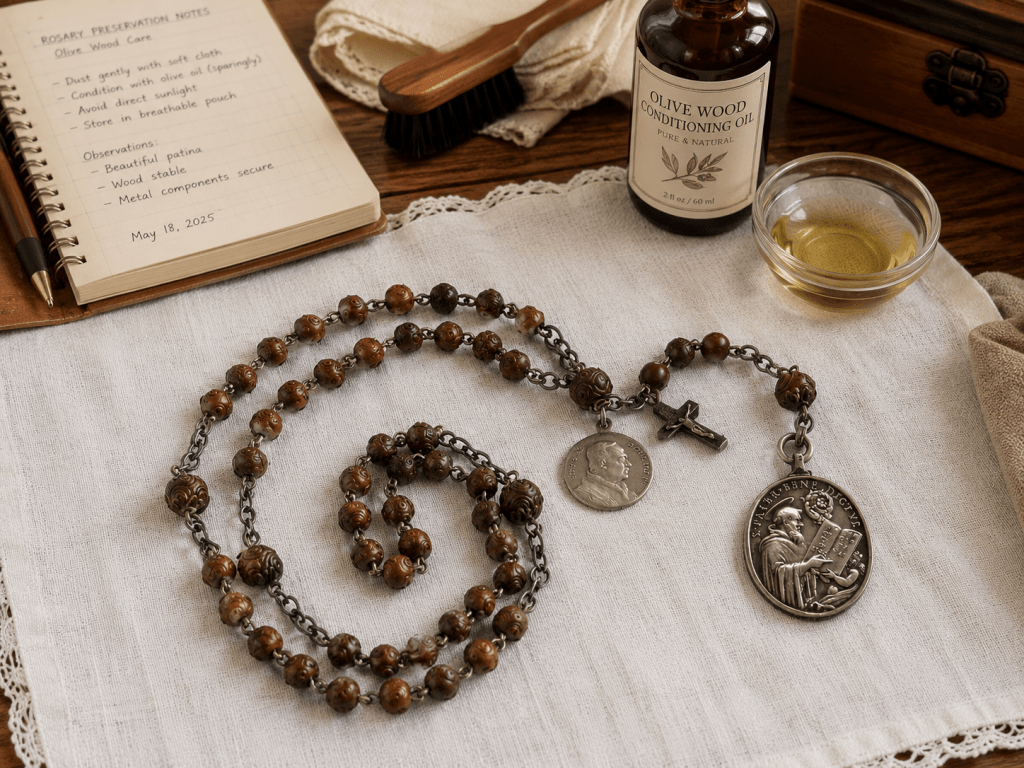
An olive wood rosary carried regularly may slowly develop a richer tone. The surface may become smoother. Areas that receive frequent contact may darken slightly as natural oils from the skin interact with the wood.
These changes are often subtle.
Months may pass before they become noticeable.
Years may pass before they become obvious.
Yet over time, the rosary begins to feel less like a newly purchased object and more like a familiar companion.
Collectors often refer to this process as patina.
Patina is not dirt.
Nor is it damage.
It is the visible record of age, handling, and use.
In olive wood, patina may appear as:
- a deeper honey or amber coloration
- greater contrast within the grain
- smoother surfaces on frequently handled beads
- softened edges where friction occurs repeatedly
- a gentle satin sheen replacing the appearance of freshly finished wood
Many people find these changes attractive.
Not because the rosary looks newer.
But because it looks lived with.
A rosary that has remained untouched for decades may still be beautiful.
A rosary worn smooth through years of prayer tells another kind of story entirely.
The wood begins to reflect relationship.
Not merely ownership.
Relationship.
This distinction matters for collectors.
When first studying antique or vintage rosaries, there can be a temptation to equate age with deterioration.
Yet devotional objects often age differently than ordinary possessions.
The wear itself may be meaningful.
A bead polished smooth by thousands of prayers is not necessarily less valuable than it once was.
In some ways, it has become more itself.
Its history is no longer theoretical.
It is visible.
This is one reason many collectors learn to appreciate honest wear.
Not every mark is damage.
Some marks are evidence that the rosary fulfilled the purpose for which it was made.
Prayer leaves traces.
And olive wood tends to preserve those traces beautifully.
When Age Becomes Damage
One of the most valuable skills a collector can develop is learning the difference between age and damage.
The two are not the same.
In fact, many of the qualities that make an older rosary appealing—patina, softened edges, worn surfaces, darkened wood—are simply signs of time and use.
They tell us that the rosary has lived a life.
Damage is something different.
Damage occurs when the material begins to lose stability, integrity, or function.
The challenge is that age and damage can sometimes look similar at first glance.
A bead may appear darker because it has been handled for decades.
Or it may appear discolored because it was exposed to moisture.
A surface may look worn because it has been prayed faithfully.
Or because it has been subjected to friction, neglect, or improper storage.
Learning to distinguish between these possibilities takes practice.
Fortunately, olive wood tends to communicate its condition fairly honestly.
Common Signs of Healthy Aging
When examining an olive wood rosary, collectors will often encounter changes that are entirely normal:
- deeper coloration
- smoother bead surfaces
- minor wear around drilled openings
- softened edges on crucifixes or centerpieces
- slight variations in tone between frequently handled and less frequently handled areas
These changes generally indicate use rather than deterioration.
Many collectors actively value them because they provide evidence of the rosary’s devotional life.
Common Signs of Damage
Damage usually reveals itself through instability rather than appearance alone.
Things worth watching for include:
- cracks extending through a bead
- splitting near drilled holes
- loose pins or chain connections
- missing wood fragments
- severe warping
- evidence of water damage or swelling
- active mold or biological growth
A single small crack does not necessarily mean a rosary is beyond preservation.
Many antique rosaries survive with minor flaws that remain stable for decades.
The question is not whether a flaw exists.
The question is whether it is growing.
Why Cracks Occur
Collectors are often surprised to learn that age itself is rarely the primary cause of cracking.
Environmental stress is usually the greater concern.
Wood expands and contracts in response to its surroundings.
Rapid shifts in temperature.
Extreme dryness.
Excessive humidity.
Prolonged exposure to moisture.
Storage in attics, garages, or vehicles.
All of these conditions place stress on natural materials.
Olive wood is relatively dense and durable, but it remains wood.
It continues responding to its environment long after it has been carved into beads.
Many cracks begin not because a rosary became old, but because it experienced conditions that the material could not comfortably tolerate.
A Preservation Mindset
Collectors sometimes feel disappointed when they discover flaws.
Yet preservation is not the same thing as perfection.
An antique rosary may have a repaired bead.
A replacement link.
A small crack that has remained unchanged for fifty years.
These conditions do not necessarily diminish its significance.
In many cases, they become part of the object’s history.
The goal is not to find a rosary untouched by time.
The goal is to understand what time has done.
To recognize the difference between evidence of life and evidence of decline.
And perhaps most importantly, to learn when a rosary needs intervention—and when it simply needs appreciation.
Caring for Olive Wood Rosaries
One of the reassuring things about olive wood is that it asks for relatively little.
Unlike some materials that require specialized products, frequent maintenance, or careful environmental controls, olive wood generally responds best to simple, consistent care.
In many cases, the greatest gift you can give an olive wood rosary is not treatment.
It is stability.
Most preservation concerns arise not from ordinary use, but from extremes.
Extreme dryness.
Extreme humidity.
Extreme heat.
Rapid environmental changes.
Or well-intentioned attempts to “improve” the rosary through aggressive cleaning or restoration.
The goal is not to keep a rosary looking new.
The goal is to help it age well.
Everyday Care
For most rosaries, routine care is remarkably straightforward.
A soft cloth is often all that is needed to remove dust or surface residue.
After extended handling, a gentle wipe may help remove excess oils or debris without disturbing the natural patina developing on the wood.
In general, less is often more.
Collectors sometimes assume wooden rosaries require regular oiling, polishing, or conditioning.
In reality, unnecessary treatments can create problems of their own.
Products intended for furniture, jewelry, or household woodwork may interact unpredictably with older finishes, adhesives, metal components, or fragile wood.
When in doubt, restraint is usually the safer choice.
Water and Cleaning Solutions
One of the most common mistakes involves moisture.
Because olive wood originated as a living material, people sometimes assume it benefits from soaking, washing, or conditioning treatments.
The opposite is usually true.
Rosaries should generally not be submerged in water.
Nor should they be soaked in jewelry cleaners, detergents, ultrasonic cleaners, or chemical solutions.
While a brief accidental exposure is unlikely to destroy a healthy rosary, repeated moisture can stress wood fibers, weaken connections, and contribute to cracking or swelling over time.
If cleaning becomes necessary, a lightly dampened cloth followed by thorough drying is often sufficient.
The emphasis should remain on gentle care rather than intensive cleaning.
Storage and Environment
Where a rosary lives often matters more than how it is cleaned.
Olive wood tends to fare best in the same environments where people are comfortable.
Moderate temperatures.
Reasonable humidity.
Protection from prolonged exposure to direct sunlight.
Storage in a drawer, devotional cabinet, rosary pouch, or display case is generally preferable to locations subject to dramatic environmental shifts.
Collectors should exercise particular caution with:
- attics
- garages
- storage sheds
- vehicle interiors
- areas near heating vents
- areas exposed to prolonged moisture
These environments place unnecessary stress on natural materials.
A rosary carried daily often experiences fewer problems than one forgotten in harsh storage conditions for years.
Antique and Vintage Examples
Older rosaries deserve an additional measure of patience.
Collectors frequently encounter antique pieces that show wear, darkening, repairs, or small imperfections accumulated across decades of use.
The instinct to restore them to a “like new” condition can be strong.
Yet preservation and restoration are not the same thing.
A worn finish.
A softened bead.
A repaired connection.
A darkened surface.
These may represent history rather than problems.
Before cleaning, polishing, refinishing, or replacing components, it is worth asking:
Am I preserving this rosary—or am I removing part of its story?
Sometimes the most respectful care involves leaving well enough alone.
The Best Care
Perhaps the simplest advice is also the most surprising.
Use it.
Carefully.
Respectfully.
But use it.
Rosaries were not created to spend their entire lives behind glass.
They were made to accompany prayer.
To be carried.
Held.
Returned to.
An olive wood rosary that acquires gentle wear through faithful use is not being diminished.
It is continuing the purpose for which it was made.
And often, that is the most beautiful form of preservation.
Prayer Leaves Marks
Collectors often speak about condition.
Wear.
Patina.
Preservation.
Damage.
These are useful words.
Necessary words.
Yet devotional objects invite another way of looking.
Not every mark is merely evidence of age.
Sometimes it is evidence of relationship.
A rosary is unlike most objects people collect.
A chair may be used.
A book may be read.
A piece of furniture may occupy a room for generations.
But a rosary participates in something more intimate.
It is held.
Repeatedly.
Thousands of times.
The same bead passes through the same fingers.
The same crucifix rests against the same palm.
The same prayers return again and again.
Over time, this relationship becomes visible.
A bead grows smoother than its neighbors.
A crucifix loses a sharp edge.
The finish softens where a thumb naturally rests.
A chain link is repaired because someone was unwilling to let the rosary go.
These traces may appear insignificant.
To a collector, they can be profoundly revealing.
Because they remind us that devotional objects were not created merely to survive.
They were created to be used.
The Difference Between Wear and Neglect
When studying older rosaries, it can be tempting to admire pristine examples above all others.
Certainly, untouched pieces have their place.
They teach us about original construction, materials, and craftsmanship.
Yet there is another kind of beauty found in devotional wear.
A rosary carefully used for fifty years often carries a different kind of history than one preserved untouched in a drawer.
The first tells us something about practice.
Habit.
Attachment.
Need.
It suggests a relationship that endured long enough to leave evidence.
Neglect leaves marks as well.
But neglect and devotion rarely look the same.
Neglect often produces instability.
Damage.
Loss.
Devotional wear tends to produce familiarity.
Softness.
A sense that the object and its owner shaped one another over time.
Learning to recognize that difference is part of learning to read devotional objects well.
Repairs as Acts of Care
One of the most overlooked clues in a rosary’s history is repair.
Collectors sometimes view repairs as flaws.
Evidence that a piece is no longer original.
Yet repairs often reveal something more interesting.
They reveal attachment.
A broken chain replaced.
A missing bead restrung.
A worn centerpiece secured rather than discarded.
These interventions tell us that someone believed the rosary was worth saving.
The repair itself becomes part of the story.
In many cases, a repaired rosary tells us more about the life of the object than a pristine one ever could.
It reminds us that devotional objects are rarely static.
They live alongside people.
And people mend the things they love.
The Evidence of Presence
Perhaps this is what makes rosaries so compelling to study.
They preserve traces of ordinary faith.
Not the dramatic moments that fill history books.
The quieter moments.
The daily ones.
A prayer offered before work.
A decade prayed in a hospital waiting room.
A rosary carried during travel.
A hand reaching for familiar beads during grief, uncertainty, gratitude, or hope.
Most of these moments leave no written record.
Yet sometimes they leave marks.
A polished bead.
A softened edge.
A repair made by an unknown hand.
Small signs that the rosary fulfilled the purpose for which it was made.
And perhaps that is worth remembering.
Because in the end, the most meaningful devotional objects are not always the ones preserved perfectly.
Sometimes they are the ones that bear witness to having been loved.
To having been carried.
To having been prayed.
Prayer leaves marks.
And for those willing to look closely, olive wood remembers them remarkably well.
Reading an Olive Wood Rosary
Once collectors begin paying attention to materials, another question naturally follows:
What can this rosary tell me about itself?
The answer is rarely simple.
Unlike many manufactured products, devotional objects often arrive without documentation. A rosary may have passed through several owners. It may have been repaired. Restrung. Modified. Gifted. Purchased during pilgrimage. Acquired from a parish bookstore. Found in an estate sale.
Its history may be partially visible.
Or nearly invisible.
Yet even when certainty remains elusive, clues often survive.
The key is learning how to notice them.
Begin with the Material
The first clue is the wood itself.
Olive wood possesses a distinctive appearance that becomes easier to recognize with experience.
Collectors often notice:
- warm honey or amber coloration
- dramatic swirling grain patterns
- visible contrast between lighter and darker sections of wood
- a smooth, dense surface when polished
Unlike many stained woods, olive wood usually reveals its grain proudly.
The material rarely appears uniform.
Variation is part of its character.
No two beads are exactly alike.
This individuality is often one of the easiest ways to distinguish olive wood from darker stained woods or modern synthetic substitutes.
Look at the Construction
After the material, examine how the rosary was made.
Construction often reveals as much as the beads themselves.
Consider:
- chain or cord construction
- style of links and connectors
- shape and size of beads
- craftsmanship of drilled openings
- evidence of hand assembly versus mass production
A simple rosary is not necessarily a modern rosary.
Nor is an ornate rosary necessarily an old one.
Construction should be viewed as one clue among many.
Centerpieces and Crucifixes
The centerpiece and crucifix often provide some of the most visible historical clues.
Collectors may encounter:
- Marian imagery
- Miraculous Medal designs
- Sacred Heart imagery
- Jerusalem crosses
- St. Benedict symbolism
- pilgrimage inscriptions
- regional devotional styles
Sometimes these details offer useful hints about devotional context.
Other times they simply reflect personal preference.
A rosary purchased in Jerusalem may include imagery associated with the Holy Land.
A family rosary may carry a centerpiece chosen for entirely personal reasons.
The challenge—and the joy—is learning not to jump too quickly to conclusions.
Holy Land Associations
Because olive wood is so closely associated with Bethlehem and the surrounding region, many collectors naturally wonder whether a particular rosary originated there.
Occasionally, the answer is clear.
A tag survives.
A box remains.
A family story accompanies the object.
More often, certainty proves difficult.
Certain features may suggest Holy Land associations:
- olive wood crucifixes
- Jerusalem cross motifs
- pilgrimage inscriptions
- packaging identifying Bethlehem or Jerusalem
- documentation from a pilgrimage or religious tour
Yet caution remains important.
Olive wood rosaries are now produced throughout the world.
Holy Land-inspired design does not necessarily indicate Holy Land manufacture.
Likewise, a genuine Bethlehem-made rosary may carry few obvious identifying marks at all.
The goal is not certainty.
The goal is probability.
To understand what the evidence reasonably suggests.
Provenance Matters
Among collectors, few things are more valuable than provenance.
Not monetary value.
Context.
A handwritten note.
A dated pilgrimage booklet.
A family photograph.
A story passed down through generations.
These details often tell us more than the rosary itself ever could.
Two visually identical rosaries may have entirely different histories.
One purchased during a pilgrimage to Jerusalem.
Another acquired from a local parish gift shop decades later.
Without provenance, they may look nearly the same.
With provenance, they become distinct objects with distinct stories.
This is why collectors learn to preserve not only the rosary, but the information surrounding it.
The story is part of the artifact.
Learning to Read Clues
Perhaps the most important lesson is also the simplest.
No single detail tells the whole story.
Not the wood.
Not the crucifix.
Not the centerpiece.
Not the chain.
Not even the age.
Understanding emerges through observation.
One clue beside another.
A pattern gradually becoming visible.
The collector learns to ask:
Why this material?
Why this construction?
Why this symbolism?
What might this suggest about the person who carried it?
And sometimes the answers remain incomplete.
That is part of the process.
Because reading a rosary is less like solving a puzzle and more like listening to a conversation that began long before we arrived.
The object speaks quietly.
Our task is simply to learn how to listen.
Learning to Read Quietly
The longer collectors study rosaries, the more they discover that certainty is rarely the most interesting part of the journey.
Dates matter.
Materials matter.
Construction styles matter.
Historical context matters.
Yet many of the questions that first draw us toward devotional objects cannot be answered completely.
Who carried this rosary?
What prayers passed through these beads?
What moments of grief, hope, gratitude, fear, or faith became attached to it over time?
Most often, the object remains silent.
At least partly.
And perhaps that is as it should be.
A rosary is not merely an artifact.
It is a companion.
A devotional object shaped not only by the hands that made it, but by the hands that used it.
This is especially true of olive wood.
Its grain resists perfect uniformity.
Its color changes with time.
Its surface records touch.
The material itself seems almost unwilling to remain untouched by relationship.
The longer it is carried, the more evidence it gathers.
Not evidence of ownership alone.
Evidence of presence.
For collectors, this realization can be surprisingly freeing.
The goal is not to solve every mystery.
The goal is not to reduce every rosary to a date, a place, or a catalog description.
The goal is to learn how to observe carefully.
To notice what survives.
To appreciate what can be known.
And to remain comfortable with what cannot.
In many ways, studying rosaries requires the same virtues that prayer itself requires:
patience
attention
humility
the willingness to return again and again.
The object reveals a little.
Then a little more.
And sometimes, after years of looking, something once overlooked suddenly becomes visible.
A repair.
A worn bead.
A family inscription.
A clue hiding in plain sight.
This is the quiet reward of learning to read devotional objects well.
Not mastery.
Not certainty.
But relationship.
An olive wood rosary begins as a tree.
Becomes a craft.
Becomes an object of prayer.
And eventually becomes part of someone’s story.
The collector’s task is not merely to preserve the object.
It is to honor the story.
To care for what has been entrusted to them.
And to leave it ready for the next pair of hands that may someday pause, look closely, and begin listening for themselves.
Research Note
This article combines material history, devotional object study, and preservation principles. Information relating to olive wood characteristics, aging, craftsmanship, Holy Land devotional traditions, and collector practices was reviewed using botanical references, museum collections, Catholic devotional sources, artisan documentation, and conservation resources.
Because rosaries are often handmade, privately owned, repaired, altered, or passed through multiple generations, individual examples may differ from general patterns discussed here. Observations relating to provenance, craftsmanship, devotional wear, and collector interpretation are intended as guides to thoughtful study rather than definitive identification.
Selected Sources
Catholic Devotional Context
- Rosarium Virginis Mariae (St. John Paul II, 2002)
- Directory on Popular Piety and the Liturgy (Dicastery for Divine Worship and the Discipline of the Sacraments)
Olive Wood & Material History
- Encyclopaedia Britannica: Olive (Olea europaea)
- Royal Botanic Gardens, Kew — Plants of the World Online
- International Olive Council (IOC)
Holy Land Craft Traditions
- Bethlehem Fair Trade Artisans
- Holy Land Christian Ecumenical Foundation (HCEF)
Object Study & Collections
- The Metropolitan Museum of Art Collection Database
- Victoria and Albert Museum Collection
- Museum conservation resources relating to wood objects and devotional artifacts
For expanded references and research materials, please visit the Living Rosary Archives Research Library.

 The Living Rosary Archives