Part 2
The story of olive wood does not end with the tree.
In many ways, it begins there.
Olive trees have shaped life in the Mediterranean for thousands of years. They have provided food, oil, shade, fuel, trade, and livelihood across generations. Their roots run deep—not only into the soil, but into the cultures and communities that grew alongside them.
Yet the story of olive wood as a devotional material is not merely a story of agriculture.
It is also a story of people.
Artisans.
Families.
Pilgrims.
Communities that learned to transform a familiar material into an expression of faith.
For many Christians, olive wood is associated with sacred geography. A rosary made from olive wood may call to mind Bethlehem, Jerusalem, the Mount of Olives, or Gethsemane.
But sacred geography alone does not carve a bead.
It does not shape a crucifix.
It does not drill a hole through wood or string a rosary by hand.
People do that.
And for centuries, Christian artisans in the Holy Land have continued that work.
This continuity is one of the most remarkable aspects of olive wood devotion.
Unlike many historical devotional materials that survive primarily in museums or private collections, olive wood remains a living tradition. Rosaries are still being made. Families still pass down carving skills. Workshops still shape branches into prayer beads. Pilgrims still carry them home.
To understand olive wood fully, we must look not only at the tree, but at the generations of hands that have cared for it, worked with it, and carried its story forward.
A Material Shaped by Continuity
Unlike many materials used in devotional objects, olive wood is inseparable from a living agricultural tradition.
An olive tree is not planted for its wood.
It is planted for its fruit.
Its oil.
Its ability to provide year after year, often across generations.
Some olive trees remain productive for decades. Others endure for centuries. Entire groves become part of family histories, local economies, and cultural landscapes that outlive the people who first planted them.
This reality shaped how olive wood entered craftsmanship.
Historically, the value of an olive tree was not found in cutting it down.
A healthy tree was worth far more alive than harvested.
It fed families.
Produced oil.
Provided income.
Marked inheritance.
Connected one generation to the next.
As a result, olive wood often entered craft traditions through maintenance rather than destruction.
Branches were pruned to encourage healthy growth.
Storm-damaged limbs were gathered.
Older trees that had reached the end of their productive lives found new purpose through carving and woodworking.
The material itself emerged from a cycle of care.
This distinction is easy to overlook in the modern world, where wood is often thought of primarily as a building material or commodity.
Olive wood carries a different story.
Its history is rooted in stewardship.
The wood exists because the tree was tended.
The tree was tended because it sustained life.
And over time, that same material became part of devotional practice.
There is something quietly fitting about this progression.
A tree cared for through patience and repetition eventually becomes a rosary prayed through patience and repetition.
Both require attention.
Both endure through return.
Both reveal their value slowly.
Perhaps this is one reason olive wood feels so appropriate in the hand.
Long before it became a devotional material, it was already teaching lessons about continuity.
About care.
About remaining present through the passing of time.
And that continuity did not end when the wood left the grove.
It traveled with it.
From the tree.
To the workshop.
To the pilgrim.
To the person praying quietly with worn beads years later.
The story continued because someone chose to carry it forward.
From Pilgrimage Souvenir to Living Tradition
If olive wood first entered devotional life through continuity, it spread through pilgrimage.
For centuries, Christians have journeyed to places associated with the life of Christ.
Jerusalem.
Bethlehem.
Nazareth.
The Mount of Olives.
Gethsemane.
Pilgrimage was never simply tourism.
For many believers, it represented an act of devotion—a physical journey undertaken in the hope of drawing nearer to sacred memory.
And like pilgrims throughout history, those who traveled often wished to bring something home.
A reminder.
A keepsake.
A tangible connection to a place that had become meaningful through prayer.
In the Holy Land, olive wood proved uniquely suited to that purpose.
It was local.
Familiar.
Abundant within the landscape.
Already woven into the history, economy, and daily life of the region.
Artisans began transforming the material into crosses, crucifixes, rosaries, nativity scenes, icons, and devotional objects that pilgrims could carry home.
Over time, olive wood became closely associated with the experience of pilgrimage itself.
A rosary made from olive wood was not simply a prayer tool.
It became a reminder of place.
Of roads walked.
Churches visited.
Prayers offered.
Or perhaps of places one hoped to visit someday.
Yet something important happened along the way.
What began as a material associated with pilgrimage gradually became a craft tradition in its own right.
The making of olive wood devotional objects moved beyond souvenir production and became part of the cultural and economic life of Christian communities throughout the region.
Skills were passed from one generation to the next.
Techniques were refined.
Workshops emerged.
Families developed specialties.
The carving of olive wood became both livelihood and inheritance.
This is one reason olive wood devotion remains so compelling.
It is not merely connected to biblical history.
Nor is it simply a relic of past pilgrimage.
It remains rooted in living traditions carried forward by real people.
The rosary purchased today exists within a chain of continuity stretching across generations:
the grove
the pruning
the workshop
the artisan
the pilgrim
the prayer
Each depends upon the others.
And each becomes part of the story the material carries.
What began as a tree became a craft.
What became a craft became a tradition.
And that tradition remains alive.
The Hands That Still Carve
It is easy to speak about olive wood as though it belongs entirely to history.
To imagine ancient groves.
Biblical landscapes.
Pilgrims from centuries past.
Yet one of the most remarkable aspects of olive wood devotion is that it remains a living tradition.
The rosaries found in parish bookstores, monastery gift shops, pilgrimage centers, and family collections are not merely echoes of an ancient craft.
Someone still makes them.
Someone still selects the wood.
Shapes the beads.
Drills the holes.
Strings the decades.
Polishes the crucifix.
Prepares the finished rosary for a stranger they will likely never meet.
Throughout the Holy Land, particularly in communities surrounding Bethlehem, Beit Sahour, and Beit Jala, olive wood carving remains an important artistic and cultural tradition.
For generations, Christian families have passed woodworking skills from parent to child, preserving techniques that connect craftsmanship, livelihood, and faith.
While styles and tools have evolved, the essential relationship remains much the same.
A material shaped by the land becomes an object shaped by human hands.
And those hands matter.
Because traditions do not survive on history alone.
They survive because people continue to practice them.
A craft is never preserved merely by remembering it.
It is preserved by doing it.
Again.
And again.
And again.
In many workshops, the work remains deeply personal.
Family-owned businesses pass knowledge between generations.
Skills are refined through repetition.
Mistakes become lessons.
Tools acquire wear patterns unique to the people who use them.
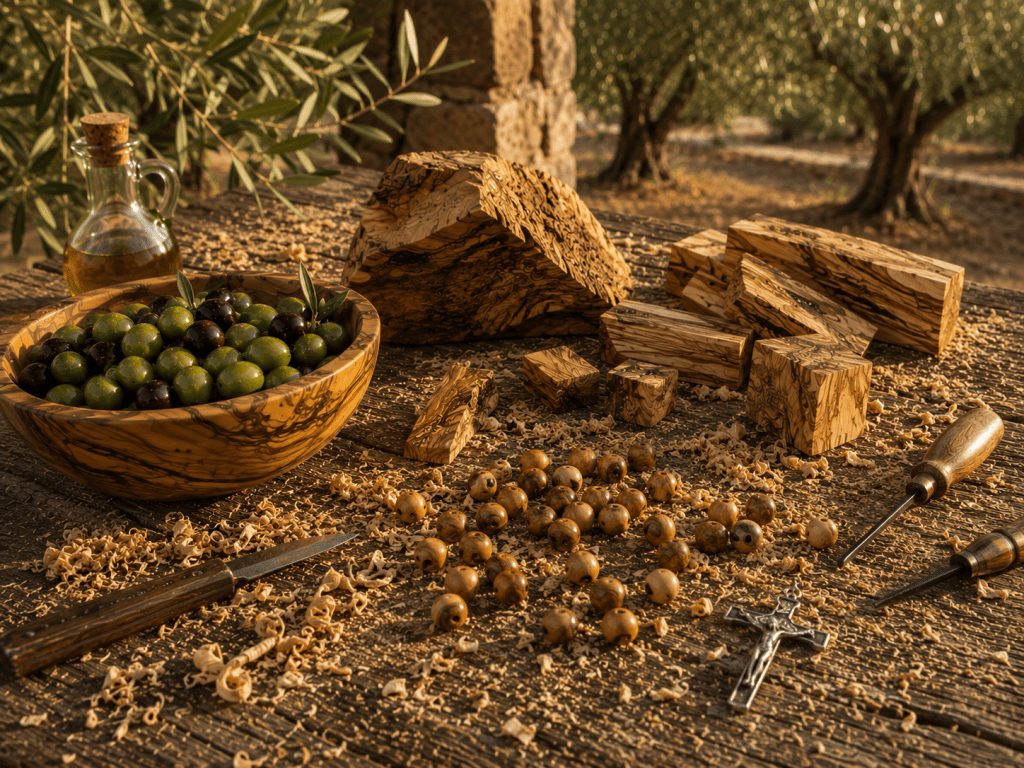
The finished rosary may travel thousands of miles, but it often begins in spaces shaped by ordinary labor:
workbenches
wood shavings
dust
conversation
routine
The realities of modern life have not always made this easy.
Political instability, economic hardship, changing tourism patterns, and fluctuations in pilgrimage travel have all affected Christian artisan communities in the region.
Many workshops operate within circumstances far more uncertain than the rosaries they produce might suggest.
Yet the carving continues.
This continuity is worth noticing.
Not because it makes the object more valuable in a monetary sense.
But because it reminds us that devotional objects do not appear from nowhere.
They emerge from relationships.
Between people and place.
Between skill and material.
Between tradition and necessity.
When someone purchases an olive wood rosary today, they are not simply acquiring a devotional object.
They are participating—however briefly—in a tradition sustained by generations of hands.
Hands that learned.
Hands that practiced.
Hands that carried something forward.
And perhaps that is part of what gives olive wood its distinctive character.
Not only the memory of sacred places.
But the evidence of human care.
A reminder that faith is often preserved not through grand gestures, but through ordinary acts repeated faithfully over time.
Stewardship and Ethical Sourcing
For many modern collectors, an understandable question eventually arises:
Is olive wood sustainable?
Or perhaps:
How should I think about purchasing olive wood devotional objects today?
These are good questions.
And they deserve thoughtful answers.
Fortunately, olive wood occupies a somewhat unusual place among natural materials.
Unlike many luxury hardwoods prized primarily for rarity, olive trees have long been cultivated within agricultural systems designed to keep the trees alive and productive. Historically, the greatest value of an olive tree was never found in its wood alone.
It was found in what the tree produced.
Fruit.
Oil.
Livelihood.
A healthy olive tree could sustain a family for generations.
Because of this, olive wood traditionally entered craftsmanship through cycles of maintenance rather than large-scale harvesting. Branches were pruned to encourage growth. Storm-damaged limbs were gathered. Older trees that had reached the end of their productive lives found new purpose through woodworking and carving.
This distinction matters.
The story of olive wood is often less about extraction and more about continuity.
The wood exists because the tree was cared for.
The tree was cared for because it remained valuable.
And the devotional object exists because someone found purpose in the material that remained.
Yet stewardship involves more than the tree itself.
It also includes the people connected to the tradition.
When considering an olive wood rosary, thoughtful questions might include:
- Where was this rosary made?
- Does the maker describe the source of the material?
- Are artisan communities acknowledged?
- Is there transparency about craftsmanship?
- Does the purchase support workshops connected to longstanding carving traditions?
Not every rosary will provide clear answers.
Nor should uncertainty automatically invite suspicion.
Historical devotional objects rarely arrive with perfect documentation.
Modern products vary widely.
Curiosity often serves better than cynicism.
Perhaps the most useful question is not:
Is this object perfectly ethical?
But rather:
Am I approaching this material thoughtfully?
To practice stewardship is to recognize that devotional objects exist within relationships.
Relationships between land and cultivation.
Between craft and livelihood.
Between tradition and memory.
Between the person who made the object and the person who eventually holds it in prayer.
In this sense, stewardship becomes more than a purchasing decision.
It becomes a posture of attention.
A willingness to know something about what we hold.
To value not only the finished rosary, but the histories, labor, and care that made it possible.
And perhaps that feels especially fitting for olive wood.
After all, both the tree and the rosary ask for something similar:
patience.
Care.
Repetition.
And the understanding that what endures is rarely created all at once.
It is cultivated over time.
Stewardship as Devotion
There is something quietly fitting about olive wood as a devotional material.
Long before it became a rosary, it existed within a pattern of care.
Olive trees do not flourish through neglect.
They require attention.
Pruning.
Patience.
Seasonal work repeated year after year.
The people who tend them often think in longer spans of time than a single harvest.
An olive tree may outlive the person who planted it.
Its value is not measured only by what it produces today, but by what it may continue producing tomorrow.
In this way, stewardship becomes an act of trust.
Care offered without immediate reward.
Effort invested in something that unfolds slowly.
Something that may benefit future generations as much as the present one.
There is a surprising resemblance between this rhythm and the rhythm of prayer.
The rosary, too, is built upon repetition.
Not dramatic moments.
Not constant revelations.
But return.
One bead after another.
One decade after another.
One day after another.
Faith practiced through ordinary persistence.
Both the olive tree and the rosary ask something similar of us.
Remain present.
Return again.
Trust that growth may be occurring even when it cannot yet be seen.
Perhaps this is one reason olive wood feels so naturally suited to devotion.
The material itself emerges from a tradition of tending.
A tree cared for over years becomes wood.
The wood becomes a craft.
The craft becomes a rosary.
The rosary becomes part of someone’s prayer.
And through each stage, something is carried forward.
Care.
Attention.
Continuity.
When viewed this way, stewardship becomes more than responsible sourcing or thoughtful collecting.
It becomes a way of participating in the same pattern that brought the material into being.
To preserve rather than discard.
To repair rather than replace.
To learn the history of an object before reducing it to a commodity.
To recognize the human labor hidden within ordinary things.
These acts may seem small.
Yet devotion often lives in small acts.
A prayer whispered.
A candle lit.
A bead worn smooth through use.
A tree tended for another season.
Perhaps this is the quiet lesson olive wood offers.
That what endures is rarely created through force.
It is cultivated.
Nurtured.
Carried forward through countless ordinary acts of care.
And in that sense, stewardship may be one of the most overlooked forms of devotion.
Not because it seeks attention.
But because it keeps showing up.
Again and again.
Much like prayer itself.

 The Living Rosary Archives